

Many businesses invest in building a website, yet struggle to turn it into a real growth engine, often due to unclear development strategies, mismatched technologies, or poor execution. The result is slow performance, limited scalability, and missed opportunities to convert visitors into customers. Without a clear understanding of how website development works, decision-makers risk wasting time, budget, and competitive advantage in an increasingly digital-first market. What’s needed is a structured, end-to-end view that connects technology choices with business outcomes.
This article will talk about what website development is, the different types, key components, technologies, processes, and trends—so you can make informed decisions and build a high-performing, scalable website.
TL;DR
- Website development is the process of building and maintaining websites, including frontend interfaces, backend systems, databases, and hosting infrastructure.
- Modern websites are typically built through front-end development (user interface), back-end development (server and application logic), and full-stack development that combines both.
- The website development process generally follows six stages: planning, UX/UI design, development, testing, deployment, and ongoing maintenance to keep the site secure and up to date.
- If you are looking to build modern, scalable websites, Sunbytes provides experienced development teams, which provides custom website development, WordPress solutions, and scalable web applications.
What Is Website Development?
Website development is the process of building, programming, and maintaining websites to ensure they function efficiently, perform reliably, and deliver a seamless user experience. It goes beyond visual design, covering everything from how a website looks in the browser to how it processes data, connects to servers, and scales as the business grows.
Research from Stanford University shows that 75% of users judge a company’s credibility based on its website design. For businesses, website development is a strategic function that directly impacts customer experience, conversion rates, and long-term digital growth.
What Is the Difference Between Web Development and Web Design?
Web development and web design are closely related, but they serve fundamentally different roles in building a website. Understanding the distinction helps businesses allocate the right resources and avoid misalignment between visual expectations and technical execution.
| Aspect | Web Design | Web Development |
|---|---|---|
| Core focus | User experience and visual appearance | Functionality and technical implementation |
| Objective | Create intuitive, engaging interfaces | Build a working, reliable website |
| Tools used | Design tools like Figma, Adobe XD | Programming languages and frameworks |
| Output | Wireframes, mockups, prototypes | Fully functional website |
| Skill set | UX thinking, visual design, user flows | Coding, system architecture, problem-solving |
For businesses, the key is not choosing one over the other, but ensuring both disciplines are aligned from the start to avoid costly redesigns or technical limitations later in the project.
Why Is Website Development Important for Businesses?
A website is often the first point of interaction between a business and its customers—making its performance, usability, and reliability critical to business success. Poorly developed websites can lead to slow load times, security risks, and lost conversions, while well-built ones become powerful growth drivers.
For businesses, website development plays a key role in:
- Establishing a strong digital presence: A well-developed website ensures your business is accessible, visible, and competitive in a digital-first market
- Building trust and credibility: Fast, secure, and professionally built websites signal reliability and strengthen brand perception
- Driving leads and conversions: Optimized performance and seamless user journeys directly impact how effectively visitors turn into customers
- Supporting scalability and growth: A solid development foundation allows your website to handle increasing traffic, new features, and evolving business needs
For businesses looking to turn these opportunities into measurable results, partnering with an experienced development team like Sunbytes can help ensure the right foundation is in place from the start.
What Are the Main Types of Website Development?
Website development can be approached in several ways, depending on how a website is built, managed, and scaled. Understanding these types helps businesses choose the right approach based on their goals, complexity, and long-term growth plans.
Front-End Development (Client-Side Development)
Focuses on everything users see and interact with in the browser, including layout, design, and responsiveness. It follows standards defined by organizations such as the World Wide Web Consortium to ensure consistency and accessibility across browsers.
What is front-end website development and why is it important? Explore more to make sure your websites load quickly, remain accessible, and provide a consistent user experience across devices.
Back-End Development (Server-Side Development)
Handles the logic behind the scenes—processing data, managing servers, and connecting to databases. This layer ensures the website functions correctly, securely, and efficiently.
Full-Stack Development
Combines both front-end and back-end development. Full-stack developers can build complete web solutions, making this approach suitable for projects that require flexibility and faster iteration.
CMS-Based Development
Uses content management systems like WordPress to build websites more efficiently. This approach is ideal for businesses that need to manage content easily without heavy technical involvement.
E-Commerce Website Development
Specialized development focused on online stores. It includes features like product catalogs, payment gateways, inventory management, and security for transactions.
Game development
A niche category that involves building browser-based or web-integrated games. While not common for standard business websites, it’s relevant for interactive platforms and entertainment-focused products.
Now that you understand the types of website development, the next step is to learn the core components that make a website reliable and scalable.
What Are the Key Components of Website Development?
A high-performing website is built on several foundational components that go beyond just coding. These elements determine how reliable, scalable, and business-ready a website is in real-world conditions.
Architecture and Structure
This defines how the website is organized, including page hierarchy, URL structure, and how different parts of the system interact. A well-planned architecture improves scalability, maintainability, and SEO performance.
Domain Name and Web Hosting
The domain name is the website’s address, while hosting is the infrastructure that delivers it to users. Choosing the right hosting setup directly impacts speed, uptime, and the ability to handle traffic spikes.
APIs and Integrations
Modern websites rely on integrations with external systems such as payment gateways, CRM platforms, and analytics tools. APIs enable these connections, allowing businesses to automate processes and extend functionality.
Security and Performance Optimization
Security measures (such as SSL, authentication, and data protection) and performance optimization (such as caching and load balancing) ensure the website remains fast, reliable, and protected against threats.
Which Programming Languages Are Used in Website Development?

Website development relies on a combination of programming languages and technologies, each serving a specific role in building, running, and scaling a website.
Frontend Technologies
These languages control how a website looks and behaves in the browser.
- HTML structures the content
- CSS handles layout and styling
- JavaScript enables interactivity and dynamic behavior. In practice, JavaScript remains dominant—used by over 65% of developers worldwide, according to the Stack Overflow Developer Survey.
Together, they form the foundation of every user-facing experience.
Backend Technologies
Backend languages power the logic behind the website, handling data processing, authentication, and integrations.
- PHP is widely used in CMS platforms like WordPress.
- Python is popular for scalable and data-driven applications
- Node.js enables JavaScript to run on the server
- Java and .NET are often used in enterprise-level systems
The choice depends on scalability needs, development speed, and system complexity.
Databases
Databases store and manage the website’s data, such as user information, content, and transactions.
- MySQL and PostgreSQL are common relational databases
- MongoDB is a popular NoSQL option for flexible data structures
Frameworks and Libraries
Frameworks help developers build websites faster and more efficiently by providing reusable structures and components.
- Frontend: React, Angular, Vue
- Backend: Laravel (PHP), Django (Python), Express (Node.js)
These tools reduce development time and improve code maintainability.
WordPress and Other Content Management Systems
Content Management Systems (CMS) like WordPress allow businesses to build and manage websites without starting from scratch. For more advanced customization, developers often extend these platforms using backend languages and frameworks to create tailored features and integrations.
Read more: Top 10 Programming Languages You Must Know
What Is the Website Development Process Step by Step?
Building a successful website requires a structured process that aligns business goals with technical execution. A structured development process is critical, as poor software quality costs organizations over $2 trillion annually. Most website development projects follow a sequence of six well-defined stages:
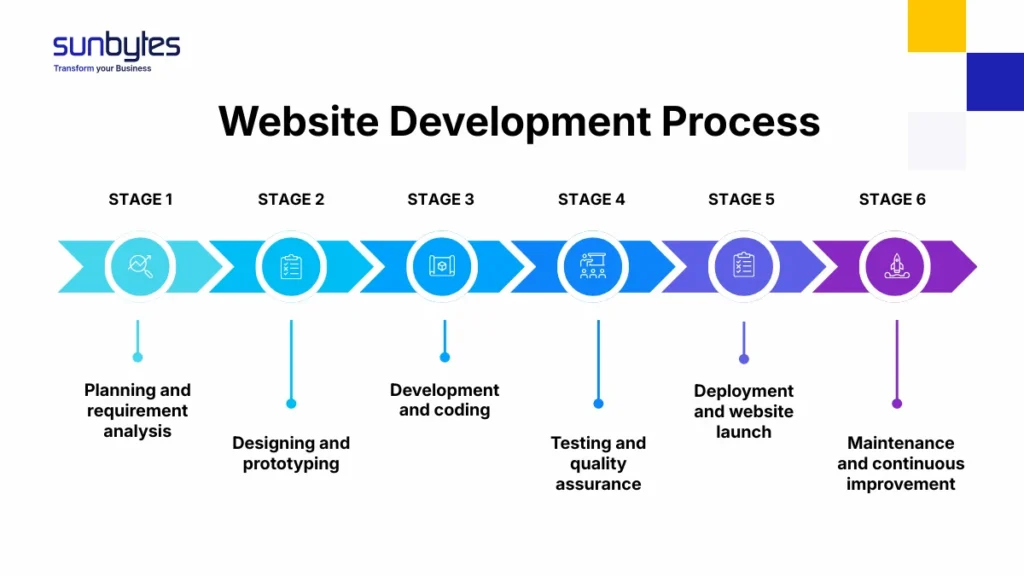
Most website development projects follow a sequence of well-defined stages:
Stage 1: Planning and requirement analysis
This phase defines the website’s purpose, target audience, key features, and success metrics. Clear requirements at this stage help avoid costly changes later and ensure alignment between stakeholders and development teams.
Stage 2: Designing and prototyping
Designers create wireframes and visual prototypes to map out user journeys and interface structure (link to ux ui design). This step ensures the website is intuitive, user-friendly, and aligned with brand identity before development begins.
Stage 3: Development and coding
Developers build the website based on approved designs and requirements. This includes implementing functionality, integrating systems, and ensuring the website performs reliably across devices and environments.
Stage 4:Testing and quality assurance
Before launch, the website is tested for bugs, performance issues, security vulnerabilities, and compatibility across browsers and devices. This step ensures a stable and consistent user experience.
Stage 5: Deployment and website launch
The website is deployed to a live environment and made accessible to users. Proper configuration, monitoring, and final checks are critical to ensure a smooth launch without disruptions.
Stage 6: Maintenance and continuous improvement
After launch, the website requires ongoing updates, performance monitoring, and security patches. Continuous improvement ensures the website remains relevant, secure, and aligned with evolving business needs.
What do web developers do?
Web developers are responsible for turning ideas, designs, and business requirements into fully functional websites. They bridge the gap between concept and execution—ensuring that a website not only looks good but also works reliably, loads quickly, and scales with business needs.
Their responsibilities typically include:
- Building the user interface (front-end): Developing responsive layouts and interactive elements that users see and engage with across devices
- Developing server-side logic (back-end): Handling data processing, authentication, and integrations with databases or third-party systems
- Integrating systems and APIs: Connecting the website with external services such as payment gateways, CRM systems, or analytics tools
- Optimizing performance and security: Ensuring fast load times, secure data handling, and protection against vulnerabilities
- Testing and maintaining the website: Identifying bugs, improving functionality, and updating the site as technologies and business needs evolve
What Are the Latest Website Development Trends in 2026?
AI-assisted development
Research from GitHub shows developers can complete tasks up to 55% faster when using AI-assisted coding tools. AI is increasingly integrated into development workflows—from code generation to automated testing and debugging. This accelerates development cycles, reduces human error, and allows teams to focus on higher-level problem solving and product innovation.
Explore the details of the AI-Era Product Development Process Guide.
Headless CMS architecture
Headless CMS separates the frontend from the backend, delivering content via APIs. This approach provides greater flexibility, enabling businesses to deliver consistent experiences across websites, mobile apps, and other digital channels.
Progressive Web Apps (PWAs)
PWAs combine the best of web and mobile applications, offering fast load times, offline capabilities, and app-like experiences directly in the browser. They are particularly valuable for improving user engagement and retention.
Serverless architecture
Serverless computing allows developers to build and run applications without managing infrastructure. It improves scalability, reduces operational overhead, and enables faster deployment—especially for applications with variable traffic.
Security-first development
With increasing cyber threats, security is no longer an afterthought. Modern development prioritizes secure coding practices, data protection, and proactive monitoring from the earliest stages of the development process.
As systems become more complex, aligning development with strong cybersecurity practices is essential. With a security-first mindset, Sunbytes can support you with our cybersecurity solutions to ensure long-term reliability.
How Can Sunbytes Help with Website Development?
Sunbytes supports businesses in building high-performing websites that go beyond basic functionality. From planning and architecture to development and long-term maintenance, the focus is on creating scalable, secure, and reliable digital platforms aligned with business goals.
Whether you need a custom-built solution, a CMS-based website, or dedicated teams, Sunbytes combines technical expertise with a structured delivery approach to ensure projects are executed efficiently and built to scale.
Why Sunbytes?
Sunbytes is a Netherlands-based technology partner with a delivery hub in Vietnam, supporting businesses globally in building modern, high-performing websites. With over a decade of experience, the focus is on turning strategy into reliable execution—ensuring every website is built to scale, perform, and adapt.
- Digital Transformation Solutions: Build and modernize websites and digital products with senior engineering teams, covering custom development, QA/testing, and long-term maintenance.
- Cybersecurity Solutions: Integrate security into every stage of development to reduce risks and protect systems without slowing down delivery.
- Accelerate Workforce Solutions: Scale your development capacity with flexible recruitment and dedicated teams to support growth and evolving project needs.
See a real example of how we deliver scalable website solutions with FlexPress. Let’s reach out to our team to start your project.
FAQs
Website development costs vary depending on complexity, features, and technology. A basic business website may range from a few thousand dollars, while more complex platforms—such as custom web applications or e-commerce systems—can require significantly higher investment. Key cost factors include design requirements, integrations, scalability needs, and ongoing maintenance.
The timeline depends on the scope and complexity of the project. A simple website can take a few weeks, while a fully customized or large-scale platform may take several months. Clear requirements, efficient collaboration, and the right development approach can significantly reduce time to market.
No—AI is transforming web development, not replacing it. While AI tools can accelerate coding and automate repetitive tasks, human expertise is still essential for architecture, problem-solving, and aligning technology with business goals. In practice, AI enhances developer productivity rather than eliminating the need for development.
There is no single “best” tool—it depends on the project’s requirements. Different tools and technologies serve different purposes, from frontend frameworks to backend systems and CMS platforms. The key is selecting the right combination of tools (tech stack) that aligns with performance, scalability, and long-term business goals.
Let’s start with Sunbytes
Let us know your requirements for the team and we will contact you right away.


