

Vibe coding lets founders test an idea before committing to a full build. The next decision is how much responsibility that software can carry. A demonstration with fictional records needs different verification from a product customers use to manage their accounts.
Understanding the method, its uses and its limits helps you decide what to build yourself and when to arrange technical review.
TL;DR
Vibe coding means building software through natural-language instructions to AI, then running the result and refining it through further prompts, often without reading the generated code.
- The vibe coding loop has four actions: describe, generate, run and test, then refine.
- Vibe coding examples include personal scripts, internal tools, interactive prototypes, MVPs and additions to existing products.
- Before customers, personal data or business operations depend on a vibe-coded product, arrange human technical review and assign an owner.
What is vibe coding?
Vibe coding is a way to create software by describing the outcome you want to an AI tool and judging the result mainly through how it behaves. In the original meaning, the person prompting the tool accepts code without reading or fully understanding it.
Andrej Karpathy introduced the term in February 2025, describing experiments with unread code and AI-driven fixes. Collins named vibe coding its Word of the Year on 6 November 2025, using a broader definition centred on natural-language instructions for writing code.
That broader usage covers different working methods. One person accepts a feature after clicking through the screen. Another inspects the implementation and takes responsibility for future changes.
Google Cloud distinguishes exploratory vibe coding from responsible AI-assisted development, where a person reviews and understands the output. For a founder, that distinction matters more than the label: identify who can explain the code and approve changes before relying on the product.
How vibe coding works
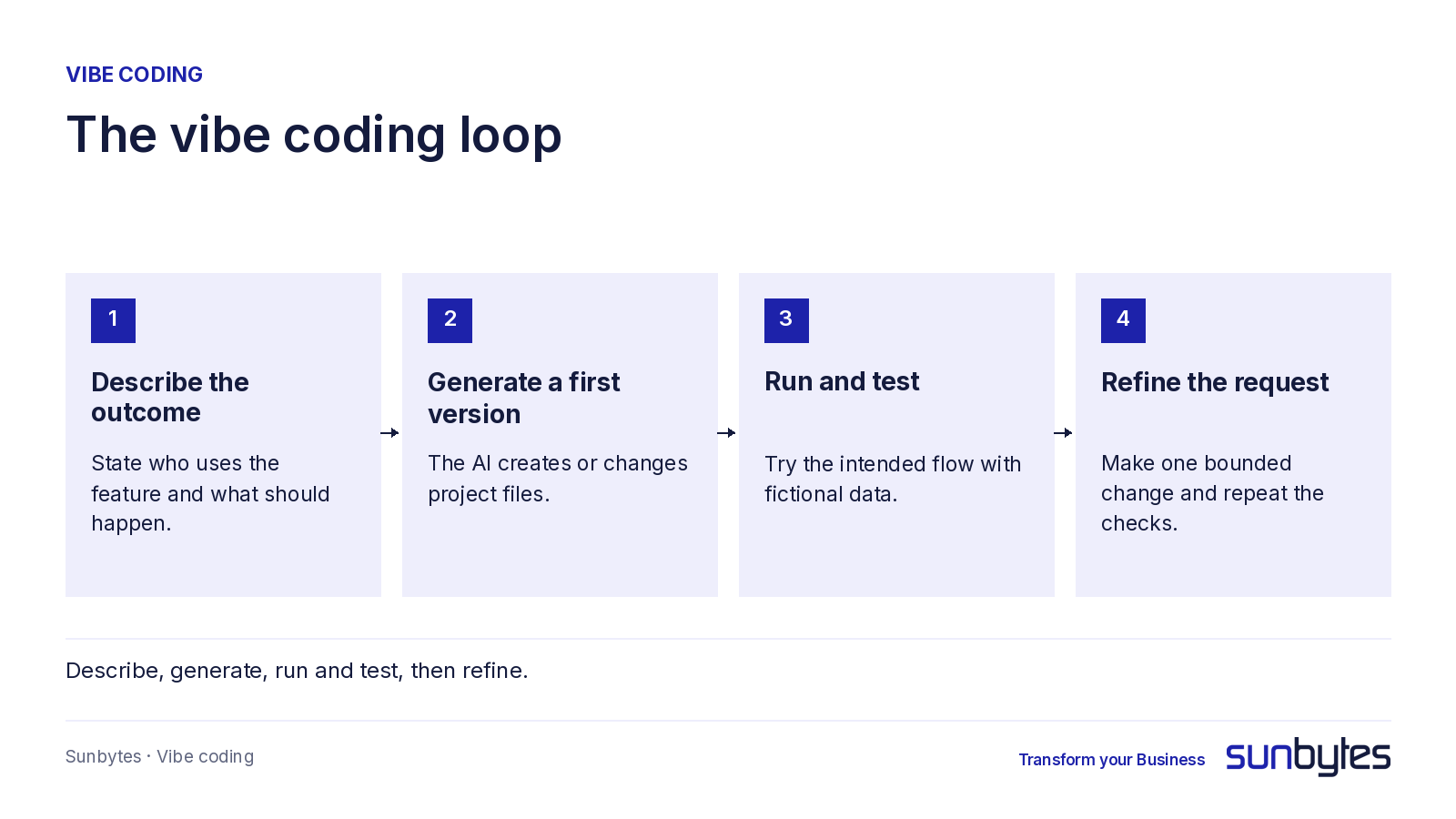
Vibe coding works through a repeated conversation: you describe a task, the AI writes or changes code, and you use the result to decide what to request next. A practical loop has four actions:
- Describe the outcome. State who uses the feature and what should happen. For a request form, specify the required fields and who may see submissions.
- Generate a first version. The AI creates or changes project files. Check the scope before adding features.
- Run and test. Try the intended flow with fictional data, then try an incomplete submission. Record the result.
- Refine the request. Describe the difference between the expected and observed result. Make one bounded change and repeat the checks.
The tools expose different amounts of the underlying project.
| Category and neutral examples | Typical user and activity | Where the code lives |
|---|---|---|
| Browser app builders: Lovable, Bolt.new, Replit, Google AI Studio | Founders or developers prompt and preview an application | An online project, with export or repository options varying by tool |
| AI code editors and assistants: Cursor, GitHub Copilot | Users work with project files and proposed changes in an editor | A development workspace and, when configured, a repository |
| Coding agents: Claude Code | Users delegate tasks across files and inspect the changes | The local or hosted workspace supplied to the agent |
Categories overlap. Check source-code access and account ownership. The product development process in the AI era also covers priorities and demand validation.
Vibe coding examples in 2026
These five vibe coding examples show possible starting points and when to add verification. Microsoft Learn’s introduction to vibe coding includes prototyping from product requirements; these examples apply that approach to business decisions.
A personal script
A script that renames copies of your own files is a contained way to test AI-generated code. Keep the originals so an incorrect result is reversible. Review becomes necessary before the script deletes source files, connects to paid services or handles confidential information.
An internal operations tool
An internal quote calculator can help a team try a new pricing workflow using fictional customers. Once staff use its output to send binding quotes or store customer details, calculation accuracy and access permissions become operating requirements. Internal use does not remove those responsibilities.
An interactive prototype
An interactive prototype lets investors or prospective users try navigation and comment on a proposed workflow. Sample records can show how the product would behave without connecting live systems. Connecting actual accounts or collecting identifiable user information introduces responsibilities before a public launch.
An MVP with first paying users
A minimum viable product (MVP) offers a narrow set of features to test whether customers will use or buy the product. Vibe coding can help produce that first version, but a small feature set still needs correct account access, dependable core flows and support ownership. The first paid pilot already carries customer commitments.
A feature in an existing product
A non-developer can use AI to demonstrate a proposed search screen or reporting view without waiting for a full implementation. Keep the experiment separate from the live product. Before merging the change, a developer should check how it interacts with existing permissions and shared code.
Can you vibe code without knowing how to code?
Yes, you can vibe code a working prototype without knowing programming syntax. Operating a business product requires someone who can inspect the implementation and investigate failures that prompting alone does not resolve.
A non-coder can define workflows and judge whether screens solve the intended problem. Those skills provide less evidence about authentication, which verifies identity, or access rules, which determine what users may retrieve or change.
An API key is a credential for another service; dependencies are external software packages. Someone must verify how both are configured.
In their 2025 study of vibe coding, Advait Sarkar and Ian Drosos analysed more than eight hours of recorded sessions and found continued use of programming expertise and manual editing. For a founder, the practical division is to lead product decisions and appoint technical ownership before others depend on the result.
Vibe coding vs traditional coding
Vibe coding starts with instructions and feedback on generated output. Traditional coding starts with direct implementation by a developer. Teams can combine AI generation with engineering review, so the distinction concerns the working method.
| Criterion | Prompt-led vibe coding | Engineering-led development |
|---|---|---|
| Who writes the code | AI generates the implementation from prompts | A developer writes code or supervises generated changes |
| Time to a first version | Depends on scope and integrations; review work may remain outstanding | Includes implementation, design and agreed release checks |
| Who understands the code | Understanding can remain limited to visible behaviour | A named developer is responsible for understanding the implementation |
| Testing | Users try flows and request changes | Tests have defined expected results and check existing behaviour after changes |
| Security review | Must be added explicitly before relying on sensitive flows | Included in the development and release process when properly scoped |
| Cost of changes after launch | Investigation may include reconstructing undocumented decisions | Documentation and tests support investigation; changes still require work |
Use vibe coding to validate an idea in a contained setting. When customers, payments, personal data or business operations depend on the product, continue with reviewed development. The AI code review guide explains how human review fits into that work.
For budgeting, separate the first build from verification, fixes and ongoing operation. Our guide to AI app development cost covers those cost lines.
Planning to put customers on a vibe-coded product? An AI-built product review brings engineers and security specialists into the same review before launch. Identify what needs fixing before committing to a wider release.
Where vibe coding breaks
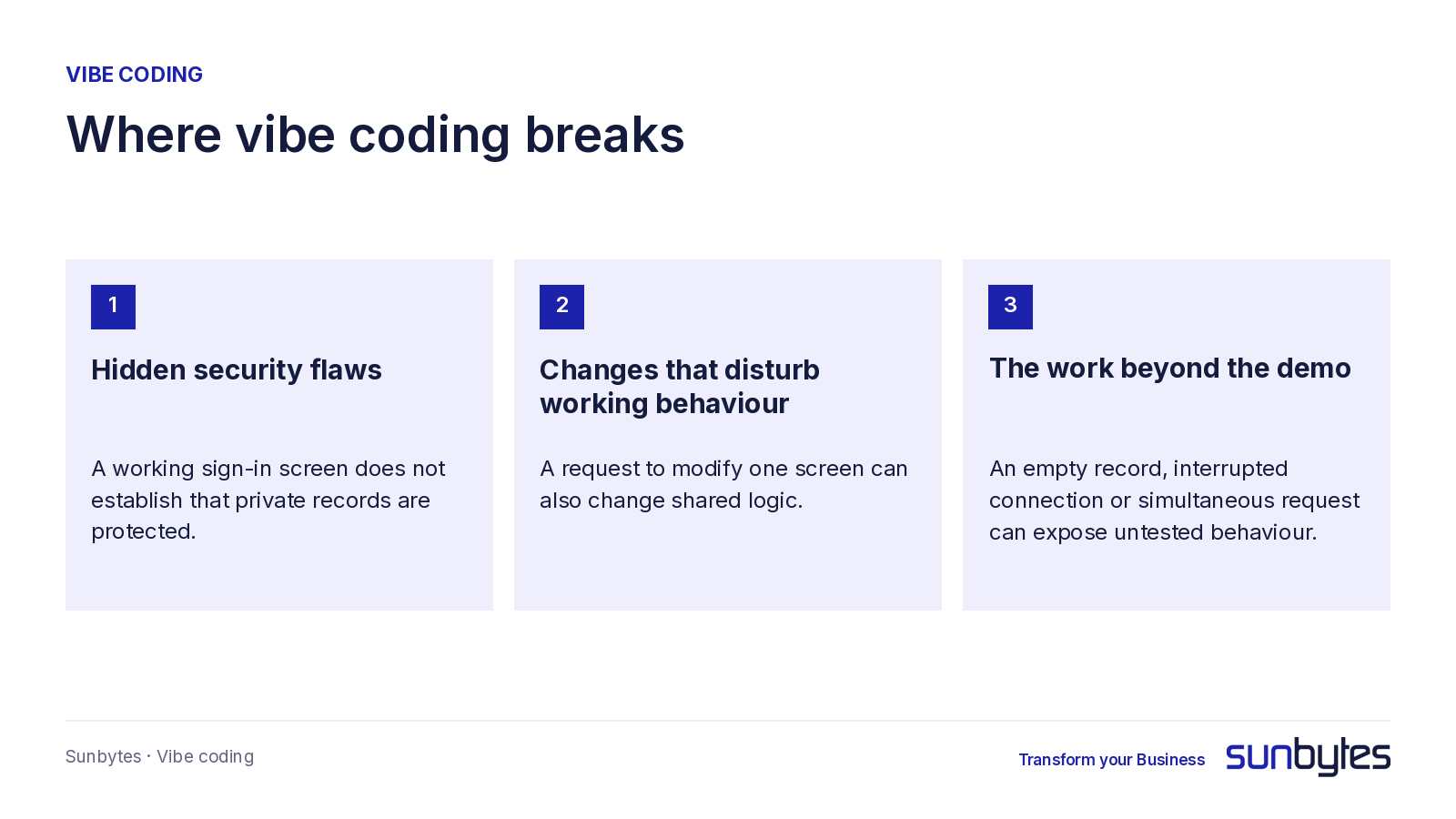
Vibe coding problems appear when successful screen behaviour is treated as sufficient evidence about the underlying product. Three failure points explain why more prompting may stop producing useful progress.
Hidden security flaws
A working sign-in screen does not establish that private records are protected. Veracode’s 2026 GenAI Code Security Report, released on 28 July, reported security failures in roughly 44% of evaluated code-generation tasks without security-specific guidance. The tests concerned models, not complete applications or the named builders. They support checking generated code rather than estimating your product’s chance of a breach.
Changes that disturb working behaviour
A request to modify one screen can also change shared logic. If nobody examines the changes, a previously working feature may fail unnoticed. Save reviewed versions in Git, a version-control system, and keep separate data backups. Restoring source code does not restore a damaged database.
The work beyond the demo
An empty record, interrupted connection or simultaneous request can expose untested behaviour. Completing those paths takes explicit requirements and testing. A working demo gives no reliable estimate of the work remaining.
For the specific access, data and configuration checks, continue to vibe coding security risks.
From prototype to production: what changes
A prototype becomes an operating product when people rely on its results, including during an internal pilot. The code may remain largely unchanged, but the evidence and ownership needed to support its use increase.
| Area | Contained prototype | Product people rely on |
|---|---|---|
| Users | Controlled tests | Customers or staff rely on the outcome |
| Data | Fictional records; actual personal data already requires protection | Risk-appropriate safeguards under GDPR Article 32 |
| Incidents | Experiments can be stopped | Named responder and assessment of any breach notification duty |
| Secrets and API keys | Test credentials with limited permissions | Protected credentials and a replacement process |
| Access control | Limited test scenarios | Verified permissions across roles and records |
| Monitoring and rollback | Manual observation | Alerts and a tested rollback to a known working version |
| Code changes | Experimental edits | An owner, review and traceable releases |
GDPR Article 32 requires security measures appropriate to the processing risk, including when personal data enters a prototype. A human review is a practical way to assess controls, not a review specifically mandated by that article.
Under Article 33, a controller must notify a reportable personal-data breach without undue delay and, where feasible, within 72 hours of awareness. The exception is where risk to people’s rights and freedoms is unlikely. The Dutch Autoriteit Persoonsgegevens explains notification where it is the competent authority.
The guide to AI-generated code in production develops four stages: inventory the product, obtain independent review, fix release blockers, then release to a limited group with monitoring and tested rollback. Use the production readiness checklist to prepare the supporting evidence.
How Sunbytes reviews vibe-coded products
Before a vibe-coded product carries customer commitments, establish which parts need attention. Sunbytes brings software engineers and security specialists together to examine five areas: security and data, code and architecture, critical flows, deployment and operations, and maintainability.
You receive findings with evidence, a prioritised action plan and a technical handoff your team or AI coding tool can use. Remediation is a separate decision, so you can review the findings before choosing who makes the fixes.
Sunbytes combines experience from 300+ delivered projects with Netherlands-led delivery and an ISO 27001-certified information security management system.
Request an AI-built product review to establish what needs attention before your next release.