

You have a working prototype built with AI and are about to set a launch date. Your budget covers the tool subscription and initial development, but you still need to estimate the work required before customers can use it: checking access permissions, testing critical workflows and preparing deployment.
This guide explains how to budget that remaining work alongside the first year of operation. It covers published price ranges, what to check in a development quote and the recurring costs to plan for if your app also includes AI features.
TL;DR
AI app development cost depends on the product’s scope, data, integrations and delivery requirements. Using AI to build an app and adding AI features affect different parts of the budget. Estimate costs in two stages:
- Before launch: development, testing and any additional review or fixes outside the agreed development scope.
- After launch: infrastructure, maintenance and operational support, plus model usage where the app includes AI features.
- Check what is already included: testing, review, deployment and fixes may be covered by the development contract. Add separate allowances only for work outside that scope.
- Estimate maintenance from the work required: a percentage of a low-cost prototype’s tool spend can underestimate the effort needed to maintain the finished product.
Two meanings of “AI app” and why the budgets differ
Before comparing prices, answer two separate questions:
- Did you use AI tools to build the app?
- Will the finished app call an AI model when customers use it?
An app can fit either description or both. A product created with an AI coding assistant may run without AI features. A product that answers questions or generates content through an AI model needs a budget for developing and operating those features.
| How the app uses AI | What to include in the budget |
|---|---|
| AI tools help build the software | Development-tool costs and the engineering, testing and deployment work required by the agreed scope |
| AI features operate inside the finished product | Development and evaluation of those features, plus ongoing model usage and supporting infrastructure |
This guide focuses on founders who have built a product with AI and are preparing to serve customers. Where the product also includes AI features, account for those additional development and operating requirements.
For the checks to make before serving real users, see our guide to AI-generated code in production.
How much does AI app development cost?
Use the table below to identify the closest reference scope for your project. Start with the workflows, data and integrations involved, then check the delivery assumptions behind each range. Prototype prices and production-development estimates describe different levels of work.
| Tier | Typical example | Softr (May 2026) | Iternal (September 2026) |
|---|---|---|---|
| Prototype or personal app | A booking tool or dashboard made with an AI app builder | Free–$1,000 | Not covered |
| Basic AI app or AI MVP | One AI feature, such as a support chatbot or one validated use case | $10,000–$50,000 | $25,000–$80,000 (AI MVP); $25,000–$60,000 (simple chatbot) |
| Mid-level AI app | Search over your own documents, recommendations, several workflows | $80,000–$150,000 | $80,000–$180,000 (RAG application); $120,000–$250,000 (AI agent) |
| Complex AI system | Multiple workflows, deep integrations, governance and audit trails | $300,000–$500,000+ | $250,000–$1,000,000+ (enterprise AI platform) |
Scope note: These publishers group costs differently. Check whether each estimate includes testing, security review, deployment, infrastructure or ongoing support. When building your own budget, add only the work and services excluded from your development quote.
Sources: Softr, “How much does AI app development cost in 2026?”, May 2026 , “How much does AI app development cost?”, updated September 2026
The two sources draw the tier lines differently, so the ranges overlap. A quote that sits inside a tier says little on its own; the scope behind it, and which cost lines below it includes, decides whether the number is realistic.
What AI coding tools actually cut from the build cost
AI coding tools cut the cost of writing new, well-defined code the most, and the saving shrinks on large, existing codebases. The evidence comes from controlled trials, not vendor estimates, and the trials disagree in a way that explains the gap.
In a 2023 trial by researchers at Microsoft, GitHub and MIT, developers with GitHub Copilot implemented an HTTP server in JavaScript 55.8% faster than a control group (Peng et al., 2023). The task was small, new and clearly specified, which is close to how a founder builds a first prototype.
In a July 2025 randomised trial, METR found that 16 experienced open-source developers took 19% longer on 246 real issues in their own large repositories when early-2025 AI tools were allowed. The same developers had expected a 24% speed-up. A February 2026 METR update on late-2025 tools points to a speed-up of roughly 4–18%, which METR itself calls very weak evidence.
The practical reading for a budget: AI tools make the first version cheaper, often by a wide margin. They do not apply a fixed discount to the whole project, because most of the cost of a product sits in changing, checking and running code that already exists.
AI app development cost factors that AI does not remove
Five cost lines stay after AI writes the code: product decisions, data and integrations, security and access control, review and fixes, and running costs. AI tools change the effort inside some of these lines, but none of them disappears. Table 3 shows what changes per line.
| Cost line | What AI changes | What still costs money |
|---|---|---|
| Product decisions and requirements | Faster mock-ups to test ideas | Deciding pricing rules, user roles and what the app must never do |
| Data and integrations | Faster connection code | Cleaning data, mapping fields, handling payment and CRM edge cases |
| Security and access control | Generates login and permission code quickly | Checking who can see which record; GDPR Article 32 requires measures appropriate to the risk |
| Review, testing and fixes | More code produced per day; AI can also draft tests and fixes | Validating results against real behaviour, security requirements and the production environment |
| Hosting and model usage | No change | Monthly hosting, database and, for AI features, model usage per request |
| Maintenance and updates | Faster small changes | Dependency updates, security patches, model and price changes |
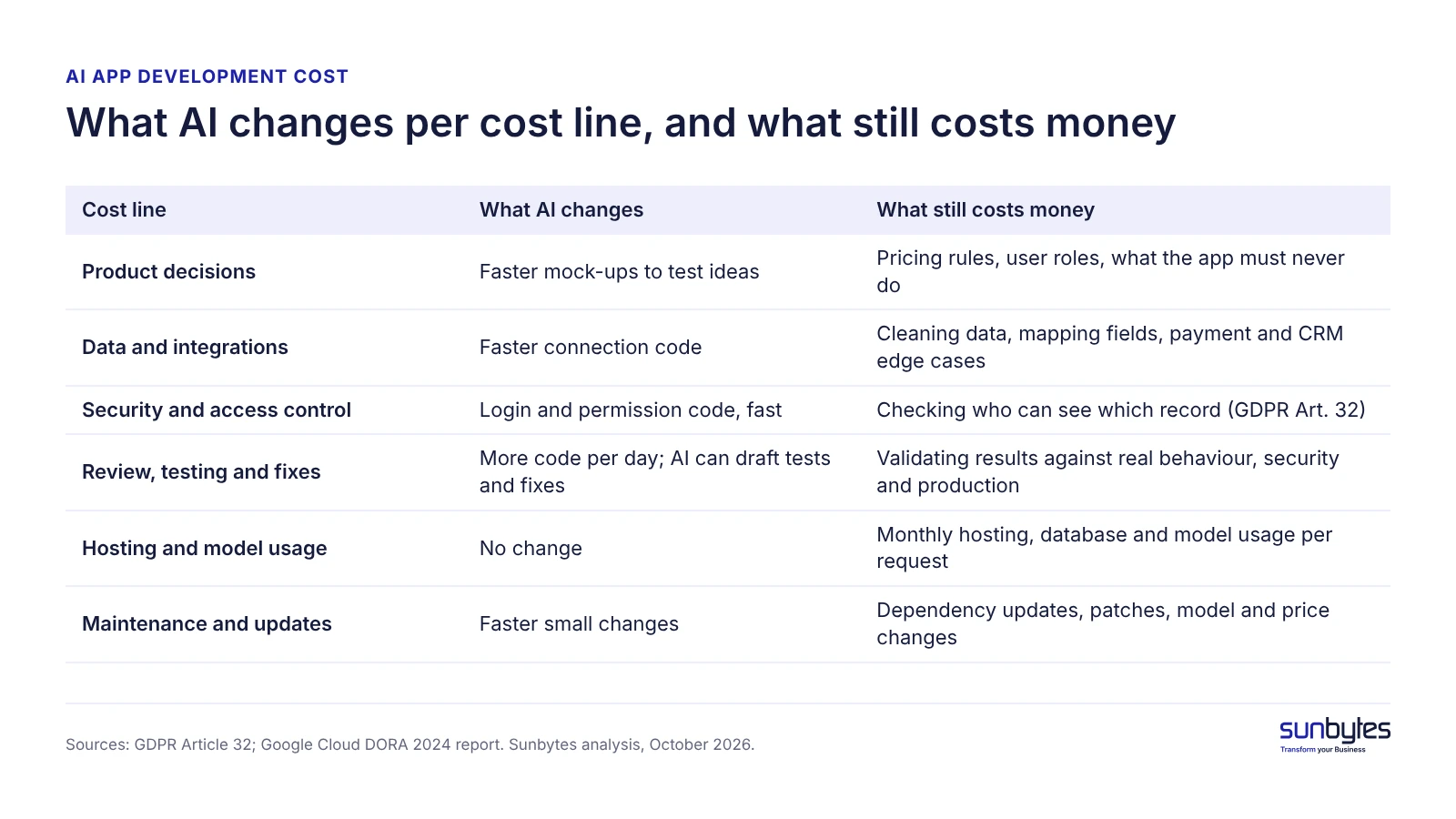
Security and access control carry a legal floor in the EU. GDPR Article 32 requires technical and organisational measures appropriate to the risk once an app processes personal data, whoever or whatever wrote the code.
The Google Cloud DORA 2024 report associated higher AI adoption with lower delivery throughput (an estimated 1.5%) and lower delivery stability (an estimated 7.2%) in its analysis. This does not mean AI-generated code necessarily causes delivery failures. It does show why teams should measure review effort, change failure rates and rework alongside coding speed when evaluating the financial impact of AI tools.
If you commission a review outside the development scope, obtain a separate quote and allow time for any resulting fixes. Our guide to AI code audit cost explains the factors to discuss with a provider.
Know which cost lines your AI-built app still carries
An AI-built product review looks at the parts of your app that AI tools did not price in: how user data is accessed, what is exposed, and what needs fixing before real users arrive. The review is independent from any fix work, and the findings come back in plain English with a prioritised action plan.
What an AI app costs to run after launch
An AI app costs money every month after launch for hosting, maintenance and, if it has AI features, model usage. Model usage scales with traffic: Zite’s March 2026 cost guide estimates that a small app handling 1,000 customer questions a day might spend $200–$300 per month on AI usage. An app built with AI tools but without AI features has no model line.
Model usage: priced per token
Model usage is billed per token, a chunk of text of a few characters that the model reads or writes. The OpenAI API price list prices input and output tokens separately and varies by model and processing tier; in its standard tier on 22 October 2026, the cheapest and most expensive listed models differed by a factor of about 100.
Estimate monthly model costs by separating input and output tokens:
Monthly model cost = (monthly input tokens ÷ 1,000,000 × input price) + (monthly output tokens ÷ 1,000,000 × output price).
For example, 10,000 monthly requests averaging 2,000 input tokens and 500 output tokens would use 20 million input tokens and 5 million output tokens. At illustrative rates of $1 per million input tokens and $5 per million output tokens, the monthly model bill would be $45.
This excludes additional charges for retrieval, tools, retries and other infrastructure. Calculate low, expected and high usage scenarios using the current prices of your chosen provider and model.
Hosting and maintenance
Separate infrastructure from maintenance and operational support. Infrastructure covers services such as hosting, databases, storage, backups and monitoring. Maintenance and support cover the people and work needed to update dependencies, fix bugs and respond to operational issues. Account for model usage separately where the app includes AI features.
Softr estimates annual maintenance at 15–25% of the original build cost. Iternal uses a similar percentage for a broader range of ongoing activities. These are different budgeting assumptions, so they should not be combined into one maintenance benchmark.
For an app built with inexpensive AI tools, estimate maintenance from the tasks, expected effort and support coverage required. Applying a percentage to tool subscriptions alone can produce an unrealistically low allowance. Check for services already bundled into platform or support fees, then update the estimate using actual operating data.
How to budget the first year of an AI-built app
Organise the budget into work required before launch and costs incurred after launch. Keep development, additional review and remediation visible, while checking what the original contract already covers. For ongoing costs, separate infrastructure and model usage from maintenance and operational support.
| Stage | Budget item | How to estimate it |
|---|---|---|
| Before launch | Development | Use the agreed quote or actual spend, identifying the testing, security work and deployment already included |
| Before launch | Additional review | Obtain a scoped quote where a separate review is commissioned |
| Before launch | Additional fixes | Estimate work arising from findings, excluding fixes already covered by the development scope or warranty |
| After launch | Infrastructure and model usage | Estimate 12 months of hosting and supporting services, plus model usage where applicable; exclude maintenance counted below |
| After launch | Maintenance and operational support | Estimate tasks, engineering effort and support coverage; exclude infrastructure, model usage and initial remediation counted elsewhere |
This budget covers launch preparation plus the first 12 months after launch. If you have already paid for part of the work, show both the total project cost and the additional funding still required.
AI tools can assist with code review, testing and fixes, but the results still need validation against the product’s behaviour and requirements. Identify who owns these activities and whether their cost is included in development or commissioned separately.
Example: a first-year budget for an AI-built app
Consider a small AI-built customer portal that uses an external AI model to answer customer questions. The founder has already built a working prototype and plans to launch it to paying customers. The following figures are illustrative planning assumptions, not market quotations.
| Budget line | Example cost |
|---|---|
| Initial build and integrations | $12,000 |
| Independent review before launch | $2,000 |
| Fixing review findings | $3,000 |
| Hosting and model usage ($200/month × 12) | $2,400 |
| Maintenance and updates | $2,400 |
| Estimated first-year total | $21,800 |
In this example, the build represents about 55% of the first-year budget. Review, fixes, hosting and maintenance account for the remaining 45%.
For this example, the development amount includes the agreed testing and deployment work. The independent review is an additional commission, and the remediation allowance covers findings outside the original development scope. Hosting and model usage are counted separately from maintenance.
The maintenance allowance covers agreed upkeep and minor fixes after launch. It excludes initial remediation, infrastructure and model usage. These figures are illustrative planning assumptions; estimate each item from your own scope and check for overlapping charges.
When a low-cost AI build stops being cheap
A low-cost AI build stays cheap while it handles test data for a small internal group, and stops being cheap once real users’ personal data, payments or enterprise customers depend on it. Table 6 sets out where the line sits.
| Situation | Low-cost build is enough? | What to budget for |
|---|---|---|
| Internal tool, test data, fewer than 10 users | Yes | Tool subscriptions and hosting |
| Real users’ personal data or payments | No | A review before launch and access-control fixes |
| Enterprise customer sends a security questionnaire | No | Written review evidence and fixes |
| A second developer joins or the code keeps growing | Partly | Maintenance, documentation and rules for AI-written code |
Under GDPR Article 33, a personal data breach must generally be reported to the relevant supervisory authority within 72 hours of becoming aware of it, unless it is unlikely to result in a risk to individuals’ rights and freedoms. For organisations operating in the Netherlands, the relevant authority is typically the Autoriteit Persoonsgegevens.
Before launch, work through a production readiness checklist. Once the team grows, written rules for ai code governance keep maintenance costs predictable.
How Sunbytes helps you budget the cost lines AI leaves open
The worked example above shows where the first-year money of an AI-built app goes: the build is just over half, and much of the rest depends on what a review finds. That second half is the part a founder cannot price until someone has looked at the code, the data flows and the hosting set-up.
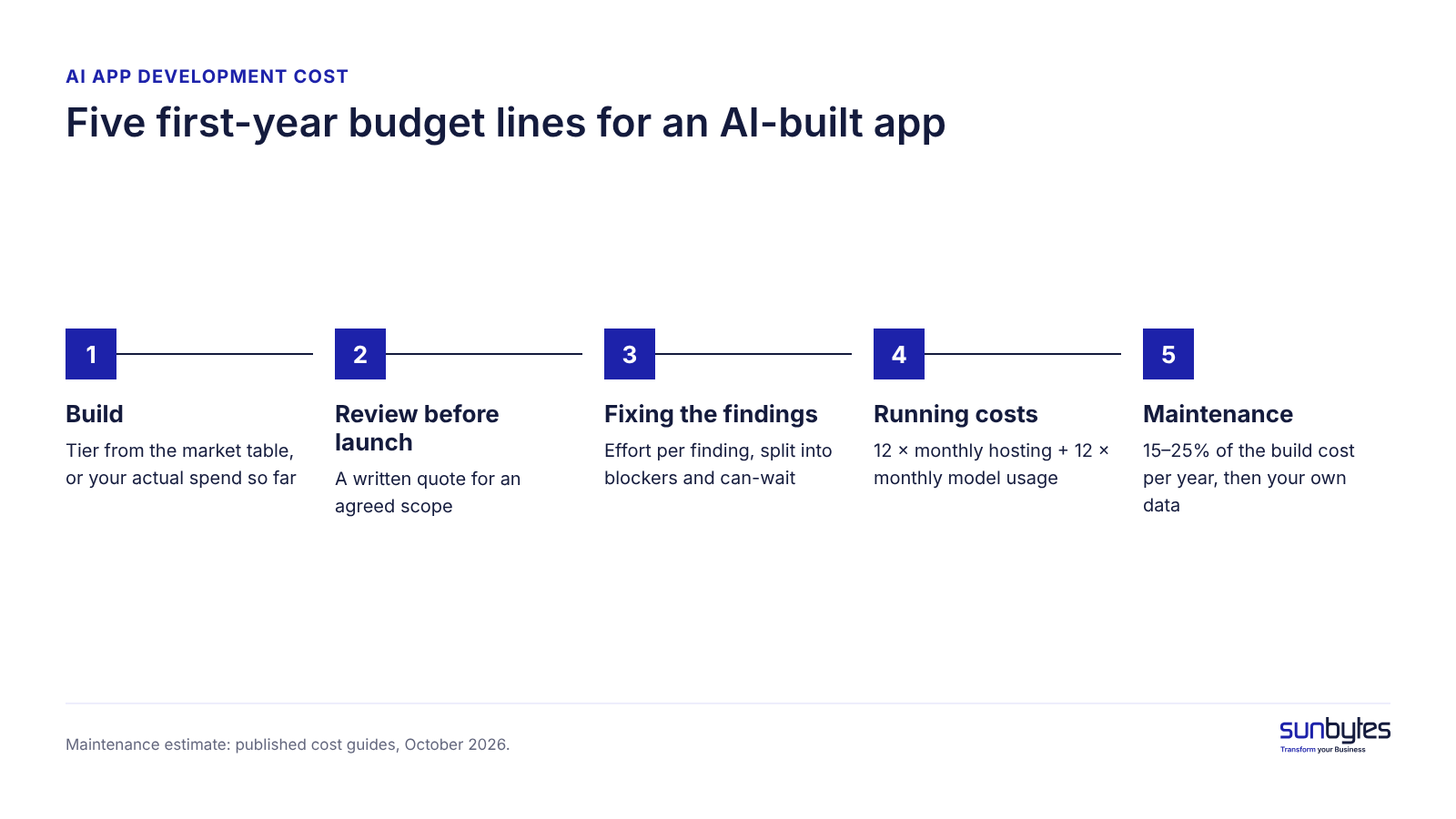
Sunbytes starts with that gap. An AI-built product review begins by scoping what was built, who uses it and which parts handle personal data or payments. Engineers then review the agreed areas across code, product behaviour and technical setup, and sort the findings into what blocks launch and what can wait. Budget lines 2 and 3 become estimates instead of guesses, and because the review is independent from the fix work, the findings are not shaped by who does the remediation.
Where findings touch access control or personal data, Sunbytes’ Cybersecurity Solutions add the security controls and the evidence a GDPR or customer security review asks for. Your own team can then fix the findings, or Sunbytes engineers fix the priority items and re-check them.
The work runs under an ISO/IEC 27001-certified information security management system, with governance from the Netherlands and engineering capacity in Ho Chi Minh City, built on 300+ delivered projects.
Before you fix a launch date, discuss the scope of a review for your AI-built app.