

AI is accelerating how fast teams build, but it is also quietly accelerating how fast they accumulate technical debt. What looks like productivity gains today often turns into slower delivery, fragile systems, and growing uncertainty tomorrow. The real risk is not just messy code, but a loss of control over systems that teams no longer fully understand or confidently change. As AI-generated and AI-assisted development becomes the norm, traditional approaches to managing technical debt are no longer enough.
This article will walk you through what AI-era technical debt really looks like, how it impacts your business, and a practical framework to identify, prioritize, and manage it without slowing down your roadmap.
TL;DR
- AI helps teams ship faster, but it can also create technical debt faster.
- In the AI era, debt is not just a code quality problem. It affects delivery speed, maintainability, onboarding, security, and future AI readiness.
- The right goal is not to eliminate debt completely, but to identify, prioritize, govern, and reduce it continuously.
- The most effective approach combines engineering standards, AI-specific review guardrails, measurable KPIs, and a remediation roadmap.
For a broader foundation on how technical debt forms and how teams traditionally manage it, our guide on Technical Debt: A Comprehensive Guide to Identifying and Managing It provides useful context before diving into the AI-specific challenges.

What AI-era technical debt actually looks like
AI has changed not just how code is written, but how technical debt is created, hidden, and scaled. In traditional development, debt typically comes from time pressure, trade-offs, or legacy decisions. In the AI era, debt can be introduced much faster, and often without full visibility, because teams adopt generated code, unfamiliar patterns, or external dependencies they did not consciously design.
The result is a different class of technical debt: one that is less about obvious “bad code” and more about lack of clarity, control, and consistency across the system. Code may look clean, pass tests, and even follow best practices on the surface, but still carry hidden risks that slow teams down later.
Here is a quick comparison of traditional and AI-era Technical Debt:
| Aspect | Traditional Technical Debt | AI-era Technical Debt |
|---|---|---|
| Origin | Manual shortcuts, tight deadlines, legacy systems | AI-generated code, prompt variability, external suggestions |
| Visibility | Often visible (messy code, TODOs, known trade-offs) | Often hidden (clean-looking code with unclear logic or dependencies) |
| Consistency | Typically aligned with team conventions | Varies depending on prompts, models, and timing |
| Knowledge | Usually owned by developers who wrote it | Often not fully understood by the team |
| Risk type | Maintainability and scalability issues | Comprehension gaps, hidden dependencies, false confidence |
| Speed of accumulation | Gradual | Rapid and compounding |
What are Four Pillars of AI Technical Debt?
In practice, most AI-driven technical debt falls into four distinct categories. Each represents a different failure mode that can slow teams down, increase risk, and reduce confidence in making changes.
Pillar 1: Comprehension debt
This occurs when code works, but no one on the team can confidently explain how it works or modify it safely. AI-generated logic can introduce layers of abstraction or unfamiliar patterns that are difficult to reason about, especially without proper context or documentation.
This is one of the most dangerous forms of debt because it directly reduces engineering confidence. Over time, teams hesitate to touch certain parts of the system, creating bottlenecks and increasing reliance on a small number of individuals who “roughly understand” the code.
Pillar 2: Hidden dependency debt
AI tools often suggest libraries, packages, or utilities that developers may not fully evaluate. While this speeds up development, it also expands the dependency surface in ways that are not always visible or intentional.
The result is a growing web of dependencies that increase maintenance effort, security exposure, and audit complexity. In regulated or security-sensitive environments, this type of debt can quickly become a critical risk.
Pillar 3: Pattern divergence debt
AI suggestions can vary based on prompts, models, or even timing. As a result, similar problems across the codebase may be solved in completely different ways.
This creates inconsistency in architecture and coding patterns, making the system harder to navigate, review, and maintain. Over time, it increases review friction, slows onboarding, and reduces the overall coherence of the codebase.
Pillar 4: Model obsolescence debt
AI-generated code is influenced by the state of tooling and best practices at the time it was created. As frameworks evolve and standards improve, those patterns can quickly become outdated even if the code still functions correctly.
This leads to systems that are technically “working” but increasingly misaligned with modern practices, making future upgrades, integrations, and scaling efforts more difficult.
How does AI technical debt impact on business?
AI technical debt rarely shows up as an immediate failure. Instead, it compounds quietly until it starts slowing down the business in ways that are difficult to trace back to code. What begins as faster delivery can gradually turn into reduced execution speed, higher risk, and limited ability to scale.
- The most visible impact is slower feature delivery. In practice, McKinsey estimates it can consume between 15% and 60% of IT spending, with a significant share of innovation budgets diverted to fixing existing systems. Teams spend more time understanding existing code, reviewing AI-generated logic, and validating dependencies before making changes. What should be a straightforward update turns into extended investigation and cautious iteration.
- This is often followed by longer review cycles and increased rework. When code is harder to reason about, reviewers need more time and more rounds to gain confidence. Issues surface later in the process, leading to more debugging, more fixes, and repeated delays.
- Over time, this creates higher onboarding friction and knowledge concentration. New engineers struggle to ramp up quickly, while a small number of team members become the default owners of complex or unclear areas. This not only slows down collaboration but also increases operational risk.
- More importantly, AI technical debt reduces a company’s readiness for future AI initiatives. When the existing system lacks clarity and consistency, integrating new AI capabilities becomes harder, riskier, and more expensive.
- The real cost is not just poor code. It is reduced innovation capacity, teams spend more time maintaining and less time building what actually moves the business forward.
What is a practical framework for managing technical debt in the AI era?
Managing technical debt in the AI era is about building control into how software is created, reviewed, and evolved. Without a structured approach, debt accumulates faster than teams can even detect it. The most effective teams treat technical debt as an ongoing discipline, following this 5-step framework:
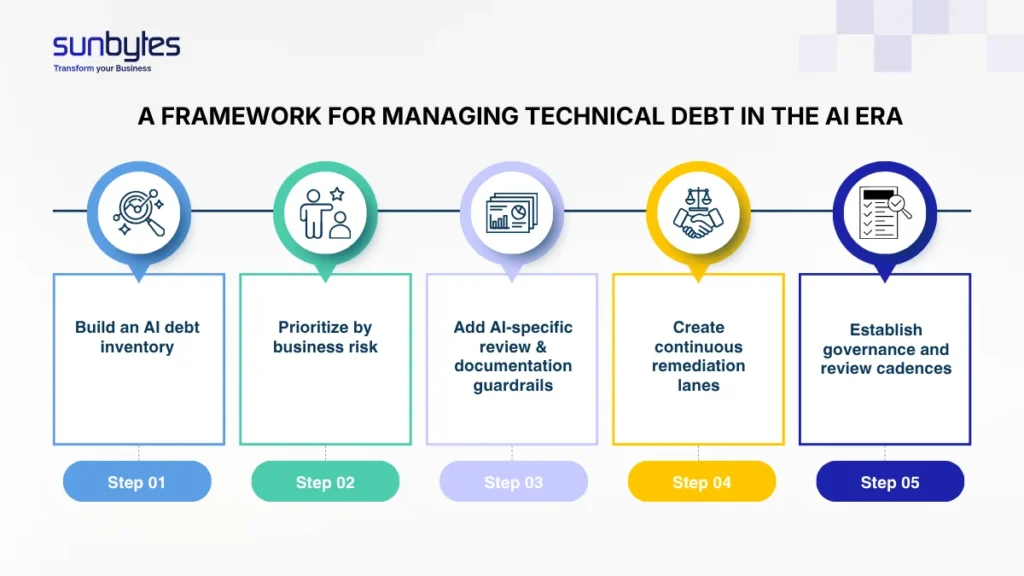
Step 1: Build an AI debt inventory
Start by making the invisible visible. Identify which parts of your system are AI-assisted or AI-generated, at the level of modules, services, or workflows.
Tag these areas based on business criticality, customer impact, security sensitivity, and rate of change. Just as importantly, distinguish between known debt (confirmed issues) and suspected debt (areas that lack clarity or confidence).
You cannot manage what you have not named.
Step 2: Prioritize by business risk, not just code ugliness
Not all technical debt is equally expensive. In the AI era, the biggest risks are often hidden in code that looks clean but lacks transparency or control.
Prioritize based on impact on delivery speed, system reliability, security exposure, knowledge concentration, and future AI readiness. Focus first on the debt that creates the highest operational drag or risk to the business.
The ugliest code is not always the most expensive debt.
Step 3: Add AI-specific review and documentation guardrails
Traditional code review is not enough for AI-assisted development. Teams need to review for understanding, not just correctness.
Introduce simple but consistent prompts during reviews:
- Can the team clearly explain this logic?
- Are all dependencies justified, trusted, and necessary?
- Is the code testable and observable in production?
- Would another engineer feel confident modifying it?
Capture key context in lightweight documentation, why this approach was chosen, what its limitations are, and what dependencies it introduces. This reduces future ambiguity and handoff risk.
Step 4: Create continuous remediation lanes
Leading organizations typically allocate around 15% of their IT budgets to technical debt remediation, reinforcing the need to treat it as an ongoing discipline rather than a one-time effort. Avoid treating technical debt as a one-time cleanup project. Large rewrites are expensive, risky, and often delayed indefinitely.
Instead, allocate recurring capacity within normal delivery cycles to address debt incrementally. Maintain a rolling remediation plan aligned with business priorities, so debt reduction supports, not competes with, product delivery.
The goal is not to eliminate debt, but to keep it under control while the roadmap moves forward.
Step 5: Establish governance and review cadences
Technical debt decisions should not happen ad hoc. They need to be part of regular engineering and product governance.
Introduce recurring checkpoints, architecture reviews, engineering syncs, or product health reviews, where teams evaluate debt and decide what to:
- Fix now
- Monitor
- Accept temporarily
- Redesign later
Treat technical debt as a portfolio of decisions, not just isolated engineering tasks. This ensures alignment between technical reality and business priorities.
Which KPIs matter most for AI technical debt?
You cannot manage AI technical debt through intuition alone. In many teams, the warning signs show up first in review friction, delivery delays, and knowledge gaps, not in obvious code quality metrics. These 5 KPIs make these hidden costs visible and actionable at a leadership level.
KPI 1: Review overhead
AI-assisted code often requires more scrutiny to build confidence. Tracking review dynamics helps reveal where understanding is breaking down.
- Average review time for AI-assisted code vs. non-AI code
- Number of review rounds per pull request
- Reviewer confidence levels (e.g., how often reviewers request clarification)
KPI 2: Maintenance friction
When technical debt accumulates, even small changes become expensive. These metrics highlight how difficult it is to work with existing code.
- Time required to modify AI-generated or AI-assisted code
- Rework rate after initial implementation
- Debugging time per incident or issue
KPI 3: Knowledge concentration
AI can accelerate development, but it can also concentrate knowledge in unpredictable ways. These KPIs show how distributed or fragile your system understanding is.
- Number of engineers who can confidently explain and modify a module
- Handoff difficulty between team members
- Bus factor in AI-heavy areas
KPI 4: Dependency and security exposure
AI-driven development often expands the dependency surface. Measuring this risk is critical, especially for scaling teams.
- Number of unvetted or poorly understood dependencies
- Age, maintenance status, and health of key libraries
- Vulnerability findings linked to AI-generated implementation choices
KPI 5: Delivery impact
Ultimately, technical debt shows up in your ability to deliver. These metrics connect engineering signals to business outcomes.
- Velocity drag in AI-heavy modules compared to the rest of the system
- Delays to roadmap items caused by investigation, cleanup, or rework
- Frequency of situations where teams slow down due to lack of trust in the code
The goal is not to track everything, but to focus on signals that reflect confidence, speed, and control. When these start to decline, technical debt is no longer just an engineering concern, it becomes a business constraint.
Where AI helps reduce technical debt?

AI is not just a source of technical debt, it can also be a powerful tool to reduce it when used with the right intent and oversight. The advantage of AI lies in its ability to analyze systems at scale, surface hidden issues, and accelerate repetitive engineering work. Here are 6 common benefits of AI in reducing technical debt:
- Code analysis and smell detection: AI tools can scan large codebases to identify inconsistencies, anti-patterns, and potential risks much faster than manual reviews. This improves visibility into areas where debt is accumulating, especially in complex or fast-moving systems.
- Refactoring efforts: by suggesting cleaner structures, simplifying logic, or standardizing patterns across the codebase. While these suggestions still require human validation, they significantly reduce the effort needed to modernize legacy or inconsistent code.
- Documentation reconstruction: AI can generate summaries, explain code behavior, and help teams rebuild missing context, addressing one of the most critical gaps in AI-era technical debt: lack of understanding.
- Dependency mapping and observability: helping teams track how components interact, where risks are concentrated, and how changes propagate across the system. This is particularly valuable for identifying hidden dependency debt and improving system transparency.
- Provide predictive visibility into debt hotspots: By analyzing patterns in code changes, incidents, and review cycles, it can help teams anticipate where technical debt is likely to create future friction.
- Improve speed and visibility: but it does not replace architectural judgment or product context. Used correctly, it becomes a force multiplier for disciplined teams, not a substitute for them.
Where AI makes technical debt worse?
AI accelerates development, but without the right controls, it can also amplify technical debt at a scale and speed teams are not prepared for. The risk is not just in what AI generates, but in how easily teams accept and integrate it without full understanding.
- AI lacks full business and system context. It generates code based on patterns, not on the specific constraints, trade-offs, or long-term goals of your product. This often leads to solutions that work in isolation but do not align with the broader architecture.
- AI can also normalize suboptimal or inconsistent patterns. When different developers use different prompts or tools, similar problems may be solved in different ways. Over time, this creates fragmentation across the codebase, increasing complexity and reducing maintainability.
- False confidence from clean-looking code. AI-generated code often appears well-structured and readable, which can mask deeper issues such as hidden dependencies, edge-case failures, or lack of scalability. Teams may trust the output too quickly without applying the same level of scrutiny.
- AI encourages shallow fixes instead of structural improvements. Instead of addressing root causes, teams may rely on quick patches suggested by AI, which temporarily resolve symptoms but increase long-term complexity.
Perhaps most importantly, teams can begin to over-trust code they do not fully understand. This leads directly to comprehension debt, knowledge gaps, and higher risk when systems need to evolve.
This risk becomes even more visible with the rise of “vibe coding,” where teams rely heavily on AI-generated code without fully understanding the underlying logic, an approach that can accelerate delivery but also introduce hidden complexity and long-term maintainability issues. Explore how this trend is evolving in this breakdown of vibe coding.
What is a team operating model for managing debt without slowing the roadmap?
Managing technical debt in the AI era requires a clear operating model. Without it, debt reduction is constantly deprioritized in favor of delivery, until it starts slowing the roadmap it was meant to protect. The goal is to embed debt management into how teams work, not treat it as a separate initiative.
Create an AI-specific Definition of Done
In AI-assisted development, “it works” is no longer a sufficient standard. A feature is only complete when the team can explain, review, test, and safely modify it.
This means extending your Definition of Done to include:
- Clear understanding of the logic (not just functional output)
- Verified and justified dependencies
- Sufficient test coverage and observability
- Lightweight documentation for high-risk or complex areas
This shifts quality from output to long-term maintainability and control.
Upgrade code review for AI-assisted development
Code review must evolve from checking correctness to ensuring team-level understanding and confidence.
Reviewers should actively challenge:
- Whether the logic is clearly understood, not just accepted
- Whether dependencies are necessary and trustworthy
- Whether abstractions introduced by AI are maintainable
The goal is to prevent “black box code” from entering the system, even if it passes all tests.
Explore more:
Assign ownership for the debt backlog
Technical debt cannot remain a shared, undefined responsibility. Without clear ownership, it becomes invisible in planning and execution.
Define roles across:
- Engineering managers (prioritization and capacity allocation)
- Architects or senior engineers (technical direction and standards)
- Product leaders (alignment with business priorities)
This ensures debt is managed as part of the product lifecycle, not as optional cleanup work.
Protect remediation capacity
If all capacity is allocated to new features, technical debt will always accumulate faster than it is reduced. High-performing teams deliberately reserve a portion of their bandwidth for remediation and modernization.
This is not a cost to delivery, it is what protects delivery speed over time. Leading organizations often allocate a consistent share of engineering effort to debt reduction, treating it as a necessary investment rather than a trade-off.
What is a 30-60-90 day plan to regain control of AI technical debt?
A structured plan helps teams move from awareness to control without disrupting delivery. Instead of large, risky rewrites, the goal is to build visibility, introduce discipline, and create momentum within normal engineering workflows.
In the first 30 days
Focus on visibility and quick wins.
- Audit systems that are AI-assisted or AI-generated
- Tag high-risk modules based on business impact, security, and rate of change
- Establish baseline KPIs (review time, rework rate, knowledge distribution)
- Identify fast, high-value cleanup opportunities to reduce immediate friction
This phase is about understanding where you stand and reducing the most obvious sources of drag.
In the next 60 days
Introduce structure and standardization.
- Implement AI-specific review checklists and guardrails
- Define and enforce dependency evaluation rules
- Improve documentation for critical or high-risk modules
- Begin targeted remediation of the most impactful technical debt
At this stage, teams start shifting from reactive fixes to controlled, repeatable practices.
By day 90
Establish governance and long-term control.
- Introduce recurring technical debt reviews within engineering or product cadences
- Build a debt heatmap across systems to visualize risk and priorities
- Decide what to refactor, replace, modernize, or isolate
- Align technical debt work with roadmap planning and business priorities
By this point, technical debt is no longer invisible or unmanaged, it becomes a governed part of how the product evolves, not something that competes with it.
If you need additional support to execute this plan effectively, Sunbytes’ dedicated team service can help accelerate each phase while keeping your roadmap on track.
When to refactor, modernize, or bring in outside support
Not all technical debt requires the same response. In the AI era, the key decision is not whether debt exists, but what kind of action will restore control with the least disruption to delivery. Choosing the wrong approach can either waste effort or delay critical progress.
- Refactor when the system is still structurally sound, but specific areas are creating friction. This typically applies to localized issues such as inconsistent patterns, unclear logic, or overly complex modules. The goal is to improve readability, maintainability, and consistency without changing the overall architecture.
- Modernize when the problem is deeper and limits your ability to scale or evolve. This includes architectural misalignment, outdated frameworks, or tightly coupled systems that make change slow and risky. Modernization often requires rethinking parts of the system—not just cleaning them up—to align with current standards and future needs.
- Bring in outside support when internal teams are constrained—either by capacity, proximity to legacy decisions, or lack of specialized experience. This is especially relevant when:
The team is fully allocated to roadmap delivery
The system has accumulated long-standing, complex debt
Objective assessment is needed to prioritize and plan effectively
Specialized modernization or remediation skills are required
A dedicated external team can work in parallel, reducing technical debt while your core team continues shipping. The goal is not to replace internal capabilities, but to accelerate progress without creating additional bottlenecks.
How Sunbytes helps teams manage technical debt in the AI era
At Sunbytes, we help teams regain control through technical debt audits and system health checks, giving a clear view of risks across code, dependencies, architecture, and knowledge gaps, so decisions are based on data, not assumptions.
We strengthen code review practices and dependency visibility, making hidden risks in AI-assisted development explicit and easier to manage. With dedicated engineering capacity, Sunbytes enables continuous remediation in parallel, so your core team can stay focused on delivery. For deeper challenges, we support legacy modernization to align systems with current standards and future AI readiness.
The result is a practical, business-aligned roadmap that balances delivery speed with long-term maintainability, so technical debt stays under control, not in the way.
Need a clearer picture of what is slowing delivery? Sunbytes can help you audit, prioritize, and reduce technical debt without stalling product progress.