
Modernization projects often start with a clear goal, reduce costs and improve performance, but end up doing the opposite. While organizations expect modernization to reduce costs, often by 20–30% on average, many fail to realize these savings due to poor execution and hidden complexity. Budgets expand, timelines slip, and teams find themselves maintaining both legacy and new systems at the same time. The problem isn’t modernization itself, but how it’s approached: unclear priorities, inefficient processes, and decisions made without a clear view of ROI. Left unchecked, this turns modernization into a cost multiplier rather than a cost optimizer.
This article will show how to reduce costs in application modernization through a structured, ROI-driven approach, covering the key strategies, hidden cost traps, and practical ways to maximize long-term value.
TL;DR
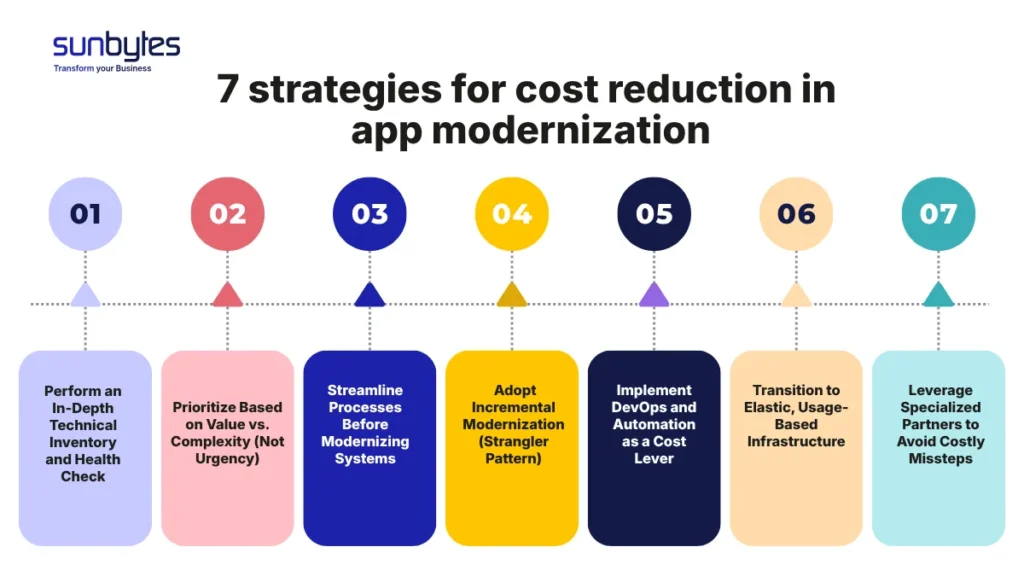
The 7 Core Strategies for ROI-Driven Modernization:
- Technical Health Checks: Audit your inventory to kill “zombie” apps and save on licenses immediately.
- Value-Based Prioritization: Use a Value-vs-Complexity matrix to tackle high-impact “Quick Wins” first.
- Process Streamlining: Lean out your workflows before you code to avoid “automating a mess.”
- Incremental Rebuilding: Use the “Strangler Fig” pattern to replace modules without “Big Bang” risks.
- DevOps Automation: Slash manual QA and deployment overhead through CI/CD pipelines.
- Elastic Infrastructure: Move to cloud-native or serverless models to pay only for what you actually use.
- Specialized Partnerships: Leverage external expertise to avoid expensive internal hiring and trial-and-error.
Best fit when: your modernization budget is increasing without clear ROI, or delivery speed is slowing despite new investments
Not effective when: you modernize systems without clear prioritization or cost visibility
To effectively lower expenses, you first need a solid grasp of the basics. Read our comprehensive guide on App Modernisation Explained: Strategies, Patterns, Technologies, and How to Get It Right to identify the best path for your business.

What are the 7 best strategies for cost reduction in app modernization?
Modernization only reduces cost when it is designed for efficiency from the start. The following seven strategies form a structured approach to control spend, reduce risk, and maximize ROI without slowing delivery.
1. Perform an In-Depth Technical Inventory and Health Check
Studies show that up to one-third of budgets are wasted due to overprovisioning and poor cost governance. Before changing anything, establish full visibility and control over your current landscape. Most organizations underestimate how much cost sits in:
- Unused licenses (“shelfware”)
- Duplicate systems solving the same problem
- Legacy components no one owns but everyone maintains
What a proper audit includes:
- Application usage vs. business value
- Total cost of ownership (licenses, infra, support hours)
- Dependency mapping (what breaks if removed?)
- Lifecycle status (end-of-life, unsupported tech)
You will typically find that 20–30% of systems can be retired or consolidated immediately, unlocking fast savings before any transformation begins. Move from “What should we modernize?” → to “What should we stop paying for?”
2. Prioritize Based on Value vs. Complexity (Not Urgency)
Modernization often follows internal pressure, not business value. This is where budgets get drained. A Value vs. Complexity matrix introduces decision control:
- High value / Low complexity → Quick wins (prioritize first)
- High value / High complexity → Strategic investments
- Low value / High complexity → Defer or eliminate
What defines value:
- Revenue impact
- Customer experience
- Operational efficiency
- Risk reduction (e.g., compliance exposure)
What defines complexity:
- Integration depth
- Data migration effort
- Architectural constraints
- Team capability gaps
Teams that skip prioritization often spend 60–70% of budget on low-impact systems. Move from “modernize everything” → to “sequence modernization for ROI”
3. Streamline Processes Before Modernizing Systems
Technology does not fix broken processes, it scales them.If your current workflow includes:
- Manual approvals
- Redundant handoffs
- Poor QA coordination
…then modernizing without fixing this will simply increase the speed of inefficiency.
Apply before modernization:
- Lean principles → eliminate waste
- Value stream mapping → identify bottlenecks
- Standardization → reduce variation
Up to 30% of modernization effort is wasted on compensating for inefficient workflows. Move from “build better systems” → to “build on better processes”
4. Adopt Incremental Modernization (Strangler Pattern)
The biggest cost risk in modernization is the “big bang rewrite”:
- High upfront investment
- Long time to value
- High failure probability
Instead, leading teams use the Strangler Fig pattern:
- Replace systems gradually, module by module
- Keep the business running while evolving the architecture
How it works:
- Identify a high-impact module (e.g., payments, authentication)
- Extract and rebuild it independently
- Route traffic gradually from old → new
Cost advantages:
- Spreads investment over time
- Reduces rework if priorities change
- Minimizes downtime risk
Incremental approaches reduce failure-related losses by 40–60% compared to full rewrites. Move From “replace everything at once” → to “control cost through controlled evolution”
5. Implement DevOps and Automation as a Cost Lever
Manual operations are one of the most underestimated cost drivers. Without automation:
- Testing cycles are slow and repetitive
- Deployments require coordination overhead
- Errors increase → rework increases
Core automation layers:
- CI/CD pipelines → continuous delivery
- Automated testing → regression, integration
- Monitoring & alerting → faster issue detection
What this changes:
- Faster release cycles
- Lower Mean Time to Repair (MTTR)
- Reduced dependency on manual QA
Teams that automate testing and deployment can reduce QA effort by 50–70% and release cycle time by 30–50%. Move From “optimize development cost” → to “optimize delivery cost across the lifecycle”
Automation is a direct cost-saver. If you are unsure where to start, check our breakdown of automated vs manual testing to see how shifting left reduces long-term maintenance spending.
6. Transition to Elastic, Usage-Based Infrastructure
Traditional infrastructure creates fixed cost pressure. You pay for peak capacity even when unused and scaling requires upfront investment. Modern infrastructure flips this model by three approaches:
- Cloud-native architectures
- Containerization (e.g., Kubernetes)
- Serverless execution
What changes:
- Costs scale with actual usage
- No idle infrastructure
- Faster provisioning → less operational overhead
Elastic infrastructure can reduce infrastructure waste by 30–50%, especially in variable workloads. Move From “capacity planning” → to “demand-based cost control”
7. Leverage Specialized Partners to Avoid Costly Missteps
Modernization is not just about execution speed. It’s about making the right decisions early to avoid compounding costs later. When internal teams lack specific expertise in areas like cloud architecture or DevOps, the result is often rework, delays, and inefficient use of budget.
- How to engage experts: Instead of scaling your team permanently, bring in targeted expertise through staff augmentation or a dedicated team model. This allows you to plug critical skill gaps quickly while keeping your core team focused on business priorities.
- Cost impact: You avoid long hiring cycles, reduce the risk of misaligned hires, and eliminate the need to carry full-time costs for capabilities that are only required during specific phases of modernization.
- Use case: Rather than retraining your entire internal team, you can onboard a dedicated modernization team for a fixed period, such as 6 months, to redesign architecture and deliver key components with proven frameworks.
Principle: Access the right expertise at the right time—without carrying unnecessary long-term cost
Stop the budget leak today. Partner with Sunbytes to build a custom, cost-optimized roadmap that slashes technical debt without breaking the bank.
Where to Start Reducing Cost First in Modernization
Not all cost drivers have the same impact. One of the biggest reasons modernization budgets spiral is that teams try to optimize everything at once instead of focusing on where cost reduction delivers the fastest ROI.
A practical way to approach this is to prioritize based on cost impact vs. effort required.
A Simple Priority Framework
| Area | Cost Impact | Effort | Priority | Why It Matters |
|---|---|---|---|---|
| Unused / Redundant Applications | High | Low | High | Immediate savings from license, infra, and support reduction |
| DevOps & Automation Gaps | High | Medium | High | Reduces QA effort, deployment overhead, and rework |
| Inefficient Processes | High | Medium | High | Prevents scaling inefficiency into new systems |
| Infrastructure (Cloud / Serverless) | Medium–High | Medium | Medium | Reduces long-term cost but requires upfront design |
| Architecture Refactoring | Medium | High | Medium | Improves scalability but slower ROI realization |
| Full System Rebuild | High (risk) | Very High | Low (avoid early) | High cost, long time-to-value, high failure risk |
How to Use This in Practice
- Start with low-effort, high-impact actions
- remove unused systems
- consolidate duplicate tools
- reduce unnecessary infrastructure spend
- Then optimize delivery cost
- automate testing and deployment
- remove manual bottlenecks in workflows
- Only then consider structural changes
- architecture redesign
- cloud-native transformation
- full rebuild (if justified)
What We See in Practice
- Most organizations focus too early on architecture redesign, while 20–30% of cost savings can come from simply removing unused or low-value systems
- Automation is often delayed, even though it has one of the fastest ROI cycles
- Full system rebuilds are frequently chosen for strategic reasons, but rarely deliver cost reduction in the short term
Key Takeaway
Cost reduction in modernization is not about doing more. It’s about doing the right things in the right order. Start with what reduces cost immediately, then invest in what improves efficiency over time.
What are the hidden costs of app modernization?
Modernization projects rarely fail because of visible costs, they fail because of unaccounted costs that emerge during execution. These hidden factors can quietly erode ROI if they are not anticipated and controlled early.
The “Dual-Run” Expense:
One of the most common, and underestimated expenses is running both legacy and new systems in parallel. In reality, you cannot simply switch off legacy systems the moment a new platform is ready. For a period of time, both environments must run in parallel to ensure stability and continuity. This creates a temporary, but often prolonged, state where you are effectively paying twice: twice the infrastructure, twice the support effort, and sometimes even duplicated licensing. Without a clearly defined decommissioning plan, this phase can quietly extend and erode expected savings.
Control strategy: Plan phased decommissioning early and define clear cut-off points for legacy systems
Data Gravity & Egress Fees:
Data migration introduces a second layer of cost that is often underestimated. Moving data is not just about transferring it from point A to point B. It involves cleaning, validating, restructuring, and ensuring compatibility with the new system. In cloud environments, additional costs such as data egress fees can further increase the burden. In many cases, teams realize too late that they are migrating more data than necessary, carrying forward complexity instead of reducing it.
Control strategy: Audit data early and migrate only what delivers business value
Skills Gap Training:
Modern systems require new capabilities: cloud-native thinking, container orchestration, automated pipelines. During this transition, productivity typically slows before it improves. Teams need time to adapt, mistakes become more frequent, and delivery timelines stretch. While training is necessary, relying solely on internal upskilling can delay outcomes and increase execution risk.
Control strategy: Balance upskilling with targeted external expertise to maintain delivery speed
Integration Sprawl:
As modernization is often done incrementally, organizations enter a hybrid state where legacy and modern systems must coexist. This leads to what is commonly known as integration sprawl. New APIs, connectors, and synchronization layers are introduced to keep systems aligned. While each integration may seem manageable on its own, together they create a growing web of dependencies that increases maintenance effort, testing complexity, and long-term operational cost.
Control strategy: Design integration architecture upfront and minimize long-term dependencies
The pattern across all these hidden costs is consistent: they are not unexpected, they are simply unplanned. Organizations that treat modernization as a controlled, phased transformation are better positioned to anticipate these cost drivers early.
Compliance and Audit Cost Exposure:
Modernization costs are not only technical. They are also driven by compliance and audit requirements, especially for organizations operating in regulated environments.
As systems evolve, gaps often appear in:
- access control and identity management
- audit trails and system traceability
- data protection and regulatory alignment (e.g., GDPR, ISO 27001)
These gaps don’t always show up during development, but surface later during audits, client due diligence, or security reviews.
What we see in practice: Organizations often incur unexpected remediation costs when compliance requirements are addressed late, requiring system changes, rework, or delayed releases.
Control strategy:
- embed compliance requirements early in architecture decisions
- ensure systems are audit-ready (logging, access control, traceability)
- align modernization efforts with regulatory standards from the start
Why choose Sunbytes as your modernization partner?
At Sunbytes, we apply a Lean Modernization approach, where every decision is evaluated against one principle: does this create measurable value or introduce unnecessary cost? This allows us to systematically eliminate waste, whether it’s redundant features, over-engineered architectures, or inefficient processes so you only invest in what truly moves the business forward.
At the same time, execution quality determines whether that strategy translates into results. With access to high-level, experienced dedicated teams, we combine global expertise with a delivery model designed for efficiency and control. This means you can move quickly without sacrificing structure, ensuring your modernization is more predictable, cost-efficient, and built to scale.
About Sunbytes
Sunbytes is a Dutch technology partner with a delivery hub in Vietnam, helping organizations worldwide transform systems, secure operations, and scale efficiently. In the context of modernization, this means turning strategy into execution frameworks that reduce cost, control risk, and accelerate delivery—without compromising quality or compliance.
We operate across three core pillars:
- Digital Transformation Solutions: We design, build, and modernize digital systems with senior engineering teams, covering custom development, testing, and long-term support to ensure your modernization delivers sustained value.
- CyberSecurity Solutions: We embed security into every stage of modernization, helping you reduce risk, meet compliance requirements, and avoid costly rework or incidents without slowing down delivery.
- Accelerate Workforce Solutions: We scale your capabilities through flexible workforce models, enabling you to access the right expertise at the right time so you can move faster without carrying unnecessary overhead.
Whether you’re planning a migration, scaling your system, or trying to control rising costs, the first step is understanding where your biggest cost drivers actually are. Talk to our experts to assess your current system and define a cost-optimized modernization path.
FAQs
- Use structured frameworks (e.g., value vs. complexity prioritization)
- Define phased delivery with measurable outcomes
- Anticipate hidden costs such as data migration and dual-run periods