

Most breakdowns in IT staff augmentation aren’t caused by incompetent talent, they stem from management problems. Misaligned ownership at the start of a sprint, onboarding without clear expectations, or offboarding that leaves knowledge undocumented can all erode team performance.
The real challenge is building the right structures to ensure accountability, continuity, and collaboration. This blog focuses on the management practices that prevent these pitfalls, helping leaders turn staff augmentation into a reliable driver of delivery and long‑term business impact.
TL;DR
- With the right management in place, IT staff augmentation can strategically align with business goals while ensuring streamlined integration, strong quality control, effective risk mitigation, and continuous knowledge transfer.
- To manage IT staff augmentation effectively, organizations should establish structured onboarding, maintain strong documentation, set clear KPIs, deliverables, and deadlines, ensure consistent check-ins, and enforce compliance and security for access.
- Success should be measured through key performance metrics, including delivery, quality, productivity, knowledge retention, engagement, security and compliance.
What fails without proper IT staff augmentation management?
Without strong oversight, the benefits of IT staff augmentation can quickly turn into risks:
- Misalignment with business goals: When objectives aren’t clearly reinforced, external contributors can drift off track, leading to missed sprint commitments and increased rework
- Slow ramp-up and poor integration: Without structured onboarding, productivity lags. Research from Docustream shows that technical hires often take around 3 months (≈90 days) to reach full productivity, while structured onboarding can accelerate this process by 30–50%.
- Increased security and operational risk: Weak access control and oversight can expose systems to compliance issues, data risks, and costly mistakes.
- Loss of critical knowledge: When offboarding and documentation are not properly managed, knowledge leaves with the contractor, creating recurring ramp-up gaps and long-term inefficiencies.
4 best practices to manage IT staff augmentation
The success of IT staff augmentation is rarely determined by talent quality alone. In most cases, delivery outcomes depend on management discipline: how quickly engineers ramp up, how clearly ownership is defined, and how consistently performance and security controls are enforced. These best practices help turn augmented resources into a governed, high-output extension of your core team.
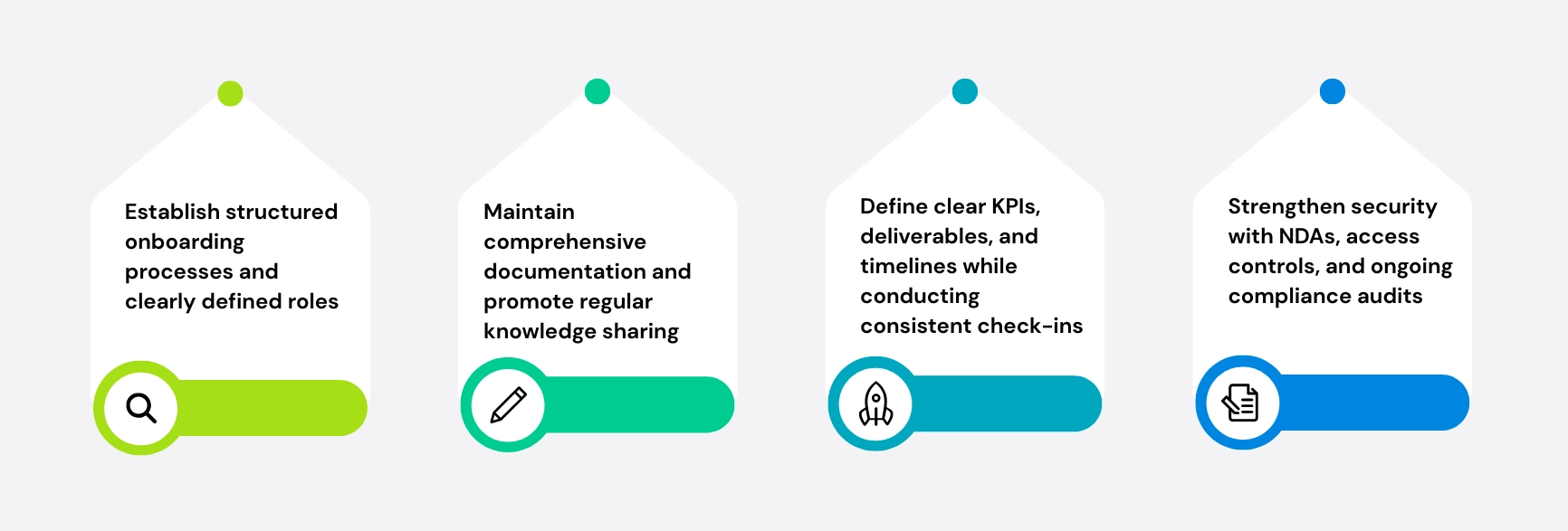
Structured onboarding and clear role definitions
One of the most common failure points when teams manage IT staff augmentation poorly is unclear integration into existing workflows, ownership models, and communication norms. Even highly skilled external engineers can underperform when they lack context on sprint rituals, decision-making processes, code review standards or stakeholder expectations.
A structured onboarding framework reduces ramp-up time and helps augmented staff become productive contributors faster. Meanwhile, clear role definitions eliminate duplicated effort, confusion, and accountability gaps. Research from PLOS ONE shows that strong onboarding can boost revenue by 2.5× and profit by 1.5×
Best practices:
- Run a formal onboarding and orientation program covering architecture, delivery processes, tools, documentation standards, and escalation paths.
- Pair augmented staff with internal mentors or team leads to accelerate context sharing and provide day-to-day guidance.
- Embed them into regular team ceremonies and communication channels, including stand-ups, sprint planning, retrospectives, and Slack/Teams workflows.
- Establish continuous feedback loops through weekly check-ins, performance reviews, and delivery retrospectives to ensure alignment.
Maintain strong documentation and regular knowledge-sharing sessions
A major risk when organizations manage IT staff augmentation across long-running delivery teams is the loss of critical technical and process knowledge when external engineers roll off the project. If architecture decisions, workflows, and operational know-how live only in individual contributors’ heads, transitions become slow, expensive, and prone to rework.
Best practices:
- Maintain continuously updated documentation for workflows, architecture decisions, runbooks, APIs, and technical standards so institutional knowledge remains inside the organization.
- Run regular knowledge-sharing sessions and technical workshops to spread context across internal and augmented team members, reducing single points of failure.
- Use shadowing and planned overlap periods during offboarding so internal engineers can absorb system knowledge before external staff exit. A 2–4 week transition window is often the safest model for enterprise teams.
- Centralize documentation in shared repositories such as Confluence, Microsoft SharePoint, or GitHub to ensure fast access, version control, and long-term discoverability.
Set clear KPIs, deliverables, deadlines & conduct regular check-ins
To effectively manage IT staff augmentation, expectations must be translated into measurable outcomes. Without structured performance controls, output may be technically complete but misaligned with business priorities or timelines. The high-performance teams solve this by converting expectations into measurable delivery controls from the start.
Best practices:
- Define role-specific KPIs upfront, such as sprint velocity contribution, defect rate, code review turnaround time, SLA adherence, milestone completion, and stakeholder satisfaction. These metrics should tie directly to product and business outcomes, not just hours worked.
- Set explicit deliverables, deadlines, and quality standards for each sprint or project phase to eliminate ambiguity around what “done” means. This improves accountability and reduces rework.
- Run weekly or biweekly check-ins with team leads, product owners, and augmented staff to review progress, blockers, delivery risks, and support needs before issues escalate.
- Use dashboards and project tools like Jira, GitHub, or Azure DevOps to track KPI trends, code quality, milestone health, and workload transparency in real time.
- Create formal performance review checkpoints at predefined milestones to assess outcomes, recalibrate scope, and recognize strong contributions.
Is your current augmentation setup slowing delivery? Book a performance review with Sunbytes to identify ramp-up, governance, and KPI gaps
Enforce NDAs, access controls, and compliance audits
To manage IT staff augmentation securely, governance controls must extend across legal, technical, and operational layers. External engineers often require access to source code, cloud environments, customer data, and internal systems, making weak governance a direct risk to regulatory exposure, IP leakage and operational resilience.
Best practices:
- Require robust NDAs and IP protection clauses for both the vendor and each augmented professional to safeguard proprietary code, trade secrets, customer data, and confidential business processes. Contracts should also define breach liability and incident reporting timelines.
- Apply strict role-based access controls (RBAC) using least-privilege principles, MFA, zero-trust boundaries, and time-bound credentials so external staff only access the systems required for their assigned work.
- Run scheduled compliance and security audits across devices, repositories, cloud permissions, data handling workflows, and vendor practices to ensure continued alignment with frameworks such as GDPR, HIPAA, PCI DSS, SOC 2, or ISO 27001.
- Include augmented staff in mandatory security awareness and regulatory training so they follow the same secure coding, privacy, and escalation procedures as internal engineers.
- Establish controlled offboarding procedures that revoke credentials immediately, rotate secrets, recover managed devices and validate data retention requirements when engagements end.
Tracking & optimizing IT staff augmentation performance
Once external engineers are embedded into delivery teams, engineering leaders need a structured system to manage IT staff augmentation performance across productivity, quality, collaboration, and business impact in real time.
| Metric | What it measures | Why it matters | Example |
|---|---|---|---|
| Time-to-productivity | Measures how quickly augmented staff reach full efficiency after onboarding | Shows onboarding efficiency and ramp-up speed | First meaningful PR merged within 7 days |
| Milestone Delivery Rate | Percentage of deadlines met on time | Tracks reliability and predictability | 95% on-time milestone completion |
| Sprint velocity contribution | Story points or tasks completed by augmented staff | Measures actual delivery impact on team output | 20–30% sprint capacity contribution |
| Code quality | Defect rate, rework, review feedback, test coverage | Ensures augmented staff maintain high engineering standards. | < 5% PR rework rate |
| Cycle time | Time from task start to production deployment | Indicates workflow efficiency and blocker levels | Average cycle time < 3 days |
| Collaboration effectiveness | Communication responsiveness and team alignment | Reduces friction between internal and external teams | < 24h blocker response time |
| Knowledge transfer score | Documentation completeness and handoff readiness | Reduces dependency risk when contracts end | 100% critical workflows documented |
| Business outcome impact | Contribution to product or operational goals | Connects engineering output to ROI | Reduced incident rate by 20% |
Maximize your IT staff augmentation performance with Sunbytes
The strongest indicators that IT staff augmentation is being managed well show up in daily delivery: sprint reviews stop feeling like surprise sessions, ramp‑up gaps no longer repeat, and offboarding no longer drains knowledge from the team. Hitting these thresholds demands clear performance KPIs, structured onboarding that embeds external talent into team routines and cross‑functional collaboration that keeps delivery predictable.
Sunbytes applies this discipline through defined delivery objectives, disciplined governance, and continuous performance monitoring. This ensures when you hire remote developers, they integrate efficiently into workflows and begin contributing measurable business value from the very start.
Ready to improve how your augmented teams perform? Book a consultation with Sunbytes to uncover ramp-up, governance and delivery bottlenecks.
About Sunbytes
Sunbytes is a Dutch technology company with more than 15 years of experience delivering Digital Transformation Solutions. Headquartered in the Netherlands and supported by a delivery hub in Vietnam, our teams design, build, and modernize digital products that are resilient, scalable, and built to create lasting value.
The strength of our digital transformation lies in its reinforcement through two key pillars:
- Cybersecurity Solutions: Applying the Secure by Design methodology, we embed security into systems from the very beginning. This reduces risk without slowing delivery, ensuring that modernized platforms remain aligned with real-world architectures and delivery constraints
- Accelerate Workforce Solutions: Successful transformation requires the right skills at the right time. We help organizations efficiently expand capacity and add critical expertise, keeping roadmaps on track and delivery models stable
FAQs
- Jira / Azure DevOps for sprint planning, KPI tracking, and workload transparency
- GitHub / GitLab for code reviews, pull request workflows, and branch governance
- Confluence / Notion / SharePoint for architecture decisions, runbooks, and onboarding documentation
- Slack / Microsoft Teams for real-time communication and escalation paths
- Okta / Azure AD for RBAC, SSO, MFA, and access lifecycle control
- Onboarding maturity
- Engineering seniority
- Documentation discipline
- Compliance readiness
- Retention and continuity model
- Ability to integrate into your SDLC and team rituals
Engaging an IT staff augmentation firm introduces access, compliance, and data protection risks that must be addressed before work begins — not after onboarding is complete.
IP protection and NDA — Require a signed NDA covering intellectual property ownership, confidentiality, and non-solicitation before any knowledge transfer or repository access takes place.
GDPR/AVG compliance — If your operations fall under EU data protection law, verify that the provider can sign a Data Processing Agreement (DPA). For Dutch companies specifically, confirm the arrangement meets AVG requirements for cross-border data transfers.
Role-based access control (RBAC) — Define access permissions before day one. Augmented staff should access only the systems, repositories, and data required for their specific role — no broader access by default.
Provider security certification — Confirm whether the firm holds ISO 27001 certification, which indicates documented and audited controls for information security management across both their internal operations and delivery teams.
Background and reference checks — Reputable providers conduct background verification and reference checks on engineers prior to placement. Ask explicitly for their screening process documentation.
Offboarding protocol — Define contractually how access revocation, credential deactivation, and knowledge handover will be handled at the end of the engagement. Leaving this unaddressed is one of the most common sources of post-engagement security incidents.
Addressing these concerns at the engagement stage — not the management stage — is what separates controlled augmentation from unmanaged risk.