
Website development cost in Europe in 2026 depends less on the number of pages and more on scope clarity, provider model, integrations, content readiness, and post-launch ownership. A small brochure website may cost a few thousand euros. A custom platform can pass €100,000 once integrations, workflows, user accounts, and security requirements enter the scope.
This guide gives EU companies practical price ranges in EUR, using the Netherlands as the main example because its VAT framework (21%), strong GDPR compliance, and structured procurement culture make it a balanced benchmark within the EU. The Dutch market sits in the middle of Europe’s cost spectrum so it provides a realistic baseline for companies planning digital projects across the Union.
The EUR ranges in this article may look higher than generic website cost guides that use USD benchmarks. Many USD-based guides focus on the initial build cost, while EU website budgets often need to account for VAT impact, GDPR consent setup, data processing agreements, accessibility checks, hosting ownership, QA, stakeholder review, and post-launch maintenance. These factors give EU companies a clearer picture of total website ownership cost, not only the first development quote .
TL;DR
- Website development cost in Europe in 2026 usually ranges from < €15,000 for landing pages, €5,000–€40,000 for CMS websites, €8,000–€60,000 for e-commerce, and €20,000–€100,000+ for custom web applications. The final cost depends on scope clarity, design complexity, content readiness, integrations, provider model, VAT, and post-launch maintenance.
- Dutch companies should budget for BTW/VAT, content production, hosting, maintenance, GDPR setup, and post-launch iterations, not only the build quote.
- The cheapest quote is rarely the cheapest 3-year option. Budget decisions should compare total cost of ownership, delivery risk, and the website development timeline, not only the first invoice.
Website development cost in Europe in 2026: the quick answer
Website development cost means the full budget required to plan, design, build, launch, host, maintain, and improve a website. For most EU companies, website development cost in 2026 falls into four broad groups:
| Website type | Typical EU planning range |
|---|---|
| Website type | Typical EU planning range |
| Landing page / brochure website | €2,000–€15,000 |
| Business website with CMS | €5,000–€40,000 |
| E-commerce website | €8,000–€60,000 |
| Custom web application / platform | €20,000–€100,000+ |
*Note: These ranges combine public 2026 web development rate benchmarks, Dutch/EU provider patterns, and Sunbytes delivery experience. They are indicative planning ranges, not final quotes.
The wide range is not a pricing trick. It reflects different assumptions. A €5,000 “business website” usually means template design, limited pages, client-provided content, and minimal integrations. A €40,000 business website may include custom UI/UX, multilingual content, CMS configuration, SEO migration, accessibility checks, analytics setup, and stakeholder approval rounds.
The more useful question is not “What is the average website cost?” It is: “What assumptions are included in this quote?”
Website pricing by type and provider model
Provider model changes the cost profile. A freelancer may be the right choice for a small marketing website. A Dutch agency may be useful when local workshops, brand design, and stakeholder management matter. Offshore project outsourcing can lower build cost, but requires stronger scope control. Hiring dedicated development team support becomes more relevant when the website needs continuous sprint work after launch, such as new features, integrations, and conversion improvements.
| Website type | Freelancer | NL agency | Offshore / project | Dedicated team / fixed sprint cost |
|---|---|---|---|---|
| Landing page / brochureware, 5–10 pages | <€5k | €5k–€15k | €3k–€10k | Contact us |
| Business website with CMS, 10–30 pages | €5k–€15k | €15k–€40k | €8k–€20k | Contact us |
| E-commerce website | €8k–€20k | €20k–€60k | €15k–€35k | Contact us |
| Custom web application / platform | €15k–€40k, with scope risk | €40k–€100k+ | €20k–€60k, with scope risk | Contact us |
A freelancer quote, an agency quote, an offshore project quote, and a dedicated team estimate may all describe the same website, but the way each provider calculates the price is different. The rate model below helps explain why two quotes for the same scope can look very different
| Provider model | Typical rate model |
|---|---|
| Freelancer | €30–€90/hr |
| NL agency | €90–€160/hr |
| Offshore / project | €25–€60/hr |
| Dedicated team | Fixed sprint cost |
*Note: Hourly rates are useful for comparing provider models, but they do not show total project cost. Total cost depends on scope clarity, content readiness, integrations, QA, compliance setup, and post-launch support.
What makes a website more expensive: 5 cost drivers
Most website quotes become expensive because they include different assumptions, not because providers are pricing the same work differently. One provider may assume a simple CMS build with ready content, while another includes custom design, integrations, QA, compliance setup, and post-launch support. The five cost drivers below help you see which assumptions are pushing the price up.
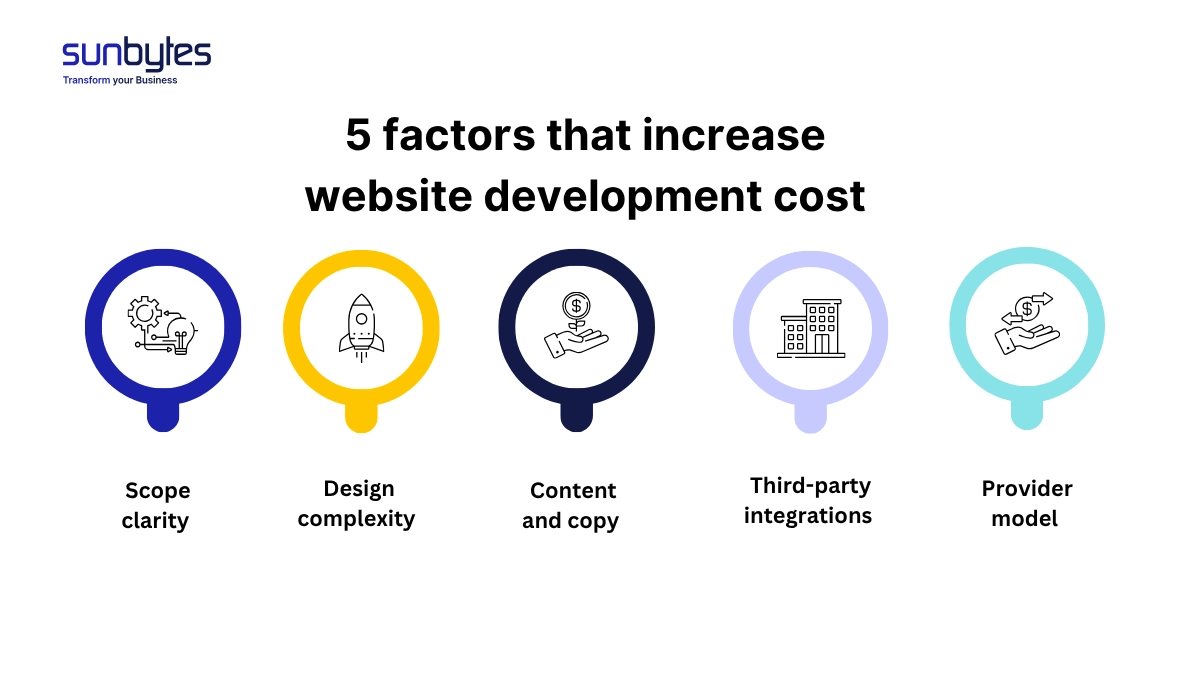
| Cost driver | Lower-cost setup | Higher-cost setup |
|---|---|---|
| Scope clarity | Pages, sitemap, wireframes, content, and integrations are defined before quoting. | The brief is exploratory: “We need a new website, but we are not sure what it should do yet.” Discovery becomes billable. |
| Design complexity | Template-based layout adapted to the brand. Proven UI patterns. | Fully custom design, advanced animation, custom responsive behaviour, and multiple approval rounds. |
| Content and copy | Client provides final copy, images, videos, case studies, and product data before development. | Agency or partner provides copywriting, photography, video, UX writing, and content migration. |
| Third-party integrations | Standard tools such as analytics, HubSpot, common payment providers, or existing plugins. | ERP, CRM, PIM, membership, booking, or inventory systems with custom APIs. |
| Provider model | Offshore or blended delivery with clear backlog and oversight. | Full Dutch agency delivery at local market rates, or unclear offshore scope requiring heavy correction. |
A vague brochure website can become more expensive than a well-scoped e-commerce build. The risk is not the label. The risk is how many decisions are still open when development starts.
Why Dutch and EU website costs differ from US benchmarks
Many website cost articles use US dollar pricing. That can mislead EU companies because the cost structure is different.
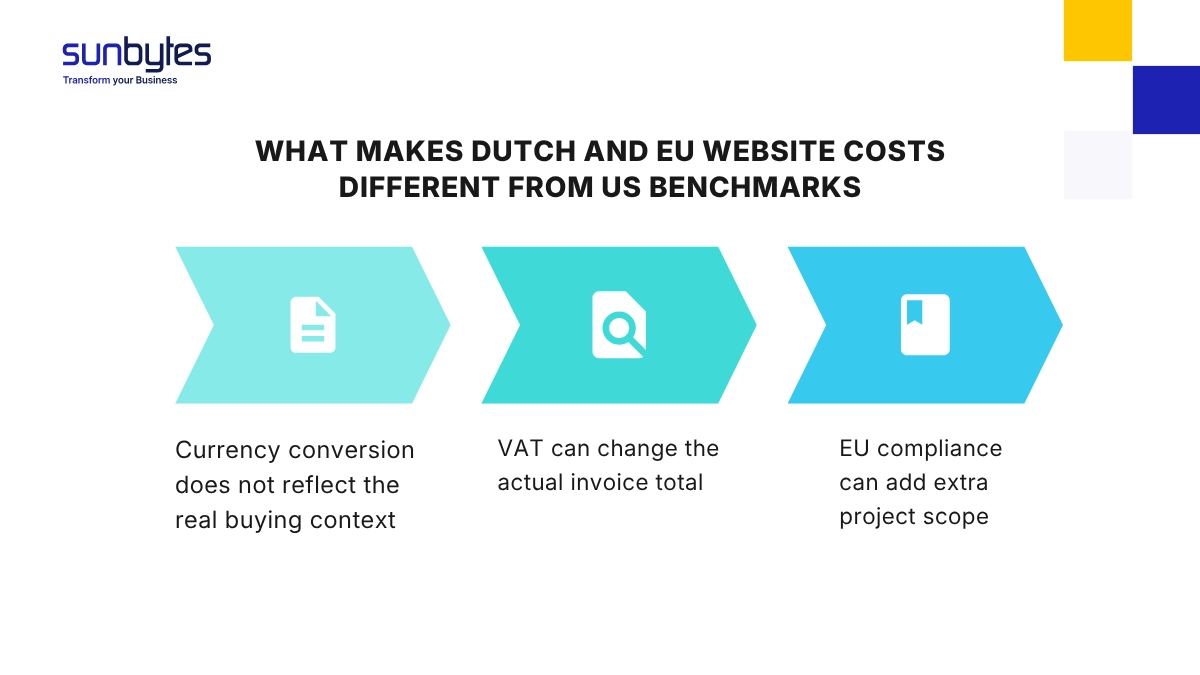
First, Dutch agency rates are usually quoted in EUR and reflect local employment cost, overhead, project management, workshops, and QA. A direct USD-to-EUR conversion misses the real buying context.
Second, Dutch quotes often exclude BTW/VAT. The Netherlands applies a standard 21% VAT rate, so a €25,000 taxable invoice becomes €30,250 including VAT unless the buyer can reclaim it. This matters for non-profits, public sector organisations, and entities with partial VAT recovery.
Third, EU website projects often carry compliance and accessibility requirements that generic pricing pages ignore. This can include GDPR consent setup, cookie management, data processing agreements with hosting or analytics providers, WCAG accessibility checks, and European Accessibility Act readiness where the website provides covered digital services.
That does not mean every EU website must become expensive. It means the quote should show whether VAT, consent setup, accessibility work, hosting, DPA review, and post-launch maintenance are included.
Need to compare website quotes on the same assumptions? Send Sunbytes your sitemap, integration list, and content status. We’ll turn the scope into a fixed 2-week sprint estimate before you commit to a build partner
5 hidden website costs EU companies underestimate
The first website quote is rarely the full 3-year cost. These are the cost items that often appear after the buyer has already approved the project.
1. VAT / BTW
For Dutch companies, VAT can change the cash budget immediately. A €25,000 quote excluding VAT becomes €30,250 including 21% VAT. Companies that can reclaim VAT may treat the net cost differently. Companies that cannot fully reclaim it need to budget the gross amount.
2. Content production
Most development quotes assume the client provides all content. That means final copy, team photos, service pages, product descriptions, case studies, icons, videos, and image rights.
If the provider has to produce content, expect the cost to rise. Copywriting, photography, UX writing, and content migration can add 20–40% to the build cost on content-heavy sites.
3. Hosting and maintenance
The build cost is one-off. Hosting, SSL, uptime monitoring, software updates, CMS maintenance, backups, plugin updates, and security monitoring are ongoing.
For business websites, managed hosting and maintenance can range from a few hundred euros per month to several thousand euros per month, depending on traffic, security, uptime needs, and support scope. Over three years, this can become larger than the initial build for smaller websites.
4. GDPR and consent setup
A GDPR-ready website is not just a privacy policy page. It may require cookie consent configuration, analytics consent mode, form data handling rules, a data processing agreement with hosting or platform providers, and tracking documentation.
The EDPB consent guidance is useful here because it sets expectations for valid consent under GDPR. For practical planning, companies should also connect this work to their GDPR compliance for websites checklist before launch.
5. Post-launch iterations
The version that goes live is not the version you will keep for the next year. Real users expose weak navigation, unclear copy, slow pages, broken conversion paths, and missing content.
Budget 10–20% of the initial build cost for the first post-launch iteration period. For larger websites, this should be planned as backlog work rather than treated as emergency fixes.
How to budget for a website project in 2026
Use a 3-year ownership model instead of a build-only estimate.
| Budget layer | What to include | Planning note |
|---|---|---|
| Build cost | Design, development, CMS, integrations, testing, launch | Start with the provider table above. |
| VAT / BTW | Dutch VAT where applicable | Use 21% for Dutch taxable invoices unless your finance team confirms otherwise. |
| Content | Copywriting, photography, video, product data, migration | Add 20–40% if content is not ready. |
| Hosting and maintenance | Hosting, updates, security monitoring, backups, support | Calculate monthly cost × 36 months. |
| Compliance and accessibility | GDPR setup, consent tooling, DPA, accessibility checks | Required more often for EU-facing websites than generic pricing guides suggest. |
| Iteration buffer | CRO, UX fixes, SEO fixes, post-launch improvements | Add 10–20% of build cost for the first iteration cycle. |
A simple formula works well for early board planning:
3-year website budget = build cost + VAT impact + content production + 36 months of hosting and maintenance + compliance setup + 15% contingency
This formula gives procurement and finance a more realistic number than a standalone agency quote. It also makes provider comparison cleaner. A €15,000 build with no maintenance plan may be less predictable than a €25,000 build with clear hosting, documentation, and post-launch support.
When cheaper website development becomes risky
A low quote becomes risky when it does not clearly state what is excluded. Content migration, browser testing, SEO redirects, GDPR setup, accessibility checks, or post-launch fixes may appear later as separate costs.
It is also a warning sign when there is no discovery or scope validation before the estimate. In that case, the provider may be guessing effort instead of estimating from requirements. Rework from unclear scope, undocumented decisions, or weak QA can add 30–40% to the original estimate before launch. The same applies when testing is described vaguely. A website still needs checks across browsers, mobile devices, forms, payments, performance, accessibility, and tracking before launch.
Post-launch support should also be clear before you sign. Without it, the website may go live, but every fix becomes separate emergency work. Ownership matters too: confirm who controls the hosting, source code, CMS access, plugins, documentation, analytics, and credentials. If those details are unclear, the first quote may not reflect the real cost of owning the website.
How Sunbytes prices website projects for EU clients
A website budget becomes predictable when scope, delivery ownership, and post-launch work are visible before build starts
Sunbytes turns that uncertainty into a controlled sprint plan for Digital Transformation Solutions: 2-week sprints, defined outputs, sprint demos, and documented architecture decisions. The Accelerate Workforce Solutions puts the right senior delivery team in place while Cybersecurity Solutions provides the control layer for GDPR, access, hosting, and audit requirements. This gives EU companies a practical way to move from rough website scope to a controlled delivery plan without separating cost, team structure, and risk management.
With 15+ years of experience and 300+ projects delivered, Sunbytes helps Dutch and European companies move from rough website scope to a controlled delivery plan. Ready to turn your website cost range into a sprint estimate? Contact Sunbytes to review your project scope.
FAQs
Quotes vary because providers make different assumptions. One quote may assume a template, client-provided content, and limited testing. Another may include custom UX, SEO migration, analytics setup, GDPR consent configuration, QA, and post-launch support. Ask every provider what is included, excluded, and assumed.
Not automatically. A €50,000 website can perform poorly if the UX, page speed, content, tracking, and SEO structure are weak. A lower-cost website can perform well if the scope is focused and execution is disciplined. Performance depends on build quality, content, technical SEO, hosting, and iteration after launch.
For many SME business websites at around €15,000, WordPress is often the more practical choice if the site mainly needs CMS pages, service content, forms, and standard integrations. Custom builds at that budget can become under-specified unless the scope is very focused. Read the WordPress vs custom website comparison before making the platform decision.
In a fixed sprint cost model, one sprint usually means a defined period of delivery, often 2 weeks, with agreed scope and output before the sprint starts. For website projects, this can include development work, QA, sprint planning, demo, and project management.
Infrastructure, hosting, domains, paid tools, and third-party licenses should be confirmed separately before signing. The client controls what gets built through the backlog and sprint planning.
It can be cheaper if your team already knows how to manage offshore delivery, write clear requirements, review code, handle QA, and control compliance. Without that internal capability, the savings can be reduced by management overhead, rework, communication gaps, and unclear ownership.
A Vietnam-based agency without Dutch or EU delivery accountability may also create contract, GDPR, language, and support concerns. The blended model is useful when you want Vietnam delivery economics with EU-facing structure, sprint planning, and accountability.
That is why many Dutch companies outsource Vietnam delivery through a partner with a Vietnam delivery team and a Netherlands headquarters like Sunbytes. This keeps the cost advantage of Vietnam-based development while giving the project EU-facing structure, sprint planning, GDPR awareness, and clear accountability.
Let’s start with Sunbytes!
Let us know your requirements for the team and we will contact you right away.