

A compensation strategy is the company-wide decision on how to position pay relative to the market. Most companies treat this as a single choice (we pay market) when it should be four separate decisions across base salary, variable pay, equity, and benefits. This guide explains the three classic positioning strategies (lead, match, lag), shows when each one works, and gives a 5-step framework for choosing the right mix.
TL;DR
- Lead the market pays in the top 40% to 10% of the market, match pays at the top 50%, and lag pays in the bottom 25% to 40%. Each is a deliberate positioning choice with a specific trade-off between cost and retention.
- Most companies should not choose a single positioning across the board. The strongest compensation strategies mix lead, match, and lag across the four pay components: base salary, variable pay, equity, and benefits.
- The most common compensation strategy mistake is applying the “match the market” default without auditing what the market actually pays today. Salary benchmarks lag the real market by 6 to 18 months, which means matching the survey often lags the actual market.
| Strategy | Market position | Best for | Main risk |
|---|---|---|---|
| Lead the market | top 40% to 10% | Scarce roles, urgent replacement hiring, early-stage cash-first hiring | Pay compression and cost inflation |
| Match the market | top 50% | Mature companies with stable employer brand and career path | Benchmark drift if data is old |
| Lag the market | bottom 25% to 40% | Mission-led, high-equity, or strong-benefits companies | Underpaying if non-cash value is weak |
What is a compensation strategy (and why pay positioning is the most consequential decision)
‘A compensation strategy is the operational expression of the company’s pay philosophy. It answers four questions for every role: how much base salary, how much variable pay is tied to what, how much equity (if any), and what benefits package.’
According to WorldatWork frameworks, these four dimensions together form what is often called the total rewards strategy.

Pay positioning, expressed as lead, match, or lag the market, is the lens applied to each of those four dimensions. The mistake most companies make is treating positioning as a single choice across the entire package, rather than a separate choice per component.
Two definitions that are frequently confused:
Compensation strategy = the operational decisions about how to pay (which level, which mix, which markets).
Compensation philosophy = the principles behind those decisions (fairness, performance link, transparency).
The two are not interchangeable, and confusing them is a recurring source of failure in compensation strategy.
Compensation strategy vs compensation philosophy: not the same thing
Compensation philosophy is the principles layer. It typically includes statements like “we pay fairly across roles” or “we tie variable pay to outcomes employees can influence.” Philosophy is what the company believes.
Compensation strategy is the operational layer. It includes specific decisions like “base salary at 60th, variable comp at 50th, equity at 40th for senior roles.” Strategy is what the company does.
If your hiring managers only have a philosophy document, every offer becomes a one-off negotiation. Within 18 months, your documented strategy and your actual payroll reality are usually different documents.
The 4 dimensions every pay positioning strategy positions: base, variable, equity, benefits
In most knowledge work, total compensation typically splits into four components. Each one can be positioned independently against the market, and the strongest pay mix strategy treats them as four separate positioning decisions.
| Component | What it covers | Typical weight in employee perception |
|---|---|---|
| Base salary | Guaranteed fixed pay | Highest; most employees equate “how much I’m paid” with base |
| Variable pay | Bonus, commission, performance pay | 5% to 50% of total cash depending on role |
| Equity | Stock options, RSUs, profit share | Zero to dominant, depending on stage and seniority |
| Benefits | Health insurance, pension top-up, learning budget, equipment, leave above statutory | Often underweighted by employers, overvalued by candidates |
Most companies overweight base salary in their thinking and underweight the other three. The implication: a compensation strategy that only considers base is incomplete.
This is where your strategy becomes a payroll structure: base salary, allowances, benefits, and variable pay all need the right tax and contribution treatment before the first payslip goes out.
What Changes When Compensation Strategy Becomes Payroll in Vietnam
For international companies hiring in Vietnam, the compensation strategy is not just a market-positioning decision. Allowances, benefits, variable pay, and employer contributions can affect net pay differently depending on how they are structured.
This is where “match the market” can fail operationally. Two offers with the same gross value can create different employee experiences once payroll, statutory contributions, and tax treatment are applied.
Lead the market: when to pay above the median (and what it actually costs)
Lead the market compensation positions pay in the top 40% to 10% of the market benchmark for a given role and market. The premium over match-the-market typically runs 15 to 25% on base salary, with corresponding increases in employer contributions and benefits.
Mercer Global Talent Trends 2024 data shows that companies using lead-the-market positioning typically apply it selectively, to specific role families or seniority levels, rather than across the entire workforce. Universal lead positioning is rare and usually unsustainable.
What “leading the market” actually means (and why%ile matters more than “above market”)
Lead positioning means paying in the top 40% of the market as a minimum, typically in the top 25% to 10% for hard-to-fill roles. Vague phrases like “above market” tell you nothing about where you actually sit, and they create internal inconsistency when different managers interpret “above market” differently.
The 75% is competitive with the top tier of typical employers in the market. The 90% is competitive with FAANG-tier pay (FAANG-tier pay refers to the highly lucrative compensation packages offered by Big Tech companies such as Facebook/Meta, Apple, Amazon, Netflix, Google/Alphabet) or with role-specific specialists. Most companies that decide to lead end up in the 60th to 75th band, which is the sustainable range for a multi-year strategy.
3 situations where leading the market is the right call
The lead-the-market compensation strategy works in three specific contexts:
● Scarce skill markets where the candidate pool is structurally smaller than demand. AI engineers, senior cloud architects, and specialized cybersecurity roles are the current examples. Leading on base is often the only way to get into the conversation.
● Early-stage companies that cannot yet compete on equity. Until equity is worth something the market believes in, cash has to do the work. Lead on base, match on benefits, accept the higher near-term burn rate.
● Replacement hiring after key losses where speed matters more than cost. When a senior departure has destabilized a team, leading the replacement signals commitment and accelerates the close.
3 situations where leading the market quietly destroys your comp structure
Lead-the-market positioning fails predictably in three contexts:
● As a default, when the real problem is manager quality, not pay. Manager-engagement variance is consistent across research cycles: 70% of team engagement variance is explained by the manager, per Gallup’s State of the Global Workplace 2024.
● When new hires are paid 15% above tenured staff in the same role, creating compression. Existing employees discover the gap (they always discover it), and the resulting attrition often costs more than the lead premium saved on hiring.
● When leading sets an expectation that pay leads every cycle. Once employees expect to lead the market, the company loses the ability to flex back to match positioning without provoking departures.
The real cost of leading: 15 to 25% premium and the equity trade-off
Lead-the-market premium typically runs 15 to 25% above match positioning on base salary, with proportional increases in employer contributions and benefits. For a USD 100,000 match role, lead positioning lands at USD 115,000 to USD 125,000 base, with fully loaded costs approaching USD 165,000 once contributions, benefits, and overhead are added.
The equity trade-off is the operational decision companies most often skip. When you lead on cash, equity headroom shrinks. That mismatch creates departures within 18 months. A strong employer branding position can substitute for some of the cash premium by changing what the candidate values in the first place.
Match the market: the default that works for most mature companies
Match the market compensation positions pay at the 50th%ile of the benchmark. This is the most common positioning for established companies because it balances cost discipline with competitiveness, and it works well when the company has other non-cash factors that strengthen its offer.
LinkedIn Global Talent Trends research consistently shows that match-the-market compensation works best when paired with a strong employer brand, well-developed non-cash benefits, and clear career progression. Without those supporting factors, match positioning underperforms in hot talent markets.
Why match is the default for most companies (and why “default” is not always “right”)
Match positioning is the default because it is the safe choice on paper. The operational risk appears when “default” becomes “unexamined”. Companies that set match positioning five years ago and never revisited it often discover their actual position has drifted to the bottom 35% to 40% as the market moved without them. Match is a strategy that requires active maintenance.
When matching the market actually outperforms leading it
Match-the-market compensation outperforms lead-the-market in two specific contexts. The first: when non-cash factors carry the recruiting pitch. Strong mission, learning opportunities, equity upside, or location flexibility can all substitute for 5 to 15% of cash premium in candidate decision-making, according to Deloitte Human Capital Trends research.
The second: when the existing workforce is engaged and high-performing. Leading on pay for new hires while keeping existing pay flat is the fastest way to create compression. In that situation, matching is the responsible choice.
The risk hidden in “matching the market”: your benchmark might be 18 months old
Based on Sunbytes’ operational experience running payroll and compensation modeling across Vietnam and APAC markets, salary benchmarks typically lag actual market movement by 6 to 18 months. In stable markets, that lag is negligible. In hot markets (AI talent, cybersecurity, specialised cloud roles since 2024), the lag means matching the published survey is effectively lagging the real market by a meaningful margin.
The fix is benchmark frequency. Annual benchmark reviews are the minimum. For roles in hot markets, twice-yearly or quarterly reviews catch the market move before it costs you departures.
The cost of being wrong on benchmarks shows up downstream in recruitment cycles. Every additional hiring round driven by under-paying triggers the spend documented in the recruitment cost breakdown, where time-to-fill and agency fees compound on top of base salary expectations.
Lag the market: when paying below median actually makes sense
Lag the market pay positions compensation at the 25th to 40th%ile of the benchmark. Most readers assume this is a mistake. In three specific contexts, it is the correct strategy, and in many others it is a cost-saving decision masquerading as strategy.
Lag the market: 25% to 40% pay, by deliberate design
The 25% to 40% band is where companies operate when cash is not the primary thing they offer. The positioning is sustainable only when the rest of the total rewards package compensates for the gap.
3 situations where lag actually works
● Mission-driven organizations with a strong non-cash story: non-profits, public sector, mission-led private companies. Employees join for impact, not for the cash. Lag positioning is structurally aligned with the value proposition.
● High-equity early-stage companies with credible upside. Employees accept lag-on-cash because the equity is meaningfully valuable. The strategy fails if the equity is theoretical rather than convertible.
● Strong total rewards packages where benefits, learning, lifestyle, or location materially exceed market. A 4-day work week, exceptional learning budgets, or premium remote work flexibility can each substitute for 10 to 20% of cash premium in candidate decisions.
The lag-the-market trap: cost savings disguised as strategy
The most common lag failure: leadership decides to pay below market with no equity, no strong benefits, no mission story. It’s called a strategy. The actual result is chronic understaffing, weaker hires, and replacement cycles that burn the cost savings three times over within 18 months. The recruitment overhead alone often exceeds the comp savings before any productivity cost is counted.
Lag-the-market positioning that works has a complete non-cash story to back it up, including a strong employee benefits package that materially exceeds market. Without that, lag is not a market pay strategy, it is just under-paying.
How to choose the right compensation strategy for your business (5 Steps)
The 5-step framework below applies to companies entering a new market, building a compensation strategy from scratch, or auditing an existing one. The steps are sequential, and skipping the diagnosis stage is the single most common reason compensation strategy work fails.
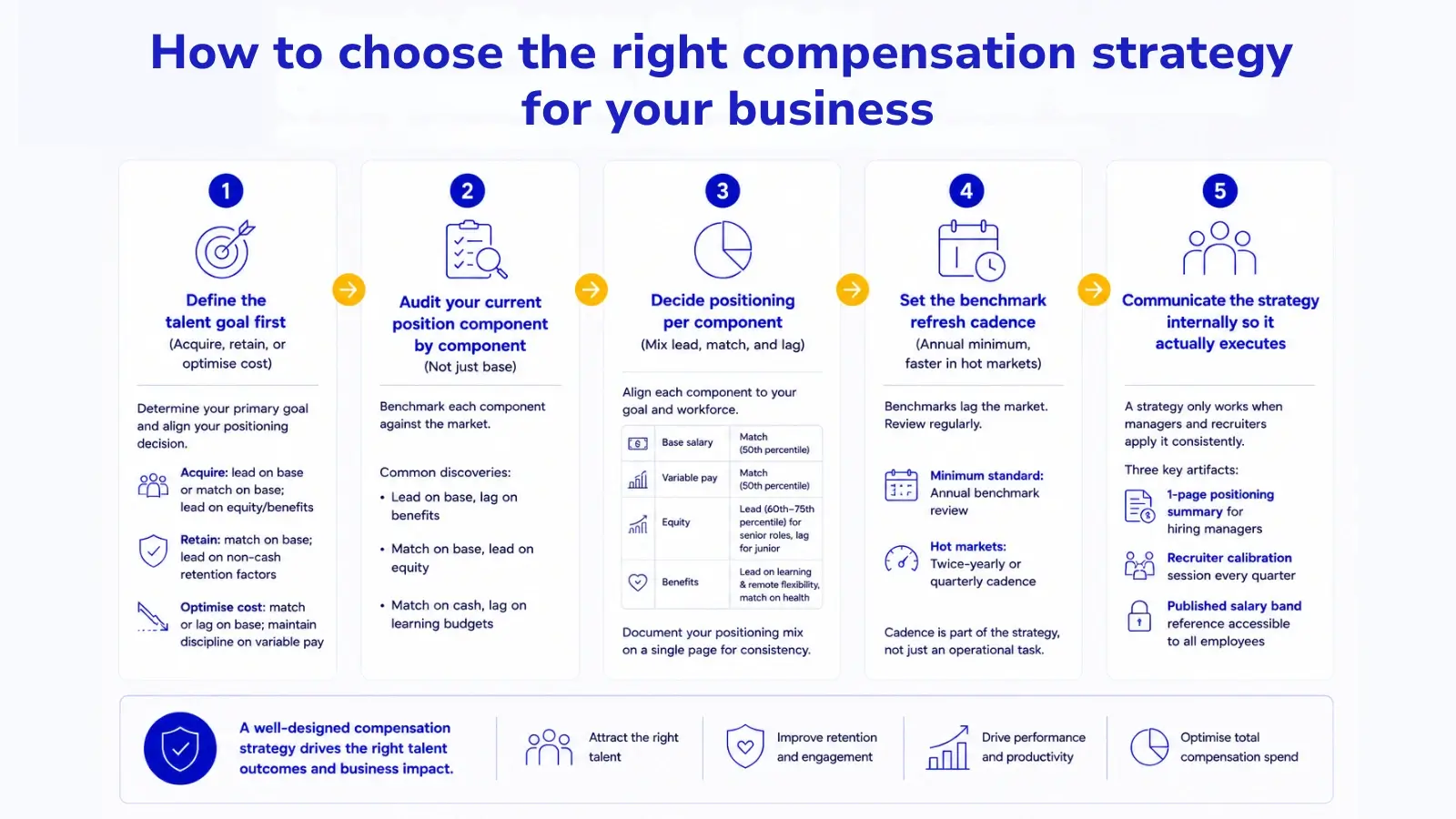
Step 1: Define the talent goal first (acquire, retain, or optimise cost)
Every compensation strategy serves one of three primary goals: acquire (we need to bring in more people), retain (we need to keep the people we have), or optimize cost (we need the same outcome at lower spend). The positioning decision depends on which goal is primary.
Acquire-led strategies typically lead on base or match on base while leading on equity or benefits. Retain-led strategies typically match on base while leading on the non-cash factors that drive retention. Cost-optimise strategies typically match or lag on base, with discipline on variable pay to maintain motivation.
Step 2: Audit your current position component by component (not just base)
Most companies know their base salary position. Few know their position on variable pay, equity, and benefits separately. The audit step requires benchmarking each of the four components against the market, not just the headline number.
Common discoveries from this step: leading on base but lagging on benefits (compresses retention), matching on base but leading on equity (works for tech, less so for traditional sectors), or matching on cash but lagging on learning budgets (slow erosion of retention over 18 to 24 months).
Step 3: Decide positioning per component, most companies should mix lead, match, and lag
The strongest compensation strategies use different positioning per component, calibrated to the goal from Step 1 and the workforce composition. For a typical mid-sized technology company, a common mix is:
| Component | Positioning | Rationale |
|---|---|---|
| Base salary | Match (top 50%) | Controls fixed cost; stable competitive floor |
| Variable pay | Match (top 50% ) | Consistent with base; motivates without over-committing |
| Equity | Lead (top 40% to 25%) for senior, lag for junior | Attracts senior talent that values upside; manages dilution for junior roles |
| Benefits | Lead on learning and remote flexibility, match on health | Differentiates offer without proportional cash cost |
The pay positioning strategy mix should be documented as a single page that any hiring manager can reference when scoping an offer. Without documentation, the strategy degrades to whatever the most recent recruiter conversation produced.
Step 4: Set a benchmark review cadence (annual minimum, faster in hot markets)
Compensation benchmarks lag the actual market. Setting positioning once and not revisiting it is the slow-motion version of getting it wrong. Annual benchmark reviews are the minimum standard. For roles in hot markets, twice-yearly or quarterly cadence is the right tempo.
The cadence question is part of the strategy, not a separate operational concern. A documented compensation strategy includes when and how it gets reviewed. Without that, the review happens only after attrition signals the drift, which is 12 to 18 months too late.
Step 5: Communicate the strategy internally so it actually executes
If your compensation strategy lives only in HR documents, your hiring managers will default to whatever they remember from their last company. Your recruiters will default to whatever closes the offer fastest. The gap between strategy on paper and strategy in operation opens within 12 months.
Three artifacts that close this gap: a 1-page positioning summary for hiring managers, a recruiter calibration session every quarter, and a published salary band reference accessible to all employees. With those three in place, the strategy that exists on paper is the strategy that operates in practice.
5 Common mistakes companies make with compensation strategy
The same five mistakes show up across markets and company sizes. Knowing them in advance lets you check your strategy against them before the cost compounds.
1. Picking lead, match, or lag once and never revisiting it
Compensation strategy is not a one-time decision. Markets move, especially for technical roles, and a positioning that was right two years ago can be meaningfully wrong today. Annual review is the minimum cadence. Without it, the strategy that exists on paper diverges from the position the company actually holds.
2. Applying the same positioning to every pay component
“We pay market” is not a compensation strategy, it is an aspiration. The strongest strategies position base, variable, equity, and benefits separately, calibrated to what the workforce actually values. Treating positioning as a single choice across all four components leaves leverage on the table.
3. Confusing compensation philosophy (the principles) with compensation strategy (the operational choices)
Philosophy statements like “we pay fairly” tell hiring managers nothing useful when scoping a specific offer. A strategy translates the philosophy into specific positioning per component, per role family, per market, so the principles produce consistent decisions in the field.
4. Using outdated benchmark data in a fast-moving market
Salary surveys lag the actual market by 6 to 18 months. In hot markets, the lag means matching the survey is effectively lagging the real market. Quarterly or twice-yearly benchmark refresh is the standard for roles in moving markets. Annual is the floor.
5. Not communicating the strategy, so managers default to whatever they remember from their last company
A compensation strategy that lives only in HR documents executes inconsistently across hiring managers and recruiters. Without active communication, training, and reinforcement, the strategy on paper diverges from the strategy in operation within 12 to 18 months.
When compensation strategy moves from spreadsheet to payroll, the risk becomes operational. Base salary, variable pay, allowances, equity treatment, and benefits do not stay as strategy categories, they become payroll line items with statutory contribution and tax consequences.
Sunbytes helps international companies design compensation structures for Vietnam and APAC, then run the payroll that makes those decisions accurate every month. We map base, variable allowances, benefits, statutory contributions, and tax treatment before the first hire, so the strategy you approve lands correctly in net pay. Payroll on time, every month.
This works because Accelerate handles the employment and payroll layer, Secure keeps onboarding, access, and compliance controlled, and Transform provides the delivery structure when the compensation plan supports engineering or technical teams.
How Sunbytes helps turn compensation strategy into payroll reality
Sunbytes supports international companies designing compensation structures for Vietnam and APAC operations, then running the payroll that turns those structures into accurate monthly payouts. We model the four components (base, variable, equity, benefits) against local market benchmarks before the first hire, so the strategy you design on paper executes correctly of each month.
Three pillars cover the work:
● Payroll Services designs and runs payroll for international companies hiring in Vietnam and across APAC. We model compensation structure including base, variable allowances, statutory contributions, and tax treatment per component, so the positioning choices made in strategy land correctly in net pay. Payroll on time, every month.
● Accelerate Workforce Solutions runs the full hiring stack for international companies entering Vietnam: EOR for fast market entry without entity setup, dedicated remote teams for sustained engineering capacity, and recruitment for project-based work. All aligned with the compensation strategy you have defined.
● Digital Transformation Solutions supports companies building engineering, DevOps, QA, and AI integration teams as part of their Vietnam workforce, with compensation structure built into how we scope and deliver.