
The wrong DevSecOps operating model creates work in the place it was meant to remove. An internal hire can become a single point of dependency. An external team can generate findings without giving developers a clear remediation path. This in-house vs outsourced DevSecOps comparison focuses on the decision that matters: which model gives your company enough implementation capacity without weakening control, evidence ownership or release accountability.
TL;DR
Outsourced DevSecOps means external delivery capacity working under a defined scope, while a dedicated external engineer usually works inside the client’s delivery process, with the client directing priorities and approving outcomes. A managed DevSecOps service owns defined service outputs within an agreed scope. Both models can add capacity, but they assign daily direction and delivery accountability differently.
Keep DevSecOps in-house when security engineering is a permanent strategic function with enough work for a dedicated role. Use outsourced DevSecOps when the immediate gap is implementation capacity, pipeline controls, remediation follow-up or evidence production. In either model, your company must retain risk acceptance, security policy, data-access approval and final release authority.
- Choose in-house for long-term ownership and knowledge retention.
- Choose outsourced support when capacity is needed faster than a local hiring cycle.
- Reject any model that leaves findings, exceptions or handover assets without a named owner.
What is the difference between in-house and outsourced DevSecOps?
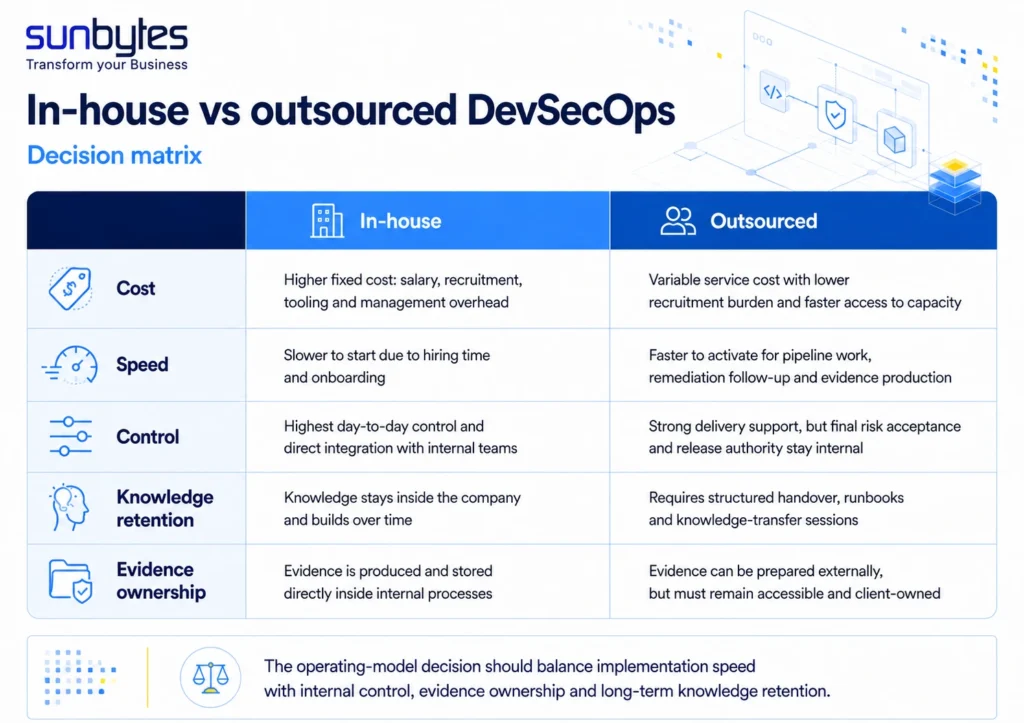
In-house DevSecOps places the engineer, employment relationship and day-to-day security delivery inside your company. Outsourced DevSecOps assigns defined implementation work to an external engineer or team while your company retains business accountability.
The difference is not simply who pays the engineer. It changes how quickly capacity becomes available, where operational knowledge sits, who maintains security tooling and how easily the company can continue the process after a provider leaves.
An in-house DevSecOps engineer normally works across the same repositories, cloud environments and product teams over a long period. That supports context retention and direct access to decision-makers. It also means your company owns recruitment, onboarding, retention, tooling and backfill risk.
An outsourced team can configure CI/CD security gates, triage scanner findings, route remediation into sprints and prepare control evidence. The scope must be explicit. A provider that only sends vulnerability reports has not taken ownership of the delivery work behind those reports.
This differs from a fully managed service. Teams evaluating ongoing managed coverage should first review how DevSecOps as a Service works and when it fits. That model is designed around defined service coverage, while outsourced or dedicated engineers can work directly inside the client’s delivery process.
| Decision criterion | In-house DevSecOps | Outsourced DevSecOps |
|---|---|---|
| Employment and management | Managed directly by your company | Managed through an external engagement |
| Time to add capacity | Depends on recruitment and notice periods | Can begin once scope, access and interview steps are complete |
| Context retention | Stays inside the company | Requires documented transfer and handover |
| Tool ownership | Internal team configures and maintains tools | Provider can configure tools within an agreed scope |
| Risk acceptance | Must remain internal | Must remain internal |
| Evidence production | Produced and stored internally | Can be produced externally but must remain accessible to the client |
| Best fit | Permanent strategic security function | Defined delivery gap or temporary capacity constraint |
| Main risk | Hiring delay or dependency on one specialist | Unclear ownership, access or exit arrangements |
Cost comparison: salary, tooling, recruitment and management overhead
In-house DevSecOps has a higher fixed-cost structure. Outsourced DevSecOps moves more cost into a contracted monthly or project rate, but it does not remove internal management or governance work.
A useful comparison should cover at least five cost categories. Comparing salary with a provider rate produces an incomplete result because the two numbers include different responsibilities.
For an internal hire, budget for base salary, employer costs, recruitment, equipment, software licences, onboarding, line management and replacement risk. For an outsourced model, review the monthly rate together with tooling exclusions, account management, minimum commitment, access preparation and exit support.
Sunbytes’ DevSecOps engineer salary benchmarks for Europe provide country-level salary planning in more detail. The same analysis uses an 8-to-12-week local search as a planning range and notes that employer costs, recruitment and tooling can push the actual annual cost well above gross salary.
| Cost component | In-house model | Outsourced model | What to verify |
|---|---|---|---|
| Core labour cost | Gross salary plus employer-side costs | Monthly or project-based rate | What responsibilities are included? |
| Recruitment | Internal sourcing time or agency fees | Usually included in provider delivery model | Is candidate replacement included? |
| Tooling | Licences, hardware and environments paid directly | Included, shared or charged separately | Who owns licences and configurations? |
| Management | Line management, performance reviews and retention | Client still manages scope and priorities | Who manages daily delivery? |
| Onboarding | Internal access, product and process onboarding | Client access preparation plus provider onboarding | What must be ready before Day 1? |
| Continuity | Absence and turnover handled internally | Depends on provider coverage and documentation | Is backup capacity defined? |
| Exit and handover | Knowledge remains with the employee until departure | Requires contractual handover outputs | Which assets are delivered at exit? |
Outsourcing is not automatically cheaper. It is financially useful when the company needs capacity for a defined period, cannot fill a local role fast enough or would otherwise pull senior developers away from delivery.
In-house hiring earns its higher fixed cost when the workload is permanent and the engineer will own a long-term security platform, internal standards and cross-team engineering culture.
Risk comparison: control, handover, access and evidence
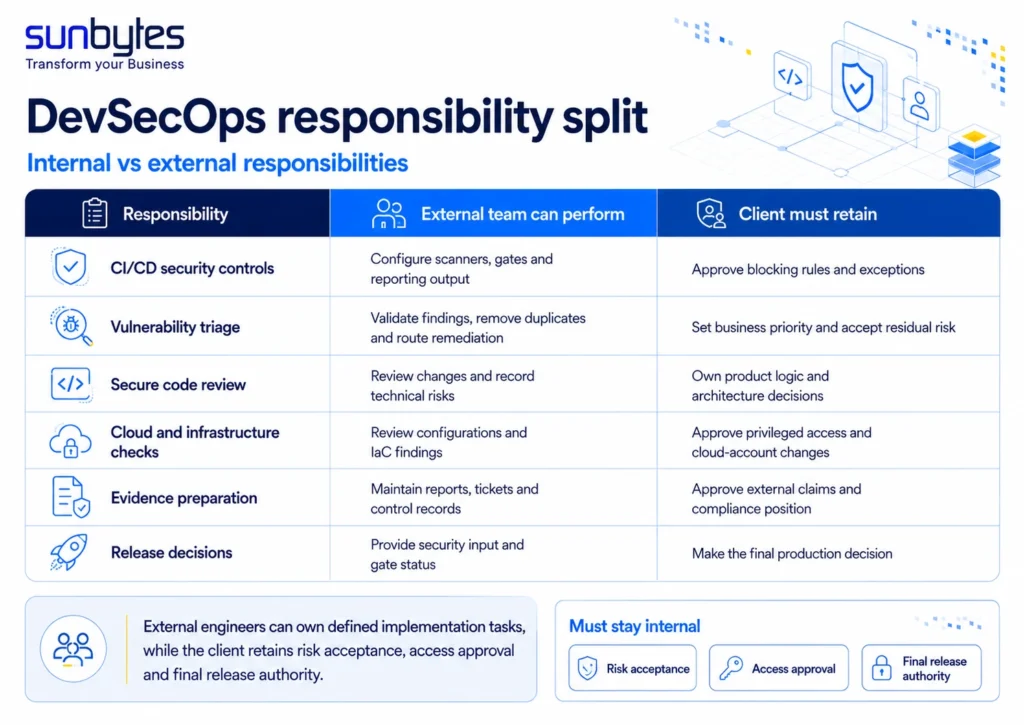
The larger risk in outsourced DevSecOps is not the external location of the engineer. It is an unclear boundary between implementation work and internal decision authority.
A provider can operate scanning tools, recommend blocking rules and prepare evidence. The client must still decide which risks are accepted, which systems can be accessed and whether a release proceeds.
This distinction also matters for compliance. NIS2 Article 21 includes risk-management areas such as supply-chain security, secure system acquisition and development, vulnerability handling and access control. GDPR Article 32 requires appropriate technical and organisational measures based on processing risk. An external team may support those measures, but accountability does not move automatically with the delivery work.
ISO/IEC 27001 provides requirements for an information security management system. A certificate can support vendor due diligence, but buyers should still verify the scope, access process, evidence location and delivery responsibilities involved in the engagement.
What should never be outsourced?
Four responsibilities must remain under company control:
- Risk acceptance. The provider may explain the technical exposure, but the company decides whether to accept, remediate or defer it.
- Final control ownership. Internal security or engineering leadership must approve policies, severity thresholds and release-blocking rules.
- Data-access approval. The company decides which repositories, environments and production systems an external engineer may access.
- Board-level security accountability. Management remains responsible for security governance and business consequences.
These are decision rights, not implementation tasks. Keeping them internal does not require your team to configure every scanner or process every finding.
| DevSecOps responsibility | External team can deliver | Client must retain |
|---|---|---|
| CI/CD security controls | Configure scanners, gates and reporting output | Approve blocking rules and exceptions |
| Vulnerability triage | Validate findings, remove duplicates and route remediation | Set business priority and accept residual risk |
| Secure code review | Review changes and record technical risks | Own product logic and architecture decisions |
| Cloud and infrastructure checks | Review configurations and infrastructure-as-code findings | Approve privileged access and cloud-account changes |
| Evidence preparation | Maintain reports, tickets and control records | Approve external claims and compliance position |
| Release decisions | Provide security input and gate status | Make the final production decision |
What should be included in the handover?
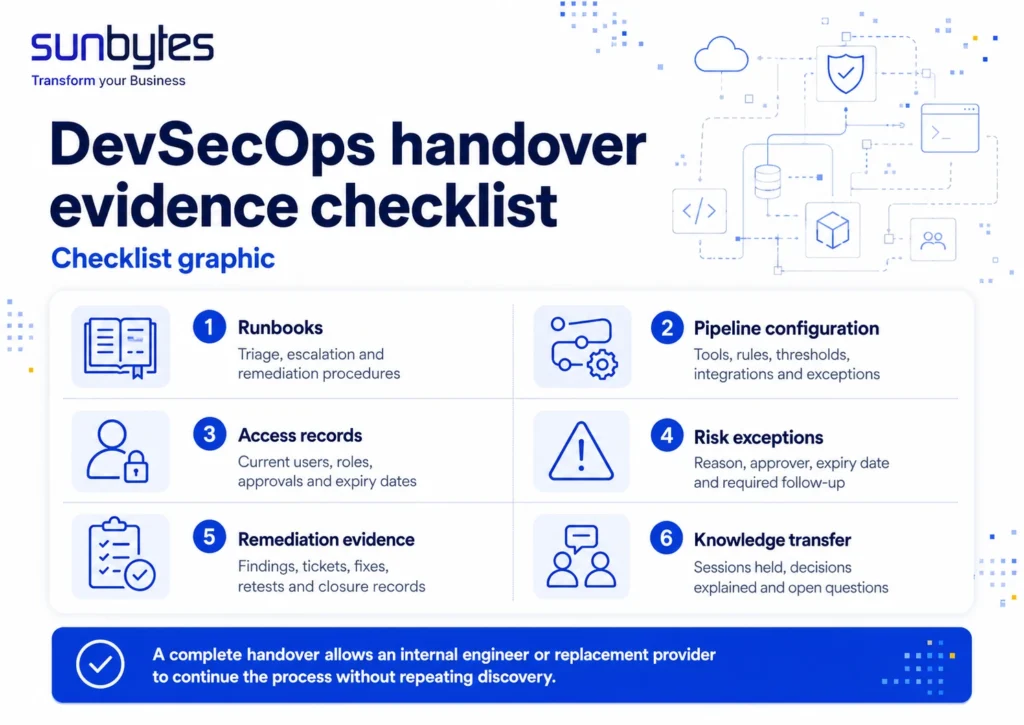
A handover should give the next engineer enough information to continue the operating process without repeating the discovery phase.
| Handover asset | Required content | Internal owner after transfer |
|---|---|---|
| Runbooks | Triage, escalation, remediation and incident procedures | Engineering or security lead |
| Pipeline configuration | Tools, rules, thresholds, integrations and exceptions | Platform or DevOps owner |
| Access records | Current users, roles, approvals and expiry dates | System or cloud owner |
| Risk exceptions | Reason, approver, expiry date and required follow-up | Risk or security owner |
| Remediation evidence | Findings, tickets, fixes, retests and closure records | Engineering owner |
| Knowledge-transfer record | Sessions held, decisions explained and open questions | Incoming engineer or team lead |
The DevSecOps outsourcing Europe vendor checklist provides a deeper provider assessment covering DPA terms, access controls, evidence, remediation ownership and exit planning. Use it after choosing the operating model, when the next task is comparing vendors.
Need DevSecOps capacity without transferring risk ownership?
Speed comparison: local hiring cycle vs dedicated onboarding
Outsourced DevSecOps is faster when the requirement is immediate implementation capacity. In-house hiring is slower to start but can create stronger continuity once the right person has joined and settled into the role.
Sunbytes uses 8 to 12 weeks as a planning range for a local DevSecOps search, depending on seniority and market fit. Dedicated engineers can typically become operational within 2 to 4 weeks when scope, interview flow, repositories and access preparation are ready.
The start date is not the only useful speed measure. The first month should produce controlled outputs:
- a documented repository and pipeline map;
- named owners for findings and exceptions;
- an agreed triage and remediation workflow;
- one working control improvement;
- an evidence-storage location;
- a draft handover checklist.
A team that starts in two weeks but spends six weeks waiting for access is not faster. The onboarding plan must cover decision rights, DPA status, least-privilege access and communication cadence before technical work expands.
The first 90 days of remote DevSecOps onboarding should move from controlled access and pipeline review to repeatable remediation and evidence ownership. By Day 90, the team should have an operating rhythm that does not depend on undocumented knowledge.
Delivery speed should also be measured after onboarding. DORA uses metrics including change lead time, deployment frequency, change failure percentage and failed deployment recovery time. These signals help determine whether new controls support delivery or create avoidable queues.
Which model fits your stage?
Choose in-house DevSecOps when the company needs a permanent security engineering owner. Choose outsourced DevSecOps when the company has a defined implementation gap that cannot wait for recruitment.
The following conditions provide a clearer decision than a general advantages-and-disadvantages list.
| Company condition | Recommended model | Why it fits | Next step |
|---|---|---|---|
| No DevSecOps owner exists and security must become a permanent internal function | In-house | The company needs long-term context, authority and culture ownership | Define the role and use the DevSecOps team hiring guide to set responsibilities and selection criteria |
| CI/CD exists, but scanner findings and remediation work have no owner | Outsourced | The gap is implementation and operating capacity | Define tools, finding ownership and sprint integration |
| Enterprise buyers are requesting security evidence faster than the team can produce it | Outsourced | External capacity can organise evidence and remediation records | Set an evidence scope and internal approval owner |
| Security engineering is already mature and has enough recurring work for a full-time role | In-house | Long-term platform ownership justifies a permanent position | Recruit against the existing control roadmap |
| A temporary remediation backlog is delaying releases | Outsourced | A defined backlog can be scoped, processed and handed over | Agree severity rules, acceptance criteria and exit outputs |
| The company wants a vendor to accept business risk or make final release decisions | Neither | Those responsibilities must remain with company leadership | Name internal risk and release owners before selecting a delivery model |
A useful threshold is workload continuity. If there is enough strategic and operational work for a senior engineer across the next several years, in-house ownership is easier to justify. If the immediate need is to repair pipeline gaps, build evidence discipline or clear a defined backlog, outsourced capacity can start sooner and leave the process in a better state for future internal ownership.
How Sunbytes supports outsourced DevSecOps without removing your ownership
Sunbytes supports outsourced DevSecOps as dedicated engineering capacity, not as a transfer of business accountability.
The client keeps risk acceptance, policy approval, access decisions and final release authority. Sunbytes engineers can work inside the agreed scope on pipeline controls, finding triage, remediation coordination, evidence records and handover assets.
Dedicated senior teams can typically become operational within 2 to 4 weeks when the role, interview process and access requirements are clear. The 4-to-5-hour Amsterdam–Vietnam overlap provides a working window for sprint decisions, blockers and security escalation. Netherlands-based account management keeps stakeholder communication close to the client, while the Vietnam delivery hub supports day-to-day engineering work.
Delivery follows ISO 27001-certified practices where access, evidence and information handling are relevant. DORA metrics can be used to track whether security controls affect change lead time, deployment frequency, change failure percentage or recovery time.
The model should produce measurable outputs within the first month: controlled access, named finding owners, a working remediation flow and evidence stored where the client can retrieve it.
Hire dedicated DevSecOps engineers when the operating-model decision points to missing capacity rather than missing executive ownership.
FAQs
Yes. An external team can support evidence such as access reviews, vulnerability records, remediation tickets, change logs, scan output and exception approvals. The company must still verify the evidence, approve external compliance statements and confirm whether each regulation or standard applies to its organisation.
A dedicated DevSecOps engineer can typically become operational within 2 to 4 weeks when scope, access, interview flow and internal approvers are ready. Full integration takes longer: the first 30 days establish context and controls, while a repeatable operating and handover rhythm is normally assessed across the first 90 days.
The handover should include runbooks, tool and pipeline configurations, current access records, vulnerability backlog, accepted-risk register, remediation evidence, reporting cadence and unresolved decisions. It should also include knowledge-transfer sessions with the incoming internal owner and a date for removing provider access.