

Recruitment services in Vietnam help foreign companies source, screen, and hire local talent without running the search alone from another country. For an EU company opening or scaling a team in Ho Chi Minh City, the right service turns a slow, blind search into a shortlist of qualified candidates within days. This guide maps the recruitment models, the real cost drivers, the compliance handoffs after you select someone, and how to choose a provider in 2026.
TL;DR
- Recruitment services in Vietnam range from contingency agencies and retained search to recruitment process outsourcing and integrated recruitment with an employment handoff. The right model depends on role seniority, hiring volume, and how much of the process your team wants to keep.
- Agency placement fees in Vietnam commonly run 15 to 25 percent of first-year gross salary, while recruitment process outsourcing is priced as a monthly or per-project fee. The hidden cost of in-house hiring is recruiter time, manager interview hours, and the cost of a role that stays open.
- Recruitment ends at candidate acceptance, but employment in Vietnam begins with a compliant labor contract, Social Insurance registration, and Personal Income Tax setup under the Social Insurance Law 2024, effective July 1, 2025. A provider that also offers EOR or payroll closes that handoff gap.
What recruitment services in Vietnam include
Recruitment services in Vietnam cover everything from market mapping and sourcing to screening, interview coordination, offer support, and in some cases the employment handoff after a candidate signs. A full service does more than forward CVs. It defines the role scorecard, sources active and passive candidates through local channels, runs first-round screening, and presents a shortlist your hiring manager can decide on.
For EU companies, the practical value is local reach. A provider already inside the market knows where Vietnamese developers, finance staff, and operations talent actually look for work, which is rarely the same channel a European recruiter would use. You can read how the service hub frames this in Human Resource Services in Vietnam.

A complete recruitment company in Vietnam typically delivers the following:
- Role intake and scorecard: agreeing on must-have skills, salary band in EUR-equivalent VND, and a target start date before sourcing begins.
- Sourcing and market mapping: active outreach plus passive candidate mapping across local job platforms, referrals, and talent communities.
- Screening and technical assessment: first-round filtering and, for tech recruitment Vietnam roles, a structured technical screen before the shortlist reaches you.
- Shortlist and interview support: a ranked shortlist, interview scheduling, and feedback loops, with a 3-day time-to-shortlist target once the brief is signed.
- Offer and handoff: offer guidance, reference checks, and a clear handoff to employment, payroll, and onboarding.
The difference between a CV vendor and a full recruitment company in Vietnam shows up in the screening layer. A vendor forwards profiles that match keywords. A recruitment company in Vietnam that owns the funnel checks role fit, salary alignment, and notice period before a candidate ever reaches your hiring manager, which protects your interview time and your start date.
Which recruitment model fits your hiring stage
The recruitment model that fits depends on how many roles you are hiring, how senior they are, and whether you need speed or full process ownership. A single urgent specialist points to contingency or retained search. A hiring spike of 10 or more roles in a quarter points to recruitment process outsourcing. A first Vietnam hire with no local entity points to integrated recruitment with an employment handoff.
Use the model as a map, not a menu. Your first Vietnam hire and your tenth have different risk profiles, and the right service changes with that stage.
A recruitment agency Vietnam-based is the default starting point for most EU companies because the cost is tied to a result: you pay on a hire, not on activity. The trade-off with a pure recruitment agency Vietnam model appears on senior or scarce roles, where a contingency fee gives the provider little incentive to run the long, patient search those roles need. That is when retained search or recruitment process outsourcing fits better.
Contingency agency, retained search, RPO, and integrated recruitment
Each model carries a different cost structure, speed, and level of ownership. The table below compares the four most common options for EU companies hiring in Vietnam.
| Model | Best fit | Cost structure | Who owns the process | Main risk |
|---|---|---|---|---|
| Contingency agency | One urgent role, pay only on hire | 15 to 25% of first-year gross, on placement | Provider sources, you decide | Less depth on hard-to-fill or senior roles |
| Retained search | Senior or confidential roles | Fixed fee, often staged in thirds | Provider runs a dedicated search | Higher upfront cost if the role changes |
| Recruitment process outsourcing | 5+ roles or a hiring spike | Monthly or per-project fee | Provider runs part of your funnel | Needs a clear scope to avoid overlap |
| Integrated recruitment + handoff | First Vietnam hire, no local entity | Recruitment fee plus EOR or payroll | Provider hires, screens, and employs | Choose a provider that can own employment, not only CVs |
For a shortlist of named providers and how they position, see top recruitment service companies in Vietnam.
Hiring in Vietnam should not add another process for your HR team to chase. Send Sunbytes the role profile and your hiring deadline. We map the talent pool, screen for role fit, and show what the first shortlist should look like before you commit to a full search, with a 3-day time-to-shortlist once the brief is signed.
What makes Vietnam recruitment different from Europe
Vietnam recruitment differs from Europe in candidate sourcing channels, salary expectations, interview speed, and notice periods. A European recruiter posting on the channels they know will reach far fewer Vietnamese candidates than a local team using domestic job platforms, university networks, and referral communities.
Salary expectations move faster in technology than in most European markets. Vietnam talent acquisition for engineers and product roles is competitive, and counter-offers are common, so a slow process loses candidates. The ITviec Vietnam IT salary and recruitment market report is a useful external reference for current developer salary bands and demand by stack.
Three differences matter most for your hiring plan:
- Sourcing channels: local platforms and referrals outperform European job boards for Vietnamese candidates.
- Process speed: strong candidates in tech recruitment Vietnam often hold multiple offers, so a two-week decision window protects your shortlist.
- Notice periods: Vietnamese employees on indefinite contracts typically give 45 days notice under the Vietnam Labor Code 2019 (Law No. 45/2019/QH14), Article 35, so factor that into your start date.
For technology roles the gap is widest. If you plan to hire developers Vietnam-side, the candidates you want are usually employed and passive, not browsing job boards, so outreach and referral networks matter more than advertising. A team built to hire developers Vietnam-side keeps a live map of engineers by stack and seniority, which is why Vietnam talent acquisition for engineering moves faster through a local specialist than through a remote search.
This is where Vietnam talent acquisition rewards local presence. Knowing which neighborhoods, universities, and communities supply backend, mobile, and data talent shortens the search from weeks to days, and it lets a provider commit to a named shortlist date instead of an open-ended one.

How much recruitment services cost in Vietnam
Recruitment services in Vietnam are priced by model: contingency agencies charge a percentage of first-year salary, retained search uses a fixed fee, and recruitment process outsourcing uses a monthly or per-project fee. The cost you do not see on the invoice is internal recruiter time, hiring manager interview hours, and the cost of a role that stays open.
The table below shows the visible cost drivers in EUR-equivalent terms. Treat the ranges as planning estimates and validate against a current quote, since they shift with role seniority and market demand. For a deeper breakdown, see recruitment costs.
| Cost driver | Typical structure | Planning range (EUR-equivalent) | Notes |
|---|---|---|---|
| Contingency placement fee | % of first-year gross | 15 to 25% per hire | Paid only on successful hire |
| Retained search | Fixed fee, staged | One-off per senior role | Often split across search milestones |
| RPO monthly or project fee | Recurring or per-project | Scales with role volume | Best value above 5 concurrent roles |
| Internal recruiter time | Salary plus tools | Fully loaded monthly cost | The hidden cost in the in-house model |
| Cost of a vacant role | Lost output per month | Role-dependent | Rises the longer a key role stays open |
The cheapest line item on the invoice is rarely the cheapest outcome. A low placement fee that produces a weak shortlist costs you in extra interview rounds and a delayed start date, while a slightly higher fee that delivers a 3-day shortlist of qualified candidates often lowers the total cost of the hire. Compare cost against time-to-hire, not against the fee alone.
What compliance handoffs matter after candidate selection
After a candidate accepts, recruitment ends and legal employment begins, and three compliance handoffs matter: the labor contract, Social Insurance registration, and Personal Income Tax setup. A clean handoff is the difference between a signed offer and a compliant first payroll run.
Employment in Vietnam is governed by the Vietnam Labor Code 2019. Mandatory contributions follow the Social Insurance Law 2024 (Law No. 41/2024/QH15), effective July 1, 2025, with implementing rules in Decree 158/2025/ND-CP. Employers register Social Insurance, Health Insurance, and where applicable Unemployment Insurance, then withhold Personal Income Tax (PIT) each payroll cycle. For current contribution rates, see the PwC Vietnam tax summary.
The handoff points to plan for:
- Labor contract: a compliant, often bilingual contract that names salary, role, probation, and notice.
- Social Insurance and Health Insurance: employer registration and monthly remittance. See the Vietnam Social Insurance guide for the current contribution structure.
- Personal Income Tax: monthly withholding and annual finalization for each employee.
- Work permit, where relevant: for foreign hires, a work permit under Decree 219/2025/ND-CP, effective August 7, 2025.
How to choose a recruitment provider in Vietnam
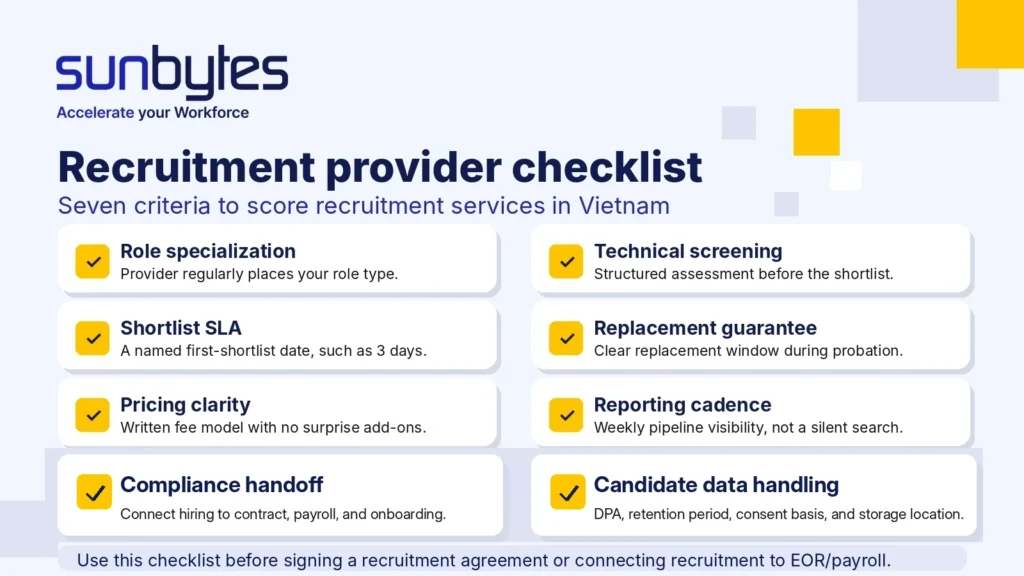
Choose a recruitment provider in Vietnam on seven criteria: role specialization, technical screening, shortlist SLA, replacement policy, pricing clarity, reporting cadence, and compliance handoff. A generic provider list ranks brands; a decision checklist ranks fit for your roles.
Score each provider against the same checklist so the comparison is measurable, not impressionistic:
- Role specialization: does the provider place your role type often, for example backend engineers or finance leads.
- Technical screening: is there a structured technical assessment before the shortlist, not after.
- Shortlist SLA: a named date for the first shortlist, for example 3 days from a signed brief.
- Replacement guarantee: a free replacement window if a hire leaves during probation.
- Pricing clarity: a written fee model with no surprise add-ons.
- Reporting cadence: weekly pipeline visibility, not a silent search.
- Compliance handoff: can the provider connect to employment, payroll, and onboarding, or does it stop at the offer.
- Candidate data handling: confirm DPA, retention period, consent basis, and where candidate data is stored. Recruitment processes personal data under both GDPR and Vietnam PDPL (Law 91/2025/QH15), so the answer should be in writing.
A provider that can own more than CV forwarding reduces handoff risk and shortens your time-to-hire, with a 14-day target for qualified roles when the role and salary range are aligned. A strong recruitment company Vietnam-side publishes its shortlist SLA and replacement window in writing, so you can hold it to a number rather than a promise.
When recruitment should connect to EOR, payroll, or HR operations
Recruitment should connect to EOR, payroll, or HR operations when you are hiring in Vietnam without a local entity, or when you want one provider to own hiring through to the first compliant payroll. This removes the handoff gap where a signed offer stalls because no one owns the employment setup.
An Employer of Record (EOR) becomes the legal employer in Vietnam, so you can hire before you set up an entity. Entity setup takes 3 to 6 months; EOR onboarding takes 2 to 4 weeks. For the full picture, see Employer of Record in Vietnam.
Connect recruitment to employment when any of these apply:
- You are making your first Vietnam hire and have no local entity.
- You want payroll on time and benefits administered locally from day one.
- You need a single accountable provider from role brief to first payslip.
How Sunbytes supports recruitment services in Vietnam
Recruitment in Vietnam breaks when sourcing, screening, and employment handoff sit with separate vendors. The search may produce CVs, but your first payroll still stalls because no one owns the contract, Social Insurance setup, or onboarding.
Sunbytes runs recruitment as part of the employment infrastructure, not as CV forwarding. We define the role scorecard, map the local talent pool, screen for role fit, salary alignment, notice period, and technical capability, then connect the accepted candidate to payroll and onboarding when needed.
Founded in the Netherlands in 2011, Sunbytes operates from a Ho Chi Minh City delivery hub and has hired 300+ specialists across recruitment work. For qualified roles with a clear brief and salary range, the first shortlist target is 3 days from brief sign-off and the time-to-hire target is 14 days.
Why Sunbytes?
Founded in the Netherlands in 2011, Sunbytes has delivered more than 300 client projects across 20+ countries. Our delivery hub in Ho Chi Minh City gives us direct knowledge of Vietnam’s talent market, salary bands, and regulatory environment, with over 300 specialists hired across our recruitment work.
Sunbytes works across three connected pillars: Digital Transformation Solutions, Cybersecurity Solutions, and Accelerate Workforce Solutions, the workforce pillar this guide sits under, so recruitment and employment are backed by the same delivery and security governance.
Our service pillars support recruitment at every stage:
- Recruitment and technical hiring: Through Accelerate Workforce Solutions, we source, screen, and assess candidates, with a 3-day time-to-shortlist from a signed brief and a 14-day time-to-hire target for qualified roles.
- Employment and payroll handoff: Through our Employer of Record (EOR) and recruitment packages, we turn an accepted offer into a compliant labor contract with payroll on time and benefits administered locally.
- Screening and reference checks: Through our recruitment packages, we run technical assessment and background and reference checks before the shortlist reaches your hiring manager.