
DevSecOps outsourcing fails when the vendor only sends reports. It works when ownership is clear: who configures the pipeline controls, who reviews findings, who fixes issues, who stores evidence, and who hands the system back when your internal team is ready.
TL;DR
DevSecOps outsourcing Europe means using an external DevSecOps team or specialist to own defined security tasks inside your software delivery process. For Dutch and EU SMEs, the right provider should prove five things before contract signing: control ownership, DPA coverage, least-privilege access, ISO 27001 evidence, and a handover plan.
- Choose outsourcing when your internal team lacks DevSecOps capacity, not when you want to avoid ownership.
- Ask for evidence before signing: DPA, access model, sample reports, remediation workflow, and handover format.
- Reject vendors that only run scanners without owning triage, remediation routing, or evidence storage.
What DevSecOps outsourcing Europe means
DevSecOps outsourcing Europe means assigning part of your secure software delivery work to an external provider while keeping business accountability inside your company.
That work can include CI/CD security controls, SAST, SCA, DAST, IaC checks, vulnerability triage, cloud configuration reviews, evidence preparation, and secure release gates. The provider may work as embedded engineers, managed delivery support, or a security advisory team.
For most Dutch and EU SMEs, the strongest model is embedded delivery ownership. A report-only provider can identify issues. An embedded DevSecOps provider helps the team decide what gets fixed, when it enters the sprint, how evidence is stored, and what remains as accepted risk.
If your team is still defining the role before comparing vendors, start by clarifying the scope in the DevSecOps team hiring guide. A vendor shortlist is easier to judge when the role responsibilities are already clear.
When does DevSecOps outsourcing make sense?
DevSecOps outsourcing makes sense when your engineering team needs security ownership inside delivery, but hiring a senior DevSecOps engineer would take too long or leave gaps in the pipeline.
The usual trigger is not one big incident. It is a pattern: customer security questionnaires take longer to answer, scanner findings pile up, audit evidence sits across Slack threads and spreadsheets, and senior engineers lose sprint time deciding which vulnerabilities matter.
Outsourcing is a good fit when at least two of these conditions are true:
- Your team has CI/CD in place but no clear owner for security gates.
- Developers receive SAST, SCA, DAST, or cloud findings without triage rules.
- Customer or procurement teams ask for evidence your team cannot produce quickly.
- NIS2, GDPR, ISO 27001, or client security reviews now affect sales cycles.
- Hiring a senior DevSecOps engineer in-house would delay roadmap work by several months.
It is a poor fit if the company wants to transfer all security responsibility to the vendor. DevSecOps still needs product owners, engineering leads, and security stakeholders to decide risk acceptance, release trade-offs, and business priority.
If you are comparing outsourcing with a managed service model, the DevSecOps as a Service guide is the better next read. Use this checklist when you are already evaluating vendors.
What should a DevSecOps outsourcing provider own?
A DevSecOps outsourcing provider should own defined delivery controls, not vague security support. The provider should know which tools they configure, which findings they triage, which reports they produce, and which handover assets they maintain.
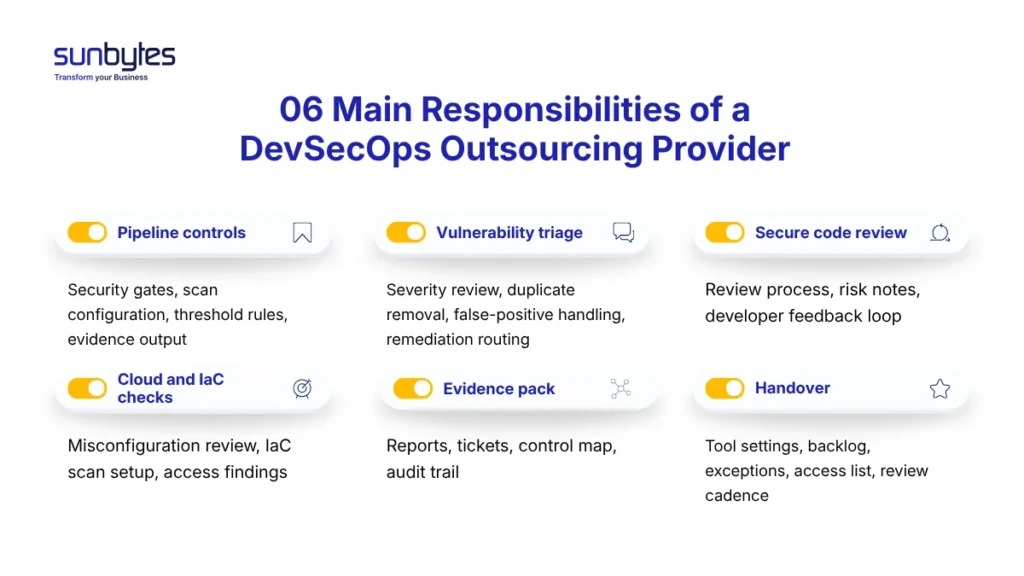
At minimum, the contract should define ownership for these areas:
| Responsibility | What the provider should own | What your team should keep |
|---|---|---|
| Pipeline controls | Security gates, scan configuration, threshold rules, evidence output | Release priority and risk acceptance |
| Vulnerability triage | Severity review, duplicate removal, false-positive handling, remediation routing | Final business priority |
| Secure code review | Review process, risk notes, developer feedback loop | Product logic and architecture trade-offs |
| Cloud and IaC checks | Misconfiguration review, IaC scan setup, access findings | Cloud account ownership |
| Evidence pack | Reports, tickets, control map, audit trail | Client-facing approval and compliance position |
| Handover | Tool settings, backlog, exceptions, access list, review cadence | Internal ownership after transition |
The provider should also work inside your development rhythm. If findings arrive outside the sprint process, developers treat them as side work. That is where DevSecOps outsourcing becomes noise.
Before giving any vendor pipeline access, map your current controls against a baseline such as the DevSecOps pipeline guide. The first discussion should be about control ownership, not tool preference.
DevSecOps outsourcing EU vendor scorecard
A DevSecOps outsourcing EU vendor scorecard should test evidence, not sales language. Use the table below to compare providers before you sign.
Score each item as pass, partial, or fail. A provider does not need to be perfect on day one, but any failure in DPA, access governance, remediation ownership, or handover should stop the shortlist until clarified.
| Area | What to verify | Evidence to request | Reject if |
|---|---|---|---|
| 1. Delivery model | Provider explains whether they are embedded, advisory, or managed service | Delivery model description | They cannot explain who joins your sprint |
| 2. Role ownership | Provider names owners for triage, controls, evidence, and handover | RACI or responsibility matrix | Every task is described as shared |
| 3. Pipeline scope | CI/CD controls are included or excluded clearly | Control map | Pipeline security is left undefined |
| 4. SAST ownership | Static analysis setup and review process are defined | Sample SAST workflow | They only export tool output |
| 5. SCA ownership | Dependency scanning and license/security review are covered | SCA policy or report sample | Open-source risk has no owner |
| 6. DAST ownership | Runtime testing scope is explained | DAST scope example | They run scans without remediation routing |
| 7. IaC checks | Infrastructure-as-code scanning is included where relevant | IaC scan policy | Cloud misconfiguration is out of scope without reason |
| 8. Vulnerability triage | Severity, exploitability, and false positives are reviewed | Triage workflow | Every scanner finding becomes a ticket |
| 9. Remediation routing | Findings go to the right team with priority and context | Ticket examples | Developers receive raw reports |
| 10. Release gates | Blocking rules are defined for high-risk findings | Gate policy | No threshold exists for blocking release |
| 11. Evidence storage | Reports and decisions are stored in a known repository | Evidence repository structure | Evidence lives only in email or chat |
| 12. Access model | Least-privilege access is defined before onboarding | Access matrix | Admin access is requested by default |
| 13. Access review | Review cadence is agreed | Monthly or quarterly review process | Access has no review date |
| 14. Logging | Tool and repository access are logged where possible | Logging policy | No audit trail is available |
| 15. DPA coverage | Data processing terms are reviewed | DPA template or signed DPA | No DPA is available |
| 16. Cross-border access | Access from outside the EU is described and controlled | Access location statement | The vendor avoids the topic |
| 17. ISO 27001 evidence | ISMS scope is explained accurately | Certificate or Trust Center link | Certification claims are vague |
| 18. Security reporting | Report format supports decisions | Sample executive and technical report | Reports are only screenshots |
| 19. Communication cadence | Overlap hours and decision meetings are defined | Weekly cadence plan | All work depends on async updates |
| 20. Onboarding speed | First access and control review timeline is realistic | 30-day onboarding plan | No first-month plan exists |
| 21. Handover assets | Tool settings, backlog, exceptions, and access list are maintained | Handover checklist | Handover is treated as final documentation only |
| 22. Internal team fit | Provider explains how they work with developers | Sprint workflow example | They bypass engineering leads |
| 23. Escalation path | High-risk findings have a named escalation route | Escalation matrix | Urgent findings go to a shared inbox |
| 24. Continuity | Backup coverage is defined for vendor-side absence | Continuity plan | One person holds all context |
| 25. Exit plan | Contract includes transition support | Exit and knowledge-transfer plan | Exit means only final invoice and files |
The strongest vendors will not treat this scorecard as procurement friction. They will already have most of this evidence because the same evidence is needed to run secure delivery work.
Talk to Sunbytes about dedicated DevSecOps engineersineers →
GDPR, ISO 27001 and data access checks
GDPR, ISO 27001, and data access checks should be treated as due diligence questions before the vendor receives access to code, tickets, cloud environments, or vulnerability reports.
For GDPR, the first question is whether the provider acts as a processor and needs a signed DPA before access starts. The DPA should define processing purpose, access scope, subprocessors, retention, deletion, and incident notification.
For cross-border access, the question is practical: who can access what, from where, and under which controls? A European provider with offshore delivery can still be suitable, but access needs to be documented. Use least-privilege access, named accounts, MFA, logging, and scheduled access reviews.
For ISO 27001, do not stop at the certificate. Ask for the certificate scope, the access-control process, the vulnerability handling process, and where delivery evidence is stored. Certification supports due diligence only when the certified scope matches the systems, people, and process involved in your engagement.
A clean vendor answer should sound like this: “Here is our ISO 27001 certificate, here is the scope, here is the DPA process, here is how access is granted and reviewed, and here is where evidence is stored.”
If you need a deeper proof model, use the ISO 27001 app development evidence guide to define what should be documented during delivery. You can also verify Sunbytes security documentation through the Sunbytes Trust Center.
Red flags when outsourcing DevSecOps
The biggest red flag in DevSecOps outsourcing is unclear ownership. If the vendor cannot say who owns a finding after it appears, the engagement will create reports but not reduce delivery risk.
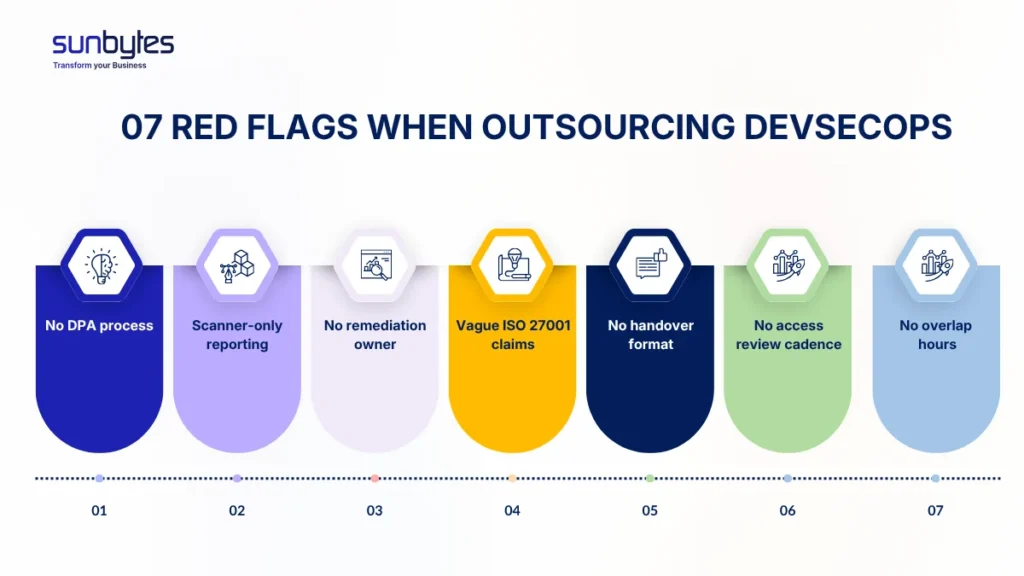
Watch for these stop signs before signing:
| Red flag | Why it matters | What to ask instead |
|---|---|---|
| No DPA process | Data access may be undefined | “Which data do you process and under what agreement?” |
| Scanner-only reporting | Developers receive noise without decisions | “Who validates and prioritises findings?” |
| No remediation owner | Fixes fall between teams | “Who routes each finding into the sprint?” |
| Vague ISO 27001 claims | Certification scope may be unclear | “Can we see the certificate and scope?” |
| No handover format | Internal ownership becomes harder later | “What will we receive if we hire internally?” |
| No access review cadence | Privileges can remain open too long | “When is access reviewed and removed?” |
| No overlap hours | Decisions slow down | “Which hours are reserved for blockers and review?” |
A vendor can recover from a partial answer. A vendor that avoids the question should not stay on the shortlist.
For security control examples such as recurring vulnerability checks, compare the provider’s claims against a practical service scope like vulnerability scanning services. The point is not to buy every service. The point is to see whether the provider can explain the control, evidence, and owner.
How to structure the first 30 days
The first 30 days should produce a working control baseline, not a long discovery phase. By the end of month one, your team should know what is scanned, what is blocked, what is accepted, and where evidence lives.
A practical first-month plan looks like this:
| Timing | Focus | Output |
|---|---|---|
| Days 1 to 3 | Kickoff and scope | Named owners, access request list, tool inventory |
| Days 4 to 7 | Access and control map | Least-privilege access, repository list, CI/CD control map |
| Week 2 | Baseline review | First scan baseline, duplicate removal, false-positive rules |
| Week 3 | Remediation workflow | Ticket routing, severity rules, escalation path |
| Week 4 | Evidence and cadence | Evidence repository, review meeting, handover checklist draft |
The first scan should not be treated as success by itself. The useful output is the remediation workflow that follows it.
If the vendor is embedded properly, the engineering team should feel the difference within two to three sprints: fewer unclear findings, faster ownership decisions, and cleaner evidence for customer or audit conversations. If sprint review is still full of surprise security work after month two, the ownership model needs adjustment.
How Sunbytes supports DevSecOps outsourcing for EU teams
DevSecOps outsourcing works when tool findings have an owner. That is the point Sunbytes optimises for: embedded DevSecOps delivery capacity that works inside your engineering rhythm, not a detached report cycle.
Why Sunbytes?
Sunbytes is a Dutch technology company with Netherlands-based accountability and a delivery hub in Vietnam. For EU teams, that model gives access to DevOps, QA, software architecture, and secure delivery capability while keeping account management close to the European business context.
For DevSecOps outsourcing, that combination matters. Our Digital Transformation Solutions help teams build, modernize, test, maintain, and support digital products with senior engineering capacity. Our CyberSecurity Solutions help reduce delivery risk through practical security services, compliance readiness, and evidence-led ways of working. The Accelerate Workforce Solutions help companies scale specialist capacity when hiring timelines, project pressure, or internal bandwidth become blockers.
That is why Sunbytes approaches DevSecOps outsourcing as more than vendor support. We help EU teams add dedicated DevSecOps capacity, define pipeline ownership, manage security evidence, and keep delivery moving without losing control of access, handover, or accountability.