
A recruitment agency can source, assess and place an employee in Vietnam. Once the candidate accepts, however, the employment process moves into a different stage. The legal employer must issue the employment contract, register the employee for applicable Social Insurance, Health Insurance and Unemployment Insurance (SHUI), withhold Personal Income Tax (PIT), run payroll and maintain employment records.
These responsibilities do not automatically transfer to the recruitment agency. A payroll provider may administer SHUI, PIT and monthly payroll under a separate agreement, but the client remains accountable when its Vietnamese entity employs the worker. When an Employer of Record (EOR) signs the local employment contract, the EOR becomes the legal employer and handles the agreed employment-administration scope.
This guide shows Dutch and EU companies who owns each task after candidate placement, what must be ready before the first payroll and when to choose recruitment only, payroll administration or an EOR.
TL;DR
- A recruitment agency usually handles sourcing, screening and offer coordination. After placement, the legal employer remains responsible for the employment contract, SHUI, PIT, payroll, benefits and employee records.
- Before the first payroll, HR, Finance and payroll need one approved employee file, clear cut-off dates and named owners. Payroll support can handle administration, but liability stays with the client when the client remains the legal employer.
- Choose recruitment only when your Vietnam entity can manage employment operations. Add payroll support when you need local processing, or use an EOR when you do not have a Vietnamese entity or want the provider to act as the legal employer.
What SHUI obligations does an employer have in Vietnam?
SHUI stands for Social Insurance, Health Insurance and Unemployment Insurance. For eligible employees, the legal employer must coordinate registration and contribution reporting with Vietnam Social Security and other relevant authorities. SHUI is therefore a complete employment-administration process, not simply a deduction on the payslip.
The legal employer must:
- Determine which SHUI schemes apply based on the employee’s nationality, employment status, contract type and other relevant conditions.
- Register the employee with the appropriate authority.
- Establish the statutory contribution salary and apply any relevant minimum or maximum basis.
- Calculate the employer and employee contribution portions.
- Withhold the employee portion through payroll.
- Pay and report contributions by the applicable deadlines.
- Retain registration, payroll, filing and payment records.
- Update the employee record after changes to salary, benefits or employment status.
- Complete the required declarations and final payments when employment ends.
Vietnam’s SHUI framework includes several connected laws:
- Compulsory social insurance is governed by Law No. 41/2024/QH15 on Social Insurance, effective from 1 July 2025, and Decree No. 158/2025/NĐ-CP.
- Health insurance requirements include the Health Insurance Law as amended by Law No. 51/2024/QH15, effective from 1 July 2025.
- Unemployment insurance is governed by Law No. 74/2025/QH15 on Employment, effective from 1 January 2026, and Decree No. 374/2025/NĐ-CP.
Contribution rates, salary bases, caps and employee eligibility can change. See the dedicated Vietnam social insurance contribution guide for the applicable calculation framework.
Every SHUI workflow should identify three elements:
- Owner: the legal employer or EOR.
- Basis: the employee’s statutory contribution salary under current rules and applicable caps.
- Evidence: registration confirmation, payroll calculations, statutory filings and proof of payment.
SHUI must be configured before payroll begins. Adding it after the payroll profile has been created can produce inconsistencies between the employment contract, contribution basis, payroll register and payslip.
Who is responsible after a recruitment agency places the candidate?

A recruitment agency normally owns candidate sourcing and placement. The legal employer owns the employment relationship unless an EOR employs the worker.
A service agreement may assign payroll or registration tasks to a recruitment or payroll provider. However, assigning administrative work does not automatically transfer the legal employer’s statutory responsibilities.
The following matrix separates each task, its typical owner and the evidence the buyer should receive.
| Task | Typical recruitment-agency role | Legal-employer or EOR role | Required evidence |
|---|---|---|---|
| Job brief | Structures or validates the brief | Approves the role, headcount and budget | Approved role scorecard |
| Candidate sourcing | Manages the search | Reviews qualified profiles | Shortlist and sourcing record |
| Candidate assessment | Coordinates agreed screening and assessments | Makes the hiring decision | Interview and assessment record |
| Offer coordination | Communicates the approved offer | Approves salary, benefits and terms | Approved offer record |
| Employment contract | Transfers the agreed candidate data | Prepares and signs the contract | Executed contract and annexes |
| Employee registration | Supports only when included in scope | Completes or owns the registration | Registration confirmation |
| Payroll data | Transfers approved hiring data | Validates the employee file | Approved payroll input |
| SHUI | Administers only when contracted | Remains accountable, or EOR owns | Filing and payment evidence |
| PIT | Administers only when contracted | Remains accountable, or EOR owns | Tax data, return and payment evidence |
| Payroll calculation | Processes only when contracted | Reviews accuracy and approves funding | Payroll register and approval |
| Payslip | Produces only when contracted | Ensures correct and timely issuance | Payslip and issue record |
| Leave records | May explain benefits during recruitment | Maintains the official leave ledger | Updated leave record |
| Employee changes | Transfers information if still involved | Approves and records each change | Signed change document |
| Termination | May support replacement recruitment | Manages the employment process | Termination and handover documents |
| Final payroll | Has no standard recruitment role | Calculates and approves the settlement | Final payslip and closure file |
The distinction between administration and accountability is important:
- A payroll provider may calculate SHUI and PIT, prepare payslips and submit agreed filings.
- The client entity must provide accurate inputs, approve payroll and fund payments when it remains the legal employer.
- An EOR signs the employment contract and assumes the statutory employer role, subject to the agreed service scope.
The employment contract is the primary source for payroll setup. Salary, allowances, working arrangements, benefits and contract dates must match the employee file and payroll profile. Sunbytes’ guide to employment contracts in Vietnam explains which clauses should be confirmed before the recruitment-to-payroll handoff.
If registration, payroll approval or offboarding has no named owner, the handoff is incomplete.
What must the legal employer set up before the first payroll?
The first payroll should start with a confirmed employment model and a complete employee file, not a spreadsheet submitted shortly before payday.
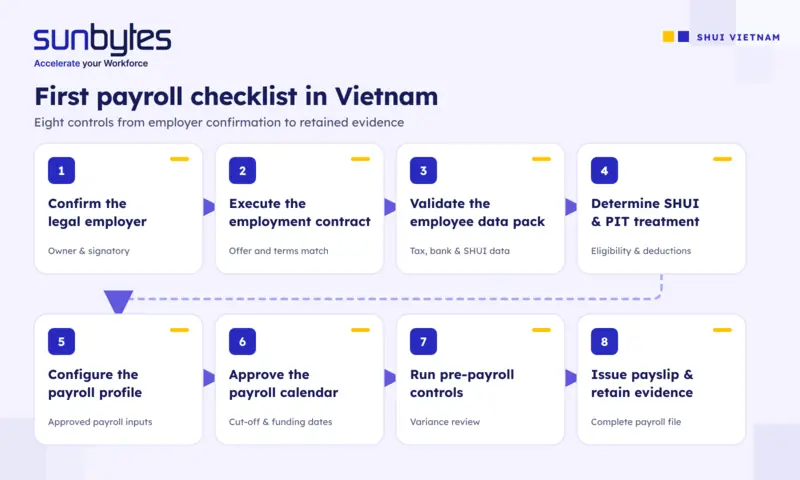
Use the following sequence during the recruitment-to-payroll handoff.
1. Confirm the legal employer
The local legal representative or expansion owner must identify the entity that will employ the worker. This determines who signs the employment contract and carries the statutory employer obligations.
Output: Named legal employer and authorised signatory.
2. Execute the employment contract
HR must confirm that the signed contract matches the approved offer. The job title, salary, allowances, benefits, working arrangements, start date and contract term must be consistent across both documents.
Output: Signed employment contract and applicable annexes.
3. Validate the employee data pack
HR should collect only the information required for employment, payroll, tax and insurance administration. This normally includes:
- Identity and contact details
- Bank information
- Tax identification and residency data
- SHUI information
- Dependent-registration data where applicable
When a Dutch or EU company transfers employee personal data from the European Economic Area to a separate organisation in Vietnam, the transfer may need to comply with Chapter V of the GDPR. The European Data Protection Board also requires organisations to consider a lawful basis, data minimisation, security safeguards and processor arrangements.
Output: Validated employee data pack with documented access controls.
4. Determine SHUI and PIT treatment
HR and payroll must determine which registrations, deductions and reporting requirements apply. Review the employee’s:
- Nationality and employment status
- SHUI eligibility
- Tax code
- Tax-residency information
- Dependent-registration data
- Taxable allowances and benefits
Output: Documented SHUI and PIT treatment.
5. Configure the payroll profile
The payroll owner enters the approved salary, allowances, benefits, deductions and payment details. Every payroll input must trace back to the employment contract, company policy or an approved change document.
Output: Payroll profile ready for review.
6. Approve the payroll calendar
HR, payroll and Finance must agree on:
- Monthly payroll cut-off
- Input owner
- Review and approval dates
- Funding deadline
- Payslip date
- Final approver
- Process for late or exceptional changes
Output: Approved payroll calendar and approval workflow.
7. Run pre-payroll controls
The payroll preparer compares the payroll calculation with the employment contract and approved employee file. The approver reviews new hires, leavers, salary changes, bonuses, leave adjustments and other material variances before payment.
Output: Payroll variance report and recorded approval.
8. Issue the payslip and retain evidence
The legal employer or contracted payroll provider issues the payslip and retains the payroll register, approval record, bank-payment evidence and statutory filing documents.
Output: Complete first-payroll file.
The final control is straightforward: no employee should enter live payroll until the employment contract, bank details, tax data, SHUI status and approved payroll inputs reconcile.
How do SHUI, PIT, payroll and employee benefits connect?
The employment contract supplies the main payroll inputs. Payroll then converts those inputs into gross pay, statutory deductions, PIT and net pay. Registrations, approvals and payment records show how each amount was handled.
The process should run in this order:
Employment terms → payroll inputs → SHUI and PIT calculations → approval → payments → payslip → retained evidence
A change at the start of this chain can affect every later step.
For example, an employee receives an agreed salary increase. HR records the change after the payroll cut-off but does not tell payroll. The old salary appears on the payslip, while the new amount is stated in the contract annex. The next payroll run now needs a correction and a review of the related SHUI and PIT treatment.
Dependent registration can create a similar issue. The payroll team needs the approved information before calculating the relevant PIT position. Vietnam’s current PIT framework includes Law No. 109/2025/QH15, which took effect on 1 July 2026. Provisions relating to salary and wage income apply to the 2026 tax period, as explained in the Government’s 2026 PIT finalisation guidance.
Benefits also need clear labels. “Employee benefit” does not always mean “statutory benefit.”
| Benefit category | What it means | Examples | Employer control |
|---|---|---|---|
| Statutory obligation | Required when the legal conditions apply | Annual leave, qualifying severance and applicable SHUI duties | Apply current law and retain evidence |
| Contractual benefit | Payable because it is promised in a contract, policy or binding agreement | Contractual bonus, agreed allowance or extra leave | Record eligibility and payroll treatment |
| Common market benefit | Often offered to attract or retain employees, but not automatically required | 13th-month salary, private insurance or a wellbeing allowance | State the terms before the employee accepts |
The Vietnam Labour Code governs matters such as annual leave, bonuses and qualifying severance. Ministry of Justice guidance also confirms that payment for unused annual leave applies in specified termination or job-loss cases, rather than every unused-leave situation (Ministry of Justice).
A 13th-month salary is not a universal statutory payment. It can become an employer obligation when the contract, bonus policy, collective arrangement or another binding commitment provides for it. HR should therefore define its conditions instead of placing it under “mandatory benefits.”
Every salary or benefit change should reach payroll before the agreed cut-off.
What should you verify when a recruitment agency also offers payroll?
Some recruitment agencies continue supporting the employee after placement through payroll administration. This can reduce the handoff work for your HR team, but the service label does not explain who employs the worker, approves payroll or carries legal responsibility. Before signing, confirm the scope in writing through five contract checks.
1. Who is the legal employer?
Identify the entity named in the employment contract. Do not infer the answer from the vendor’s service name.
2. Who prepares and approves filings?
The same company may perform both tasks, or the provider may prepare the records while the client approves them. The contract should state who submits each filing and who corrects an error.
3. Who funds payroll?
Set the funding deadline, bank process and escalation path. A correct payroll file still fails if funds arrive after the payment cut-off.
4. Who carries legal responsibility?
Payroll administration does not make the provider the legal employer. If the client entity signs the employment contract, employment liability stays with the client unless the law and contract establish another valid arrangement.
5. What evidence will the client receive?
Request the payroll register, variance report, approval log, payslips, registration confirmations and proof of statutory payments. “Handled by the provider” is not an audit record.
This gives buyers a clear classification:
- Candidate search and placement only: recruitment service.
- Client employs the worker and the provider operates payroll: recruitment plus payroll administration.
- Provider legally employs the worker: EOR.
If you are still reviewing the hiring stage, the recruitment services in Vietnam guide explains how sourcing, screening and employment handoff should connect.
Need to connect candidate placement with payroll setup? Sunbytes can map the owner, input and evidence required from offer acceptance to the first payroll. Explore Sunbytes recruitment services.
When should recruitment hand off to payroll support or an EOR?
Once the candidate accepts, recruitment is no longer the only process that needs an owner. The employee now needs a legal employer, an employment contract and a working payroll setup. Confirming these responsibilities before the start date helps HR avoid a late contract, incomplete registration or a delayed first salary.
Start with one question: Which entity will legally employ the worker?
Once that answer is clear, choose the model that matches your entity status and local HR capacity.
| Decision criterion | Recruitment only | Recruitment plus payroll administration | EOR |
|---|---|---|---|
| Legal employer | Client entity | Client entity | EOR entity |
| Client needs a Vietnamese employing entity | Yes | Yes | No |
| Employment contract signed by | Client | Client | EOR |
| Payroll operated by | Client or its existing provider | Contracted payroll provider | EOR |
| SHUI and PIT administration | Client | Provider may administer | EOR administers |
| Employment liability | Client | Client | EOR within the contracted legal-employer scope |
| Best fit | Client has a ready HR and payroll operation | Client has an entity but needs local payroll capacity | Client lacks an entity or does not want to run local employment administration |
Choose recruitment only when your Vietnamese entity can sign the employment contract, register the employee, run payroll and maintain the required employment records. In this model, the agency hands the successful candidate back to your HR team after placement.
Add payroll administration when your entity remains the legal employer but needs local support with payroll calculations, payslips and agreed statutory processing. The provider handles defined payroll tasks, while your HR and Finance teams approve employee data, fund payments and retain legal responsibility.
Use an Employer of Record when your company does not have a Vietnamese employing entity or does not want to operate the local employment layer. The EOR signs the local contract and handles payroll, SHUI, PIT and employment administration within the agreed scope. Your company continues to direct the employee’s role, priorities and daily work.
For a closer comparison, see Employer of Record versus payrolling in Vietnam. Companies without a local entity can also review how an Employer of Record in Vietnam connects hiring with local employment.
Choose the model based on legal-employer status first. Then check whether your HR and Finance teams have the local capacity to operate the responsibilities that remain.
Which handoff failures create payroll and employee risk?
Most post-placement problems begin when candidate information moves from recruitment to employment without a clear owner. The candidate may have accepted the offer, but HR still needs to confirm the legal employer, complete the employee file and send approved data to payroll before the cut-off.
A controlled handoff gives every risk one owner, one deadline and one retained output. The table below shows the most common failure points, what causes them and which control should be in place before the employee starts or payroll runs.
| Failure point | What triggers it | Likely consequence | Control | Evidence |
|---|---|---|---|---|
| No confirmed employer | Candidate accepts before the model is selected | Contract and registration delay | Confirm the employing entity before offer approval | Entity decision record |
| Incomplete employee data | Recruitment data does not reach payroll | Delayed or incorrect first payroll | Use a mandatory handoff data pack | Approved employee file |
| Contract and payroll differ | Offer, contract and payroll show different terms | Salary or deduction error | Reconcile contract data before payroll | Variance report |
| Employee change misses cut-off | A raise or benefit change arrives late | Incorrect net pay or statutory treatment | Use a monthly change calendar | Approved change log |
| Benefit is misclassified | A market benefit is called mandatory | Disputes or unplanned cost | State the source and conditions of each benefit | Contract or policy record |
| Offboarding is split across teams | HR, payroll and IT use separate timelines | Unresolved pay, records or access | Use one termination checklist | Final closure pack |
These controls also help Dutch and EU teams limit unnecessary access to employee records. Candidate files should not remain open to every recruitment user after the worker moves into payroll. Access should follow the new purpose and owner.
How Sunbytes supports the recruitment-to-employment handoff
A candidate accepts your offer, but several operating decisions remain. HR needs a contract owner. Finance needs an approved payroll calendar. The employee’s tax, bank and insurance data must reach the right people without spreading across inboxes and disconnected files.
Sunbytes connects these steps through one documented handoff.
Through Accelerate Workforce Solutions, Sunbytes supports recruitment, payroll administration and EOR. Recruitment transfers the approved offer, employee details and start date into the selected employment model. When the client employs the worker, payroll administration supports calculations, payslips and agreed statutory processing. When the client lacks a Vietnamese entity, EOR provides the local legal-employer layer.
Digital Transformation Solutions support the workflow behind this handoff. HR and payroll data can move through defined inputs, approval steps and system records, reducing manual re-entry between recruitment, contract setup and monthly payroll.
Cybersecurity Solutions support the control layer. Access rules, secure document handling and audit trails help protect CVs, identity documents, bank details, salary data and payroll records. This is relevant for Dutch and EU companies transferring employee data between the EEA and Vietnam.
The result is one controlled employment process: the employee knows who employs and pays them, HR knows which changes must reach payroll, and Finance knows what to approve before each cut-off.
Talk to Sunbytes about recruitment services in Vietnam and map the handoff from candidate acceptance to payroll and employment.
FAQs
SHUI stands for Social Insurance, Health Insurance and Unemployment Insurance. These statutory insurance schemes are processed through payroll for eligible employees, but participation rules can differ by employee type and insurance category.
Both the employer and eligible employee may have contribution obligations. The legal employer is responsible for registration, payroll withholding, payment and retained evidence. Check current rates and caps in the Vietnam social insurance guide.
Not under a standard recruitment-only engagement. An agency may administer SHUI when payroll services are separately contracted. The legal employer remains accountable unless an EOR is appointed as the local employer.
No. Running payroll does not by itself make the provider the legal employer. When the client’s Vietnamese entity signs the employment contract, the client remains the employer even if a provider calculates payroll and prepares statutory submissions.
No universal statutory rule requires every employer to pay a 13th-month salary. It may become payable if the employment contract, bonus policy, collective agreement or another binding commitment provides for it.
Annual leave is a statutory employment right under the Labour Code. Severance applies only when the legal conditions are met and must be calculated using the applicable service period and salary rules. The employer should assess each termination rather than add severance automatically to every final payroll.
The handoff should be agreed before the employment contract is issued. Use an EOR when the client has no Vietnamese employing entity or chooses not to own the local contract, payroll, SHUI, PIT and offboarding process.
Yes, but the transfer must meet applicable data-protection rules. For personal data transferred from the EEA, the EU organisation must assess and apply the safeguards required by Chapter V of the GDPR. Access should also be limited to the people who need the data for recruitment, employment or payroll.
Let’s start with Sunbytes
Let us know your requirements for the team and we will contact you right away.