
Background checks are essential in today’s hiring environment, where resume inaccuracies are more common than expected. From mismatched job titles to unverifiable degrees or employment history, candidate information can not always be taken at face value.
This guide explains what background checks are, what they reveal, how to run them compliantly, and what companies hiring in Vietnam need to know.
TL;DR
- 73% of companies have received a resume with false information. Background checks are the only reliable way to verify what candidates claim before a hire becomes a costly mistake.
- Standard checks cover identity, employment history, credentials, criminal records, and global sanctions. Which types to run depends on the role, industry, and hiring country.
- In Vietnam, background checks are legal but require written candidate consent. The Police Check process was transferred to the Ministry of Public Security in March 2025. EOR arrangements simplify compliant screening significantly.
What is an employment background check?
“An employment background check is a process employers use to verify information a candidate has provided and to surface any material facts about their history that are relevant to the role. It is a verification exercise, not an investigation.”
Background checks confirm that the person in front of you is who they say they are, has done what they claim to have done, and does not carry an undisclosed history that creates risk for the organization, its clients, or its other employees.
The scope of what can be checked varies significantly by country, role, and industry. There is no single universal standard. What is routine in one jurisdiction may be legally restricted in another.
Why background checks are no longer optional

The scale of resume fraud in modern hiring
73% of companies have received a resume containing false information. The most common embellishments involve employment dates, job titles, credentials, and reasons for leaving previous roles. In remote and cross-border hiring, these discrepancies are harder to detect through standard interview processes alone. (HireRight Employment Screening Benchmark Report)
The financial consequence of a bad hire goes beyond the visible. It includes the cost of recruitment, onboarding, lost productivity during tenure, exit costs, and the time to replace. For mid-level roles, that figure typically reaches 50 to 100% of annual salary. For senior roles, it is higher.
A structured background check process is one of the most cost-effective risk reduction tools available at the hiring stage. For a detailed view of what bad hires cost across the full recruitment cycle, the analysis of recruitment costs makes the financial case clear.
Why remote and cross-border hiring raises the verification stakes
When a candidate is hired locally, informal verification happens naturally. Former employers are reachable. Educational institutions are familiar. Cultural and professional norms are shared. Cross-border hiring removes most of these informal checks.
A hiring manager in Amsterdam reviewing a candidate in Ho Chi Minh City can not easily verify claims about a previous employer that no longer exists, a university certificate that was issued by an unrecognized institution, or a criminal history in a country with limited public record access.
Remote and international hiring requires structured, formal verification precisely because the informal mechanisms are absent. This is not about distrust of international candidates. It is about replacing the informal verification that geography previously provided.
Background check vs reference check: Understanding the difference
These two terms are often used interchangeably, but they measure different things. A background check verifies factual claims using official records and databases. A reference check gathers subjective assessments from people who have worked with the candidate.
| Factor | Background Check | Reference Check |
|---|---|---|
| What it verifies | Facts: dates, credentials, records | Opinions: performance, character, fit |
| Source | Official databases, institutions, courts | Former managers, colleagues, clients |
| Objectivity | High, record-based | Variable, relationship-dependent |
| Legal restrictions | Significant, varies by country | Fewer, but defamation risk applies |
| When to use | Before offer or at offer stage | Before final offer decision |
What do background checks show?
The question “what do background checks show?” does not have a single answer. Results depend on which types of checks are enabled, the legal permissions in the hiring country, and how the employer has configured their screening program.
Education and credential verification
Education checks confirm the highest degree or qualification a candidate claims to hold, the institution that issued it, the dates of attendance and completion, and whether the institution is accredited.
Credential fraud is more common than most hiring managers expect. Degree mill certificates, inflated GPA claims, and fabricated professional certifications are documented issues across all sectors.
What gets verified:
- Degree type and field of study
- Dates of attendance and graduation
- Institution name and accreditation status
- Professional licenses or certifications where applicable
Employment History: Roles, timelines, and gaps
Employment history verification confirms the candidate’s previous employers, job titles, dates of employment, and in some jurisdictions, whether the departure was voluntary. It does not typically include performance assessments, which belong to the reference check.
Gaps in employment history, overlapping dates across multiple roles, and title inflation are the most common discrepancies found at this stage. None are automatically disqualifying, but all require explanation.
Common discrepancies found:
- Employment dates that do not match official records
- Job titles that were one level lower than claimed
- Roles at companies that can not be verified or no longer exist
- Gaps explained differently in interviews vs documented records
Criminal record screenings (Where legally permitted)
Criminal record checks reveal convictions, pending charges, and in some markets, arrests without conviction, subject to local legal limits on what can be disclosed and used. The scope of what appears varies significantly by country.
The key principle is relevance. A criminal record check result should be assessed in relation to the specific role. A financial fraud conviction is highly relevant for an accounting role. It may not be relevant for a software engineering position without financial access.
Criminal record information must never be used as a blanket disqualifier. Employers must assess relevance, recency, and nature of the offense against the specific role requirements. Applying criminal history as a general exclusion criterion creates both ethical and legal exposure in most markets.
Global sanctions and watchlist status
Global sanctions screening checks whether a candidate appears on international watchlists maintained by bodies including the UN Security Council, OFAC, the EU, and various national financial intelligence units.
This check is particularly important for roles involving financial transactions, data access, or work with clients in regulated industries. It is not a standard requirement for all hires, but for roles with elevated risk profiles, it is a critical step.
Credit and financial history (role-specific)
Credit checks are role-specific and legally restricted in many markets. They are most appropriate for roles involving direct access to company funds, financial reporting responsibilities, or client financial data.
Where permitted, a credit check shows outstanding debts, payment history, bankruptcy proceedings, and financial judgments. The relevance test is strict: a poor credit history is not a general indicator of untrustworthiness, but it is a meaningful data point for roles with financial control.
Types of background checks for employment: Which ones do you actually need?
Knowing the types of background checks for employment is the first step. Knowing which combination fits your roles, industry, and hiring markets is where the real design work happens.

Standard checks for all hires
These checks apply regardless of role level or industry. They verify baseline identity and factual claims that every candidate makes.
- Identity verification: government-issued ID, passport, or national ID
- Employment history: most recent 2 to 5 years depending on role
- Highest educational credential: the specific qualification relevant to the role
- Right to work verification: legal authorization to work in the hiring country
Enhanced checks for sensitive or senior roles
Roles involving financial access, data handling, leadership responsibility, or work with vulnerable populations require a broader and deeper screening package.
- Extended employment history: 7 to 10 years for senior leadership roles
- Criminal record check: for roles with direct access to clients, finances, or sensitive data
- Global sanctions screening: for roles in regulated industries or with international financial exposure
- Professional license verification: for roles requiring regulated certifications (legal, medical, financial advisory)
- Credit history check: for roles with direct financial control or reporting responsibilities
Checks that vary by country and industry
Some checks are industry-mandated. Others are legally restricted by the hiring country’s privacy and labor laws. Employers must verify what is permitted before including any check type in their standard process.
| Check Type | Common in | Restricted in | Industry-Specific |
|---|---|---|---|
| Criminal record | US, UK, Australia, Vietnam | EU (strict GDPR limits) | Financial services, Healthcare |
| Credit history | US, Canada | EU, Vietnam (not standard) | Finance, Accounting |
| Social media | Informal in most markets | France (prohibited) | PR, Communications |
| Drug testing | US, Australia | Most EU markets | Transport, Safety-critical roles |
| Global sanctions | All markets | N/A (universally applicable) | Finance, Government, Tech |
What you legally can not check (and why it matters)
Equally important is knowing what you can not check. Health history, pregnancy status, political affiliation, religion, and in many markets sexual orientation are legally protected and can not be researched through background screening.
In Vietnam, the Personal Data Protection Decree 2023 classifies health information as sensitive personal data requiring explicit consent and registration with the Personal Data Protection Committee before processing. Medical screening for hiring purposes is therefore subject to specific procedures.
Understanding the legal perimeter of background checks is as important as knowing what to verify. Employer of Record in Vietnam manages this compliance boundary on behalf of international clients, ensuring every screening step is legally permissible before it is initiated.
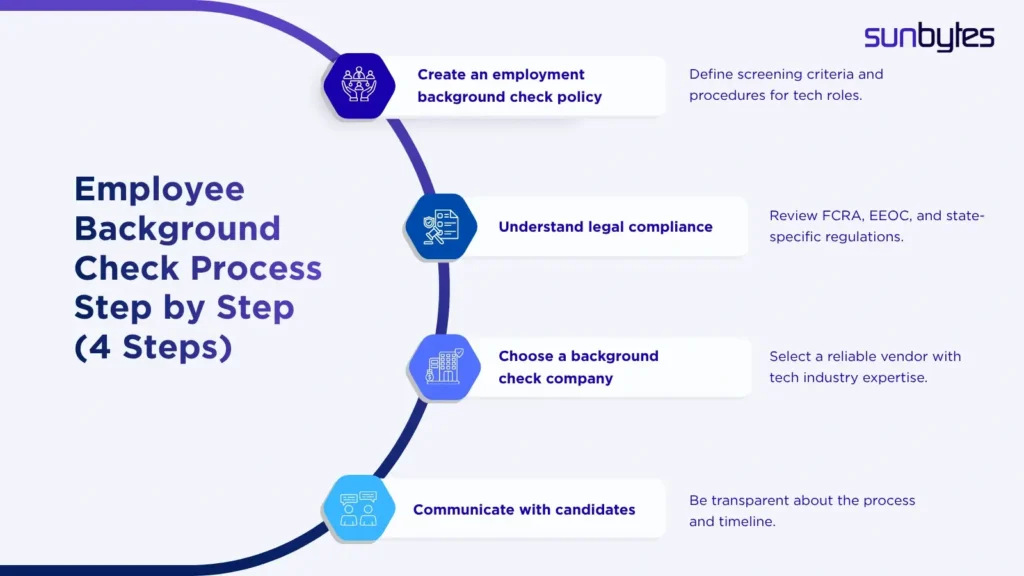
Employee background check process step by step (4 Steps)
Running a structured employee background check process consistently across every hire is what separates organizations that catch problems before they become expensive from those that discover them afterward.
Step 1: Create an Employment Background Check Policy
Before running a single check, define what your organization will screen for, at what stage of hiring, for which roles, and how results will be used in hiring decisions.
The policy must clearly define which types of background checks apply to each role category, when in the hiring process those checks are conducted (whether pre-offer, post-offer, or during onboarding), and how results are evaluated through a structured adjudication framework that links findings to hiring decisions.
It should also outline an appeals process for candidates who dispute results, as well as specify how long background check data is retained and the data security standards used to protect it.
A written policy also protects the organization in disputes. If a hiring decision based on background check results is challenged, documented criteria applied consistently across all candidates are the primary defense.
Step 2: Understand legal compliance
Every country, and sometimes every state or province within a country, has specific rules about what employers can check, when they can check it, and how results can be used. Failure to comply creates legal exposure that is often more costly than the bad hire the check was meant to prevent.
Key compliance questions to answer before running checks:
- Is candidate consent required? (Yes in Vietnam and most markets)
- Are there restrictions on criminal record use? (Yes in most EU markets and some US states)
- Does the check involve sensitive personal data under local privacy law?
- Are there sector-specific regulations governing screening for this role?
- Who is the data controller for screening results and what are the retention obligations?
Step 3: Choose a Background check company
The provider you select determines the quality, speed, and compliance of your results. A provider with strong international coverage matters significantly for cross-border hiring, where local data access and legal knowledge vary widely by market.
Key criteria for provider selection:
- Country coverage: does the provider have direct access in your hiring markets?
- Turnaround time: what are average completion times for the check types you need?
- Compliance posture: how does the provider stay current with regulatory changes per market?
- Integration: does the provider connect to your ATS or HRIS to minimize manual steps?
- Candidate experience: how is the self-enrollment process presented to candidates?
Step 4: Communicate with candidates
Transparency with candidates throughout the screening process is both a legal requirement in most markets and a practical retention tool. Candidates who understand what is being checked and why are less likely to withdraw from the process and more likely to respond promptly to information requests.
Inform candidates about background checks before or at the offer stage, clearly explain what checks will be conducted and what data will be collected, allow them to flag any expected findings in advance, and share the results before making any adverse hiring decision.
In Vietnam and most markets with data protection frameworks, the communication step is not optional. Employers must obtain written, informed consent before initiating any background check. The consent form must specify the purpose, scope, storage duration, and the candidate’s right to access and correct their data.
How long do background checks take?
“How long do background checks take?” is one of the most common questions from hiring managers, and the honest answer is: it depends significantly on what you are checking and where.
Turnaround times by check type
| Check Type | Typical Turnaround | Key Variable |
|---|---|---|
| Identity verification | Minutes to 24 hours | Database access quality |
| Employment history (express) | 1 to 3 business days | Employer responsiveness |
| Employment history (standard) | 3 to 7 business days | Manual verification needed |
| Education verification | 2 to 5 business days | Institution processing speed |
| Global sanctions screening | Minutes to hours | Automated database check |
| Criminal record (domestic) | 1 to 5 business days | Court system access |
| Criminal record (international) | 5 to 21 business days | Country-specific processes |
| Vietnam Police Check | 5 to 21 business days | Ministry of Public Security queue |
Why international and cross-border checks take longer
Domestic checks run against databases that providers access directly. International checks require coordination with foreign institutions, government agencies, and verification bodies that operate on their own timelines and in their own languages.
Factors that extend international check timelines include: document translation requirements, manual outreach to foreign employers, limited digitization of records in some markets, and the requirement in some countries for candidates to apply for their own criminal clearance certificate and submit it to the employer.
Vietnam-specific timelines: Police check, credential verification, work permit documents
The Vietnam Police Check is the primary criminal record verification tool for employment in Vietnam. As of March 2025, issuance transferred from the Ministry of Justice to the Ministry of Public Security, which has introduced some processing variability as the transition stabilizes.
Current Vietnam-specific timelines:
- Vietnam Police Check for Vietnamese nationals: 5 to 10 business days on average
- Vietnam Police Check for foreign nationals: 10 to 21 business days, longer if home-country legalization is required
- Education credential verification: 3 to 7 business days for local institutions, longer for foreign qualifications requiring notarization
- Work permit document review (employer side): 5 to 10 business days for Department of Labour, Invalids and Social Affairs (DOLISA) processing under Decree 219/2025
How to reduce delays without cutting corners
The most effective way to reduce background check timelines is to integrate the process earlier and run checks in parallel rather than sequentially. Starting education and employment verification at the conditional offer stage, rather than after acceptance, removes weeks from the process with no reduction in rigor.
To reduce timelines, brief candidates in advance on required documents, use express verification methods for key roles, run sanctions screening in parallel with other checks, and in Vietnam, start Police Check coordination as soon as candidates pass the interview stage.
For companies evaluating build vs buy on HR functions, the outsourcing vs offshoring comparison is relevant here. Partnering with a Vietnam-based EOR provider who manages background check coordination locally eliminates the international coordination lag that inflates timelines for companies running the process remotely.
Hiring in Vietnam and wanting to get compliance right from the start?
Sunbytes helps international companies integrate structured background checks into their Vietnam hiring workflow through our EOR and staffing services. From candidate consent documentation to Police Check coordination and payroll compliance, we handle the administrative complexity so your team can focus on the hire.
Explore Accelerate Workforce Solutions
Background checks for international employees: Global compliance considerations
Running checks in three countries does not mean three times the effort. It means three entirely different legal regimes, each with its own consent rules, permissible check types, data retention requirements, and enforcement bodies. For Vietnam-specific workflow that covers consent-led checks, reference calls, technical validation, and probation planning before offer, read our guide to candidate vetting in Vietnam.

Why your domestic screening process fails for international hires
The data sources are different, the permissible checks differ, the consent mechanisms differ, and the turnaround timelines differ significantly.
The most common failure mode is applying a domestic policy to international candidates without local legal review. This results in either over-screening (collecting data that is not legally permissible in the candidate’s country) or under-screening (missing checks that are standard practice in the hiring market).
GDPR, PDPD, and cross-border data transfer restrictions
For companies headquartered in the EU or UK hiring candidates in Vietnam, two privacy frameworks interact: the EU General Data Protection Regulation (GDPR) and Vietnam’s Personal Data Protection Decree (Decree 13/2023/ND-CP), also referenced as Vietnam’s Personal Data Protection Regulation Decree 356.
Key cross-border considerations include ensuring EU-level data protection under GDPR when transferring data from Vietnam, as the country does not have an adequacy decision, and conducting a cross-border transfer impact assessment under Vietnam’s PDPD.
Both frameworks also require explicit consent, so a single, unified consent form should ideally cover both to avoid duplication.
How EOR arrangements handle compliant screening across jurisdictions
An Employer of Record acts as the legal employer and handles data processing, consent, and background checks in compliance with Vietnam’s laws, while the client company receives only the necessary hiring outcomes.
This structure keeps sensitive data within Vietnam under the EOR’s control, simplifying cross-border data transfer and reducing compliance risk. It also aligns well with broader strategies such as person-focused pay, where compensation design must work alongside compliant employment structures.
How Sunbytes helps international companies hire with confidence in Vietnam
When background checks are delayed, Sunbytes takes a proactive approach to follow up and keep the process moving, so your hiring timeline stays on schedule.
This is part of the broader employment infrastructure we build for international companies entering or scaling in Vietnam. Through our Employer of Record (EOR), Staffing, and Contractor of Record (COR) services, we enable compliant and consistent hiring at every stage of growth.
Why Sunbytes?
Founded in the Netherlands in 2011, Sunbytes has delivered more than 300 client projects across 20+ countries. Our delivery hub in Ho Chi Minh City gives us direct knowledge of Vietnam’s labor market, regulatory environment, and talent landscape.
Our three service pillars support compliant hiring at every stage:
- Digital Transformation Solutions – We build and scale technology teams across Vietnam. In a sector where credential fraud is common and security access is high, structured background checks are built into every engineering and tech hire we support.
- CyberSecurity Solutions – For organizations where employees handle sensitive data, financial systems, or client infrastructure, our security-first approach to team-building includes background screening as a baseline, not an afterthought.
- Accelerate Workforce Solutions – Our Employer of Record(EOR), Contractor of Record, payroll, and staffing services give international companies a fully compliant employment structure in Vietnam. This includes coordinating background check documentation, consent management, Police Check support, and SHUI-compliant payroll from day one.