

EOR onboarding is how you put a new hire on a compliant payroll in a country where you have no legal entity. Done well, it moves from a signed offer to a payroll-ready employee in a few weeks, with the provider carrying the legal and compliance load. This guide covers how the process works in 2026, how long it takes, the documents you need, and when it beats setting up your own entity.
TL;DR
- Onboarding through an EOR puts a new hire on a compliant local payroll through a third party that acts as the legal employer, so you can hire where you have no entity. The provider owns contracts, statutory registration, and payroll; your team owns the day one experience.
- Most onboarding runs in 1 to 3 weeks once documents are ready, stretching to 4 to 6 weeks when a work visa or complex local compliance is involved (2025 industry onboarding benchmarks). Document readiness, not the provider’s speed, sets the real timeline.
- For hiring international or remote employees in a single market, onboarding through an EOR is usually faster and lower risk than entity setup, which can take several months. An entity only wins once the headcount in one country is large and permanent.
What is EOR onboarding?
“EOR onboarding is the process of hiring and activating an employee through an Employer of Record, the third party that becomes their legal employer, handles statutory compliance, and runs payroll, while the client company directs the actual work.”
EOR onboarding defined: legal employer vs functional employer
Two employer roles run at the same time. The Employer of Record is the legal employer: it signs the contract, registers the worker with local social and tax authorities, withholds and remits tax, runs payroll, and carries compliance liability under local law.
Your company is the functional employer: you set the role, manage daily work, and decide pay and benefits within a compliant frame. For the service itself, this is what an Employer of Record (EOR) does operationally.
What the EOR handles vs what your team handles
The split is the single most useful thing to understand before you start, and it is where the most common day one failure comes from, when a new hire is legally employed but arrives without a laptop, accounts, or a manager expecting them.
| The EOR handles | Your team handles |
|---|---|
| Employment contract, statutory registration, tax withholding, payroll, compliance liability | Role and goals, daily management, equipment and accounts, manager handoff, team introductions |
EOR onboarding vs direct entity onboarding
Before you onboard anyone, you are really choosing between two setups: hire through an EOR, or set up your own legal entity and onboard staff directly. EOR onboarding vs entity onboarding is a speed, cost, and risk decision, not a quality one.
| Factor | Hiring via EOR | Own entity |
|---|---|---|
| Time to first hire | 1 to 3 weeks once documents are ready | Several weeks to several months for registration |
| Upfront cost | Per employee service fee, no setup cost | Entity, legal, and accounting cost before hire one |
| Compliance liability | Carried by the provider as legal employer | Carried fully by your company |
| Best when | Testing a market, fewer hires, speed matters | Large, permanent headcount in one country |
| Exit | End the engagement, provider offboards | Wind down or keep maintaining the entity |
A simple rule: if you expect fewer than roughly 30 employees in a country, or you are still validating the market, the EOR route is the faster and lower risk path. Once headcount is large and permanent, an entity can lower the per head cost enough to justify the months of setup.
For companies hiring fewer than 30 employees in Vietnam who are not ready to commit to entity setup, EOR is the faster and lower-risk path. For broader context on hiring and managing remote employees, Sunbytes covers the full range of options.
How long does EOR onboarding take?
How long onboarding takes is the question every hiring manager asks first, and the honest answer is that the provider is rarely the bottleneck.
Standard EOR onboarding timelines by country complexity
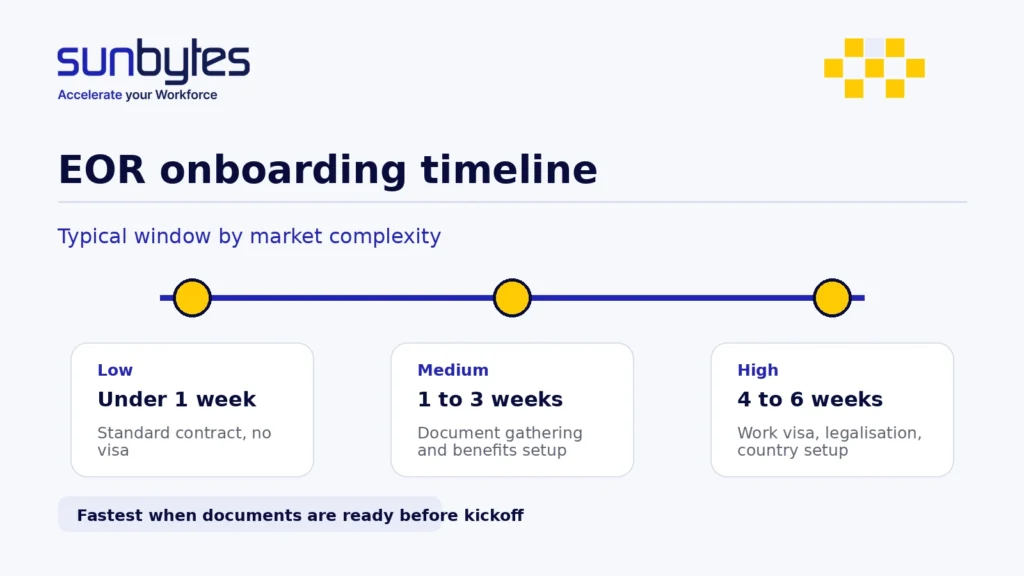
Timelines move with the complexity of the market, not the marketing promise. The bands below reflect 2025 industry onboarding benchmarks.
| Market complexity | Typical window | What drives it |
|---|---|---|
| Low, local hire in an established market | Under one week to 1 week | Standard contract, no visa |
| Medium | 1 to 3 weeks | Document gathering and benefits setup |
| High, visa or strict compliance | 4 to 6 weeks | Work visa, legalisation, country setup |
Vietnam’s work permit process improved under Decree 219/2025/ND-CP, effective August 7, 2025. The three-step process was consolidated into a single dossier submitted to the provincial People’s Committee, reducing statutory processing time from 15 to 10 working days.
What makes onboarding faster: documents ready first
The variable you control is document readiness. The single biggest accelerator is collecting documents in parallel with provider selection, not after the service agreement is signed. A confirmed start date set around the payroll cut off, rather than against it, keeps the first payment on time.
What causes delays and how to avoid them
Most delays trace back to a missing owner rather than a slow provider. The frequent causes:
- Documents requested only after signing, which adds a week for no benefit.
- A start date set just after the payroll cut off, which pushes the first full payment a month out.
- A foreign hire whose work permit or visa was not planned first, since that is the longest single step.
Plan these in parallel and the calendar compresses. For the country level breakdown of a Vietnam hire, including statutory registration and the first payroll cycle, see EOR onboarding in Vietnam.
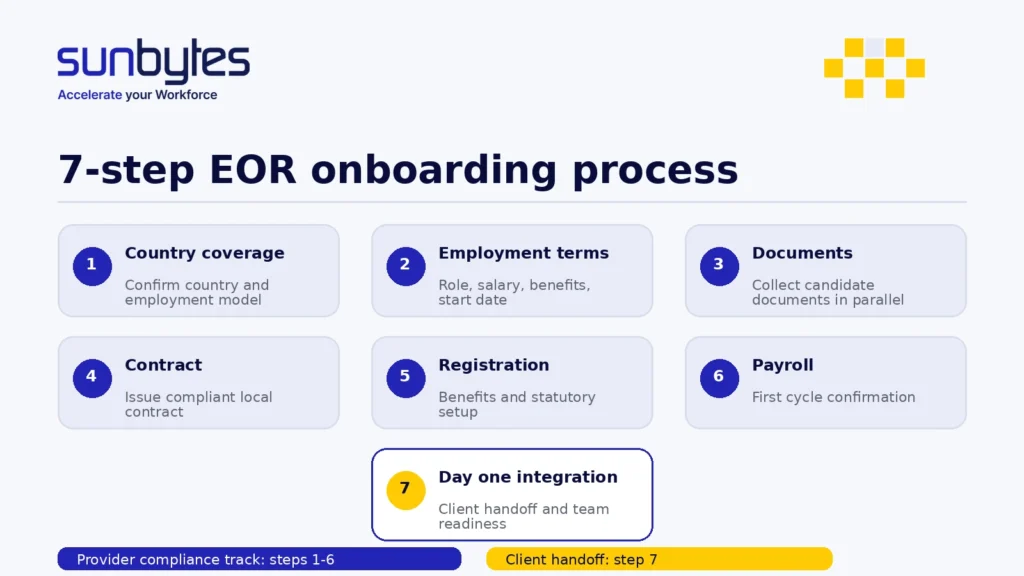
EOR onboarding process step by step (7 Steps)
Here is the Employer of Record onboarding process end to end. The first six steps are the provider’s compliance track; the last is yours. Run the client side preparation alongside steps 1 to 6 so day one actually works.
Step 1. Confirm country coverage and employment model
Check that the provider employs in the target country directly, not through a sub processor you cannot see. Confirm whether the hire is an employee or a contractor, since the onboarding path differs.
Step 2. Define the employment terms
Agree role, salary in local currency, benefits, and start date. These feed straight into the contract, so vague terms here cause rework later.
Step 3. Collect candidate documents in parallel
Start the EOR’s Timeline and Document Checklist the moment you select a provider. Most document sets take a few business days to gather, verify, and translate, and this runs fine alongside steps 1 and 2.
Step 4. The EOR issues a compliant employment contract
With complete documents, the provider can usually generate a locally compliant, often bilingual contract within a couple of business days. The employee reviews and signs.
Step 5. Benefits enrollment and statutory registration
The provider registers the employee with the local social, health, and tax authorities and enrolls the agreed benefits. The exact statutory scheme and rates depend on the country, so this is where a generic global template stops being enough. For the Vietnam scheme specifically, see the Vietnam guide.
Step 6. Payroll setup and first cycle confirmation
The provider configures payroll and confirms which cycle the first payment lands in. Confirm the payroll cut off before you lock the start date, or the first full payment can slip a month.
Step 7. Day one: your team takes over integration
On day one the employee is legally employed and payroll ready. What they actually experience, accounts, equipment, a manager, and role clarity, is yours to prepare. The provider cannot do this for you.
The new hire is legally employed, payroll-configured, and registered for all statutory benefits. Their experience on day one depends entirely on what the client has prepared. For context on recruitment costs that inform EOR budget decisions, Sunbytes covers the full cost picture.
Onboarding a new hire in a country where you have no entity? Sunbytes runs the full onboarding sequence, contract, statutory registration, first payroll, and the day one handoff, as one plan in 2 to 4 weeks once documents are ready, so the contract is issued before the start date.
EOR onboarding checklist: the documents you need
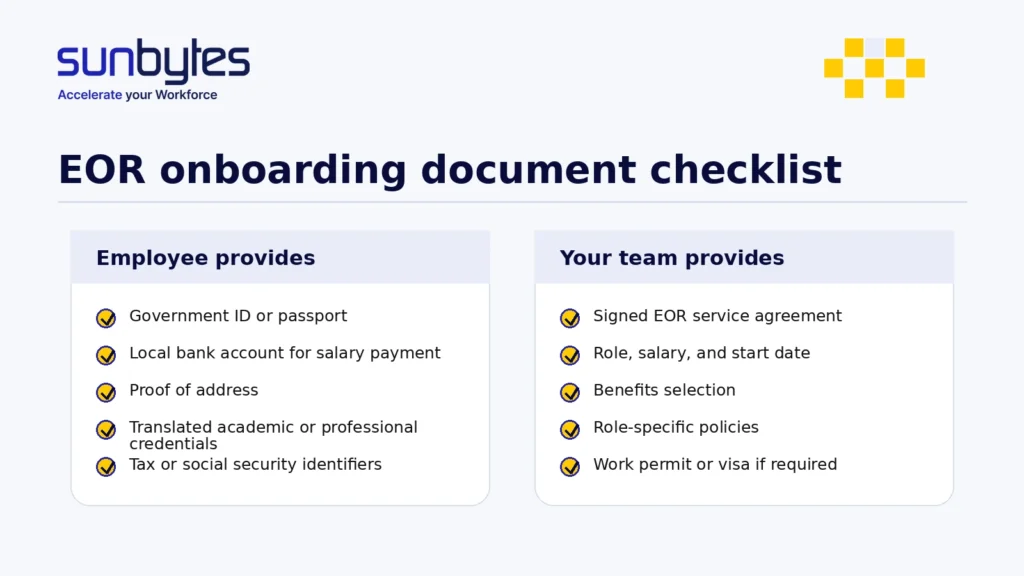
This EOR onboarding checklist splits documents by who owns them. Collect both sets before the contract stage, because the provider can only issue the contract once the employee set is complete and verified.
Documents the employee must provide
- Government ID or passport
- Local bank account for salary payment
- Proof of address
- Translated academic or professional credentials
- Tax or social security identifiers where they exist
Documents your team must provide
- Signed EOR service agreement
- Confirmed role, salary in local currency, and start date
- Benefits selection
- Any role specific policies the new hire must acknowledge
A foreign hire adds a work permit or visa and, where required, a criminal record certificate, often legalised or apostilled. For the country specific list for a Vietnam hire, see the Vietnam document checklist.
The biggest onboarding mistakes (and how to avoid them)
Most onboarding failures are not legal, they are coordination gaps. Each mistake below has a one line fix you can assign before it costs a start date.
Waiting to collect documents until after the contract is signed
Teams often wait for the service agreement before asking for documents, then lose a week. Fix: start collecting documents in parallel with provider selection, not after.
Assuming the EOR handles day one IT access and team integration
The EOR handles the legal layer. It does not create accounts, ship a laptop, or run introductions. Fix: name an internal owner for each day one task, due three business days before the start date.
Not briefing the new hire on the EOR relationship before day one
A new hire who does not know their payslip comes from a provider, not your brand, gets confused fast. Fix: explain the EOR relationship at the offer stage, in writing.
Ignoring local bank account and pay timing
No local bank account means no clean first payment, and a start date just after the payroll cut off pushes the first full cycle a month out. Fix: confirm both before you set the date.
Treating data privacy as an afterthought
Onboarding moves sensitive employee and payroll data across borders, and the OECD’s 2025 update to permanent establishment rules is a reminder that cross border setups attract scrutiny. Where EU data is involved, a GDPR Article 28 data processing agreement should be signed before any data moves. Fix: agree data handling up front, and where data security is a concern, bring in CyberSecurity Solutions before onboarding starts.
Hiring in a specific country
Local rules change the detail at every step: the contract form, the statutory scheme, the work permit route, and what the employee sees on the first payslip. For a full country example, our Vietnam guide covers the local timeline, statutory registration, work permit coordination, and first payroll in depth. See EOR onboarding in Vietnam.
How Sunbytes helps with EOR onboarding
Onboarding only works when the legal setup and your internal day one preparation move together. Sunbytes runs both sides as one sequence so the contract is issued before the start date and the new hire is productive on day one, not just employed.
This is part of the wider employment infrastructure we build for companies hiring across borders. Through our Employer of Record (EOR), staffing, and payroll services, we make hiring compliant and consistent at every stage of growth.
Why Sunbytes?
Founded in the Netherlands in 2011, Sunbytes has delivered more than 300 projects across 20+ countries, with a delivery hub in Ho Chi Minh City. That gives clients a single team for both the European side of the relationship and the on the ground execution in Vietnam.
- Onboarding planned in 2 to 4 weeks: Through Accelerate Workforce Solutions, we map the full onboarding sequence before the contract is issued, from employment terms to first payroll and the day one handoff.
- Payroll on time, every cycle: Through Payroll Services, we run statutory registration, monthly payroll, and offboarding actions within 24 hours, so the first cycle is confirmed before day one.
- Data handled to standard: Through CyberSecurity Solutions, we apply ISO 27001 controls and, for EU data, a GDPR Article 28 data processing agreement, so onboarding does not become a data risk.