
Choosing a recruitment agency in Vietnam is not only about who can send CVs first. For companies hiring without a local HR team, the better question is who owns the process from brief calibration to shortlist, interview feedback, salary alignment, and employment handoff. A weak agency makes your hiring manager review more profiles. While a strong agency removes that work before the shortlist reaches your team.
This guide gives you seven questions to ask before signing with a Vietnam recruitment partner. Use them to test sourcing quality, screening depth, shortlist speed, fee terms, and whether the agency can support the handoff from candidate selection to compliant employment. Learn more about the fundamentals of recruitment in Vietnam in this guide on recruitment services in Vietnam.
TL;DR
- Evaluate agencies on ownership of key hiring stages: brief calibration, sourcing, screening, shortlist speed, salary alignment, compliance handoff, and replacement risk not just database size.
- Ensure the agency demonstrates clear processes for role calibration, candidate screening (especially for tech roles), and communication before presenting a shortlist.
- Confirm upfront details such as pricing, replacement terms, data handling, and how the agency manages employment handoff (SHUI, PIT, payroll, EOR, or direct hiring).
What should a recruitment agency own in Vietnam?
A recruitment agency in Vietnam should own more than CV delivery. It should help your team define the role, source the right candidates, screen before shortlist, coordinate interviews, support offer alignment, and prepare the handoff into employment.
That ownership matters when your hiring manager is based overseas while the candidate is in Ho Chi Minh City, Hanoi, Da Nang, or another Vietnamese hiring market. Time zone overlap can support communication, but only if the recruitment process has clear owners.
A practical recruitment agency should be able to answer these questions before the search starts:
- Who confirms the role brief?
- Who checks candidate motivation and salary expectation?
- Who controls the shortlist quality?
- Who keeps interview feedback moving?
- Who explains what happens after offer acceptance?
- Who restarts the search if the hire does not pass probation?
If those answers are unclear during agency selection, they usually become more expensive after week two of the search.
Choose a recruitment agency in Vietnam by asking these 7 questions
To choose a recruitment agency in Vietnam, ask questions that expose how the agency works before the first CV is sent. Good answers are specific. Weak answers rely on reputation, database size, or speed without showing the process behind it.
1. How do you calibrate the hiring brief before sourcing?
A strong recruitment process starts before sourcing. The agency should not accept a job description and start sending profiles without checking the role against the local candidate market.
Ask the agency how it confirms:
- must-have skills,
- nice-to-have skills,
- seniority level,
- English communication level,
- salary range,
- notice period expectations,
- interview stages,
- decision owner,
- target start date.
This is where many searches slow down. Your hiring manager may know the role well, but the agency needs to translate that brief into Vietnam’s candidate market.
For example, “senior software developer” can mean different things depending on stack, ownership level, communication needs, and reporting structure. Before the brief is calibrated, your team reviews weak CVs. After calibration, the shortlist has a reason to exist.
2. Which sourcing channels do you use for this role?
A strong agency should explain which sourcing channels fit the role. A weak agency says it has a large database.
Candidate sourcing in Vietnam can include direct outreach, referrals, job boards, local communities, LinkedIn, university networks, and role-specific talent pools. The right mix depends on the role, seniority, salary range, and urgency.
For a finance role, the agency may need industry networks and professional referrals. For a software role, it may need direct outreach, developer communities, stack-specific screening, and a clear reason why passive candidates should respond.
Vietnam’s labour-market data is becoming more structured. The VietJobs dataset, accepted at LREC 2026, includes 48,092 Vietnamese job postings from all 34 provinces and municipalities, covering job titles, categories, salaries, skills, and employment conditions. This highlights how recruitment language and salary expectations vary across Vietnam (source).
The question for your agency is simple: “For this role, where will you search, and why?”
3. How do you screen candidates before they reach our hiring manager?
Screening should reduce your hiring manager’s workload. It should not push basic filtering back to your team.
Ask what the agency checks before a candidate reaches your shortlist. At minimum, this should include role fit, motivation, salary expectation, notice period, English communication, availability, and practical constraints such as remote work setup or interview timing.
For technical roles, screening needs more depth. A developer profile should not pass because the CV lists React, Node.js, Java, Python, PHP, .NET, mobile, DevOps, cloud, data, or AI keywords. The agency should explain what the candidate actually built, what part of the project they owned, how they handled reviews, and whether they can work with a distributed team.
Learn more about hiring developers in Vietnam in this guide on IT recruitment in Vietnam and how to assess Vietnamese developers remotely.
Candidate data handling also matters. Recruitment involves personal data such as CVs, contact details, interview notes, salary expectations, and assessment feedback. The European Commission states that EU data protection legislation includes the GDPR, which governs personal data processing (source).
Ask the agency how candidate data is stored, who can access it, how long it is kept, and how interview notes are shared with your team.
4. What shortlist SLA do you commit to?
A shortlist SLA only works when the hiring brief is clearly defined. If the role is not calibrated first, faster delivery usually means more irrelevant profiles, not better hiring outcomes.
When evaluating an agency, ask two things:
- When will the first shortlist be delivered after the brief is confirmed?
- What conditions must be in place for that timeline to be realistic?
A strong agency will give a clear, conditional answer, for example:
“First shortlist within 3 days from brief sign-off, provided the role scope, salary range, interview process, and decision owners are confirmed.”
This is very different from a vague promise like “we work fast.”
Typical benchmarks to expect:
- Time-to-shortlist: 3 days from brief sign-off
- Time-to-hire: 14 days when role scope, salary range, and decision owners are aligned
These timelines matter because candidate availability changes quickly. A strong candidate identified early in the week may already be in final interviews elsewhere by the end of the week. A reliable agency helps your hiring team move before that window closes.
5. How do you handle salary expectations and offer alignment?
Salary mismatch should surface before the final interview. If it appears at offer stage, your team has already spent time on a process that may not close.
Ask the agency how it checks salary expectations. The answer should cover current salary, expected salary, benefits, notice period, work model, and whether the candidate understands the role location, contract model, and reporting setup.
A strong agency should help translate market expectations into a realistic hiring range. It should also tell you when your range is unlikely to attract the seniority you want.
For deeper insights, see this guide on recruitment agency fees in Vietnam.
6. Do you explain SHUI, PIT, and employment model handoff?
A recruitment agency does not need to act as your legal advisor, but it should explain what happens after the candidate accepts the offer. This is often where a good search becomes a slow start date.
Before signing, ask who owns the employment handoff.
The answer should cover:
- whether the candidate will be hired through your local entity, an EOR, or another employment model,
- who prepares the employment contract,
- who handles payroll setup,
- who owns SHUI registration,
- who owns PIT withholding,
- who collects onboarding documents,
- who confirms the start date,
- who closes the loop with the candidate.
Keep this question practical. You are not asking the agency to give legal advice. You are asking whether the agency can identify the handoff owner before the offer is accepted.
That one step protects your process. Without it, your team may select the right candidate and still lose time because contract, payroll, SHUI, PIT, or EOR ownership was not ready.
For official legal references, consult Vietnam’s Ministry of Labour (molisa.gov.vn).
7. What happens if the hire fails probation?
Replacement risk should be written before you sign. If it is only discussed after the hire fails probation, the agency agreement is already too vague.
Ask about:
- warranty period,
- replacement conditions,
- refund or refill policy,
- payment trigger,
- payment timing,
- probation-related replacement terms,
- who restarts the search,
- whether the replacement search uses the same brief or a recalibrated one.
This is also where pricing should be discussed, but not only as a fee percentage. A lower recruitment fee can become expensive if the agency does not define replacement terms, shortlist standards, or candidate ownership.
Ask this question directly: “If the candidate leaves or fails probation, what do you do, by when, and at whose cost?”
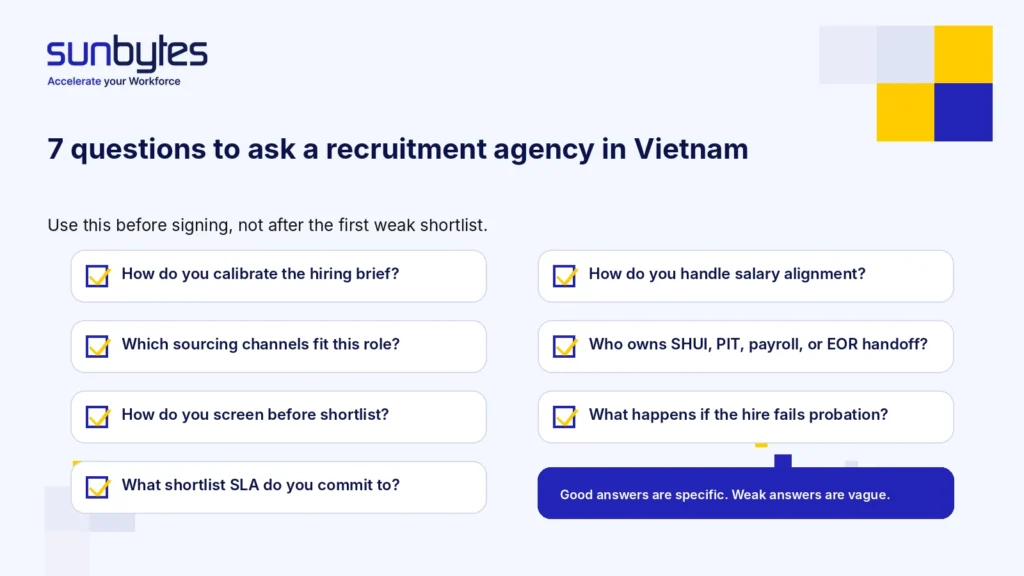
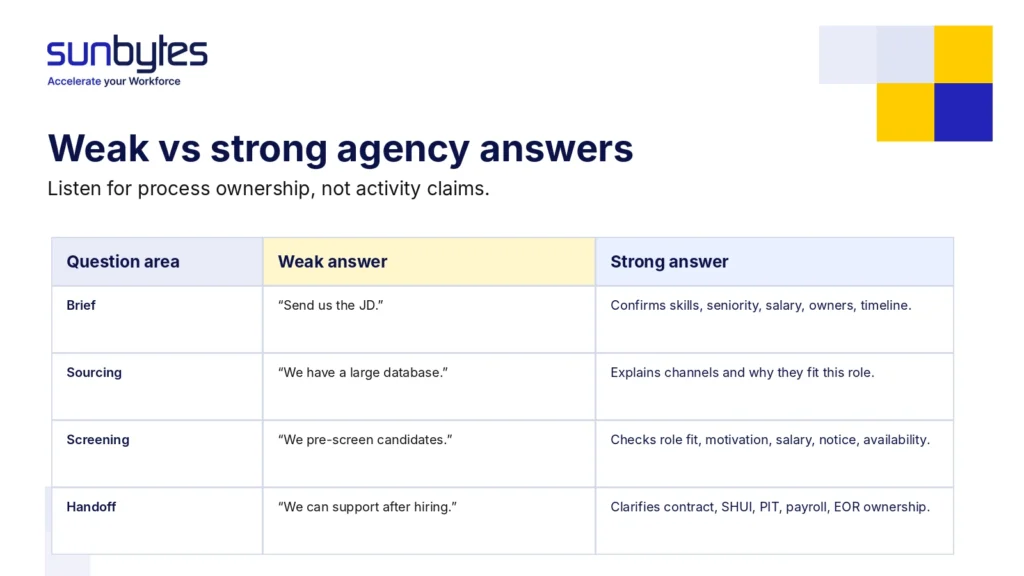
Weak vs strong agency answers: what to listen for
Weak agency answers are usually activity-based. Strong agency answers are process-based.
That difference matters because your team is not buying CV volume. Your team is buying a controlled hiring process that reduces wasted interviews, salary surprises, and post-offer delays.
| Question area | Weak agency answer | Strong agency answer |
|---|---|---|
| Brief calibration | “Send us the JD and we will start.” | “We confirm must-have skills, salary range, seniority, English level, interview owners, and decision timeline before sourcing.” |
| Sourcing | “We have a large database.” | “For this role, we will use direct outreach, referrals, local communities, and active candidate channels. Here is why.” |
| Screening | “We pre-screen all candidates.” | “We screen for role fit, motivation, salary expectation, notice period, communication, and practical availability before shortlist.” |
| Shortlist SLA | “We work quickly.” | “First shortlist within 3 days from brief sign-off if salary range and role scope are confirmed.” |
| Salary alignment | “We know the market.” | “We flag salary mismatch before final interview and explain where the range sits against current candidate expectations.” |
| Compliance handoff | “We can support after hiring.” | “We clarify who owns contract, SHUI, PIT, payroll, EOR, or direct employment before offer acceptance.” |
| Replacement risk | “We have warranty.” | “The warranty period, replacement trigger, payment timing, and re-search responsibility are written in the agreement.” |
What changes when the role is technical or software-related?
Technical recruitment needs deeper screening because job titles do not prove stack depth, project ownership, or communication fit. A software candidate can list the right technologies and still be wrong for your team.
The agency should test more than keywords. Ask how the agency checks:
- which stack the candidate used most recently,
- whether the candidate built features, maintained code, reviewed pull requests, or led delivery,
- how the candidate explains technical decisions,
- whether the candidate has worked with remote teams,
- whether English communication is strong enough for your interview process,
- whether salary expectations match your seniority requirement.
A Vietnam tech recruitment partner should also know when a role brief is too broad. “Full-stack developer with DevOps, cloud, mobile, AI, and strong English” may look efficient in a job description. In practice, it often creates a smaller candidate pool and a slower shortlist.
For technical roles, your agency should help narrow the search before sourcing starts. Better brief, better shortlist.
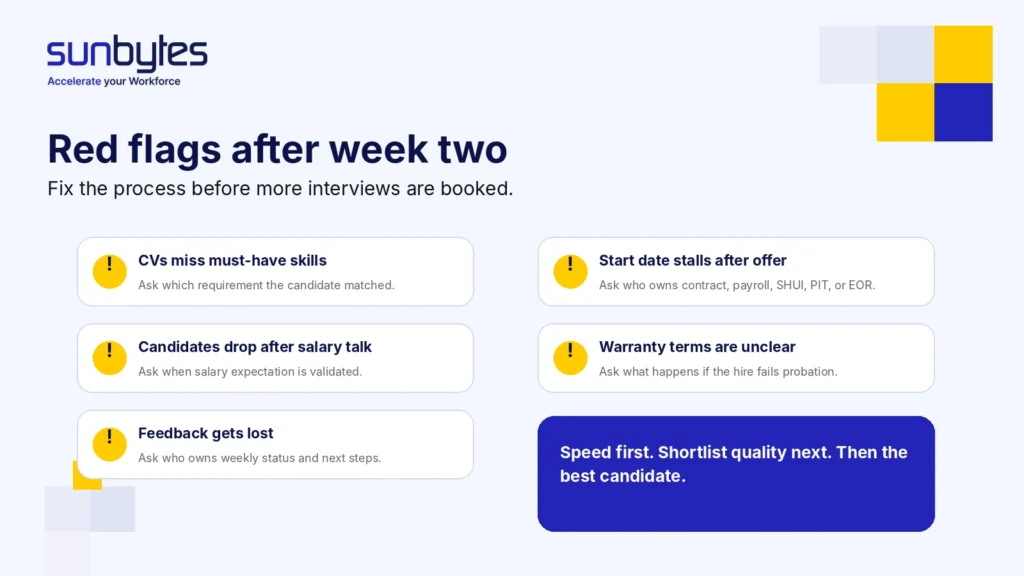
Red flags that usually appear after week two
Weak agency selection usually becomes visible after the first shortlist. The sales call feels fine, then your hiring manager starts seeing mismatched CVs, missing salary signals, or unclear follow-up.
Use week two as a checkpoint. If these signs appear early, fix the process before more interviews are booked.
| Red flag | What it usually means | What to ask next |
|---|---|---|
| CVs arrive quickly but miss must-have skills | The brief was not calibrated | “Which requirement did this candidate match?” |
| Candidates drop after salary discussion | Salary expectation was not checked early | “When do you validate salary expectation?” |
| Hiring manager feedback gets lost | No feedback cadence exists | “Who owns weekly status and next steps?” |
| Offer is accepted but start date stalls | Employment handoff was not planned | “Who owns contract, payroll, SHUI, PIT, or EOR?” |
| Warranty terms are unclear | Replacement risk was not defined | “What happens if the hire fails probation?” |
Speed went first. Then shortlist quality. Then the candidate your team actually wanted.
Turn these questions into a shortlist process
Need a buyer-side agency checklist before your first Vietnam search starts? Sunbytes can help turn these seven questions into a controlled shortlist process, from role calibration to interview coordination and offer handoff.
How Sunbytes supports Vietnam recruitment
When agency selection feels unclear, your recruitment process usually slows down after the first shortlist. Sunbytes gives your team one accountable recruitment layer in Vietnam, from role calibration to vetted shortlist, interview coordination, and employment handoff.
The Accelerate Workforce Solutions team owns the hiring process. Before sourcing starts, Sunbytes helps confirm role requirements, salary expectations, seniority level, interview owners, and timeline. Once the brief is signed off, the first shortlist is prepared within 3 days. Time-to-hire is 14 days when the role scope, salary range, and decision owners are confirmed.
For technical roles, Sunbytes brings in delivery experience from Digital Transformation Solutions work. This helps the recruitment team read beyond keywords on a CV and check whether a developer has the right stack depth, project context, communication level, and remote collaboration fit. Your hiring manager receives candidates who have already been screened against the actual work, not only the job title.
When candidate data, assessment notes, or onboarding documents need to move between teams, Sunbytes applies the control mindset from Cybersecurity Solutions work. Candidate information is handled through a structured process, with clear access ownership, GDPR/AVG awareness, and handoff points that reduce confusion before the offer is accepted.
If the selected candidate also needs employment setup, Sunbytes can connect recruitment to the right workforce layer, including payroll, EOR, SHUI, PIT, or contract handoff. Your team does not need to solve that after the candidate has already said yes.
Talk to Sunbytes about your Vietnam recruitment shortlist