

Recruitment agency fees in Vietnam are usually evaluated as a percentage. That is useful for budgeting, but it does not tell you whether the hiring process will actually cost less.
The fee is only one line in the total hiring cost. Your real cost also includes manager screening time, slow shortlist delivery, offer drop-off, salary mismatch, and the risk of replacing a hire after probation.
A practical way to evaluate the fee is to ask what work it removes from your team. A good recruitment partner should reduce CV noise, shorten shortlist time, support offer acceptance, and prepare a clean handoff into contract, payroll, and onboarding.
If you are exploring hiring support, you can review our recruitment services in Vietnam to understand how the process is structured.
TL;DR
- Recruitment agency fees in Vietnam typically range from 18–25% of first-year salary, but vary based on role complexity, urgency, and service scope; a lower fee may increase overall cost if it leads to delays or poor candidate quality.
- Evaluate fees beyond percentage by considering manager time, hiring delays, offer risks, and replacement terms.
- Ensure clear candidate data handling and employment handoff processes before starting the recruitment.
How much are recruitment agency fees in Vietnam?
In Vietnam, recruitment agency fees are usually calculated as a percentage of the candidate’s first-year salary. For most permanent positions, companies often plan for a fee in the range of 18 to 25 percent of the first-year salary. In some cases, fees may reach up to 27 percent, depending on the nature of the search. It is important to confirm the actual fee with the agency before proceeding.
These fee ranges are not fixed and can vary. Fees may be higher for senior roles, positions requiring rare skills, urgent searches, or when the agency provides additional services beyond sourcing.
For example, a mid-level developer position with a standard salary range, typical hiring timeline, and a clear interview process will usually have a different fee structure than a senior cloud engineer search that requires bilingual skills and a quick turnaround.
When considering agency fees, it is helpful to look beyond the percentage and understand what services are included. If the fee covers role calibration, market salary insights, structured screening, interview coordination, offer support, and replacement guarantees, it can help reduce the overall cost and risk of hiring, even if the percentage appears higher.
Vietnam’s Labor Code No. 45/2019/QH14 expanded the definition of employee to include anyone who works under an agreement, receives payment, and is managed and supervised by the employer. Because of this, it is important to ensure that the employment arrangement is clearly established before the new hire begins work, not just after candidate selection.
Common recruitment fee models in Vietnam
Recruitment agencies in Vietnam may price work through contingency, fixed-fee, retained search, or recruitment process support. Each model changes who carries the risk and how much ownership the agency has over the search.
| Fee model | How it works | When it fits | Risk to watch |
|---|---|---|---|
| Contingency search | The fee is paid after a successful hire. | One or a few roles with clear requirements. | If several agencies compete, ownership of screening quality can drop. |
| Fixed fee | The client agrees on a fixed project or role fee. | Roles with stable scope and predictable hiring needs. | Replacement terms and shortlist quality must be clear. |
| Retained search | Payment is split across search stages. | Senior, specialist, or confidential roles. | Higher upfront commitment needs strong reporting and milestones. |
| RPO-style support | Recruitment support is charged as a process or monthly service. | Ongoing hiring across multiple roles. | SLA, reporting, and hiring ownership must be defined from day one. |
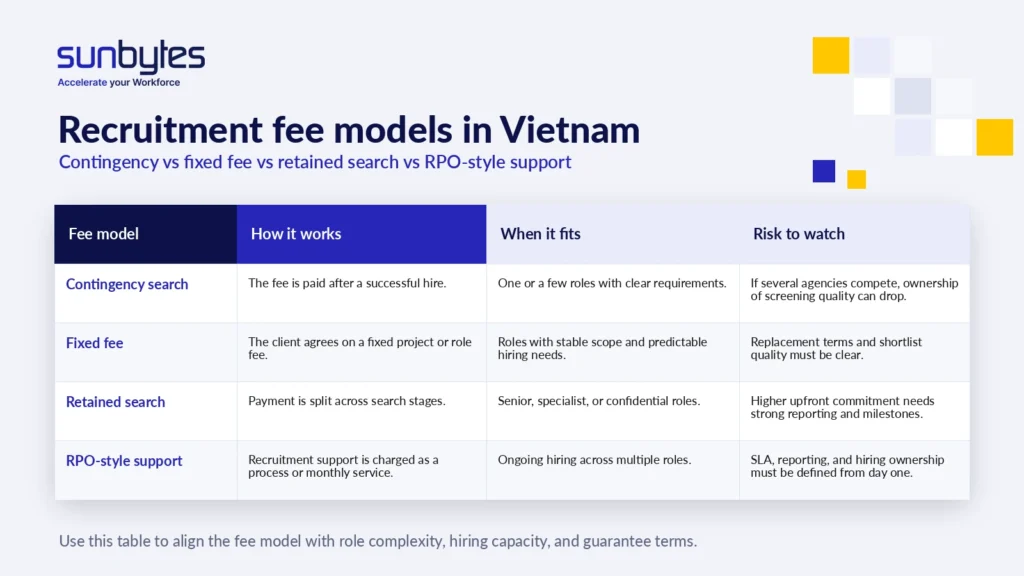
A contingency model can work when your role is clear and the candidate pool is active. A retained model may be more suitable when the role is scarce or senior enough to require mapping, direct outreach, and controlled communication.
The fee model should match your internal hiring capacity. If your hiring manager can screen CVs daily and move fast, a lighter model may be enough. If your manager is already losing hours to weak profiles, the fee should cover deeper screening and coordination.
What changes the recruitment fee?
Recruitment fees change when the search becomes harder to run. The main drivers are role seniority, skill scarcity, location, language requirement, urgency, exclusivity, screening depth, and guarantee terms.
Developer roles are a useful example. A standard mid-level web developer search is not the same as a senior backend, DevOps, data, or AI-related search. The second type usually needs more market mapping, more candidate qualification, and tighter salary calibration.
To better understand salary expectations, you can review our software developer salary benchmarks.
Salary clarity matters before sourcing begins. If your approved range is below the market, the agency may still send candidates, but offer acceptance will become the problem. Your shortlist may look active, yet the process slows down when candidates reject the offer or leave for another company with a clearer package.
Urgency also changes the fee conversation. If the role needs to close quickly, the recruitment partner must add more sourcing bandwidth, faster screening cycles, and tighter interview coordination.
Time-to-shortlist: 3 days from brief sign-off is possible when the role scope, salary range, and decision path are clear. Time-to-hire: 14 days depends on fast feedback from your hiring team and a realistic offer process.
Recruitment ROI in Vietnam: fee vs internal cost of delay
A recruitment fee should be compared with the cost of delay, not only with another agency’s percentage. If internal hiring adds three or four weeks, your cost includes the empty seat, manager screening hours, delayed delivery, and candidate drop-off.
The delay is often caused by unclear role scope or slow feedback. A candidate available on Monday can be in another process by Thursday. Your hiring cost rises when the shortlist arrives late or when your team spends time screening profiles that should have been filtered earlier.
For a deeper comparison, see our guide on recruitment agency vs in-house hiring in Vietnam.
| Cost item | Internal-only hiring | Agency-supported hiring |
|---|---|---|
| Developer monthly salary | €3,000 | €3,000 |
| Time to first qualified shortlist | 3–4 weeks | 3 days from brief sign-off |
| Manager screening hours | 20–30 hours | 6–10 hours |
| Recruitment agency fee | €0 | 18–25% of first-year salary |
| Cost of delayed start | €X | lower delay cost |
| Replacement risk | Higher if screening is weak | Lower if warranty terms are clear |
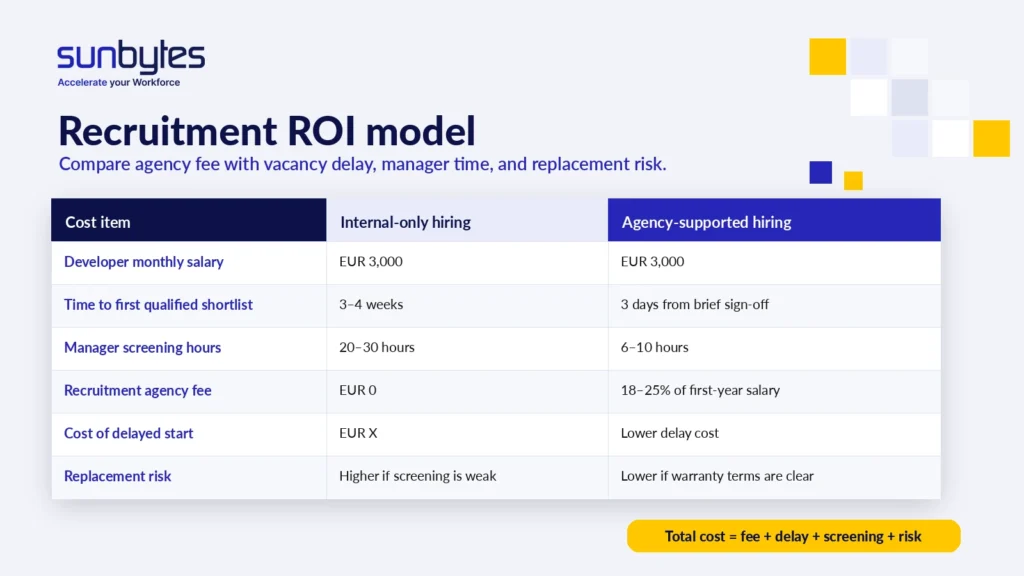
The table is not meant to prove that agency hiring is always cheaper. It shows where the real comparison belongs.
If your team already has local salary data, sourcing capacity, screening time, and fast decision owners, internal hiring may work. If your hiring manager is reviewing weak CVs every week and still cannot close the role, the agency fee may be cheaper than another month of delay.
Need a clearer recruitment budget?
Explore Sunbytes recruitment packages to compare recruitment fee, internal hiring effort, and time-to-hire risk before you approve your first Vietnam role.
What should be included in a recruitment agency fee?
A useful recruitment agency fee should cover more than candidate sourcing. It should include brief calibration, market salary feedback, sourcing, screening, shortlist notes, interview coordination, offer support, and replacement terms.
The first part is brief calibration. Before the search starts, the agency should challenge unclear requirements, unrealistic salary ranges, and missing decision steps. This saves time later because the wrong brief produces the wrong shortlist.
The second part is screening quality. Your hiring manager should not receive a pile of CVs with no context. A useful shortlist explains why each candidate fits the role, what risks remain, and what should be checked in the interview.
The third part is offer support. In Vietnam, candidate movement can be fast for in-demand roles. If your offer process takes too long, the fee does not protect you. The agency should help manage salary expectations, notice period questions, and candidate motivation before the final stage.
If you are evaluating partners, read our guide on how to choose a recruitment agency in Vietnam.
Replacement terms should also be written clearly. Ask when the guarantee applies, how long it lasts, what happens if the candidate resigns during probation, and whether the replacement search has extra conditions.
When does a lower recruitment fee become risky?
A lower recruitment fee becomes risky when it removes the work that protects hiring quality. The most common signs are weak screening, unclear replacement terms, no salary calibration, limited candidate notes, and no handoff after offer acceptance.
The risk usually appears after your team has already spent time.
Your hiring manager reviews CVs that do not match the brief. Interviews happen with candidates who were never aligned on salary. A preferred candidate reaches offer stage, then declines because expectations were not checked early enough.
That is when the cheaper fee becomes expensive.
For developer roles, the biggest issue is often technical mismatch. A CV may show the right keywords, but the candidate may not have worked at the depth your project requires. The recruitment fee should pay for better filtering before your technical team spends interview time.
A lower fee can still work if the role is simple, the candidate pool is active, and your internal team can handle screening. It becomes risky when the role is scarce, your team has limited Vietnam market knowledge, or the agency does not own shortlist quality.
What to check before approving a Vietnam recruitment fee
The fee should be reviewed together with the data, handoff, and employment process. Recruitment involves candidate CVs, contact details, salary expectations, interview notes, and sometimes assessment results. Personal data includes information relating to an identified or identifiable living person, and data processing includes collection, storage, consultation, use, disclosure, and erasure.
Before sharing candidate data, agree who controls the purpose of processing, who processes data on whose instructions, how long candidate data is retained, and who can access interview notes. A data controller determines the purposes and means of processing, while a processor handles personal data on the controller’s documented instructions.
Data protection responsibility should be visible in the recruitment setup. The agency fee should not only buy sourcing time. It should also support a cleaner process for candidate data, screening notes, and offer handoff.
The Vietnam-side handoff should also be clear. Once the candidate accepts, someone must own contract preparation, payroll setup, SHUI/PIT coordination, and onboarding documents. If recruitment and employment setup are split across teams, confirm where the handoff happens before the search begins.
A 4–5 hour working overlap can help when interviews, feedback, and offer decisions need to move fast. That overlap only helps if decision owners are named before sourcing starts.
How Sunbytes structures recruitment value in Vietnam
Recruitment value starts before sourcing. If the role brief is unclear, the salary range is not market-ready, or decision owners are missing, the fee can quickly turn into more CV review work for your team.
Sunbytes structures Vietnam recruitment around one practical outcome: your hiring team receives fewer weak profiles and moves faster with the candidates who fit. Through Accelerate Workforce Solutions, Sunbytes handles brief calibration, sourcing, shortlist quality, interview coordination, offer support, and recruitment handoff. Time-to-shortlist: 3 days from brief sign-off. Time-to-hire: 14 days when role scope, salary range, and decision owners are confirmed.
From Digital Transformation Solutions, Sunbytes helps structure the workflow around clear hiring stages, feedback loops, shortlist notes, and handoff points, so your team can see where each role stands. Through our Cybersecurity Solutions, candidate data handling, access control, GDPR/AVG awareness, and document protection are built into the process instead of being treated as an afterthought.
That combination is useful for companies hiring in Vietnam for the first time. Your recruitment fee should not only buy sourcing time. It should reduce internal workload, protect candidate data, and prepare the next step after offer acceptance, whether that is contract setup, payroll, EOR, or onboarding.
Explore Sunbytes recruitment packages to plan your Vietnam hiring approach.