

Hiring international employees is becoming a priority for companies expanding beyond their home market. The benefits are clear: access to global talent, more competitive cost structures, and broader market coverage.
This guide explains how to hire international employees legally by using three proven methods and how to choose the right approach.
TL;DR
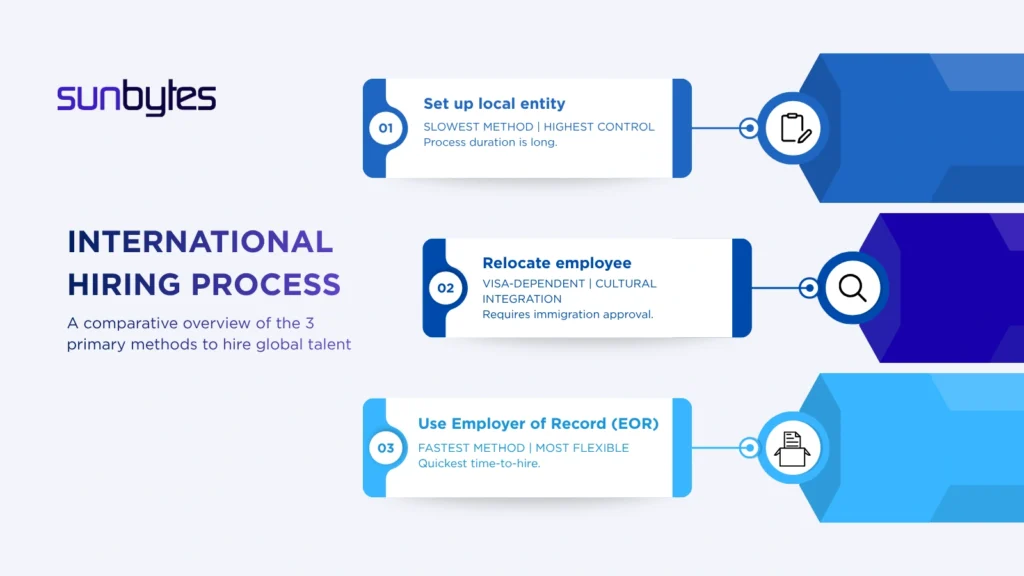
- There are 3 legal ways for hiring international employees: Setting up a local entity, relocating the worker, or using an Employer of Record (EOR) service.
- If you are hiring fewer than 20 employees in Vietnam, EOR is faster and cheaper than entity setup. The time difference is 2 to 4 weeks vs 3 to 6 months. (IFLR, Foreign Investment in Vietnam 2026)
- Every employer in Vietnam must register employees for SHUI, withhold PIT at the correct rate, issue bilingual contracts, and secure work permits for foreign staff. Getting any of these wrong creates liability that surfaces during a labor inspection.
Why companies are hiring international employees
Companies are increasingly hiring international employees to stay competitive in a global market, scale faster, and fill critical skill gaps. Global hiring is no longer a long-term strategy but an immediate solution to workforce challenges.

Access to talent pools that do not exist at home
Skill shortages in specific technical disciplines, local-language capability for regional markets, and deep domain expertise in emerging sectors are increasingly found outside a single country’s talent market.
58% of small businesses hire internationally because they cannot find necessary talent domestically. The talent access argument has become the primary driver for international hiring decisions across technology, engineering, and professional services. (Gusto SMB Survey, 2023)
Cost efficiency without sacrificing quality
Labor cost differentials between markets remain significant. A senior software engineer in Vietnam earns a fraction of the equivalent salary in Western Europe or North America, yet has comparable technical capability across many domains.
Understanding the full cost picture requires accurate compensation benchmarking. The guide to average salary in Vietnam provides current market data by role, level, and sector for companies building hiring budgets for their Vietnam teams.
Market proximity and global coverage advantages
A team that spans time zones extends the operational day. A team with cultural and linguistic proximity to a target market opens commercial opportunities that a purely domestic team cannot access. These are not soft benefits, they translate directly into measurable business impact.
The compliance complexity that most companies underestimate
International hiring compliance is the part most organizations discover too late. Every country has its own employment classification rules, tax withholding obligations, mandatory benefits, notice periods, and termination procedures. Doing it wrong does not look like a fine on day one. It looks like a labor dispute 18 months later.
The good news is that the compliance challenge is entirely solvable with the right structure. The three methods covered below represent the main legal paths to hiring across borders.
Hiring international employees vs contractors: Getting the classification right
Before hiring international employees, clarify who you are actually hiring. International employee vs contractor is the most consequential classification decision in cross-border workforce strategy. And it needs to be made correctly before any hiring process begins.
What defines an employee vs independent contractor internationally
The distinction varies by jurisdiction, but the core question is consistent: does the company control how, when, and where the work is done? If yes, the worker is typically an employee regardless of what the contract says.
| Factor | Employee | Independent Contractor |
|---|---|---|
| Control | Employer controls method and schedule | Worker controls method and schedule |
| Equipment | Company-provided | Self-provided |
| Exclusivity | Usually exclusive to employer | Can work for multiple clients |
| Benefits | Employer-mandated (social insurance, leave) | Self-managed |
| Tax | Employer withholds and remits | Worker handles own tax obligations |
| Risk | Low for worker | Worker bears commercial risk |
| Termination | Statutory notice and severance apply | Per contract terms |
The legal and financial risk of misclassification
Classifying an employee as a contractor removes tax obligations in the short term. When reclassified, the employer faces back-payments and penalties.
In Vietnam, misclassification is assessed by labor inspectors who look at the actual working arrangement, not the contractual label. A contractor who works exclusively for one company, follows that company’s schedule, and uses company equipment will be treated as an employee.
When to hire an employee and when a contractor is enough
Contractors work well for project-based or time-limited engagements where the scope is defined and the relationship is genuinely commercial. Employees are the right structure for ongoing operational roles, roles with management responsibility, or any position where the company controls the working arrangement.
How contractor of record (cor) manages contractor compliance
For companies that need contractor flexibility with legal protection, a Contractor of Record structure engages the contractor compliantly under the COR’s legal entity, ensuring proper contracts, payment processing, and local tax compliance without the worker being classified as a company employee.
Employer of Record(EOR) in Vietnam and Contractor of Record services provide both engagement models within a single compliant structure, giving companies the flexibility to match the right arrangement to each role.
Method 1: Set up a local legal entity
A local legal entity, also called a foreign subsidiary or daughter company, is a business registered in the target country under the control of a parent company. It is the most direct way to hire employees, but also the most resource-intensive.
What a local legal entity gives you
A registered entity allows you to hire employees directly, open local bank accounts, enter commercial contracts, and operate as a recognized legal presence in the market. It provides the highest level of operational control and the most straightforward path to scaling a large local team.
The trade-off is that you take on the entire compliance responsibility. Employment law changes, tax obligations, labor disputes, and regulatory requirements all fall directly on the entity without the buffer that an EOR provides.
Which organizations should set up a local entity
Entity setup is the right call when you plan to hire more than 30 to 50 employees in the same country over a 12 to 24 month period, need to establish a commercial presence for client facing or revenue generating activities, require full control over employment terms and company culture from day one, and have experienced in country HR and legal resources to manage ongoing compliance.
The real cost and timeline of entity setup in vietnam
Setting up a foreign-invested company in Vietnam requires Department of Planning and Investment (DKI) registration, investment registration certificate, enterprise registration certificate, tax code registration, and social insurance account setup.
The process typically takes 3 to 6 months when documentation is complete. Common delays include charter capital requirements, legal representative appointments, and back-and-forth on investment purpose classification.
Typical costs:
- Legal and registration fees: USD 5,400 to 16,200, depending on complexity
- Accounting and compliance setup: USD 3,200 to 8,600 in year one
- Ongoing HR, payroll, and compliance management: USD 21,500 to 43,000 annually for a small team
- Opportunity cost of 3 to 6 months before the first hire can be made legally
When entity setup is the right call and when it is not
For most companies hiring their first 5 to 20 people in Vietnam, entity setup is the wrong starting point. Hiring employees in another country without entity support, using an EOR, is faster by months and cheaper by tens of thousands of dollars at this scale.
For companies evaluating Vietnam as a potential market entry point, the market entry considerations extend beyond employment. Entity setup is a commitment that locks in a legal and tax structure that is expensive to unwind if the market strategy changes.
Method 2: Relocate the employee to your home country
The second option involves sponsoring a foreign worker to move to your home country or to a country where you already have a legal entity. Rather than expanding your employment structure internationally, you bring the talent to where your structure already exists.
How employee relocation works in an international hiring context
Relocation involves sponsoring a work visa, assisting with immigration procedures, and, in many cases, providing relocation support, including housing, travel, and family assistance. The employer becomes responsible for maintaining the worker’s legal right to work throughout their employment.
This method keeps the employment relationship within an existing legal structure, which simplifies payroll and compliance. The complexity shifts to immigration, which varies significantly by nationality and destination country.
Which organizations should consider relocation
Relocation makes sense when the role cannot be performed remotely and requires on-site presence, the candidate is actively seeking to relocate and this creates a recruitment advantage, the company aims to build a culturally integrated team at its headquarters, and the target market is the home country, where local market knowledge is the primary value of the hire.
Sponsoring work visas and managing immigration compliance
Visa sponsorship requires registering as a sponsor with immigration authorities in the destination country, filing the appropriate work authorization documentation, and maintaining the employee’s legal status throughout their employment. Each change of role, location, or employer requires updated filing.
The complexity and timeline depend heavily on nationality, destination country, and role classification. EU Blue Card programs, US H-1B visas, and Australian Skilled Migrant visas all operate under different criteria, quotas, and timelines. Legal counsel in the destination country is not optional.
Work permit requirements for foreign employees in Vietnam
For companies bringing foreign employees into Vietnam, Decree 219/2025/ND-CP (effective August 2025) governs the work permit process. The employer must apply for approval at least 10 days before the employee’s intended start date, and the work permit is valid for a maximum of 2 years.
Required documents for a Vietnam work permit:
- Written employer request explaining the need for a foreign employee
- Criminal background certificate from the home country, legalized by the Vietnamese embassy, issued within 6 months
- Health certificate from a qualified medical facility, issued within 12 months
- Proof of qualifications or at least 3 years of relevant professional experience
- 2 color photographs (4cm x 6cm, white background)
Method 3: Hiring international employees by using an Employer of Record (EOR)
An Employer of Record is a third-party organization that employs workers on behalf of a client company. The EOR is the legal employer of record in the hiring country, managing all employment compliance, payroll, taxes, and mandatory benefits, while the client company directs the day-to-day work.
This is the method that has enabled employers of record international hiring to grow into one of the dominant models for cross-border workforce expansion, particularly for companies entering new markets without established entities.
What an employer of record does and how it works
An Employer of Record employs workers under a compliant local contract in the hiring country, manages payroll processing including local currency payments and tax withholding, handles mandatory social insurance contributions such as SHUI in Vietnam, administers statutory benefits and leave entitlements, and oversees employment documentation as well as regulatory filings while serving as the legal employer for all compliance purposes.
The client company retains full control over the employee’s day to day tasks, deliverables, and performance management, while the EOR takes full responsibility for administrative and legal employer obligations.
Which organizations should use an EOR for international hiring
EOR is the right structure when you need to hire quickly in a country where you have no legal entity, or when you want to test a new market before committing to entity setup costs. It is also ideal if your team size in the target country is below 30 employees and the ROI of setting up an entity does not yet make sense.
Additionally, EOR works well when you want payroll, compliance, and employment administration handled by local specialists, or when you do not have in-country HR and legal resources to manage these functions internally.
EOR vs setting up a local entity: A direct comparison
| Factor | Local Entity | Employer of Record |
|---|---|---|
| Setup time | 3 to 6 months | 2 to 4 weeks |
| Upfront cost | USD 8,600 to 24,800+ | Minimal (service fee per employee) |
| Compliance ownership | Client company | EOR manages on behalf of client |
| Payroll processing | Client manages or outsources | Included in EOR service |
| Best for team size | 30+ employees long-term | 1 to 30+ employees, any stage |
| Market exit flexibility | Low (entity wind-down required) | High (contracts can be exited cleanly) |
| Control level | Full operational control | Full work direction control |
How EOR handles Payroll, Tax, and Labor Compliance in Vietnam
In Vietnam, the EOR registers employees for social, health, and unemployment insurance (SHUI), withholds personal income tax (PIT) at progressive rates under Circular 111/2013/TT-BTC, and processes payroll in Vietnamese dong through a local bank account.
The EOR also manages employment contract requirements under the Vietnam Labor Code 2019, including mandatory bilingual contract provisions, probation terms, and statutory notice periods.
For companies comparing full employment via EOR with outsourced project delivery, the Recruitment Process Outsourcing (RPO) model provides an alternative that suits specific talent acquisition contexts without the ongoing employment commitment.
A full evaluation of the pros and cons of using an Employer of Record (EOR) covers the decision framework in more detail, including scenarios where EOR is not the optimal structure.
Hire independent contractors for international work (Bonus option)
Hiring international contractors is an accessible entry point for companies with fluctuating or project-based needs. It requires no entity, no mandatory benefits administration, and often less administrative setup than full employment.
When international contractors make sense
Contractor arrangements are suitable for project-based or time-limited engagements with a clearly defined scope, especially when specialist skills are needed for a specific phase rather than an ongoing function.
They also work well for roles where the worker independently controls their method, schedule, and client base, as well as for early-stage market testing when committing to full employment is still premature.
What independent contractors manage themselves vs what you must handle
Independent contractors manage their own taxes, insurance, equipment, and benefits. They invoice the company for their services and are responsible for their own legal status.
What you must handle: proper contractor agreements that accurately reflect the working arrangement, compliant payment processing across jurisdictions, and ongoing assessment of whether the arrangement still meets the classification criteria that justify contractor status.
Contractor of Record (COR): Compliance without the employment commitment
A Contractor of Record engages the contractor under a compliant local contract, processes payments through a local structure, and manages the legal relationship. This structure is particularly useful in Vietnam, where informal contractor arrangements carry misclassification risk and payment processing through foreign accounts creates PIT compliance questions.
For companies evaluating build vs buy decisions across different workforce configurations, the outsourcing vs offshoring framework provides a useful structure for matching workforce models to business objectives.
The table below summarizes all four workforce options across the key decision variables:
| Option | Speed | Cost | Compliance owner | Best for |
|---|---|---|---|---|
| Local entity | Slow (3-6 months) | High upfront | Client company | Large, long-term teams |
| Relocation | Medium (visa timeline) | Medium | Client company | On-site roles, HQ culture build |
| Employer of Record | Fast (2-4 weeks) | Per-employee fee | EOR | Any size, fast entry |
| Contractor (direct) | Fast | Low | Worker | Project-based, short-term |
| Contractor of Record | Fast | Low-medium | COR | Compliant contractor engagement |
Ready to hire in Vietnam without the entity overhead?
Sunbytes helps international companies hire, manage, and pay compliant teams in Vietnam through EOR, staffing, and Contractor of Record services. From employment contract setup to SHUI registration and payroll, we handle the compliance so your team can focus on the hire.
Explore Accelerate Workforce Solutions
Hiring international employees in Vietnam: What foreign companies must know
Hiring in Vietnam for foreign companies involves a specific legal and administrative environment that differs meaningfully from Western markets. The obligations are clear, but they must be understood and implemented correctly from the first employment relationship.

Vietnam Labor Code 2019: Key obligations for foreign-invested companies
The Vietnam Labor Code 2019 (Law 45/2019/QH14) applies to all employment relationships in Vietnam, including those within foreign-invested enterprises. There is no reduced obligation set for foreign companies.
Key provisions include: written employment contracts are mandatory for all roles lasting more than 3 months, probation periods are regulated (maximum 180 days for managers, 60 days for other roles), and termination requires documented cause and statutory notice periods.
Employment Contracts, Probation Periods, and Termination Rules
If your employment contract in Vietnam is not bilingual, it is legally deficient. You will discover this during a labor inspection, not before. Every contract must specify the job title, salary, working hours, workplace location, and applicable allowances and benefits.
Under Vietnam Labor Code 2019, wrongful termination carries back-pay obligations and reinstatement risk. Foreign companies that apply home-country termination practices without understanding the Vietnamese statutory framework regularly discover this exposure during labor inspections or disputes.
Probation rules by role category:
- Managers and executives: maximum 180-day probation
- Professionals with university degree or above: maximum 60-day probation
- Other employees: maximum 30-day probation
- During probation: either party may terminate without notice or compensation
SHUI, PIT, and Payroll Compliance for International Employees
SHUI contributions in Vietnam are employer-funded (approximately 17.5% of salary) and employee-funded (approximately 10.5%). Both are calculated on a base salary defined in the employment contract, with a contribution ceiling updated annually by the government.
Personal income tax is withheld by the employer at progressive rates from 5% to 35% under Circular 111/2013/TT-BTC. Foreign employees are taxable residents if they spend more than 183 days in Vietnam in a calendar year, with specific treaty positions applying for some nationalities.
Work permit and residency requirements for foreign employees
Foreign nationals working in Vietnam require a work permit under Decree 219/2025/ND-CP unless they qualify for one of the statutory exemptions. The work permit is valid for up to 2 years and must be applied for by the employer.
Upon receiving a work permit, the foreign employee can apply for a Temporary Residence Card (TRC) valid for up to 2 years, which replaces the need for periodic visa renewal during their employment period.
Why EOR is the fastest compliant path into Vietnam for most companies
For companies entering Vietnam without an established entity, the EOR model resolves the compliance challenge on day one. The EOR’s existing legal entity, SHUI registration, payroll infrastructure, and compliance processes are immediately available to the client company’s new hires.
The alternative, building that infrastructure through entity setup, takes 3 to 6 months and significant cost before the first employee can be legally engaged. For companies that need talent now, that timeline is the wrong answer.
The full framework for Employer of Record engagement in Vietnam, including how the EOR relationship works under Vietnamese law, is covered in the Employer of Record Vietnam for FDI guide.
How to pay international employees compliantly
Knowing how to pay international employees in compliance with local tax laws is a distinct operational challenge from knowing how to hire them. Payment mechanics, currency rules, and tax obligations differ significantly by hiring method and country.
Local currency payroll vs foreign currency payment: What the law requires
In Vietnam, the Labor Code requires that salaries be paid in Vietnamese dong (VND) unless the employee is a foreign national whose employment contract explicitly provides for foreign currency payment. Even then, the payment must be routed through a Vietnamese bank account.
Paying Vietnamese employees directly to a foreign bank account in a foreign currency is not compliant under Vietnamese law. Companies running payroll from offshore accounts without an EOR or local entity are creating tax reporting gaps and currency control violations.
Tax withholding and employer payroll obligations by method
| Hiring Method | PIT Withholding | SHUI Registration | Payroll Currency | Complexity |
|---|---|---|---|---|
| Local entity | Employer withholds and files | Employer registers | VND required | High, handled internally |
| EOR | EOR withholds and files | EOR registers employee | VND processed by EOR | Low, EOR manages all |
| Direct contractor | Contractor self-manages | Not applicable | Flexible (invoice-based) | Medium, contractor compliance risk |
| Contractor of Record | COR handles filing | Not applicable | COR processes payment | Low, COR manages |
How EOR handles cross-border payroll and compliance
An EOR runs payroll in the local currency through its local bank account and corporate structure. The client company sends the gross payroll amount in their home currency, and the EOR converts, processes, and distributes net salaries to employees in Vietnamese dong.
All PIT filings, SHUI contributions, and payroll tax reporting are handled by the EOR under its own tax registration. The client company receives a monthly payroll report with full cost transparency but carries no direct tax filing obligation in Vietnam.
For a complete view of how Vietnam payroll compliance works and what employers are responsible for under local law, the payroll compliance in Vietnam guide covers the full employer obligation set.
How Sunbytes helps international companies hire and scale in Vietnam
Hiring international employees sounds straightforward until the first compliance question lands. What employment contract format does Vietnamese law require? How does SHUI registration work without a local entity? Who handles PIT withholding when the payroll is run from Amsterdam?
These are the questions Sunbytes was built to answer. We give international companies the operational infrastructure they need to hire compliantly in Vietnam from the first employee onward, without the cost and timeline of entity setup.
Why Sunbytes?
Founded in the Netherlands in 2011 and operating across 20+ countries, Sunbytes brings 15+ years of workforce and technology experience to international companies scaling in Vietnam. With a delivery hub in Ho Chi Minh City, we combine Dutch operational discipline with deep local market knowledge.
Our three service pillars support every stage of international workforce expansion:
- Digital Transformation Solutions – We build and scale technology teams across Vietnam for international companies. For tech-focused hiring, we combine technical recruitment capability with compliant employment structure, reducing the gap between finding the right candidate and getting them on board legally.
- CyberSecurity Solutions – As international hiring scales, so do the data and security obligations. Our cybersecurity practice helps growing teams maintain risk control and compliance across systems as they expand their Vietnam operations.
- Accelerate Workforce Solutions – Our Employer of Record, Contractor of Record, staffing, and payroll services give international companies a fully compliant employment foundation in Vietnam. This means employment contracts in the required format, SHUI and PIT compliance, work permits, and payroll processing, all managed locally from day one.