
Sunbytes staffing services cover four hiring models: temporary staffing, Contractor of Record (COR), Employer of Record (EOR), and IT staffing. The right model depends on engagement duration, compliance requirements, and whether you have a legal entity in Vietnam.
Sunbytes is a Dutch-founded technology and workforce company that has helped international companies build compliant teams in Vietnam since 2011. This guide explains what each model covers, how the process works from role definition to payroll, and how to choose the right structure for your hiring situation.
TL;DR
- Vietnam’s staffing market grew 15% in 2025 and ranks in the top 10 most attractive APAC markets. FDI disbursements hit a five-year high of $27.6 billion, creating hiring demand that moves faster than entity setup allows. EOR and staffing services are the practical entry point.
- Sunbytes staffing services cover four hiring models: Temporary staffing, Contractor of Record, Employer of Record, and IT staffing. The right model depends on engagement duration, role type, and how much compliance liability you want to retain.
- Sunbytes operates through its own legal entity in Vietnam. Employment contracts are issued within 48 hours of receiving complete candidate documentation. Time-to-hire is 14 business days for Vietnamese nationals under EOR and 2 to 6 weeks for temporary staffing roles. Payroll is processed on time, every cycle, under ISO 27001-certified processes.
What are staffing services in Vietnam?
“Staffing services connect companies with qualified workers through a third-party provider that handles sourcing, screening, and employment administration. The client defines the role and directs the work. The staffing provider manages the legal and administrative side of the engagement.”
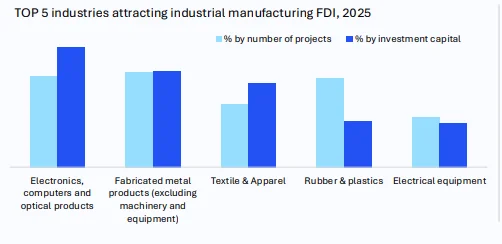
Vietnam’s staffing industry grew 15% in 2025, ranking among the top 10 most attractive staffing markets in APAC according to Staffing Industry Analysts’ 2026 Global Staffing Industry Trends report. FDI disbursements reached a five-year high of $27.6 billion in 2025 (General Statistics Office Vietnam), with manufacturing accounting for 56.5% of newly registered capital. That investment flow creates hiring demand that moves faster than most foreign companies can build internal HR capability.
For international companies entering Vietnam, asking “what are staffing services” is often the wrong question. The more relevant question is which staffing model fits the engagement. A German electronics manufacturer that needed 40 assembly technicians and 3 bilingual operations managers within 8 weeks of lease signing could not wait 16 to 24 weeks for entity setup. A staffing partner sourced and onboarded the technician team in 6 weeks. The managers were placed through permanent staffing in 11 weeks. The manufacturing line launched on schedule.
Staffing services vs Recruitment vs Employer of Record
These three terms describe different points on the same continuum, and using them interchangeably creates real operational confusion.
| Criteria | Recruitment | Staffing Services | Employer of Record (EOR) |
|---|---|---|---|
| Definition | Recruitment is a matchmaking service. A recruiter finds candidates, the client evaluates and hires them, and the recruiter’s involvement ends at placement. | Staffing services go further. The staffing provider sources workers and maintains the employment relationship on an ongoing basis. | Employer of Record (EOR) is a specific staffing model where the EOR becomes the legal employer of record. |
| Employment relationship | The client becomes the employer. | The staffing provider maintains the employment relationship. | The employment contract is between the EOR and the worker. The client company has no direct employment relationship. |
| Scope of responsibility | All employment obligations (SHUI, PIT, labor contracts, annual leave) sit with the client company. | The client directs the daily work; the staffing firm handles payroll, compliance, and HR administration. | The EOR handles employment responsibilities as the legal employer. |
| Compliance liability | Sits with the client company. | Does not sit with the client. The staffing firm handles SHUI registration, PIT withholding, and labor law adherence. | Carried by the EOR entity. |
| Operational role of client | The client evaluates, hires, and fully manages the employee. | The client directs the daily work. | The client directs the daily work. |
| Key advantage | Simple hiring solution with full control by the client. | Reduces administrative and compliance burden while keeping operational control. | Enables compliant hiring in Vietnam without a local entity. |
| Keynote | The recruiter’s involvement ends at placement. | Ongoing service with continuous HR and compliance handling. | This is the model that allows compliant hiring in Vietnam without a local entity, because the EOR’s entity carries the employment. |
When companies actually need staffing services
Four situations consistently drive international companies toward staffing services in Vietnam:
1. Market entry without an entity
Setting up a Vietnamese entity typically takes 16 to 24 weeks and requires charter capital, local representation, and ongoing compliance management. In contrast, a staffing partner or an EOR can have the first hire operational in under two weeks.
2. Volume hiring with a deadline
Recruiting, screening, and onboarding dozens of employees, for example 40 technicians, is not a standard internal HR capability for companies new to Vietnam. Staffing providers already maintain active talent pools and can manage the entire hiring process end to end.
3. Specialist roles that require local networks
Positions such as senior bilingual managers, cloud architects, AI practitioners, or compliance officers are rarely sourced effectively through general job boards. Staffing firms with sector-specific networks can fill these roles faster because the candidates are already identified and engaged.
4. Compliance without infrastructure.
A foreign company paying Vietnamese workers directly, without a staffing or EOR structure, faces misclassification risk under the Labor Code 2019 (Law No. 45/2019/QH14), Article 13. If the working arrangement meets the three-criteria test, the relationship is treated as employment regardless of how the contract is labeled.
Sunbytes staffing services overview
Sunbytes offers four staffing models, each covering a different engagement type. The Sunbytes staffing services overview starts with what you need the hire to do and how long the engagement runs, then routes to the right model.
![Four hiring models available through Sunbytes, matched to engagement type and duration]](https://sunbytes.io/wp-content/uploads/2026/04/How-staffing-services-work-in-practice.webp)
Scope of Sunbytes staffing services
The service covers both short-term and long-term hiring needs, from project-based placements to permanent employment through EOR. It supports a wide range of roles, from blue-collar operations to senior technical specialists.
Sunbytes operates through its own legal entity in Vietnam. This ensures that employment contracts, SHUI registration, PIT withholding, and payroll processing are handled directly, without relying on third-party aggregators or partner networks.
Key operational parameters
- ISO 27001 certified
- All engagements are governed by a signed Data Processing Agreement
- Employment contracts issued within 48 hours after receiving complete candidate documents
- SHUI registration submitted from day one of the contract
- Payroll processed on time, every cycle
- Time-to-hire: 14 days for Vietnamese nationals under EOR
- Offboarding completed within 24 hours
What this means in practice
- Faster hiring without setting up internal infrastructure
- Direct control over compliance through a single provider
- Consistent delivery without dependency on third-party partners
Sunbytes covers hiring across Ho Chi Minh City, Hanoi, Binh Duong, Dong Nai, and other industrial and technology hubs. Both Vietnamese nationals and eligible foreign employees can be engaged through the appropriate model, with work permit coordination handled for foreign hires under Decree 219/2025/ND-CP (effective August 7, 2025).
Sunbytes hiring models explained
The four Sunbytes hiring models differ in who holds the employment contract, who absorbs compliance liability, and how long the engagement typically runs. Choose the model based on your hiring need, not on familiarity with the terminology.
Temporary staffing services (project-based hiring)
Temporary staffing covers short-term placements where Sunbytes employs the worker and supplies them to the client for a defined period or project. This model is commonly used during manufacturing ramp-ups, Tet production peaks, project-based operational needs, or to cover maternity and sick leave.
How the model works
The client directs the daily work, while Sunbytes manages the full employment layer, including the employment contract, SHUI registration, PIT withholding, payroll, and offboarding. This allows the engagement to scale up or down without the client taking on fixed employment costs.
In the German manufacturer case above, 40 technicians were placed under this model, sourced, screened, and registered for social insurance within six weeks.
Duration and flexibility
Assignments typically run from one to twelve months, with extension options available. At the end of the fixed term, the role can be converted into permanent employment through a change in structure if needed.
Typical roles
This model is commonly applied to roles such as assembly workers, production technicians, logistics operators, quality control staff, customer service representatives, and administrative support.
Contractor of Record (COR)
In this structure, the COR holds the service agreement with the contractor and the commercial agreement with the client, while the client retains operational control. Sunbytes absorbs the classification liability.
How the model works
This model is designed for situations where the worker is genuinely independent, but the duration or level of integration makes a direct service agreement risky. Under Vietnam Labor Code 2019, Article 13, any arrangement involving paid work, managerial control, and regular payment is treated as employment regardless of how the contract is labeled. A COR structure removes the client from that liability entirely.
Duration and flexibility
Engagements typically run on a monthly basis with ongoing review. The structure allows flexibility depending on project scope, while still maintaining a compliant framework for longer-term or integrated roles.
Typical roles
This model is commonly used for IT contractors, management consultants, specialized engineers, interim executives, and cross-border project specialists. IP assignment, confidentiality, and scope documentation are built into the Sunbytes COR agreement.
For a deeper comparison with direct freelancer engagement, see the contractor vs freelancer guide.
Employer of Record (EOR) staffing in Vietnam
OR staffing is the model for permanent or long-term employment without a local entity. Sunbytes became the legal employer of record, signing the employment contract under Vietnam Labor Code 2019, registering the employee with Vietnam Social Security for SHUI, withholding and filing PIT, and running payroll. The client defines the role, sets performance expectations, and manages daily work.
How the model works
Under this structure, all statutory obligations are handled through the EOR entity. Employer SHUI contributions total 21.5% of gross salary, including 17.5% for Social Insurance, 3% for Health Insurance, and 1% for Unemployment Insurance under Decree 143/2018/ND-CP. Employee contributions are 10.5%.
Personal Income Tax is withheld monthly on a progressive scale from 5% to 35% and remitted to the General Department of Taxation by the 20th of the following month.
Duration and flexibility
This model is designed for long-term or permanent roles, while still allowing flexibility in workforce planning. Companies can build and manage teams in Vietnam without setting up a local entity, while maintaining full operational control over day-to-day work.
Typical roles
EOR staffing is commonly used for full-time employees across functions, including operations, engineering, finance, and management roles. Time-to-hire is typically 14 business days for Vietnamese nationals, from document receipt to day one.
For foreign employees requiring a work permit, the timeline is usually 3 to 4 weeks under the consolidated process introduced by Decree 219/2025/ND-CP. For the full onboarding sequence, including required documents and how to avoid common delays, see the EOR onboarding guide.
IT staffing services (specialized tech talent)
Sunbytes holds active networks of backend engineers, cloud architects, AI/ML practitioners, cybersecurity specialists, QA engineers, and senior technical leads in Ho Chi Minh City and Hanoi.
Vietnam’s IT staffing market is growing because the talent exists at seniority levels that European markets cannot supply at scale or at comparable cost. A senior backend engineer in Amsterdam typically commands EUR 90,000 to EUR 120,000 in annual gross salary, plus 25% to 30% in employer social contributions. The equivalent role in Ho Chi Minh City ranges from VND 40 to 60 million per month, approximately EUR 1,500 to EUR 2,300, with SHUI at 21.5%.
How the model works
IT staffing engagements can be structured through EOR for permanent roles, COR for contractor or project-based roles, or as dedicated team arrangements where a full engineering function is built and managed in Vietnam. The client retains technical direction, while Sunbytes handles legal employment, payroll, and compliance.
Duration and flexibility
The model supports both long-term team building and short-term project needs, depending on the structure selected. Companies can scale engineering capacity up or down without establishing a local entity or building internal HR infrastructure.
Typical roles
This model is commonly applied to backend engineers, cloud architects, AI/ML practitioners, cybersecurity specialists, QA engineers, and senior technical leads, particularly in Ho Chi Minh City and Hanoi where talent concentration is highest.
Staffing vs COR vs EOR: which one should you use?
| Criteria | Temporary staffing | Contractor of Record | Employer of Record |
|---|---|---|---|
| Employment type | Sunbytes employs, supplies to client | Service agreement, not employment | Full employment contract (Labor Code 2019) |
| Duration | 1 to 12 months | 1 month to ongoing | Ongoing, no fixed term |
| Best for | Volume, seasonal, project-based | Specialist contractors, project work | Permanent team members |
| Statutory benefits (SHUI) | Yes, handled by Sunbytes | No (civil contract, not labor contract) | Yes, handled by Sunbytes |
| Misclassification risk | Low (Sunbytes holds contract) | Low (COR absorbs classification risk) | None (clear employment relationship) |
| Local entity required? | No | No | No |
| Time to first hire | 2 to 6 weeks | 1 to 2 weeks | 5 to 14 business days |
Model comparison for Sunbytes hiring models. Misclassification risk refers to client company exposure. Under all three models, Sunbytes holds the relevant legal structure and the client retains the operational direction of the worker.
How Sunbytes staffing model works
The Sunbytes staffing model operates in five stages from role definition to ongoing workforce management. Each stage has defined outputs and defined timelines. The process applies across all four hiring models with adjustments for employment type and compliance requirements.

1. Role definition and hiring brief
The engagement starts with a structured brief covering: role title and responsibilities, required seniority and technical skills, compensation range, target start date, contract type (temporary, COR, or EOR), and any specific compliance requirements (work permit for foreign hires, data access restrictions, IP considerations).
For volume roles such as the 40 technicians in the German manufacturer case, the brief includes production line requirements, shift structure, physical requirements, and language needs. For specialist IT roles, the brief covers tech stack, team structure, and performance objectives. A clear brief compresses sourcing time by 30 to 50%.
2. Candidate sourcing and screening
Sunbytes sources from its active talent network, job boards, referral programs, and direct outreach to passive candidates. For volume roles, the talent pool covers HCMC, Binh Duong, Dong Nai, and adjacent industrial zones. For specialist technical roles, the network covers senior engineers and technical leads who are not actively searching but are open to the right engagement.
Screening covers: CV and portfolio review, technical assessment where relevant, structured interview by a Sunbytes specialist with domain knowledge, reference checks on request, and criminal record verification for roles requiring it. A shortlist is presented to the client with structured candidate notes. Client interviews are coordinated by Sunbytes. Offer negotiation is handled jointly.
3. Contracting via staffing or EOR model
Once the client confirms the selected candidate, Sunbytes generates the appropriate contract based on the engagement model:
- For EOR engagements, a bilingual Vietnamese-English employment contract compliant with Labor Code 2019 is issued within 48 hours of receiving complete candidate documents.
- For COR engagements, a service agreement is executed under Civil Code 2015, including IP assignment, confidentiality, and defined scope clauses.
- For temporary staffing, a fixed-term labor contract is issued with Sunbytes as the employer.
Once issued, the candidate signs and returns the contract. Sunbytes then submits SHUI registration to Vietnam Social Security from the contract start date. For foreign employees, work permit coordination begins at role confirmation, not after contract signing, to avoid timeline compression.
4. Payroll and compliance handling
Sunbytes processes payroll on its established cycle. PIT is withheld monthly and remitted to the General Department of Taxation by the 20th of the following month. SHUI contributions are calculated on gross contractual salary and submitted to Vietnam Social Security. Payslips are issued showing gross salary, all deductions, and net pay in VND.
All payroll data is handled under ISO 27001 certified information security processes. Employee personal data is processed under a signed Data Processing Agreement compliant with Vietnam’s Personal Data Protection Decree (Decree 13/2023/ND-CP) and, for European clients, aligned with GDPR Article 32 obligations.
Off-cycle changes, competency-based salary adjustments, bonus payments, and contract amendments are handled within the payroll cycle. Offboarding, including final pay calculation, SHUI deregistration, and PIT reconciliation, is completed within 24 hours of termination.
5. Ongoing workforce management
Each engagement is supported by a dedicated Relationship Manager who serves as the primary contact for the client. This role covers both ongoing coordination and compliance oversight.
The Relationship Manager handles:
- Contract renewals and headcount changes
- Compliance updates, including new decree effective dates and statutory rate changes
- Performance escalations when issues arise
- Worker conversion requests, such as transitions from temporary to permanent roles or from COR to EOR
For multi-person teams, Sunbytes provides consolidated reporting to give a clear operational view, including:
- Headcount breakdown by engagement model
- Monthly payroll summary
- SHUI status by worker
- A compliance calendar covering upcoming obligations
The client retains full control over day-to-day operations and team management, while Sunbytes manages the underlying employment and compliance infrastructure.
Why choose Sunbytes staffing services over traditional agencies?
The Sunbytes staffing agency vs other traditional agencies comparison comes down to five operational differences that affect your total cost, compliance exposure, and time to a functioning team.
| Traditional staffing agency | Sunbytes | |
|---|---|---|
| Time to first hire | 4 to 12 weeks typical, longer for specialist roles | 0 to 2 weeks (existing talent pools), 0 to 8 weeks (full teams) |
| Pricing structure | Placement fee (15 to 25% of salary) or hourly markup, often opaque | Transparent service fee, no recruitment markups |
| Compliance coverage | Varies; many agencies do not hold their own entity and use third-party EOR | End-to-end: SHUI, PIT, labor contracts, Decree 219/2025 work permits |
| Legal entity in Vietnam | Many agencies act as aggregators using local sub-contractors | Sunbytes owns its entity directly. Contracts are signed by Sunbytes, not a partner network |
| Data security | Certification standards vary. DPA often not included by default | ISO 27001 certified. Secure by Design processes. DPA on all engagements |
| Relationship model | Transactional; account manager may handle 30 to 50 clients simultaneously | Dedicated Relationship Manager per engagement |
| Scope | Most agencies specialise in one model. Multi-model needs require multiple vendors | Temporary staffing, COR, EOR, IT staffing. All four models under one provider |
The single most consequential difference is the legal entity question. Traditional agencies that act as aggregators or broker arrangements through local partners pass the compliance liability to a third party you have not vetted. Sunbytes owns its Vietnam entity directly. The employment contract is between Sunbytes and the worker. The SHUI registration is in Sunbytes’s name. If a labor inspection reviews the engagement, Sunbytes, not a sub-contractor, is the accountable entity.
How Sunbytes supports international workforce expansion
Sunbytes is a Dutch-founded technology and workforce company founded in 2011, with 300+ client projects across 20+ countries. Here is how our three service pillars cover the full staffing need:
- The employment foundation that makes staffing work: Through Accelerate Workforce Solutions, Sunbytes manages employment contracts, SHUI registration, PIT withholding, and payroll under its own Vietnam entity.
- Technical sourcing backed by delivery capability: Staffing a senior engineering or AI role is not a search problem. It is a network problem. Digital Transformation Solutions maintains active relationships with senior engineers, cloud architects, and technical leads, enabling faster access to qualified candidates.
Worker data protected across borders from day one: CyberSecurity Solutions ensures all data and IP handling complies with both GDPR Article 32 and Vietnam’s Decree 13/2023/ND-CP from the first document exchange.