

Vietnam has no formal legal category for independent contractors in the way that many European countries do. What determines which one applies to your working arrangement is not what the contract says. It is what the working conditions look like. For international companies managing contractors in Vietnam, this distinction is the difference between a compliant engagement and a labor inspection that reclassifies the relationship retroactively.
TL;DR
- Vietnam classifies working relationships using a three-criteria test under Labor Code 2019, Article 13: paid work, management and supervision by one party over another, and regular payment. If all three are present, the arrangement is employment regardless of what the contract calls it.
- A German fintech company managed 8 backend contractors under direct service agreements for 11 months. A labor inspection reclassified five of them as employees. Retroactive SHUI contributions and penalties totaled more than EUR 60,000.
- A Contractor of Record removes the classification risk from the client by holding the service agreement through a third-party entity. The client directs the work. The COR absorbs the liability. For engagements that run more than three months or involve daily team integration, COR is the recommended structure.
How contractor management works in Vietnam
Knowing how to manage contractors in Vietnam starts with understanding that the country has no formal independent contractor category in its Labor Code. What exists is a distinction between a labor contract (Labor Code 2019) and a service agreement (Civil Code 2015). Whether your arrangement falls into the first or the second is determined by its substance, not its form.

The three-criteria test: How Vietnam classifies the working relationship
“Under Labor Code 2019, Article 13, an agreement that contains provisions on paid work, management and supervision of one party by another, and regular salary payment will be treated as a labor contract regardless of its name or the designation of the parties.”
The three criteria are: first, paid work, which means the worker performs specific tasks for remuneration; second, management and supervision, which means the client directs the work, sets the hours, defines the methods, and can instruct the worker on how to do the task, not just what outcome to deliver; and third, regular payment, which means compensation is paid on a periodic basis rather than per milestone or deliverable.
An arrangement that meets all three criteria is an employment relationship under Vietnamese law. The Civil Code service agreement you signed does not change that. The word “contractor” in the title does not change that. Baker McKenzie Vietnam’s Contingent Worker Risk Map notes that even when a worker signs a contract with a name other than labor contract, if the agreement includes paid work, management, and supervision, it may still be regarded as a labor contract.
What contractor management looks like in practice vs employment
The contractor vs employee Vietnam distinction is simpler in practice than the legal definition suggests. If you tell the worker when to start, how to work, which tools to use, and when to attend meetings, you are managing an employee. If you define only the outcome and give the worker freedom over how they achieve it, you are managing a contractor.
| Contractor arrangement | Employment arrangement |
|---|---|
| Output-based: paid on deliverable or milestone | Input-based: paid monthly regardless of specific output |
| Worker controls how and when work is done | Employer controls working hours and methods |
| Worker provides own tools and systems | Employer provides tools and access |
| Worker has multiple clients simultaneously | Worker works exclusively for employer |
| Engagement has defined scope and endpoint | Engagement is ongoing with no defined endpoint |
| No daily supervision or standups required | Regular check-ins, standups, team meetings |
Misclassification risk: what triggers a reclassification in Vietnam
Vietnam contractor compliance failures are rarely intentional. Most misclassification happens because a contractor engagement that started correctly drifted over time into conditions that resemble employment, and nobody reviewed the classification as the engagement evolved.
Learn more: contractor vs freelancer guide
Warning signs that a contractor arrangement will be reclassified
An arrangement is at high reclassification risk when any of the following apply: the contractor has been engaged for more than three months; the contractor attends daily standups or regular team meetings; the contractor uses client-provided tools, systems, or email addresses; the contractor works exclusively for the client with no parallel engagements; and the contractor is paid on a monthly basis regardless of specific deliverables. For a deeper overview, refer to the ultimate guide to hiring contractors in Vietnam.
Each of these individually is a signal. In combination, they represent the exact pattern that labor inspectors look for when reviewing whether a service agreement is masking an employment relationship. You can also review misclassification workers for further detail.
What happens when a labor inspection reclassifies the relationship
A labor inspection in Vietnam can be triggered by a worker complaint, a routine audit of a company’s labor compliance, or an industry-wide compliance sweep. The inspection reviews employment contracts, social insurance records, and payroll records against the actual working conditions of people working at the company.
If the inspector finds that a worker on a service agreement meets the three-criteria test, the relationship is reclassified as employment from the start of the arrangement. The company must pay retroactive SHUI contributions for the full period of the arrangement, calculated at 21.5% of the worker’s gross remuneration per month. The company also faces penalty interest on the outstanding amount and, in serious cases, administrative sanctions.
The German fintech company in the opening case paid retroactive SHUI plus penalties totaling more than EUR 60,000 for five reclassified contractors. The arrangements had been running for 11 months. The company had no COR structure and had assumed that a Civil Code service agreement was sufficient protection.
Decree 12/2022/ND-CP: penalties and retroactive liability
Decree 12/2022/ND-CP governs administrative sanctions for violations of employment and social insurance law in Vietnam. Penalties for failing to enter into a labor contract with a worker who should be an employee range from VND 3,000,000 to VND 7,500,000 per worker. Penalties for failing to register SHUI range from VND 18,000,000 to VND 75,000,000 depending on the number of workers affected.
These penalties apply per worker and per violation. A company with five reclassified contractors is facing penalties for five separate violations of the labor contract requirement and five separate violations of the SHUI registration requirement, in addition to the retroactive SHUI contributions for all five workers for the full period of their arrangement.
How to manage contractors compliantly in Vietnam (5 steps)
Compliant contractor management is not primarily a legal exercise. It is an operational one. The contract matters, but the working conditions that the contract governs matter more. These five steps address both.
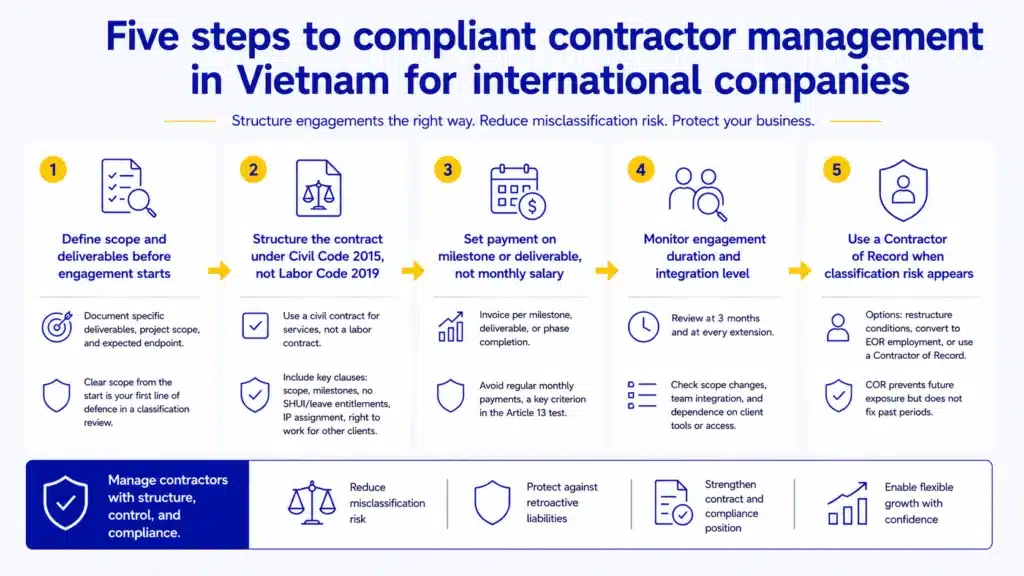
Step 1: Define scope and deliverables before engagement starts
Before signing the service agreement, document the specific deliverables, the project scope, and the expected endpoint of the engagement. This documentation is the first line of defence in a classification review. An engagement that begins with a clear scope statement and ends when that scope is delivered looks structurally different from one that begins with a general brief and extends indefinitely.
The scope document does not need to be a legal brief. It needs to be specific enough that an external reviewer could assess whether the deliverables were completed. “Backend API development for payment integration, Phase 1” is a scope. “Software development support” is not.
Step 2: Structure the contract under Civil Code 2015, not Labor Code 2019
The service agreement should be structured explicitly as a civil contract for services, not as a labor contract. It should not contain provisions on working hours, leave entitlements, or termination notice under the Labor Code.
Key clauses for a compliant service agreement in Vietnam: defined scope and deliverables; milestone-based payment terms; confirmation that the contractor is not entitled to SHUI, annual leave, or Labor Code protections; IP assignment clause; and a provision confirming that the contractor may engage other clients simultaneously.
Step 3: Set payment on milestone or deliverable, not monthly salary
Regular monthly payment is one of the three criteria in the Article 13 test. An engagement where the contractor invoices per milestone, per deliverable, or on completion of a defined phase does not trigger the regular payment criterion in the same way as monthly salary.
In practice, this means structuring invoices and payment schedules around project phases rather than calendar months. A contractor who submits an invoice when a feature is complete and receives payment within the agreed payment terms is in a structurally different position from one who receives a fixed monthly transfer on the last working day of each month.
Step 4: Monitor engagement duration and integration level
The risk profile of a contractor arrangement changes over time. An engagement that starts correctly can drift into misclassification territory as the contractor becomes more integrated into the team. The review should happen at the three-month mark and at every extension beyond that.
The questions to ask at each review: Has the scope changed from the original agreement? Is the contractor attending regular team meetings that are not directly related to deliverable review? Has the contractor’s work begun to depend on client-provided tools or access that were not specified in the original scope? If any of these have changed, the classification needs to be reassessed.
Step 5: Use a Contractor of Record when classification risk appears
When a review at step four identifies that the arrangement has drifted, the options are to restructure the working conditions to remove the classification risk, to convert the arrangement to EOR employment, or to bring in a Contractor of Record to absorb the liability going forward.
A COR does not retroactively fix the period before the structure was put in place. If the arrangement has already been running for 11 months without a COR, the retroactive exposure for that period remains. What a COR does is prevent the exposure from continuing to accumulate from the point of restructuring forward.
Contractor of Record (COR) vs direct contractor management
Using a contractor of record in Vietnam is how international companies shift classification risk away from the client. A contractor of record in Vietnam holds the service agreement through a third-party entity that absorbs the liability. The choice between direct management and a COR is a risk decision. Direct management is lower cost and operationally simpler. COR adds a cost layer. The question is whether the classification risk in direct management is worth the savings.
| Direct Contractor Management | Contractor of Record (COR) in Vietnam | |
|---|---|---|
| Structure | Client engages contractor directly | Third-party entity holds the service agreement |
| Classification risk | Fully borne by client | Shifted to COR provider |
| Liability | Client is exposed to reclassification risk | COR absorbs legal and compliance liability |
| Cost | Lower, no intermediary fees | Higher, includes COR service fees |
| Operational complexity | Simpler setup and management | Additional layer of coordination |
| Compliance handling | Managed internally by client | Managed by COR provider |
| Flexibility | High control over contractor relationship | Structured through third party |
| Key consideration | Cost savings vs risk exposure | Paying for risk mitigation and compliance assurance |
What a COR does that direct management cannot
In a direct service agreement, the compliance liability sits entirely with the client. If the arrangement is reclassified, the client pays retroactive SHUI, penalties, and interest. The COR moves that liability. In a COR arrangement, the service agreement is between the COR and the contractor. The COR is an engaging entity. If a labor inspection reviews the arrangement, the COR, not the client, is the party with the compliance obligation.
The COR also handles IP assignment, confidentiality documentation, payment processing, and PIT withholding. For international companies managing contractors across multiple markets, having these elements handled by a single provider rather than negotiated and documented individually for each contractor reduces both administrative complexity and legal exposure.
When to switch from direct engagement to COR
Switch to COR when: the engagement has run for more than three months; the contractor has begun attending regular internal meetings; the contractor is using client-provided systems or email; the client cannot demonstrate that the contractor maintains parallel client engagements; or the client has received a notice from a labor authority about its use of service agreements.
The cost of switching to COR at the three-month mark is lower than the cost of retroactive SHUI and penalties at the eleven-month mark. The German fintech company’s EUR 60,000 exposure for five contractors over eleven months was significantly higher than the COR service fees for the same period would have been.
If an engagement has run more than 3 months, involves daily standups, or uses client-provided tools, the classification question is worth reviewing now. Sunbytes COR arrangements absorb misclassification liability from day one.
Explore Accelerate Workforce Solutions
How Sunbytes structures contractor management in Vietnam
The German fintech company’s situation is not unusual. Most companies that reach an EUR 60,000 retroactive liability started with what looked like a clean Civil Code service agreement. The drift happened incrementally. The review never happened. A COR structure from day one would have absorbed that liability before it accumulated.
Sunbytes is a Dutch-founded technology and workforce company founded in 2011, with 300+ client projects across 20+ countries.
- Through Accelerate Workforce Solutions, Sunbytes provides COR arrangements structured under Civil Code 2015, with IP assignment, confidentiality, and scope documentation built in.
- Finding the right contractor for a specialist role in Vietnam is a network problem before it is a compliance problem. Digital Transformation Solutions holds mapped candidate relationships for backend engineers, cloud architects, and AI practitioners in HCMC.
- Contractor documents and personal data move between European clients and Vietnamese entities. CyberSecurity Solutions embeds GDPR Article 32 and Decree 13/2023/ND-CP compliance from the first document exchange, so the engagement does not create a data liability alongside the classification risk.