

Your product roadmap needs one more developer next month. The shortlist is not ready. Your CTO has two interview slots this week. Finance has not approved the offer range yet. That is usually where the hiring timeline starts slipping.
The time to hire a Vietnam developer is not only about how many candidates are available. It depends on role clarity, interview speed, salary fit, technical assessment design, and the employment setup after offer acceptance. For EU teams hiring their first 1 to 5 developers in Vietnam, the fastest process is usually the one where the brief, interview owners, and offer range are agreed before sourcing starts.
Time to hire means the period from approved role brief to accepted offer. For Vietnam developer hiring, the realistic planning range is usually 2 to 12 weeks, depending on role complexity, salary fit, interview speed, and whether the employment setup is ready before the offer.
To better understand how the process works in practice, you can explore tech recruitment in Vietnam as part of your hiring preparation.
TL;DR
The time to hire a Vietnam developer is usually 2 to 12 weeks. Standard developer roles often take 2 to 5 weeks when the brief is clear, the salary range fits the market, and interviews move quickly. Senior, specialist, and technical leadership roles take longer because the candidate pool is smaller and offer expectations are higher.
- Standard developer roles in Vietnam typically take 2 to 5 weeks to hire when the job brief is clear, the salary matches the market, and interviews are conducted promptly.
- Senior or specialized roles usually require 3 to 10 weeks, while technical leads and engineering managers can take 6 to 12 weeks due to a smaller talent pool and higher expectations.
- In optimal conditions, hiring can be completed in as little as 14 days, but delays often occur due to slow feedback, unclear requirements, or lack of preparation in salary approval and hiring processes.
The realistic time-to-hire range in Vietnam
A realistic Vietnam developer hiring timeline usually sits between 2 and 12 weeks, depending on role complexity and how ready your hiring team is. The first number is market access. The second number is process discipline.
Use the ranges below for planning, then verify the final target with your recruitment partner or internal talent lead.
Methodology note: These ranges are Sunbytes planning estimates for 2026 hiring discussions. They assume a clear role brief, market-aligned salary range, responsive interview owners, and standard full-time developer availability. Actual timelines can change when the role is niche, salary approval is delayed, technical tests are too long, or the employment model is not decided before offer stage.
| Developer role type | Planning range | Why the timing changes | What to prepare first |
|---|---|---|---|
| Standard mid-level developer, such as React, Node.js, Java, PHP, QA, or frontend | 2 to 5 weeks | Candidate pool is larger, but salary fit and interview speed still matter | Must-have stack, seniority level, salary range, English requirement |
| Senior developer in common stacks, such as senior full-stack, mobile, backend, or DevOps | 3 to 6 weeks | Strong candidates are often passive and already employed | Clear technical screen, faster interview calendar, pre-approved offer range |
| Niche developer, such as AI/ML, blockchain, Rust, security, embedded, or specialist cloud | 5 to 10 weeks | The pool is smaller and competing offers move quickly | Specialist sourcing plan, realistic salary range, short technical test |
| Technical lead, engineering manager, or staff-level engineer | 6 to 12 weeks | The role mixes technical depth, leadership, English communication, and delivery ownership | Role scorecard, leadership interview plan, decision owner, employment model |
These are planning ranges, not guaranteed outcomes. A mid-level React role can take longer than a senior role if your brief changes after sourcing starts. A specialist role can move faster when your salary range is ready and your CTO gives feedback within 48 hours.
Time-to-shortlist: 3 days from brief sign-off. Time-to-hire: 14 days when role requirements, salary range, and interview owners are agreed.
The 8-step developer hiring timeline
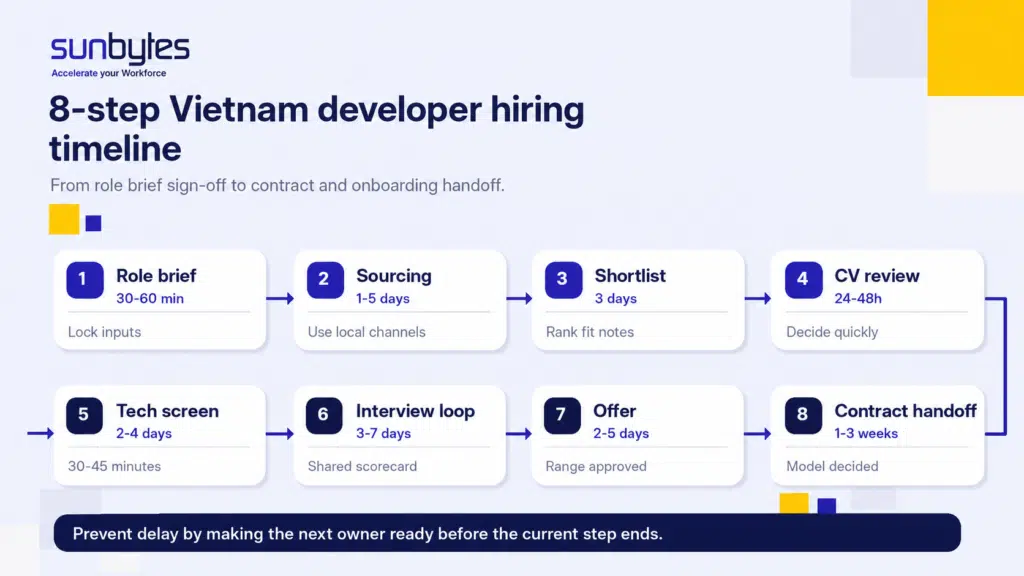
A strong developer hiring process in Vietnam moves from brief sign-off to onboarding handoff in eight steps. Each step has a different owner, and most delays happen when ownership is unclear.
| Step | Main owner | Expected timing | Common delay | How to prevent delay |
|---|---|---|---|---|
| 1. Role brief sign-off | CTO, hiring manager, recruiter | 30 to 60 minutes once inputs are ready | The brief says “full-stack” but does not define stack depth, seniority, English level, or product context | Lock must-have skills, nice-to-have skills, salary range, work model, and start date before sourcing |
| 2. Sourcing | Recruiter or local recruitment partner | 1 to 5 working days for the first pool | The sourcing channel does not match the role. LinkedIn alone may not reach enough passive senior candidates | Use local job boards, referrals, recruiter networks, and passive sourcing based on role level |
| 3. Shortlist | Recruiter, technical screener | 3 days from brief sign-off when criteria are clear | CVs arrive, but they are not ranked against your real criteria | Ask for a vetted shortlist with technical fit, English fit, salary fit, and availability notes |
| 4. CV review | Hiring manager | 24 to 48 hours | CVs sit in Slack or email while the hiring manager waits for a “better batch” | Review the first shortlist quickly. Good candidates are often in other processes |
| 5. Technical screen | Technical lead or senior engineer | 2 to 4 working days | The screen tests too much and slows the process before the candidate meets the team | Use a 30 to 45 minute screen to confirm stack fit, problem-solving, and communication |
| 6. Interview loop | CTO, hiring manager, team lead | 3 to 7 working days | Too many interview rounds or no agreed evaluation scorecard | Cap the loop at two rounds where possible. Use one shared scorecard |
| 7. Offer and negotiation | Hiring manager, finance, recruiter | 2 to 5 working days | Finance approves the range after the finalist is already waiting | Pre-approve salary range, benefits, notice-period handling, and start-date flexibility |
| 8. Contract and onboarding handoff | HR, payroll, EOR or local entity team | 1 to 3 weeks depending on employment model | Candidate accepts, then legal employment setup starts from zero | Decide entity, EOR, or contractor model before the final interview |
The 8-step timeline matters because Vietnam developer hiring is fast only when the next step is ready before the current step ends. A shortlist is not useful if your CTO or tech manager cannot interview this week. A strong finalist is not secure if the offer range still needs internal approval.
If you need help structuring your hiring inputs, review the role brief, must-have stack, English requirement, seniority level, and interview owners before sourcing starts.
Where hiring timelines usually slow down
Developer hiring in Vietnam usually slows down at five points: the role brief, salary range, technical test, feedback loop, and employment model. These delays sit inside your process more often than inside the candidate market.
The first delay is an unclear brief. “Senior backend developer” is not enough. Your recruiter needs the stack, version depth, product environment, English requirement, salary range, remote or hybrid setup, and must-have experience. If the brief changes after two weeks of outreach, your pipeline resets.
The second delay is salary mismatch. If your offer range is not close to the market, your shortlist will look weak even when sourcing is working. Candidates who fit the role may screen out before interview because the pay range does not match the seniority.
The third delay is an overlong technical test. A four-hour take-home assignment can work for a very specific senior role, but it will slow down standard hiring. A short live technical screen often gives enough signal for the first decision.
The fourth delay is feedback. A finalist available on Monday is often in another process by Thursday. Set a 48-hour feedback rule after every CV review, screen, and interview.
The fifth delay is the employment model. If your EU company does not have a Vietnam entity, the question is not only “who do we hire?” It is also “who legally employs the person, runs payroll, handles the contract, and manages statutory employment obligations?”
If your finalist waits more than 48 hours for feedback, your timeline is already slipping. A slow “yes” can lose the same candidate as a clear “no.”
How EU teams can shorten the process without lowering quality
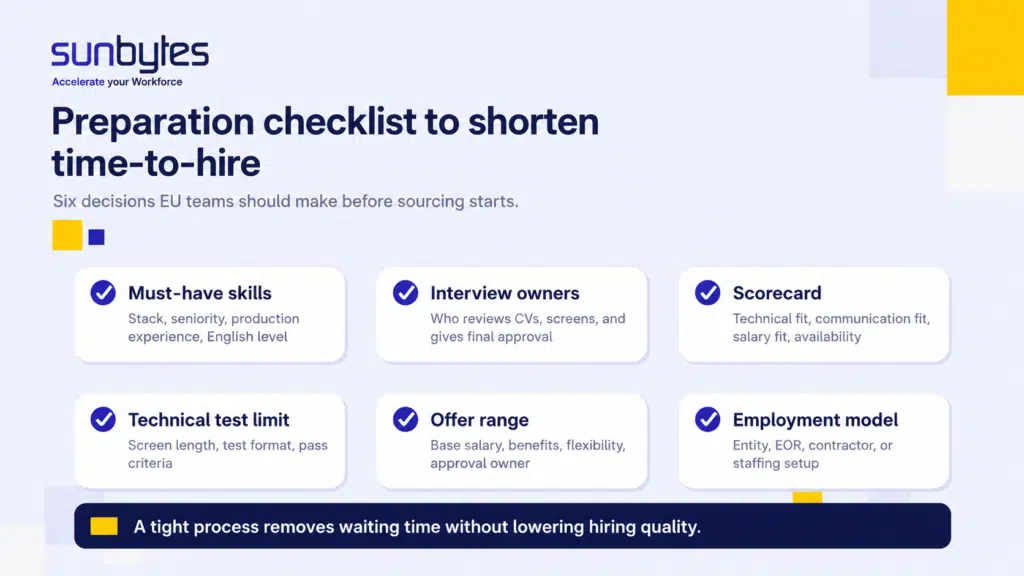
EU teams shorten the Vietnam developer hiring timeline by removing waiting time between decisions, not by skipping checks. The hiring process should be tight, not rushed.
Before sourcing starts, prepare these six items:
| Item | What to decide | Why it protects the timeline |
|---|---|---|
| Must-have skills | Stack, seniority, production experience, English level | Prevents weak CV matching |
| Interview owners | Who reviews CVs, who screens, who gives final approval | Prevents calendar drift |
| Scorecard | Technical fit, communication fit, salary fit, availability | Prevents subjective late-stage debate |
| Technical test limit | Screen length, test format, pass criteria | Prevents candidate drop-off |
| Offer range | Base salary, benefits, flexibility, approval owner | Prevents final-stage negotiation delays |
| Employment model | Entity, EOR, contractor, or staffing setup | Prevents post-acceptance compliance drag |
A 30-minute role brief sign-off can remove a week of later clarification. A 48-hour feedback rule can keep candidates warm without extra selling. A capped technical test can protect quality while still respecting the candidate’s time.
Your hiring team does not need more steps. It needs CV review, interview scheduling, feedback, offer approval, and employment setup owned before sourcing starts.
Need a shortlist before your next sprint planning cycle? Sunbytes recruitment services can turn a signed-off developer brief into a vetted shortlist in 3 days, then help your team keep interviews, feedback, and offer timing on track.
What happens after the candidate accepts
After a candidate accepts, the timeline shifts from recruitment to employment setup. This stage should be prepared before the final interview if your EU company wants the developer to start on time.
In Vietnam, the employment handoff can include the employment contract, probation terms, payroll setup, personal income tax handling, social, health, and unemployment insurance checks, onboarding documents, work equipment, and start-date confirmation. These requirements are governed under the official Vietnam Labour Code, which you can review via the ILO NATLEX database: Vietnam Labour Code 2019 via ILO NATLEX.
For EU teams, GDPR/AVG candidate-data handling also matters. CVs, interview notes, technical assessments, references, and evaluation reports can all contain personal data. Keep data access limited to the hiring team, define the retention period, and avoid collecting information that is not needed for the selection criteria. For guidance on recruitment data protection, refer to the European Data Protection Supervisor guidance on processing personal data in selection and recruitment.
If your EU company has no Vietnam entity, decide before offer stage whether the hire will be employed through an Employer of Record, a local entity, or another compliant model. This is where recruitment and employment operations meet. A fast offer still turns into a delayed start if the employment structure is unresolved.
To understand payroll and statutory contribution requirements in more detail, review Vietnam social insurance as part of your onboarding preparation.
When a recruitment agency changes the timeline
A recruitment agency changes the timeline when your main delay is sourcing, screening, shortlist quality, or interview coordination. A recruitment agency does not fix a slow internal decision process unless your team also agrees to faster feedback and offer approval.
| Hiring route | Sourcing speed | Shortlist ownership | Interview coordination | Employment setup | Best fit |
|---|---|---|---|---|---|
| Internal hiring | Depends on internal network and recruiter capacity | Your team owns all screening | Your team manages all scheduling and follow-up | Your entity or HR team owns setup | Best when you already know the Vietnam market and have hiring capacity |
| Recruitment agency | Faster access to active and passive candidates | Agency owns initial screening and shortlist quality | Shared between agency and your hiring team | Your company still needs an employment model | Best when your team needs a better shortlist and faster candidate movement |
| Recruitment plus EOR support | Faster shortlist plus employment handoff | Agency or partner owns screening and handoff | Shared with clearer timing checkpoints | EOR can employ the hire if you lack a Vietnam entity | Best when your EU company wants to hire in Vietnam without opening an entity first |
The agency route is most useful when your issue is finding the right candidate quickly. Recruitment plus EOR support becomes useful when your issue is both finding the candidate and employing that person correctly in Vietnam.
If you are still comparing recruitment support models, pros and cons of using a recruitment agency can help your team weigh speed, cost, and control. You can also review top recruitment service companies in Vietnam if you are building a vendor shortlist.
For post-offer employment setup, the EOR contract Vietnam guide can help your team check which party owns payroll, data, and employment obligations.
How Sunbytes supports developer hiring timelines in Vietnam
When your Vietnam developer hiring timeline slips, the delay rarely sits in one place. It can start with an unclear brief, continue through screening and interview feedback, then reappear after offer acceptance when contract setup, payroll, security access, or delivery onboarding is not ready.
Sunbytes supports this timeline across three connected pillars, with Accelerate Workforce Solutions leading the hiring process.
First, Accelerate helps your team move from signed-off role brief to vetted shortlist faster. Sunbytes clarifies the must-have skills, salary range, English requirement, interview owners, and feedback rhythm before sourcing starts. Time-to-shortlist: 3 days from brief sign-off. Time-to-hire: 14 days when role requirements, salary range, and interview owners are agreed.
Second, Digital Transformation Solutions helps make the developer role delivery-ready after the hiring decision. This matters when the new hire joins an EU product team, remote squad, or software delivery setup that already has sprint rituals, code review standards, backlog ownership, and handover expectations. A fast hire still needs a clear technical environment to become productive quickly.
Third, Cybersecurity Solutions supports the security side of remote developer onboarding. For EU teams, this can include access control, data handling expectations, secure device or account setup, and security evidence when developers work with client systems or sensitive information. This reduces the gap between “candidate accepted” and “developer can safely start work.”
For EU companies hiring developers in Vietnam, the outcome is not only a faster recruitment process. It is a cleaner handoff from shortlist to offer, from offer to employment setup, and from employment setup to productive, secure work.
FAQs
For a clear standard developer brief, a strong recruitment partner should be able to provide an initial vetted shortlist in about 3 days from brief sign-off when criteria are clear.
EU companies should decide the likely employment route before the final interview, and ideally before sourcing starts. If your company has no Vietnam entity, an EOR route can prevent the accepted candidate from waiting while contract, payroll, PIT, and SHUI handling are arranged.