

Vietnam’s nationality law, updated and effective July 1, 2025, removes the mandatory 5-year residency and language requirements for skilled foreign talent, opens dual citizenship under specific conditions, and allows applications to be submitted from abroad. Employers need to update payroll, SHUI contributions, and work permit records when an employee’s nationality changes.
This article explains the 8 key provisions now in effect, how naturalization works under the new rules, and what HR teams and employers must do when a foreign employee’s nationality status changes.
TL;DR
- Vietnam nationality law is the legal framework that determines who holds Vietnamese citizenship, under what conditions foreigners can acquire or restore it, and what compliance obligations it creates for employers.
- When an employee acquires Vietnamese citizenship, three things happen that require employer action: the work permit becomes void and must be closed with DOLISA, SHUI contributions shift to the Vietnamese citizen schedule, and PIT classification must be reviewed before the next pay cycle.
- Decree 219/2025 (effective August 7, 2025) simplified work permit processes for foreign employees in parallel, reducing job-posting requirements and cutting issuance timelines to 10 working days. This applies to all foreign employees regardless of nationality status.
Why Vietnam nationality law matters for foreign employees in 2026
Vietnam nationality law determines who holds Vietnamese citizenship, under what conditions foreigners can acquire or restore it, and how that status intersects with employment rights, work permits, and payroll obligations. For foreign employers, it is a compliance trigger that changes what you owe, what documents you hold, and how your payroll system runs.
From the 2008 Law to the 2026 digital-first operating framework
The original Law on Vietnamese Nationality (Law No. 24/2008/QH12) established a single-nationality principle with narrow exceptions. A 2014 amendment (Law No. 56/2014/QH13) introduced limited dual-nationality provisions for overseas Vietnamese, but implementation remained restrictive. Decree 16/2020/ND-CP added naturalization pathways for investors and contributors, which the 2025 amendment now formally incorporates and expands.
The 2025 amendment, effective July 1, 2025, is driven by Resolution 57-NQ/TW, Vietnam’s policy framework for science, technology, and high-skilled talent attraction. It is the first major structural reform in 17 years and sets the legal baseline that all 2026 compliance decisions reference.
What the 2025 amendment introduced and how it reshapes the 2026 landscape
The amendment introduces five key changes that reshape how foreign employees and their employers engage with Vietnam’s legal system. It removes residency and language requirements for skilled talent, allows conditional dual nationality with Presidential approval, expands acceptable proof of Vietnamese origin beyond civil records, enables applications from abroad through diplomatic missions, and opens the reacquisition pathway to any former Vietnamese national without category restrictions.
These updates mean that Vietnamese-origin employees holding foreign passports can now restore citizenship more easily and with fewer administrative barriers, creating direct implications for payroll and HR compliance.
Who the updated law applies to and what changed for foreign employees in Vietnam
The law applies to three distinct groups in the context of foreign employment:
- Overseas Vietnamese: Foreign passport holders of Vietnamese origin who wish to restore citizenship under the simplified reacquisition pathway
- Foreign nationals without Vietnamese heritage: Individuals who meet standard or fast-track naturalization conditions under Article 19
- Civil servants, military, and public security personnel: Subject to stricter single-nationality rules regardless of the amendment’s liberalizations
For most HR managers at international companies, the first group is the most relevant. A Vietnamese-born employee now holding a European or US passport can restore citizenship under simplified terms, which changes their work permit status and payroll classification from the moment Vietnamese citizenship is granted.
VNeID integration and the move to e-filing for nationality applications
A significant operational change in the 2026 framework is the integration of nationality records with Vietnam’s National Population Database through the Vietnam Electronic Identification (VNeID) system. Under Article 39 of the amended law, the government is responsible for digitizing nationality records and enabling electronic cross-verification with immigration, social insurance, and tax systems.
For HR teams, this means that when an employee’s nationality changes, the update propagates through connected government databases, including social insurance and the General Department of Taxation. Employers who manage their own payroll need to align their records with the VNeID-linked data to avoid discrepancies during inspections.
Understanding how nationality law interacts with corporate structure decisions is explored in detail in a guide on EOR vs. entity setup in Vietnam, which compares compliance costs and timelines across different stages of expansion.
8 Key provisions of Vietnam nationality law in effect in 2026
The table below summarizes all 8 provisions now in effect. Each is covered in detail in the sections that follow.
| Provision | What changed | Who it affects |
|---|---|---|
| 1. Reacquisition open to all | No category precondition required. Any former Vietnamese national can apply. | Overseas Vietnamese |
| 2. Naturalization exemptions expanded | Residency and language waived for contributors, investors, and those with Vietnamese relatives. | Foreign investors, experts, spouses of Vietnamese nationals |
| 3. Dual nationality conditionally allowed | Permitted with Presidential approval for those with close Vietnamese relatives. | Naturalization and reacquisition applicants |
| 4. Applications accepted from abroad | Submit via Vietnamese diplomatic missions overseas. No Vietnam presence required. | Overseas Vietnamese, foreign applicants abroad |
| 5. Faster Ministry processing | Ministry of Justice review capped at 10 working days. | All applicants |
| 6. Broader descent documentation | School records, community letters, and language certs now accepted alongside civil documents. | Second-generation overseas Vietnamese |
| 7. Hybrid names on official documents | Combined Vietnamese and foreign names permitted on nationality certificates. | Dual-nationality applicants |
| 8. Stricter rules for government roles | Party, state, military, and security personnel must hold Vietnamese nationality exclusively. | Civil servants, armed forces, public security |
All applications to regain Vietnamese nationality are now reviewable
Previously, individuals who had lost Vietnamese nationality could only apply for reacquisition if they fell into one of six specific categories, including returning to reside in Vietnam, having Vietnamese family members, or having made exceptional contributions to the state. The 2025 amendment removes all of these conditions.
Naturalization standard exemptions expanded (marriage, Vietnamese parents, contribution)
Under Article 19 of the Law on Vietnamese Nationality, the standard naturalization conditions include permanent residency for at least five years, Vietnamese language proficiency, financial self-sufficiency, and clean criminal record. The 2025 amendment expands who can be exempted from the residency and language conditions.
Exemptions now apply to individuals who have made outstanding contributions to Vietnam’s development or defense, as defined in Decree 16/2020/ND-CP, as well as to those with close Vietnamese relatives (spouse, parent, or child who is a Vietnamese citizen). Marriage to a Vietnamese national remains one of the clearest pathways to naturalization with exemptions, and the amended law strengthens this track.
Dual nationality now accepted under specific conditions
The Vietnam dual nationality law has historically restricted dual citizenship to very narrow exceptions. The 2025 amendment broadens these exceptions by permitting individuals applying for naturalization or reacquisition to retain their foreign nationality if two conditions are met: they have close Vietnamese relatives who are citizens, and they receive Presidential approval.
Applications can now be submitted from abroad
Under the previous law, applicants generally needed to be present in Vietnam or have established permanent residency before lodging a nationality application. The 2025 amendment allows individuals living abroad to submit their applications through Vietnamese overseas diplomatic missions, consulates, or embassies.
They can now initiate and complete a significant portion of the citizenship restoration process without leaving their country of residence, reducing the personal disruption that previously made the process impractical for working professionals.
Shorter processing timeline (under 10 days at Ministry level)
At the Ministry of Justice level, the review period for nationality applications is now set at under 10 working days for standard cases. Inter-ministerial verification, which involves the Ministry of Public Security and the Ministry of Foreign Affairs, adds additional time, but the Ministry-level cap provides predictability that was previously unavailable.
For employers managing workforce planning, this timeline clarity is operationally valuable. An HR team can now build a realistic citizenship transition timeline into its employment planning, rather than treating the process as an indefinite administrative variable.
Broader documentation accepted to prove Vietnamese descent
Proving Vietnamese descent previously required official civil registration documents such as birth certificates issued by Vietnamese authorities. The 2025 amendment broadens the acceptable evidence base to include school records, community attestation letters, and language certificates, in addition to standard civil documents.
This change primarily benefits second-generation overseas Vietnamese whose original Vietnamese documentation may have been lost, damaged, or never formally issued.
Combined Vietnamese and foreign names now allowed on official documents
Amendments to Clauses 4 of Article 19 and Article 23 of the nationality law now allow applicants for naturalization or reacquisition who also wish to retain their foreign nationality to choose a hybrid name on official documents. This can be a combination of a Vietnamese name and a foreign name, to accommodate cross-border living and employment realities.
For employers, this has a practical implication for HR records and employment contracts. When an employee updates their name on official documents following naturalization, the employment contract, payroll records, and social insurance enrollment may need to reflect the updated name format.
Stricter rules for government, military, and security positions
While the amendment liberalizes nationality acquisition for private-sector talent, it tightens restrictions for individuals in government and security roles. Under the updated Article 5, persons holding term-based positions in Party agencies, state agencies, the Vietnam Fatherland Front, socio-political organizations, or cipher organizations, as well as members of the armed forces, must hold only Vietnamese nationality and be habitually resident in Vietnam.
Civil servants and public employees who do not fall into these categories may hold dual nationality only in exceptional cases where the government determines it serves the national interest. This provision is not relevant to most private-sector employers, but it matters for international organizations or joint ventures that have Vietnamese employees in quasi-governmental liaison roles.
For foreign-invested companies managing teams without a Vietnamese legal entity, understanding how these nationality provisions interact with EOR arrangements is covered in Employer of Record(EOR) in Vietnam service page, which outlines how EOR handles employee reclassification when nationality changes mid-contract.
How the Vietnam naturalization process works in 2026 (5 Steps)
Understanding this flow is essential for HR managers supporting an employee through citizenship acquisition or restoration.
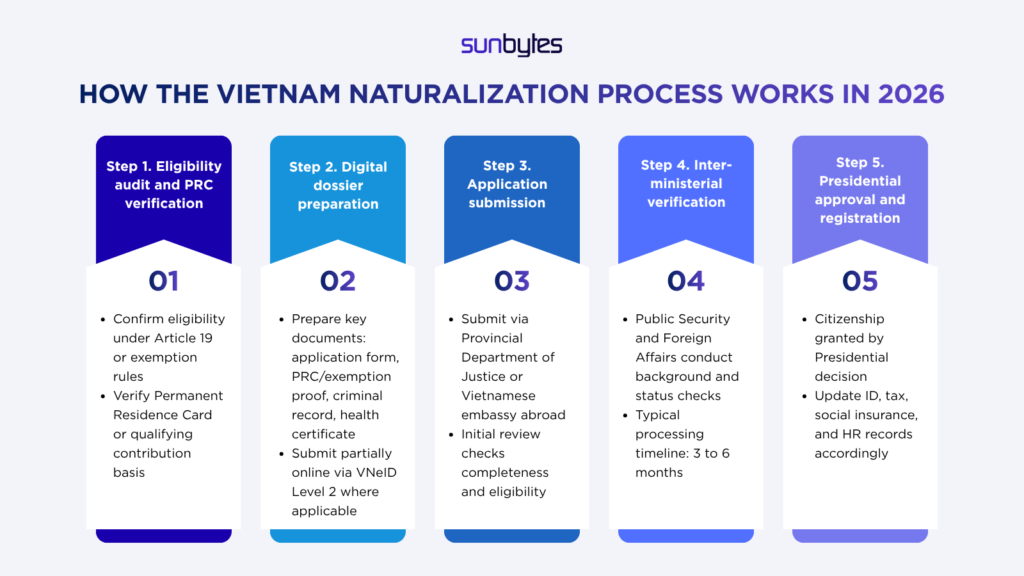
Step 1. Eligibility audit and Permanent Residence Card (PRC) verification
The first step is to determine whether the applicant qualifies for standard naturalization under Article 19 or falls into an exemption category under Decree 16/2020/ND-CP. For standard applicants, the eligibility audit confirms that the five-year permanent residency requirement is met, documented by a valid Permanent Residence Card (the blue card issued by the Ministry of Public Security).
For fast-track applicants, the audit instead verifies the contribution or relationship basis for the exemption. At this stage, the applicant should engage a Vietnam-licensed legal practitioner to confirm eligibility before preparing any formal documentation, as errors at this stage delay the entire process.
Step 2. Digital dossier preparation (VNeID Level 2 integration)
The dossier for a nationality application includes the following documents:
- Completed nationality application form
- Proof of eligibility: Permanent Residence Card or exemption documentation under Decree 16
- Criminal record certificate from the country of current residence
- Health certificate from a Ministry of Health-approved facility
- Proof of Vietnamese descent where applicable (birth certificate, school records, community letter)
Under the 2026 digital framework, applicants with VNeID Level 2 accounts can submit certain documents electronically through the national e-portal, reducing the volume of physical originals required at submission. The Ministry of Justice provides a checklist of documents accepted in digital format versus those still requiring notarized originals. HR teams supporting an employee through this step should obtain this checklist from the relevant Provincial Department of Justice before beginning document collection.
Step 3. Submission via Provincial Department of Justice or e-portal
Applications for persons residing in Vietnam are submitted to the Provincial Department of Justice in the province where the applicant holds permanent residence. Applicants submitting from abroad use the Vietnamese diplomatic mission in their country of residence, which then forwards the dossier to the Ministry of Justice in Hanoi.
The Ministry of Justice reviews the application within 10 working days under the amended law. During this review, the Ministry checks the completeness of the dossier, verifies the applicant’s eligibility category, and flags any documentation gaps before forwarding the case to inter-ministerial review.
Step 4. Inter-ministerial verification and Public Security clearance
After the Ministry of Justice review, the application moves to inter-ministerial verification. The Ministry of Public Security conducts a security clearance check, and the Ministry of Foreign Affairs verifies the applicant’s foreign nationality status and any dual-nationality implications. For applications involving Presidential approval for dual nationality retention, this stage also involves the Presidential Office.
The inter-ministerial stage does not have a fixed statutory deadline under the current framework, but the combined timeline from submission to Presidential Decree is typically 3 to 6 months for standard cases and faster for fast-track applicants under Decree 16.
Step 5. Presidential Decree and citizenship confirmation
Citizenship is formally granted by Presidential Decree for naturalization cases, and by Presidential decision for reacquisition cases. Once the Decree is issued, the applicant receives official notification and can register as a Vietnamese citizen at their local civil registration authority.
The registration step produces a new Vietnamese identity document and triggers updates to the National Population Database, which then flows through to VNeID, social insurance, and the General Department of Taxation systems. For employers, this is the point at which HR records, social insurance enrollment, and payroll classification must be updated. The process is covered in the compliance section below.
Vietnam’s personal income tax and social insurance obligations change when an employee’s nationality status shifts. An overview of Vietnam’s tax system explains the PIT structure, SHUI contribution bases, and the adjustments required when transitioning from foreign national to Vietnamese citizen classification.
What citizenship changes mean for foreign employers
Understanding the conditions, timelines, and what actually changes operationally is what turns legal awareness into workforce management competence.
Standard naturalization conditions in 2026: residency, language, compliance, finances
Vietnamese citizenship requirements for foreigners who do not qualify for a fast-track exemption remain governed by Article 19 of the Law on Vietnamese Nationality. These include full civil capacity, a minimum of five years of permanent residency in Vietnam, Vietnamese language proficiency sufficient for community integration, financial self-sufficiency, and a clean criminal record. These conditions apply to foreign nationals without Vietnamese heritage or extraordinary contribution status who wish to obtain Vietnamese citizenship for the first time.
Employers considering whether to support an employee’s naturalization application should assess whether the employee actually meets these conditions before any HR planning is built around the expected outcome. A failed or delayed application creates its own compliance complexity, particularly for employees whose work permit renewal schedule was aligned with an expected citizenship grant date.
Before building any HR plan around an expected citizenship date, verify the employee actually qualifies. A failed application creates its own compliance timeline that your payroll system needs to absorb.
Fast-track eligibility: shortening the 5-year residency rule
Understanding how to get Vietnamese citizenship for foreigners through the fast-track pathway requires knowing the exemption criteria in Decree 16/2020/ND-CP. The five-year residency requirement and the Vietnamese language condition are both waived for foreign investors in priority sectors, scientists and technology experts, individuals with exceptional contributions to Vietnam’s development or defense, or those whose naturalization serves the national interest.
If your employee falls into one of these categories, the timeline compresses significantly. Confirm the qualifying basis in writing before beginning the application, as the exemption must be documented at submission, not claimed retrospectively.
Dual nationality in 2026: which conditions allow keeping a foreign passport
The Vietnam dual nationality law as amended permits dual nationality retention only where two conditions are simultaneously met: the applicant has close Vietnamese relatives who are citizens (spouse, parent, or child), and the President of Vietnam grants written approval. This is not automatic, and it is not available to all applicants.
The practical benefit for employers is that the employee’s residency and employment status in Vietnam becomes significantly more stable, reducing annual renewal cycles and immigration risk.
The transition to e-police checks and digital health certificates
One of the procedural changes under the 2026 framework is the partial digitization of the criminal record certificate and health verification processes. E-police checks, issued through the Ministry of Public Security’s online portal, are now accepted for applicants in certain provinces. Digital health certificates from approved facilities are similarly recognized.
Submitting a document in the wrong format, such as a digital health certificate to a provincial office that still requires a notarized original, causes avoidable delays. This verification step takes less than a day and prevents multi-week setbacks.
Companies employing foreign managers in Vietnam need to understand how the Employment Service Operation License framework applies to their operations. Employment Service Operation License covers the licensing requirements for companies that recruit or manage labor in Vietnam, including how nationality transitions affect operator status.
How Vietnam nationality laws affect work permit and payroll compliance
Nationality status and work permit status are governed by separate legal frameworks in Vietnam, but they interact directly when an employee’s citizenship changes.

How Vietnam nationality law changes an employee’s work permit status
A foreign national working in Vietnam must hold a valid work permit under Decree 219/2025. When that employee acquires Vietnamese citizenship, their legal status as a foreign worker ends. The existing work permit becomes void, because work permits are issued exclusively to foreign nationals. The employee now has the right to work in Vietnam as a citizen, without the work permit requirement.
This transition does not happen automatically on the date citizenship is granted. The employer must notify the relevant Department of Labor, Invalids and Social Affairs (DOLISA) of the change, formally close the work permit record, and update the employee’s employment documentation.
Work permit rules in 2026 employers still need to align with
Vietnam work permit requirements 2026 are governed by Decree 219/2025/ND-CP, which replaced Decree 152/2020 as amended by Decree 70/2023. The table below shows the key changes employers must align with:
| Requirement | Before Decree 219 | From August 2025 (Decree 219) |
|---|---|---|
| Job posting before application | Mandatory 15-day public posting on Ministry portal | Removed. No mandatory posting required. |
| Work permit processing time | No statutory deadline at DOLISA level | Capped at 10 working days from complete application |
| Expert qualification | Degree must match job position | Degree match no longer required; experience is sufficient |
| Investor exemption threshold | Capital contribution required but threshold was ambiguous | Fixed at VND 3 billion minimum for work permit exemption |
| Multi-province assignments | Separate filings per province | Employer must notify authorities; reporting obligations apply |
Vietnam’s labor regulation registration requirements apply to all employers operating in the country. Sunbytes’ guide on Labor Regulation Registration in Vietnam covers what companies must register, when to update registrations, and how nationality changes trigger registration obligations.
Payroll, SHUI, and tax updates after nationality conversion
When a foreign employee becomes a Vietnamese citizen, the social insurance, health insurance, and unemployment insurance (SHUI) contribution structure changes. Foreign employees in Vietnam are subject to different SHUI enrollment conditions than Vietnamese nationals. Upon citizenship, the employee moves to the standard Vietnamese citizen contribution schedule, which affects both the employee’s deduction and the employer’s contribution rate.
Personal income tax (PIT) treatment may also shift. A foreign employee who was classified as a non-resident for PIT purposes, subject to a flat 20 percent rate, may now qualify as a tax resident under the standard progressive schedule if their physical presence and economic ties to Vietnam change. This reclassification must be reviewed by a qualified tax practitioner and reflected in the payroll system before the next pay cycle after citizenship is granted.
HR compliance checklist when an employee changes nationality status
The following actions must be completed in sequence when an employee acquires or restores Vietnamese citizenship:
- Notify DOLISA: File notification of work permit termination within the required timeframe after citizenship is granted.
- Close the work permit record: Formally surrender the work permit to the issuing authority and obtain a closure acknowledgment.
- Update the employment contract: If the contract references foreign national status, work permit number, or visa type, amend those clauses.
- Revise SHUI enrollment: Notify social insurance of the status change and update contribution rates to the Vietnamese citizen schedule.
- Review PIT classification: Confirm resident vs. non-resident status with a tax advisor and update the payroll withholding rate.
- Update HR records: Revise the employee’s identification documents, nationality field, and name (if changed on official documents) across all internal systems.
- Verify VNeID alignment: Confirm that the employee’s VNeID-linked records match the updated payroll and social insurance records to prevent database discrepancies.

How EOR arrangements handle nationality transitions compliantly
When a foreign employee is engaged through an Employer of Record arrangement, the EOR is the legal employer on Vietnamese records. A nationality change by the employee creates a reclassification event within the EOR relationship. The EOR must update its DOLISA records, revise the employment agreement structure if needed, and adjust SHUI and PIT processing, all while maintaining the commercial relationship between the actual business and the employee.
A well-structured EOR arrangement includes a nationality transition protocol that defines exactly which party takes which action and in what sequence when an employee’s citizenship changes. Companies using EOR for Vietnam employment should confirm that their provider has this protocol in place before a transition event occurs, not after.
For companies deciding between an EOR and direct staffing for hiring in Vietnam, an overview of top recruitment service options provides a clear comparison of both models across compliance, cost, and transition handling.
How Sunbytes helps foreign companies navigate Vietnam’s workforce and compliance landscape
Build and scale your team in Vietnam with full compliance from day one. From hiring and payroll to data protection and workforce structuring, Sunbytes provides the local expertise and infrastructure you need to operate with confidence and focus on growth.
Why Sunbytes?
Founded in the Netherlands, Sunbytes has delivered Employer of Record(EOR) and workforce compliance services in Vietnam since 2011. When an employee’s citizenship changes mid-contract, Sunbytes handles the DOLISA notification, SHUI reclassification, and payroll update, typically within one pay cycle. With operations in Ho Chi Minh City and a direct line to local labor authorities, we manage the administrative sequence so it does not fall on your HR team.
Our three service pillars support every stage of workforce operations in Vietnam:
- Digital Transformation Solutions – Enabling companies to build and scale technology teams in Vietnam from the ground up, while aligning engineering culture, team dynamics, and technical leadership to drive performance. We focus on structuring teams where culture actively supports execution and outcomes.
- CyberSecurity Solutions – Supporting growing teams in maintaining strong security practices and regulatory compliance as they scale. We help embed a security-first mindset early, making it a core part of team structure, onboarding, and overall hiring strategy.
- Accelerate Workforce Solutions – Providing Employer of Record, Contractor of Record, payroll, and staffing services that form a compliant employment backbone. This foundation allows international companies to hire, manage, and retain teams in Vietnam while supporting long-term, culture-driven growth.