

Choosing between monolith and microservices is a timing decision that directly affects your product’s speed, cost, and scalability.
In early-stage products, teams often struggle with slow releases, unclear architecture boundaries, or growing technical debt. At the same time, many companies adopt microservices too early, adding unnecessary complexity before their system, and team, are ready. The result is not scalability, but slower delivery and higher operational overhead.
In practice, we see two common failure patterns: teams that stay in a monolith too long and hit scaling bottlenecks, and teams that move to microservices too soon and lose development speed. The real challenge is knowing when each architecture fits your product stage and team capability.
This guide breaks down the differences, trade-offs, and most importantly a practical decision framework to help you choose the right architecture for your current and future growth.
TL;DR
A monolith is a single, unified system that is faster to build and easier to manage early on, while microservices split an application into independent services that scale and deploy separately, but require significantly more operational maturity.
- Choose a monolith when you are building an MVP, working with a small team (<8 engineers), or still validating your product and domain logic.
- Choose microservices when your system has clear domain boundaries, multiple teams working in parallel, and a need for independent scaling or frequent deployments.
- Most systems should evolve, not start, as microservices, typically after clear bottlenecks in deployment speed or team coordination appear.
- Best fit when: your architecture matches your current team size, system complexity, and growth stage.
- Watch out for: moving to microservices too early or creating a “distributed monolith” with tightly coupled services.
Need to assess if your system is ready to scale? Talk to our architects to map your current architecture maturity and next steps.

What is Monolithic Architecture?
A monolithic architecture is a traditional software design where all components of an application, UI, business logic, and data access, are built and deployed as a single, unified codebase. Everything runs as one tightly integrated unit, typically connected to a single database. This approach is often the default starting point for many products due to its simplicity and speed of development.
Core Characteristics of a Monolith
- Single codebase: All features and modules are developed within one repository
- Shared database: All components access the same data source
- Unified deployment: The entire application is built and deployed together
- Tight coupling: Components are interdependent, making changes more interconnected
The Pros of Starting with a Monolith
In the early stages, a monolith offers clear advantages. It enables faster development and simpler testing, since everything is in one place. Teams can easily manage cross-cutting concerns like authentication, logging, and transactions without dealing with inter-service communication. Performance is also more predictable, as there’s no network latency between components. For startups or MVPs, this simplicity often translates into lower costs and quicker time-to-market.
The Cons of Scaling a Monolith
As the application grows, the same simplicity can become a limitation. Tight coupling makes it harder to modify or scale individual features without impacting the entire system. Even small updates may require full redeployments, increasing risk and slowing release cycles. Over time, the codebase can become harder to maintain, especially as more developers contribute. This is where teams often encounter the “monolith bottleneck”, when growth demands flexibility that the architecture wasn’t designed to handle.
What is Microservices Architecture?
Microservices architecture is an approach where an application is built as a collection of small, independent services, each responsible for a specific business function and communicating through APIs. Instead of one unified codebase, the system is split into loosely coupled services that can be developed, deployed, and scaled independently. This structure is designed to support complex, evolving products that require flexibility and speed at scale.
Key Principles: Decentralization and Isolation
- Service independence: Each service operates as its own unit with a clear responsibility
- Decentralized data management: Services often manage their own databases
- API-driven communication: Services interact via lightweight protocols (e.g., REST, gRPC)
- Isolation by design: Failures in one service don’t necessarily bring down the entire system
The Pros of Microservices
Microservices enable teams to scale specific components independently, which is critical for high-traffic or feature-heavy applications. They also allow for technology flexibility, meaning different services can use different programming languages or frameworks based on their needs. An IBM, Microservices in the Enterprise, 2021, found that 87% of over 1,200 IT executives, developer executives and developers agreed that microservices adoption is worth the expense and effort.
For organizations with multiple teams, microservices support parallel development, accelerating delivery at scale.
The Cons of Microservices
This flexibility comes at a cost. Microservices introduce operational complexity, requiring robust DevOps practices, containerization, and orchestration tools like Kubernetes. Managing communication between services adds latency and increases the risk of failures across the network. Data consistency becomes more challenging due to distributed databases. Without strong governance, teams can fall into the trap of building a “distributed monolith”, where services are technically separate but still tightly dependent. Companies like Atlassian report that microservices can lead to development sprawl, higher infrastructure costs, and more difficult debugging if not properly managed
Microservices vs. Monolith Architecture: What’s the main difference?
At a high level, the difference comes down to how your system is structured and how it scales over time. A monolith keeps everything in one place, simple to start, but harder to evolve. Microservices break the system into independent parts, more flexible, but significantly more complex to manage.
| Feature | Monolithic Architecture | Microservices Architecture | Best For |
|---|---|---|---|
| Development Speed | Faster initial development with a single codebase | Slower setup due to service boundaries and infrastructure | Monolith for MVPs and early-stage products |
| Deployment Ease | Simple, one-step deployment | Complex, requires CI/CD pipelines and orchestration | Monolith for small teams with limited DevOps |
| Scaling | Scales as a whole application | Scales individual services independently | Microservices for high-growth, high-traffic systems |
| Fault Tolerance | Failure can impact the entire system | Failures are isolated to specific services | Microservices for mission-critical applications |
| Operational Cost | Lower infrastructure and maintenance cost | Higher cost due to DevOps, monitoring, and service management | Monolith for cost-sensitive projects; Microservices for long-term scalability |
In practice, most successful products don’t start with microservices, they evolve into them. The key is understanding when the simplicity of a monolith starts to slow you down, and when the flexibility of microservices begins to justify its operational cost.
How to Choose Between Microservices vs Monolith Architecture?

The decision is about aligning your architecture with your product maturity, team capability, and growth trajectory. Choosing too early or too late can both create unnecessary cost and complexity. The goal is to match your architecture to what your business actually needs now, while keeping a clear path for what comes next.
When a Monolith is the Right Choice
A monolithic architecture is often the smartest starting point when speed and simplicity matter most. If you’re in the MVP phase, working with a small team, or operating under a limited budget, a monolith allows you to move fast without the overhead of distributed systems. It keeps development, testing, and deployment straightforward, so you can focus on validating your product, not managing infrastructure.
This is especially relevant for early-stage products where requirements are still evolving. Locking into microservices too soon can slow iteration and introduce complexity before your business logic is even stable.
See more on MVP strategy in our guide to building scalable product foundations.
When to Switch to Microservices
Many teams underestimate this transition. Studies show that while 85% of enterprises adopt microservices, a significant portion later consolidate services due to debugging complexity and operational overhead.
Microservices become the right choice when your system, and your organization, outgrows the limits of a monolith. This typically happens when you’re dealing with complex business logic, multiple teams working in parallel, or features that need to scale independently.
At this stage, the ability to deploy services independently, adopt different technologies, and isolate failures starts to outweigh the added operational cost. Microservices are not a shortcut to scalability, they are a response to it. The shift should be intentional, based on clear bottlenecks in development speed, deployment cycles, or system performance, not just the desire to adopt a modern architecture.
A Practical Decision Framework: Microservices vs Monolith
Choosing the right architecture is less about preference and more about matching your system maturity with your team capability and business needs.
Below is a practical framework we use to evaluate when a monolith starts to break down, and when microservices actually make sense.
| Aspect | Monolith fits best | Microservices fits best |
|---|---|---|
| Team Size & Structure | – Team size is small (typically <8 engineers) -Development is centralized -Communication overhead is low | -Multiple teams work in parallel (10–20+ engineers) -Teams need ownership of specific domains (e.g., payments, user, analytics) -Coordination overhead is slowing delivery |
| System Complexity & Domain Clarity | -Business logic is still evolving -Domain boundaries are unclear -Frequent changes affect multiple parts of the system | -Clear bounded contexts exist (e.g., checkout, inventory, auth) -Features can operate independently -Changes in one domain shouldn’t affect others |
| Deployment & Release Bottlenecks | -Deployment is still manageable (weekly or less frequent releases) -Failures are easy to trace and fixCI/CD complexity is low | -Deployments are slowing down due to system size -Small changes require full redeployment -Teams are blocked waiting for other teams to release |
| Scaling Requirements | -Traffic is predictable -Scaling the entire system is still cost-effective -No need for feature-specific scaling | -Different components scale differently (e.g., search vs checkout) -High-traffic features require independent scaling -Performance bottlenecks are isolated to specific modules |
| Operational Readiness (Most Overlooked) | -Limited DevOps resources -No dedicated infrastructure or platform team -Monitoring and observability are basic | -Strong CI/CD pipelines are in place -Observability (logs, tracing, monitoring) is mature -Team can handle distributed system complexity |
Most successful systems follow this path: Start with a monolith → define domain boundaries → evolve into microservices when real bottlenecks appear. The goal is to delay complexity until it becomes necessary and justified by real system constraints.
Scored bottlenecks in Deployment or Operational Readiness? That is the migration starting point. Talk to our migration architects.
The Broader Landscape: Microservices vs Monolith vs. SOA vs. Serverless
Monolith and microservices are only part of a broader architectural spectrum. As systems evolve, different patterns emerge to solve specific challenges around scale, flexibility, and operational efficiency. Understanding where each fits helps you avoid oversimplifying the decision.
- Monolith: The starting point for most applications, simple, centralized, and efficient for early-stage development. Best suited for products prioritizing speed and low operational overhead.
- Microservices: A natural evolution for scaling systems, decomposed into independent services that can be developed and deployed separately. Ideal for complex, high-growth environments where flexibility and team autonomy are critical.
- SOA (Service-Oriented Architecture): Often seen as the enterprise predecessor to microservices, SOA also structures applications as services but typically relies on a centralized Enterprise Service Bus (ESB) for communication. While it enables reuse and integration across large organizations, it can become rigid and harder to scale compared to modern microservices.
- Serverless: Represents a further shift toward abstraction, developers focus only on code, while the cloud provider handles infrastructure, scaling, and execution. Often described as a “No-Ops” evolution of microservices, serverless follows a pay-per-execution model and works well for event-driven workloads, but can introduce challenges in debugging, vendor lock-in, and long-term architecture control.
In reality, these models are not mutually exclusive. Many modern systems combine elements of each, starting with a monolith, evolving into microservices, and leveraging serverless where it adds efficiency. The key is not choosing a single “perfect” architecture, but composing the right approach for your system’s current and future demands.
What is A Step-by-Step Strategy to Migrating from Monolith to Microservices Architecture?
A full monolith-to-microservices migration for a medium-complexity system typically runs 6–18 months across all phases. Here are six phases of the effective migration path:
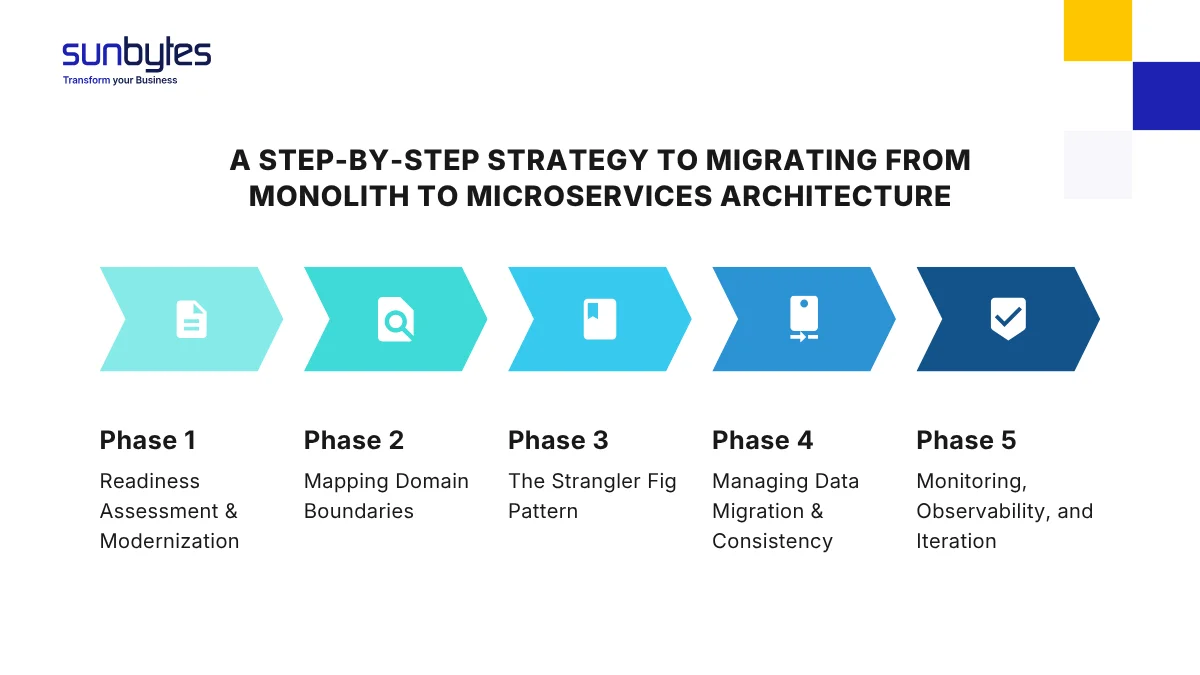
Phase 1: Readiness Assessment & Modernization
Before making any architectural shift, assess whether your system, and your team, is ready. Identify current bottlenecks in deployment speed, scalability, and maintainability. At the same time, modernize critical foundations such as CI/CD pipelines, automated testing, and cloud infrastructure. Without this groundwork, microservices will amplify existing issues rather than solve them.
A structured evaluation is essential before making any move, our application modernization assessment checklist outlines how to identify technical bottlenecks, business risks, and migration readiness.
Phase 2: Mapping Domain Boundaries (Domain-Driven Design)
Break down your system based on business capabilities, not technical layers. Using Domain-Driven Design (DDD), define clear bounded contexts, each representing a distinct domain (e.g., payments, user management, inventory). This ensures each future microservice has a well-defined responsibility and minimizes cross-service dependencies.
Phase 3: The Strangler Fig Pattern (Extracting the First Service)
Start small. Identify a low-risk, high-impact module and extract it as your first microservice. Route traffic to this new service while the rest of the system continues running in the monolith. Over time, more components are “strangled” out of the monolith and replaced by independent services without disrupting the entire application.
Phase 4: Managing Data Migration & Consistency
One of the most complex challenges is handling data. Transition from a shared database to decentralized data ownership, where each service manages its own data. This requires strategies like eventual consistency, event-driven communication, and careful data synchronization to avoid conflicts and ensure reliability.
Phase 5: Monitoring, Observability, and Iteration
As your system becomes distributed, visibility becomes critical. Implement centralized logging, monitoring, and tracing to track how services interact and where issues arise. Migration is not a one-time project, it’s an ongoing process of refinement and iteration, continuously improving system performance, resilience, and scalability.
What are Common Pitfalls to Avoid During Architectural Shifts?
Architectural shifts often fail because of misaligned decisions and premature complexity. Moving to microservices without a clear reason or without the right foundation, can create more problems than it solves. There are four common mistakes during the architecture shifts:
- “Microservices Envy”
Adopting microservices simply because it’s a trend is one of the most common mistakes. Without real scaling or organizational needs, you end up adding complexity without gaining meaningful benefits. Architecture should follow business needs—not hype. - The “Distributed Monolith” Trap
Splitting a system into services doesn’t automatically make it scalable. If services are still tightly coupled—requiring coordinated deployments or constant cross-service calls—you’ve only recreated a monolith with added network complexity. This often leads to slower performance and harder debugging. - Underestimating Operational Overhead
Microservices demand strong DevOps capabilities, including CI/CD pipelines, container orchestration, monitoring, and incident management. Teams that underestimate this shift often struggle with increased costs and slower delivery instead of faster innovation. Read more on how to reduce costs through application modernization. - Neglecting API Gateway Security
As communication moves across services, APIs become the backbone of your system. Without proper authentication, rate limiting, and monitoring at the gateway level, you expose your system to security and performance risks.
The takeaway is simple: architecture is a business decision as much as a technical one. Avoiding these pitfalls requires clarity on why you’re making the shift, and discipline in how you execute it.
To ensure your shift to microservices aligns with your long-term business goals and avoids common legacy pitfalls, explore our comprehensive guide to App Modernisation strategies. There, we break down the high-level patterns and technologies required to get a full-scale transformation right.
How Sunbytes Supports Your Architectural Evolution
Choosing the right architecture is only the first step, executing it without disrupting your product is where most teams struggle. This is where Sunbytes positions itself not just as a vendor, but as a long-term technical partner.
We support architectural evolution through our Dedicated Team model, giving you access to senior engineers, architects, and DevOps specialists who integrate directly into your workflow. This ensures continuity, faster knowledge transfer, and the ability to scale your team alongside your product without the friction of constant onboarding.
From a technical perspective, Sunbytes brings hands-on expertise across Node.js, Go, Python. Whether you’re optimizing a monolith, designing microservices from scratch, or executing a phased migration, we focus on building systems that are scalable, maintainable, and aligned with your business goals.
Why Sunbytes?
With 15+ years of experience, a Dutch-led approach, and a delivery hub in Vietnam, Sunbytes combines clear strategy paired with dependable execution, helping you move from architectural decision to real-world impact. Our complete, start-to-finish approach built on three core pillars:
- Digital Transformation Solutions: We design, build, and modernize digital products with senior engineering teams—covering custom development, QA/testing, and long-term maintenance. Whether you’re starting with a monolith or transitioning to microservices, we ensure your architecture evolves in step with your product.
- CyberSecurity Solutions: As systems become more distributed, security becomes more complex. We help you embed security and compliance into your architecture from the start—reducing risk without adding friction to development or deployment.
- Accelerate Workforce Solutions: Growth often demands more than just the right architecture—it requires the right people. We help you scale your engineering capacity and capabilities with flexible recruitment and workforce support, so your team can keep pace with your roadmap.
Talk to our experts to define the right architecture and execution roadmap for your product.