

Your AI-built app works, but changing it is becoming harder. A new feature takes longer than expected, and fixing one issue can create another. When this keeps happening, you need to understand what is causing the problems before deciding whether to improve the existing code or rebuild part of it.
The decision depends on what the product needs to do next, how much each option will cost and how the changes could affect users. Some components may need refactoring, others may justify a rewrite, and standard functions may be better handled by an existing service.
This guide helps you recognise the warning signs, identify what needs technical investigation and compare the options before committing budget. You will also learn how to plan changes around the parts of the product that still work. The wider picture sits in our founder’s guide to AI-generated code in production.
TL;DR
For a live AI-built app, favour targeted refactoring where it can meet agreed requirements, and consider rebuilding or replacing a component when the evidence supports a better outcome.
- Refactor when the architecture remains suitable and the underlying problems can be addressed through manageable changes.
- Consider a component rewrite when feasible fixes and upgrades cannot meet an essential requirement at acceptable cost and risk. For standard functions, compare a managed service as another option.
- Verify before approving budget: confirm the affected workflows, technical constraints, delivery estimates and release safeguards for each realistic option.
Refactor, rewrite or replace: what is the difference?
A refactor reorganises the implementation while preserving the results that users and connected systems observe. It can make code easier to understand and modify. Bug fixes and new features should be identified separately because they intentionally change behaviour.
A rewrite creates a new implementation against agreed requirements. Before work starts, specify which existing behaviours must remain, which defects should be corrected and which new requirements must be supported. Rebuilding does not mean copying every behaviour of the old version.
Replacing a component means adopting an existing product or managed service for that function, such as payments, email or search. The decision includes integration, ongoing service costs and responsibility for operating it.
| Option | What changes | What stays | Risk | Typical trigger |
|---|---|---|---|---|
| Refactor | Structure, naming, duplication, tests | Behaviour, data, users, integrations | Low when changes are small and covered by tests | Code works but is hard to change |
| Rewrite | One component, or in rare cases the whole codebase | The data (after migration) and the users | High: hidden fixes can be lost and timelines slip | A component cannot meet an essential requirement through targeted change |
| Replace | One commodity module becomes a managed service | Everything around that module | Medium: integration and data transfer | A standard function the product does not need to own |
Our recommendation: start from refactor and justify every step away from it, one component at a time.
Six signals that decide refactor or rewrite
Use the following six signals for an initial assessment with your team. Bug reports, release history, customer feedback and conversations with developers can help you identify where changes are becoming difficult. You do not need to inspect the code yourself to collect that evidence. Technical investigation then checks the causes and establishes which options are feasible. Assess each component separately, since one application may contain several different problems.
| Signal | Points to refactor when… | Points to investigating a rewrite when… | How a founder can check it |
|---|---|---|---|
| 1. Business logic | The rules match how the business works today | The rules are wrong for the current business model | Walk through the three most important user flows with the person who owns them |
| 2. Data model | Access boundaries can be enforced through schema, policy or authorisation changes | Required access boundaries cannot be enforced without reworking most of the data layer | Ask the developer how the app guarantees that customer A never sees customer B’s data |
| 3. Spread of problems | Findings are concentrated in a few modules | The same bug class appears across the whole codebase | Count which modules the last ten bug reports touched |
| 4. Stack | Framework and runtime have a supported upgrade path | A key technology is unsupported and cannot be upgraded or contained | Compare versions with the vendor’s published support dates |
| 5. Knowledge | Someone can explain how the code works, or tests and a specification exist | Nobody can explain it and the product has moved far from the original intent | Ask the developer to explain one module in 15 minutes without opening the AI tool |
| 6. Change cost | Fixes stay local | Each fix regularly breaks something else | For four weeks, track how often a fix causes a new bug and how much team time goes to fixes instead of features |
Use these observations to identify questions for investigation. Ask the technical team to establish whether the causes are local or shared, which fixes are feasible and which other workflows a change could affect. Compare effort, customer disruption and security implications before approving delivery. Include a rollback plan: how the team would return to a previously working release and handle any data changes if deployment fails.
Signal 4 needs care. Signal 5 also cuts both ways: missing tests make refactoring slower, but they make a rewrite riskier, because there is nothing to check the new version against. The structural causes behind signal 6 are covered in our guide to AI technical debt.
Need to verify what is behind the warning signs?
Your initial assessment helps identify where to look. A technical review can investigate the code, data access rules and connected services to establish what is causing the problems. Use those findings alongside delivery estimates to compare targeted fixes, a component rewrite or a managed replacement.
How to compare the full cost of each option
AI coding tools may reduce the time needed to produce a new implementation. The estimate still needs to include checking that it meets requirements, connecting it to existing services, handling stored data and introducing it to live users.
Compare each option against the same required outcomes, affected workflows and planning period. Separate the cost of new features from the cost of improving or replacing the existing implementation. This makes the alternatives easier to assess fairly.
| Work to budget for | Refactor the existing component | Rebuild the component |
|---|---|---|
| Data changes | Include compatibility checks and any supporting schema changes. | Include migration and reconciliation if the data model or storage changes. |
| Transition infrastructure | Allow for temporary environments or staged releases where needed. | Allow for old and new implementations to overlap where the migration requires it. |
| Team capacity | Reserve time for refactoring, review and planned feature work. | Reserve time for rebuilding, integration, handover and support for the current version. |
| Testing | Check all affected workflows, including failures and interactions with other components. | Validate agreed behaviours and all workflows affected by the replacement. |
| Release validation | Match review, monitoring and recovery preparation to the impact of the change. | Apply the same risk criteria, including checks specific to the new implementation. |
For either approach, agree who approves the release, which checks must pass and who monitors the product afterwards. Our guide to the production readiness review explains those checks. If a separate technical review is needed, include it explicitly in the budget; see our guide to AI code audit cost.
When does refactoring fit the problem?

Refactoring is a practical option when the current architecture can support the agreed requirements and the causes of difficult changes can be addressed within it. Start with a limited improvement that the team can test and review. Use the results to refine the estimate for further work. Plan capacity for both maintenance and feature delivery, since the ability to continue shipping depends on the scope and the team available.
Refactoring legacy code an AI wrote: tests first
Before changing unfamiliar AI-generated code, add characterisation tests: automated checks that capture how selected parts of the application behave today. Compare those results with the agreed requirements. Identify behaviours that must remain and record known defects separately, so existing mistakes do not become acceptance criteria for the next version.
Begin with the workflows customers depend on most, including relevant failure cases and access restrictions. These tests provide a baseline for detecting regressions. Their usefulness depends on what they cover, so combine them with code review and checks after deployment.
Is AI good at refactoring code?
AI coding tools are useful for repetitive, well-scoped refactoring work: renaming, extracting duplicated code into one function and writing first drafts of tests. They are weaker at changes that need knowledge of the whole system or of the business rules, such as changing how customer data is separated. AI-assisted refactoring is safe when a person reviews every change and the tests run on every change.
When is a rewrite the right call?
A rewrite is justified when an essential product requirement cannot be met safely or economically through targeted changes. Evaluate the decision for each component, not automatically for the whole app.
- The data and authorisation design cannot enforce required access boundaries without disproportionate rework, after viable schema and policy changes have been assessed. If customer data is exposed today, fix that access path immediately, whatever the longer-term decision.
- An unsupported technology prevents required security or product updates, and a supported upgrade or contained replacement is not feasible.
- Core workflows, deployment constraints or business rules have changed so substantially that the existing architecture no longer fits, for example a pivot to a new customer type or an on-premise requirement.
- A documented comparison of remediation, re-architecture and staged replacement shows that replacement has lower total cost or operational risk over the planning horizon.
Before starting a rewrite, document expected behaviour, acceptance criteria, migration and rollback plans. Those are safeguards for the chosen approach.
The middle path: rewrite one component at a time
A staged rewrite introduces a new implementation for one capability while other parts of the application continue operating. This gradual migration approach, often called the strangler fig pattern, requires a way to separate responsibilities and move them between the old and new implementations.
Choose the first component by examining its boundaries, dependencies and business value. Look for inputs and outputs the team can define, behaviour it can verify and an impact it can contain. The right starting point depends on the system.
Before moving live traffic, agree how the implementations will interact, how any data changes will be checked and what would trigger a return to the previous version. Recovery may require additional work once data has changed, so verify that plan before deployment.
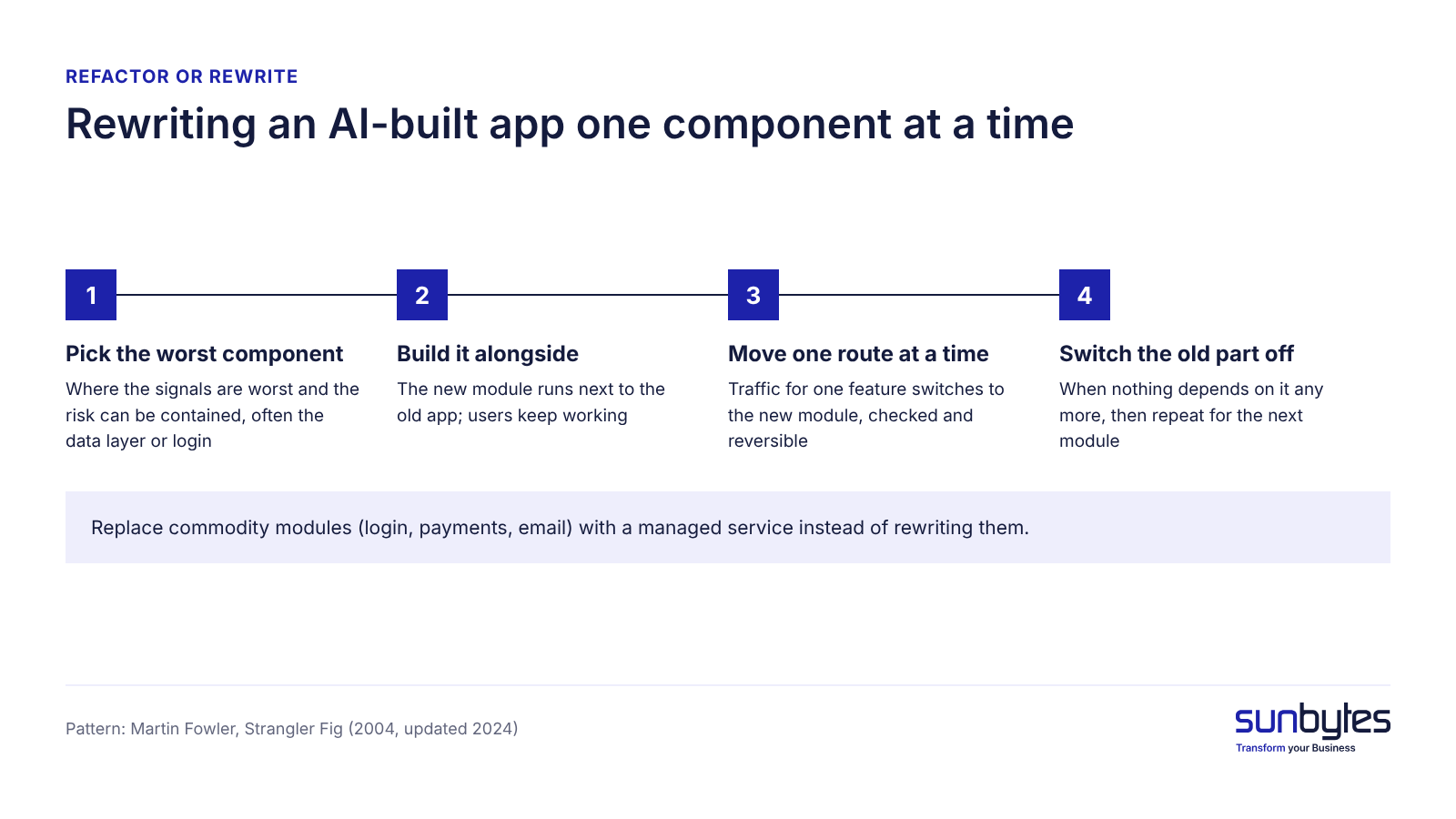
The staged route needs someone who keeps old and new parts consistent for the whole transition. When the team does not have that capacity, Sunbytes product engineering support can run the transition while the founder’s team keeps the product moving.
How Sunbytes helps decide what to keep, refactor or rebuild
A refactor or rewrite decision needs more than a code-quality score. It needs evidence of which user flows, dependencies and security controls work today, and which changes would put them at risk.
The AI-built product review from Sunbytes examines the agreed code, security, critical workflows and deployment setup, then provides evidence-backed findings, prioritised recommendations and a plain-English walkthrough. The results help your team weigh targeted refactoring, a staged component replacement or a separately scoped product engineering project. Remediation and re-checks can be discussed as follow-up work rather than assumed to be included.
Sunbytes is a Dutch-founded company, headquartered in Utrecht with a delivery hub in Vietnam since 2011. Over 15+ years, Sunbytes has delivered 300+ projects for clients in 20 countries and is ISO 27001 certified. Start with an AI-built product review to clarify the evidence and scope before committing to a rewrite.