

Your AI-built product is approaching its next milestone: onboarding customers, an investor review or an engineering handover. You’re considering an independent audit, but comparing quotes is difficult when the offers cover different work. One fee may cover an automated scan; another may include human review, evidence-backed findings and a walkthrough.
AI code audit cost depends on those differences. The review fee may also leave a separate budget to plan for fixing the findings and checking that the changes work.
This guide compares supplier-published price examples, explains seven cost drivers and five pricing models, and shows how to calculate a budget for the review, fixes and re-checks. You’ll also find eight quote terms to check, helping you compare equivalent offers and understand potential extra charges before committing.
TL;DR
Published AI code audit cost examples range from free automated scans to $10,000–$20,000+ for investor-facing due diligence. An AI code audit assesses an AI-built product against an agreed scope; published focused human reviews include $2,000–$5,000 offers, with narrower reviews available for less.
- Published price categories cover recurring tools, automated scans, narrow founder reviews, focused audits, broader codebase reviews and due diligence, each with different deliverables.
- Seven price drivers are codebase boundaries, integrations, personal data and payments, technology stack, report audience, urgency and re-check scope. Compare the billing model alongside the fee.
- Total budget includes the audit, fixes and re-checks, counting included work once. Request separate effort estimates for launch blockers and lower-priority findings.
- A comparable quote states eight items: scope, dates, reviewers, access and confidentiality, report format, walkthrough, re-check terms and VAT treatment.
How much does an AI code audit cost?
Published AI code audit prices include focused human reviews at $2,000–$5,000, broader reviews at $5,000–$10,000 and investor-facing due diligence at $10,000–$20,000+.
| Type | Supplier-published price example | Published turnaround | What you receive |
|---|---|---|---|
| AI review tool subscription | $12–$160 per developer/month, annual billing (official tool plans) | Ongoing, within plan allowances | Automated code feedback; report depth and usage limits vary |
| Automated scan | Free–$500 (March 2026 guide) | Minutes to hours | Tool findings within the configured checks |
| Narrow founder review | Published offer: $399 (September 2026) | 3–5 days for this offer | A bounded review, ranked findings and a walkthrough |
| Focused human audit | $2,000–$5,000 (March 2026 guide) | 3–5 days in the cited guide | Human review through a defined lens and prioritised findings |
| Broader codebase audit | $5,000–$10,000 (March 2026 guide) | 1–2 weeks in the cited guide | Wider engineering assessment and remediation priorities |
| Investor-facing due diligence | $10,000–$20,000+ (March 2026 guide) | 2–4 weeks in the cited guide | Transaction-facing assessment, potentially including IP, licensing and team context |
Pricing methodology: service examples are one-off US-dollar figures; subscriptions are recurring per-developer charges on annual billing. The Dutch edition converts source prices using a dated European Central Bank reference rate, with rounding stated separately. Converted amounts are indicative, not supplier quotations. Check VAT or other taxes, billing commitments, fixes and verification separately.
For the wider release context, see ai-generated code in production.
What are you buying at each audit price?
For cost comparisons, separate recurring tool access, automated scanning, human review and transaction-focused due diligence. Each pays for a different output.
- A subscription buys repeated automated feedback within the plan’s limits. It usually checks each new change, not the whole product you already have. Before you buy, ask whether it includes a full first review of the existing code.
- A scan fee covers configured checks, such as dependencies, secrets or code patterns. Confirm whether the price includes human validation of the alerts.
- A human-review fee should identify the product areas examined, the evidence and prioritised findings delivered, and any walkthrough. The AI code audit guide explains review scope and process.
- Due-diligence fees cover evidence for an investor, acquirer or board and may add licensing, ownership and continuity questions. Confirm the recipient’s requirements before paying for that depth.
What drives the price of an AI code audit?
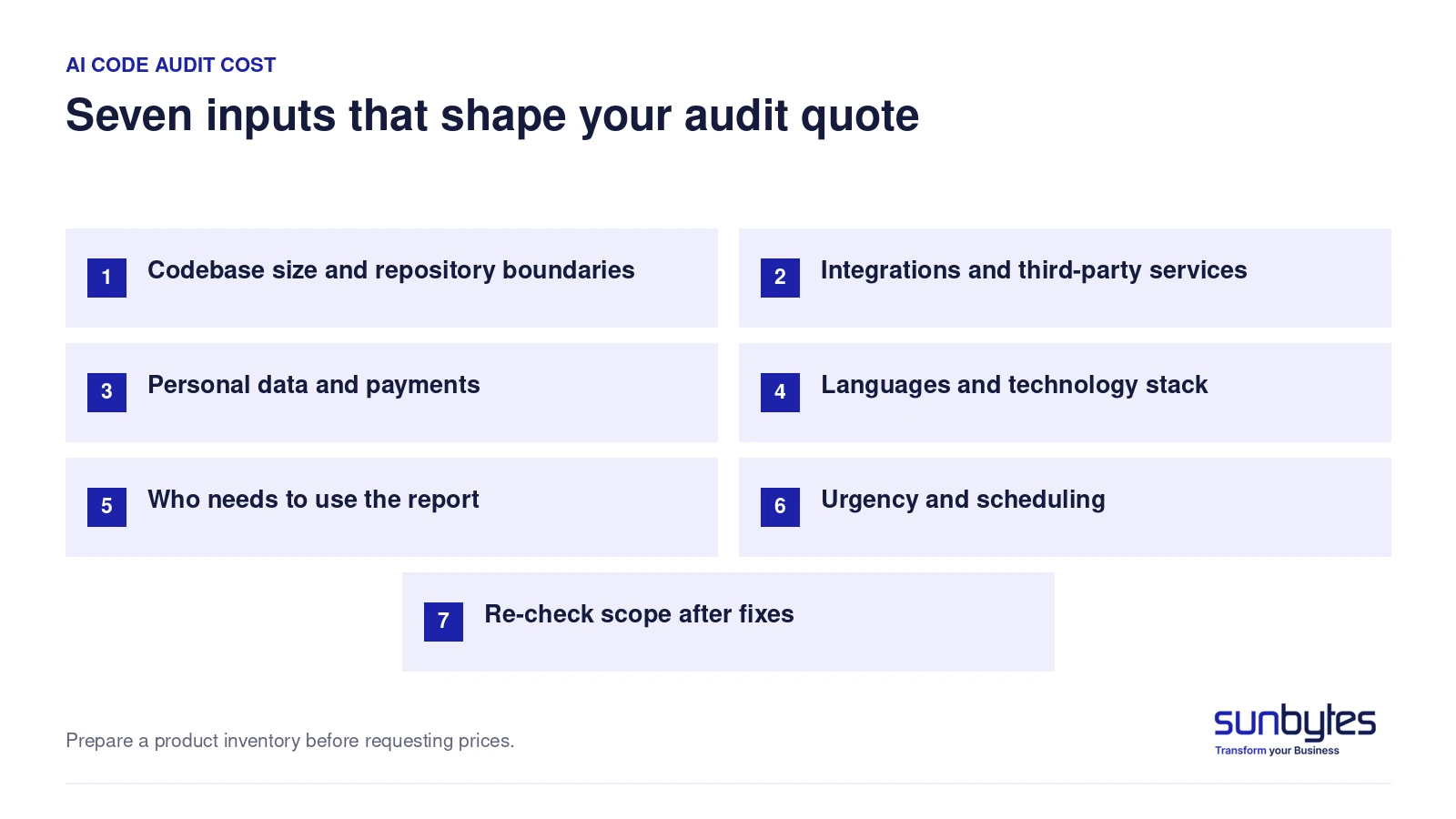
Seven inputs change the work behind an AI code audit quote. Prepare a product inventory before requesting prices, so each supplier scopes the same repositories, flows, data and expected report.
Codebase size and repository boundaries
A repository is the place where source code and its change history are stored. List the repositories and services in scope, including generated files or duplicated modules. More material may mean more reading, but line count alone does not describe the relationships a reviewer must understand.
Integrations and third-party services
An integration connects your product to another service, such as payments, identity or email. List the connections, the data exchanged and who controls each account. A reviewer needs enough context to check the agreed flows across those boundaries.
Personal data and payments
Personal data raises what the audit has to prove about access and handling. GDPR asks for security that matches the risk of the data, which supports a deeper review where sensitive data sits. Also note where payments run and whether testing can happen outside the live system.
Languages and technology stack
List the languages, frameworks, hosting and database technologies. A single web application and a product with several services require different review coverage. Ask which components are included, rather than assuming the advertised fee covers every technology in your inventory.
Who needs to use the report
A founder may need priorities for the next release. An investor or enterprise customer may need evidence in a specific format. Share the recipient’s requirements before scoping, so the report answers the intended decision without a second engagement to repackage it.
Urgency and scheduling
An earlier deadline can change staffing and price. One published supplier guide lists a 30–50% rush premium; that is one supplier’s example, not a market rule. Ask whether urgency changes the fee, the coverage or both, and record the agreed delivery date.
Re-check scope after fixes
A re-check verifies whether agreed findings have been addressed. State which fixes need verification, which environment will be used and what changes require fresh scoping. A re-check of listed findings should not be assumed to include every feature added after the original review.
Scope the review around your product
Start with the repositories, integrations, users and data the review must cover. An AI-built product review helps establish evidence-backed findings and priorities for your next release or customer milestone. Sunbytes agrees scope and delivery date before review starts.
How do pricing models change what you pay?
An AI code audit’s pricing model determines what triggers the bill: agreed scope, time used, recurring access, measured usage or later remediation. Compare that rule with the fee and the circumstances that permit extra charges.
Whatever the billing model, agree the boundaries in writing: what is in scope, who may access the code and how your data is handled. Then compare the billing terms against those boundaries.
| Model | How the bill works | Commercial incentive | Terms to check |
|---|---|---|---|
| Fixed fee per scope | A price for defined activities and outputs | Deliver the agreed scope within the budget | Exclusions and how changes are approved |
| Day rate / time and materials | Time worked at agreed rates; materials where applicable | Payment follows recorded effort | Budget cap, reporting and approval for extra time |
| Subscription / per review | Recurring access or a charge per review | Continued use and review volume | Commitment, allowances and overage |
| Per line / per token | A measured amount of processing | Payment follows measured usage | What is counted, repeated runs and spending limits |
| Audit fee credited against fixes | Some review fee offsets eligible follow-up work | The commercial relationship continues into remediation | Credit expiry, restrictions and a usable standalone report |
A day rate is a charge per working day; time and materials bills the agreed resources used. A fee credit can reduce the later bill, but check whether you can use the report with another team. For a bounded review, compare fixed-scope offers first. Use time-based discovery when the boundaries cannot yet be established, with a cap and an approval point.
What should you budget for after the audit?
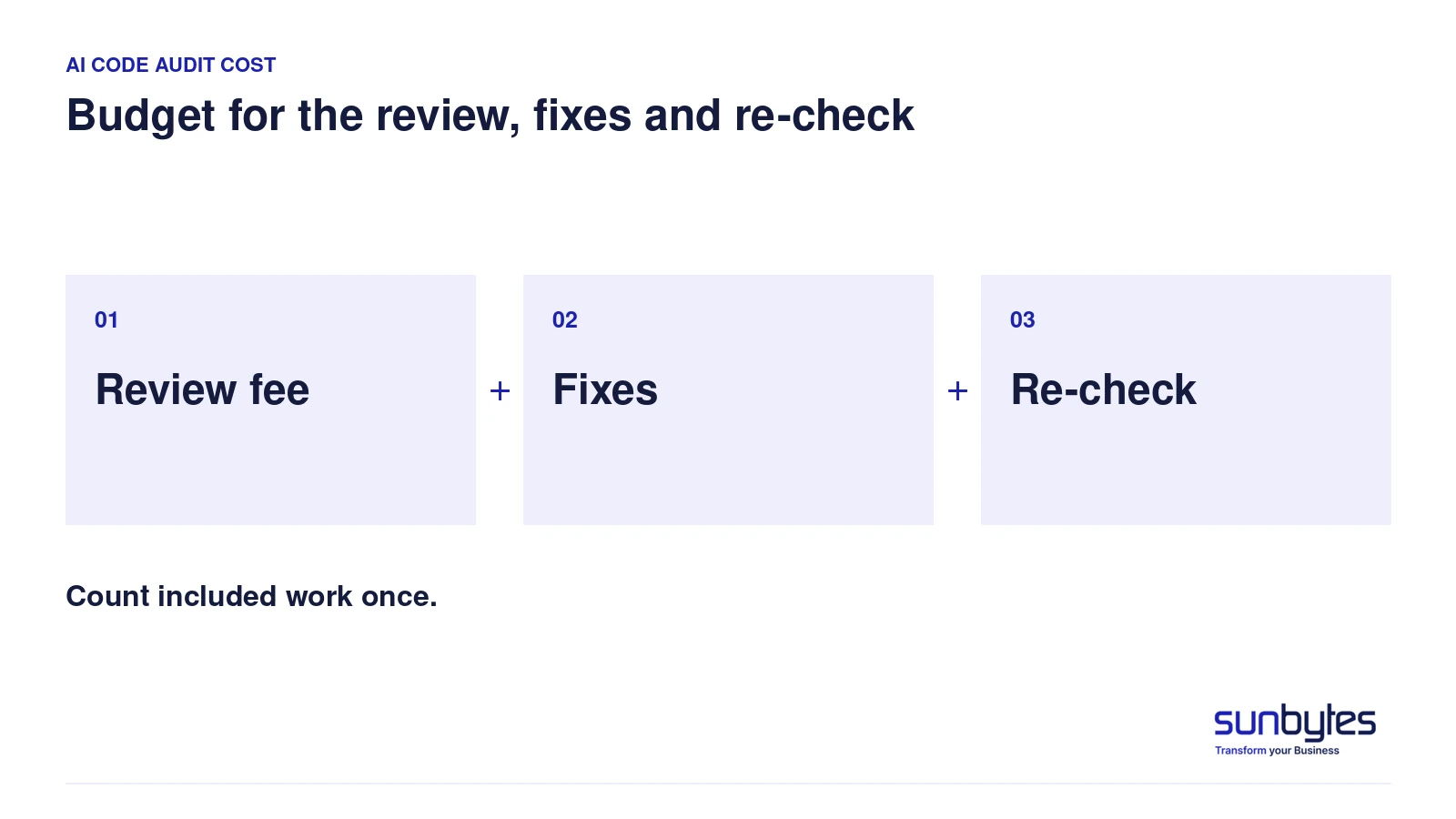
Your total AI code audit budget is the review fee + implementation + verification. Count included work once; a re-check already covered by the review fee is not a second charge.
Ask the provider to estimate effort for each finding separately: fixing it and checking the fix. That shows what must be fixed before launch and what can wait. Consider a hypothetical small AI-built SaaS product preparing to onboard customers.
Note: The following amounts and 20-hour effort assumption are chosen only to demonstrate the calculation. They are not a Sunbytes quote or verified market rates. Amounts are before any applicable tax.
| Budget item | Illustrative amount |
|---|---|
| Initial human review | $3,000 |
| Engineering fixes: 20 hours × $75/hour | $1,500 |
| Verification of agreed fixes | $500 |
| Total before tax | $5,000 |
If verification is included in the initial fee, remove the separate $500 line: the illustrative total becomes $4,500 before tax. Actual costs depend on the findings, implementation rates and re-check agreement.
After that, if the findings require structural redesign, request a new remediation estimate. The refactor or rewrite decision needs its own scope; do not apply a standard repair percentage to the audit fee.
What should an AI code audit quote include?
An AI code audit quote should show its fee and eight commercial terms: scope, dates, reviewers, access, report, walkthrough, re-check and tax treatment. Resolve exclusions and the approval process for extra charges before accepting it.
Before comparing two audit quotes, confirm that they cover the same repositories, flows, review activities and deliverables. A walkthrough or re-check included in one offer may cost extra in another. Ask suppliers to identify exclusions and explain how additional work is approved and charged. Compare provider qualifications separately in the code audit company guide.
When does a human audit justify the cost?
A human audit earns its place when a decision needs evidence about product behaviour that a generic scan cannot establish. An isolated prototype using test data can start with automated checks; customer access, money and external assurance requirements change the review decision.
The OWASP Business Logic Security Cheat Sheet explains that generic scanners can miss business-logic flaws because they lack the application’s rules. Match the review depth to those rules and the evidence your stakeholders need.
| Situation | Reasonable next step | Boundary |
|---|---|---|
| Internal concept, test data, no external dependence | Automated baseline checks | Reassess before real users or customer data depend on it |
| Customer data or payment flows | Human review of the relevant flows | A review is not blanket proof of compliance or safety |
| Enterprise customer requests evidence | Review and report aligned with the request | Check the requested scope; a separate penetration test may be needed |
| Fundraising or acquisition | Agree due-diligence requirements with the recipient | A narrow code report may not answer the transaction’s questions |
How Sunbytes scopes an AI-built product review
Start with a 30-minute discussion about your AI-built product. We’ll talk through what you’ve built, who will use it, which areas need closer review and whether an independent product review is the right next step.
If you already need a full review, our AI-built product review starts with agreement on scope, delivery date, access and data-handling terms. The review examines the relevant code, security, critical workflows and deployment setup, giving you evidence-backed findings, priorities and a plain-English walkthrough.
Sunbytes is a Dutch-founded technology partner providing independent reviews of AI-built products. We draw on 15+ years of software delivery experience, 300+ projects and work across 20+ countries.
Remediation and re-checks can be scoped separately, helping you distinguish the review cost from follow-up work and choose whether your team or Sunbytes implements the fixes.