

Choosing a European web development partner means looking past the sales proposal. The same project can look similar across three vendors, then change completely once you compare assumptions about scope, data access, team ownership, release process, and post-launch support.
That matters more for EU buyers because web projects often involve personal data, analytics, forms, user accounts, hosting, integrations, and cross-border delivery. A vendor that looks technically strong can still create legal, operational, or communication risk if the contract, data processing setup, and delivery model are vague.
Top-ranking pages for web development partner selection tend to compare portfolios, pricing, technologies, and communication style. This article adds EU-specific procurement checks that many generic vendor-selection pages miss: DPA readiness, SCC coverage for non-EEA data access or transfer, Dutch/EU contract jurisdiction, and timezone overlap for real-time delivery governance. If that decision is not yet final, compare the in-house vs outsourced team model first.
TL;DR
A strong European web development partner should prove delivery control before you sign. For Dutch and EU buyers, that means checking technical fit, DPA readiness, SCC coverage for non-EEA access, contract jurisdiction, sprint governance, and real-time overlap during EU business hours.
- Match the partner’s technical experience against your stack, integrations, user roles, and product workflow.
- GDPR documentation becomes essential when the website handles forms, analytics, user accounts, payments, CRM data, or recruitment flows.
- The contract should define IP ownership, Dutch or EU jurisdiction, liability, and data-processing responsibilities before delivery starts.
- Sprint governance needs visible measurement: review quality, change control, bug tracking, lead time, and release cadence.
- Real-time overlap matters when architecture decisions, urgent fixes, or sprint trade-offs need discussion during EU business hours.
What makes choosing a European web development partner different
A European web development partner is an external team that helps plan, build, test, secure, and support a website or web platform for a company operating in Europe. For Dutch and EU buyers, the partner should be evaluated not only on technical skill, but also on GDPR handling, contract jurisdiction, communication overlap, delivery method, and post-launch accountability.
A website build may look like a design and engineering project. In practice, it often touches personal data, analytics, CRM tools, payment flows, authentication, hosting, content workflows, and internal access rights. Once that happens, the partner is not just a supplier. They may become a processor handling data on your behalf.
For Dutch and EU companies, four issues deserve early attention.
| EU-specific criterion | Why it matters for CTOs and IT Directors |
|---|---|
| GDPR data processing | If the website processes personal data through forms, analytics, user accounts, or CRM integrations, your partner may need a Data Processing Agreement. |
| Cross-border data transfer | If delivery involves a non-EU team, ask how personal data access is controlled and whether Standard Contractual Clauses are in place. |
| Contract jurisdiction | Dutch or EU legal jurisdiction gives clearer recourse than a contract governed by unfamiliar non-EU law. |
| Timezone overlap | Real-time discussion is needed for sprint planning, architecture decisions, release issues, and urgent fixes. |
These checks belong in vendor evaluation because they affect who can access production data, who owns the code, how incidents are handled, and how fast decisions can be made during delivery.
Web development partner selection: 7 criteria for EU companies
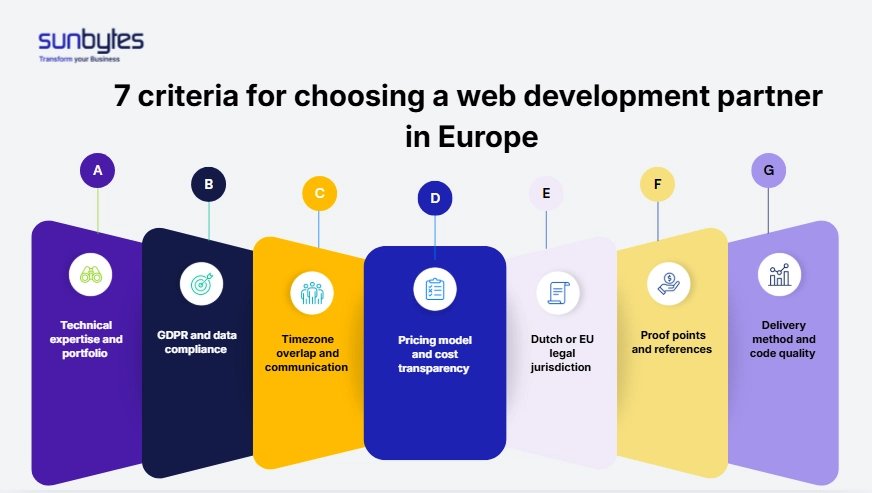
The best way to evaluate a partner is to ask the same questions of every vendor. That keeps the conversation concrete and makes weak answers easier to spot.
Use the table below during procurement, shortlist calls, or final vendor comparison.
| Evaluation criterion | What good looks like | Questions to ask | Sunbytes position |
|---|---|---|---|
| 1. Technical expertise and portfolio | The partner has experience in your required stack and can show comparable project types. Case studies should explain process, complexity, and outcome, with visuals used as supporting proof. | “Can you show projects similar in size and complexity to ours?” “Which developers would work on our project?” | Sunbytes works with a dedicated team model, so clients meet the actual developers before project start. Named Dutch client references are available on request. |
| 2. GDPR and data compliance | The partner can provide ISO 27001 certification details, a Data Processing Agreement, and SCC coverage where non-EU delivery is involved. | “Are you ISO 27001 certified?” “Do you provide a DPA?” “Where is data processed?” “Do SCCs apply to the delivery team?” | Sunbytes is ISO 27001 certified, provides a DPA as standard, and has SCCs in place for NL–Vietnam delivery. This is where GDPR-compliant development should be checked before signing. |
| 3. Timezone overlap and communication | There is at least four hours of daily overlap, a named project lead, and a clear escalation route for blocked decisions. | “When can we reach the team in real time?” “Who owns day-to-day delivery communication?” “How are urgent issues escalated?” | Sunbytes has a Utrecht HQ and Ho Chi Minh City delivery hub, creating 4–5 hours of overlap with Netherlands business hours, usually during NL mornings. |
| 4. Pricing model and cost transparency | The pricing model is clear. Scope, sprint outputs, onboarding, QA, documentation, and infrastructure responsibilities are explained before work starts. | “Is this fixed price, T&M, or sprint-based?” “What is included?” “How are scope changes approved?” | Sunbytes uses defined sprint planning and explicit backlog approval. Price is discussed after scope, team shape, and delivery risks are understood. |
| 5. Dutch or EU legal jurisdiction | The contract is governed by Dutch or EU law. IP ownership, data handling, liability, and dispute process are clear. | “Which jurisdiction governs the contract?” “Who owns the IP?” “Which court handles disputes?” | Sunbytes contracts are under Dutch law. Utrecht HQ gives Dutch companies a local contractual route rather than a distant offshore-only setup. |
| 6. Proof points and references | Certifications are verifiable. References are specific. Portfolio claims do not rely only on anonymous work. | “Can we speak to comparable reference clients?” “Can we verify the ISO certificate?” | Sunbytes has ISO 27001 certification and named Dutch client references available on request. |
| 7. Delivery method and code quality | The partner uses defined sprint cycles, sprint reviews, version control, code review, testing, and release discipline. | “What does a typical sprint look like?” “When do we review work?” “How are bugs handled after release?” | Sunbytes works in 2-week sprint cycles with sprint review, demo, backlog planning, CI/CD, and contract-defined support expectations. |
Ask the partner how they track deployment frequency, change lead time, change failure rate, and MTTR. By sprint two or three, these signals should be visible enough to show whether delivery is controlled or only busy
Comparing two or three vendors? Sunbytes can review your scope assumptions, data-processing setup, contract route, and sprint model in one structured vendor-fit call. Review your vendor shortlist with Sunbytes →
Pricing models in European web development partner selection
A quote is only useful when it explains the assumptions behind it. Before comparing vendors, ask what is included in the website development cost: discovery, UX, development, QA, project management, hosting setup, documentation, security review, and post-launch fixes. A cheaper proposal may simply exclude work that will appear later as a change request.
Clutch’s May 2026 web development pricing guide supports a common agency rate around $25–$49 per hour, but hourly rates alone do not explain total project cost.
The planning ranges below combine the public rate benchmark with Sunbytes scoping patterns from web development projects across different team sizes, integration needs, QA depth, and delivery models.
These are planning ranges, not quotes; final cost depends on scope, team shape, access requirements, and acceptance criteria
| Project or team type | Market planning range | Notes |
|---|---|---|
| Brochure website or simple CMS website | €5,000–€20,000 | Suitable when scope, page types, content, and CMS needs are limited. |
| Business website with integrations | €15,000–€60,000 | Cost increases with CRM, consent tools, multilingual content, forms, analytics, hosting, and QA. |
| Custom web application | €25,000–€120,000+ | User roles, workflow logic, payments, dashboards, APIs, and security requirements push cost up. |
| Dedicated team, sprint-based | €12,000–€30,000 per two-week sprint | Depends on team size, seniority, stack, PM/QA involvement, and sprint output. |
Each pricing model fits a different buying situation
| Pricing model | Best for | Watch out for |
|---|---|---|
| Fixed price | Well-defined scope, simple websites, landing pages, or brochureware builds with limited change expected. | Fixed price on unclear scope creates scope debates. If the scope document is weak, the price is based on assumptions. |
| Time and materials | Discovery-heavy work, evolving requirements, maintenance, and product changes based on user feedback. | Without sprint governance, T&M can expand without clear deliverables. Ask for weekly burn reporting and sprint commitments. |
| Dedicated team, sprint-based | Ongoing product development, multiple workstreams, and organisations that want the same team over time. | Requires a product owner or PM on the client side. It is not usually the best fit for a one-off brochure website. |
5 red flags that should stop the procurement process
These warning signs usually appear before the contract is signed. They are not minor sales gaps. They show where scope, compliance, staffing, or communication may become difficult once delivery starts.
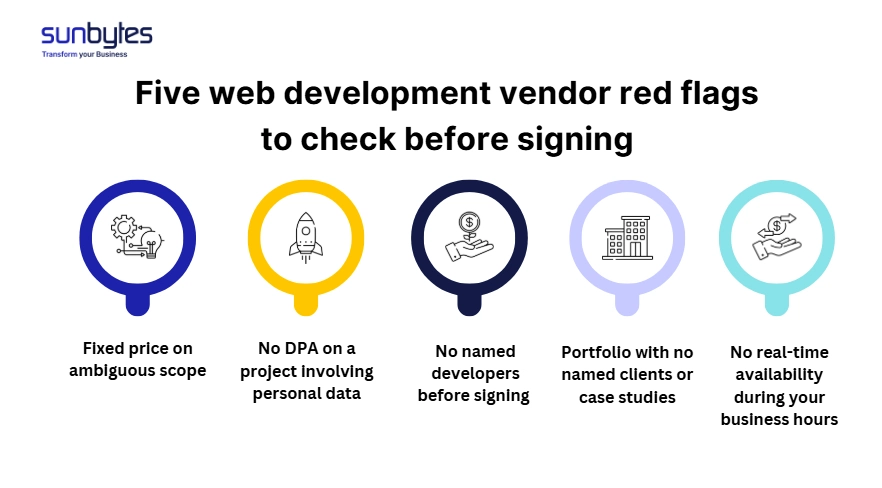
Red flag 1: Fixed price on ambiguous scope
Fixed price only works when the scope is written down. If integrations, content ownership, acceptance criteria, data flows, hosting, and release responsibilities are still unclear, the price is based on assumptions.
Check the scope document behind the number. If it does not define what is included, excluded, and change-controlled, the real price will appear later as change requests.
Red flag 2: No DPA on a project involving personal data
If your website processes personal data through forms, analytics, user accounts, recruitment flows, payment tools, or CRM integrations, ask for a Data Processing Agreement before signing.
A partner that says “we do not do DPAs” is creating a compliance gap for your organisation. GDPR Article 28 requires that processing by a processor be governed by a contract or other legal act. For website projects, that usually means your vendor documentation needs to match the data flows in the build. SCCs become relevant when personal data is transferred to, or accessed from, outside the EEA under the applicable GDPR transfer mechanism. The European Commission issued modernised Standard Contractual Clauses in 2021 for GDPR-based international data transfers.
This is where a GDPR website compliance checklist becomes useful during vendor evaluation. It helps you confirm whether the partner has covered consent setup, analytics, contact forms, user accounts, data access, subprocessors, retention, and breach-support responsibilities before development starts.
Red flag 3: No named developers before signing
Development quality is individual, not only organisational. If a company cannot tell you which developers will work on your project by name, seniority, and relevant experience, you may be buying available capacity rather than a stable team.
Names, seniority, relevant experience, and availability tell you more than a generic “senior team” promise. They also make sprint planning more realistic because you know who will own the work.
Red flag 4: Portfolio with no named clients or case studies
NDAs are normal. A portfolio with no named work at all is not.
Most established partners can show some named work, anonymised case studies with useful detail, or references available on request. A blanket “everything is under NDA” answer makes it hard to verify delivery quality.
Red flag 5: No real-time availability during your business hours
Async communication works for status updates, but blocked delivery decisions need live discussion.
Confirm the working window in your timezone and the escalation route for urgent issues. The practical test is simple: can the partner bring the right developer, delivery lead, and decision-maker into the same conversation when scope, QA, release, or production risk needs a fast answer?
Timezone and communication: the practical reality
Timezone affects delivery speed when decisions block progress. For EU companies working with non-EU delivery teams, the useful question is whether the overlap is enough for live decisions, not whether remote work is possible.
Sunbytes operates with Utrecht as the client-facing base and Ho Chi Minh City as the delivery hub. The Netherlands and Vietnam typically have 4–5 hours of useful overlap during NL mornings, giving Dutch and EU clients a daily window for decisions without relying on late-night calls or next-day async messages.
Before signing, confirm the working window, named delivery contact, and escalation route. A strong partner should be able to explain how an issue moves from report to owner, decision, fix, and release.
How Sunbytes approaches the web development partnership
For Dutch and EU companies, the partner decision should be proven before commitment: contract route, data access, named team, sprint rhythm, and escalation path. Sunbytes designs and delivers senior web development teams through Dutch-law contracts, a Utrecht client-facing base, ISO 27001-certified delivery practices, DPA/SCC handling, and 4–5 hours of Netherlands business-hour overlap.
This model has been used across 300+ projects in fintech, healthcare, and enterprise software over 15+ years. Digital Transformation Solutions gives the delivery relationship its structure: scope validation, sprint planning, architecture decisions, backlog ownership, and release discipline. For builds that need a stable product team, the same model connects delivery governance with Cybersecurity Solutions access handling and Accelerate Workforce Solutions named developer onboarding.
If you are comparing partners, start with the 7-point checklist above. Sunbytes can review your vendor shortlist against the issues that usually decide project success before the contract is signed: legal route, data-processing setup, team ownership, sprint rhythm, and escalation path.
Review your vendor shortlist with Sunbytes →