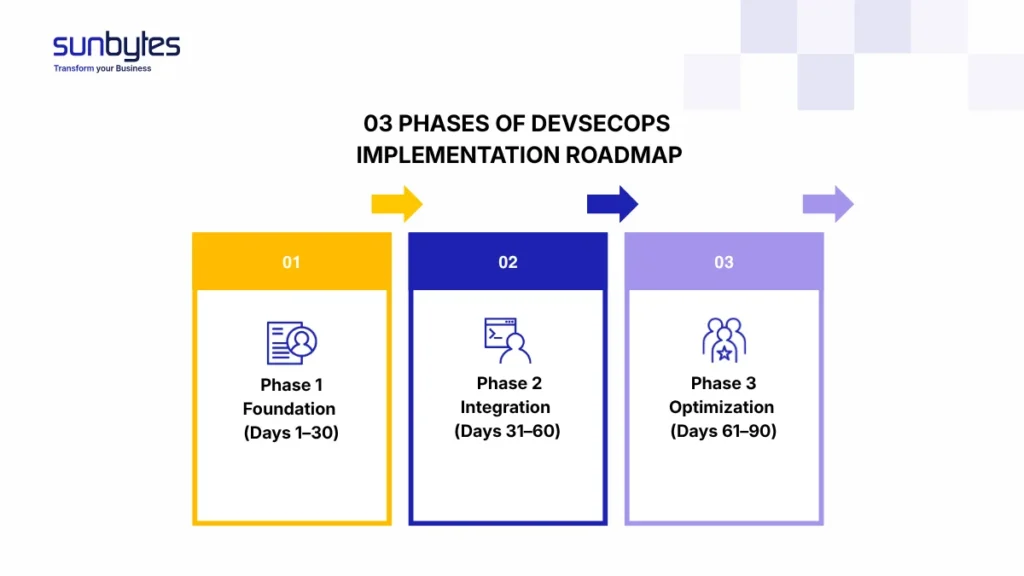
By Day 90, your team should have security ownership assigned, CI/CD security gates running, DORA metrics visible and a compliance evidence file ready for review. This DevSecOps implementation roadmap breaks the work into three phases: Foundation, Integration and Optimization.
The plan is built for EU SMEs that already know why DevSecOps matters and now need the sequence. If your team still needs the pipeline baseline before implementation, start with our DevSecOps pipeline guide before running Week 1.
If you are still deciding whether to build the role internally or add external DevSecOps capacity, use our DevSecOps team hiring guide to compare the skills, ownership model and team setup before starting the 90-day roadmap.
TL;DR
A DevSecOps implementation roadmap is a phased plan for adding security into software delivery without freezing sprint velocity.
- Days 1–30: audit the pipeline, assign ownership and install the first security gate.
- Days 31–60: embed SAST, dependency scanning, automated test gates and developer training.
- Days 61–90: track DORA metrics, enforce policy-as-code and prepare compliance evidence.
The Day 90 outcome is not full maturity. It is an operational baseline your team can run, measure and present to leadership.
What is a DevSecOps implementation roadmap?
A DevSecOps implementation roadmap is a time-boxed plan for embedding security controls into software delivery, from code commit to production release. It defines what happens first, who owns each step, which tools are introduced and what evidence the team should produce by each milestone.
For EU SMEs, a 30/60/90-day structure works better than a big-bang rollout. A mid-sized engineering team cannot pause delivery for a security rebuild. The roadmap has to protect sprint continuity while adding controls in the right order.
NIS2 and GDPR are the compliance drivers behind that structure. NIS2 pushes companies toward documented cybersecurity risk-management measures. GDPR Article 32 requires technical and organisational measures appropriate to the risk. In Dutch, teams may search for this as devsecops implementatie, but the practical question is the same: how do we implement security into delivery without slowing every release?
Why EU SMEs adopt DevSecOps in phases
Phased adoption reduces rework. If tooling comes before ownership, scanner alerts pile up without triage. If enforcement comes before observation, developers lose time fixing noisy findings before the thresholds are tuned.
A 90-day roadmap gives the team one job at a time: map the current pipeline, introduce the first gates, train developers, then measure outcomes. The sequence matters more than the tool list.
Before you start: DevSecOps readiness checklist
Complete this before Day 1. If you skip readiness, Phase 1 becomes rework instead of implementation.
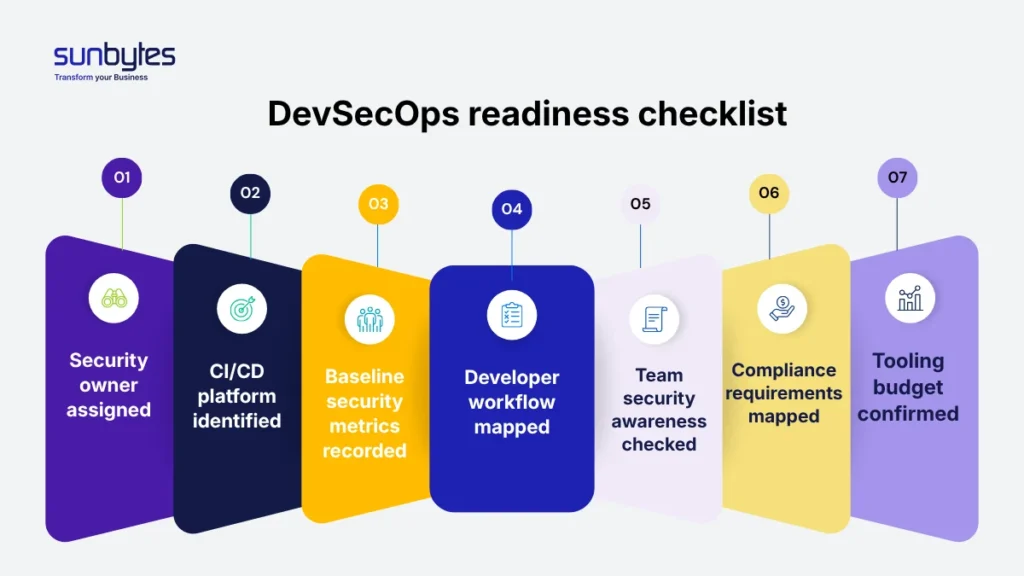
| Readiness item | What must be true before Day 1 |
|---|---|
| Security owner assigned | One named person owns DevSecOps decisions. Do not assign this to “the team”. |
| CI/CD platform identified | The team knows which pipeline will be changed first and where configuration is version-controlled. |
| Baseline security metrics recorded | Current vulnerabilities, failed builds, release frequency and incident recovery time are documented. |
| Developer workflow mapped | The team knows where code review, testing, dependency updates and deployment approvals happen today. |
| Team security awareness checked | Developers know the current secure coding expectations and where they need support. |
| Compliance requirements mapped | NIS2, ISO 27001 and GDPR requirements are translated into delivery controls, not left as legal notes. |
| Tooling budget confirmed | Finance has approved the first 90 days of tools, licenses and external support. |
Do not start with tool selection. Start with ownership, pipeline scope and measurable baseline. Tooling without ownership usually fails after the first month because nobody owns triage, exceptions or developer follow-up.
Phase 1 — Foundation (Days 1–30)
Phase 1 creates the baseline. The goal is not to secure every repository by Day 30. The goal is to know what exists, where risk enters the pipeline and which gate should go live first.
Week 1–2: Audit current pipeline and assign security ownership
Start with one production-facing application or service. Audit the pipeline stages, dependency chain, access controls and secret management. The audit should cover build configuration, container images, package managers, deployment approvals, privileged accounts and where secrets are stored.
The audit should be run by a DevSecOps lead and one developer who knows the current release flow. Security cannot audit the pipeline alone because delivery context sits with engineering. Engineering cannot own the audit alone because risk severity needs a security lens.
The output should be a Jira board with findings tagged Critical, High, Medium or Low. Each ticket needs an owner, affected system, evidence, proposed fix and target date.
Use the audit to decide where the first gate belongs. If your pipeline design is not yet documented, use our DevSecOps pipeline guide to map the stages before changing the build.
Week 3–4: Baseline tooling and first security gate
Introduce tools only after the audit has shown where they belong. For most EU SMEs, the first toolset should cover three areas: SAST, dependency scanning and container scanning.
Use SonarQube for static application security testing. Use Snyk or OWASP Dependency-Check for dependency scanning. Use Trivy for container image scanning. The exact choice depends on your stack, but the coverage areas should not be optional.
Configure the first pipeline gate in warning mode before blocking builds. A good Day 30 target is simple: Critical findings are visible in the pipeline, High findings are assigned, and Medium findings are tracked without stopping delivery.
For EU data handling, review where each tool processes scan data. If source code, dependency metadata or vulnerability data leaves the EU, check whether that creates GDPR or client-contract issues. This is especially relevant for SaaS companies handling regulated customer data.
Phase 1 milestone checklist:
| Milestone | Day 30 target state |
|---|---|
| Pipeline audit complete | One production-facing pipeline has been mapped from commit to deployment. |
| Security ownership assigned | One named owner manages findings, exceptions and tool decisions. |
| Jira findings board active | Findings are tagged by severity and assigned to owners. |
| First SAST tool connected | SonarQube or equivalent runs against the selected repository. |
| Dependency scan active | Snyk or OWASP Dependency-Check reports Critical and High findings. |
| Container scan active | Trivy or equivalent scans build images before deployment. |
Phase 2 — Integration (Days 31–60)
Phase 2 is where DevSecOps either becomes part of delivery or becomes another dashboard nobody checks. The difference is enforcement design.
Introduce gates in observe mode first. Then enforce. This gives the team time to tune false positives, agree thresholds and prevent avoidable sprint disruption.
Week 5–6: Embed SAST and dependency scanning in CI/CD
Week 5 should run SAST and dependency scanning in observe mode. Findings appear in the pipeline, but builds are not blocked yet. This gives developers one sprint to see the signal, challenge false positives and fix obvious Critical issues.
Week 6 is when enforcement starts. Block builds on Critical and High findings. Warn on Medium findings. Do not block on Low findings unless your sector or customer contract requires it.
This threshold keeps delivery moving while still preventing known severe risks from reaching production. It also creates a clear rule developers can understand: Critical and High findings stop the release. Medium findings enter the backlog with priority. Low findings are reviewed during normal maintenance.
Week 7–8: Automated test gates and developer training
By Week 7, connect automated test gates to the same pipeline view. Unit tests, integration tests and security scans should not live in separate reporting silos. Developers need one place to see whether a change is ready.
Training should be short and tied to the findings developers already see. Use a 1-hour async video to explain the new gates, severity thresholds and shift-left principle. Follow it with a 30-minute live Q&A focused on current findings from the selected repository.
The Week 8 target is specific: zero Critical findings in new commits. Do not try to clear the entire historical backlog in this phase. Historical findings can be handled through a remediation plan. New Critical findings should stop entering the codebase.
Before and after Phase 2:
| Metric | Before Phase 2 | After Phase 2 |
|---|---|---|
| Security visibility | Findings appear in separate tools or manual reviews. | Findings appear inside CI/CD with severity and owner. |
| Deployment speed | Security review may happen late or outside the sprint. | Critical and High gates run automatically before release. |
| Developer security friction | Developers receive security feedback after context has moved on. | Developers see security feedback while the change is still fresh. |
Need a DevSecOps engineer to turn these gates into delivery work? Sunbytes can add dedicated DevSecOps capacity to your existing CI/CD setup in 2-4 weeks, with NL-led coordination and daily overlap with Vietnam delivery teams. Get your 90-day DevSecOps implementation plan.
Phase 3 — Optimization (Days 61–90)
Phase 3 turns implementation into operating rhythm. The team now has gates, findings and training in place. The next step is to measure delivery impact and prepare compliance evidence.
Week 9–10: DORA metrics and delivery benchmarks
Track DORA metrics before changing more controls. Security gates are only working if they reduce risk without breaking delivery rhythm.
| DORA metric | What to measure | EU SME target range by Week 10 |
|---|---|---|
| Deployment Frequency | How often production deployments happen. | 1+ deployment per day for active SaaS teams, or a stable weekly release rhythm for smaller teams. |
| Lead Time for Changes | Time from code commit to production deployment. | Same day to 2 business days for standard changes. |
| Change Failure Rate | Percentage of deployments causing incidents, rollback or hotfix. | Below 15% after gates are tuned. |
| MTTR | Time to restore service after a failed change. | Under 4 hours for priority production incidents. |
These numbers are not maturity badges. They are control signals. If deployment frequency drops sharply after gates go live, the rules are too strict or too noisy. If change failure rate stays high, the gates are not catching the right risks.
Week 11–12: Policy enforcement and compliance readiness
By Week 11, add policy-as-code where it removes manual judgment. Open Policy Agent or Conftest can enforce rules for infrastructure configuration, deployment policies and container checks. Start with policies that are easy to explain: no privileged containers, no public storage buckets, no deployment without required scan results.
Compliance readiness means the team can show evidence quickly. By Day 90, prepare three files:
| Evidence file | What it should contain |
|---|---|
| NIS2 Article 21 evidence file | Risk-management measures, vulnerability handling process, incident response links and access control evidence. |
| ISO 27001 Annex A.14 control mapping | How secure development, change control and test evidence map to software delivery controls. |
| GDPR Article 32 technical measures log | Encryption, access control, logging, vulnerability management and recovery measures relevant to systems processing personal data. |
For Dutch companies, reference the Cyberbeveiligingswet as the Dutch implementation of NIS2. Use current soft timing language: expected around 1 July 2026, subject to formal entry into force. Until then, treat Cbw obligations as readiness requirements, not as a final enforcement statement.
The Day 90 deliverable is clear: the team should be able to produce a compliance evidence audit in under 2 hours. If evidence still takes days to assemble, the roadmap has created tools but not operating control. Teams that need the handover model after implementation can use the first 90 days onboarding playbook to define ownership, cadence and reporting.
Working with a remote DevSecOps team: NL-VN onboarding cadence
A remote DevSecOps team works when the operating rhythm is explicit. The timezone model should be planned before the first sprint, not fixed after delays appear.
Use a 4–5 hour daily overlap between the Netherlands and Vietnam. A practical window is 09:00–13:00 CET for the Netherlands and 14:00–18:00 ICT for Vietnam, adjusted each season for daylight saving time.
Daily standup should happen at 09:00 CET / 15:00 ICT. Keep it focused on pipeline blockers, security findings, release risks and handoffs. Do not turn it into a full status meeting.
Use Jira ticket comments for standard async handoff. For complex security context, attach a short Loom video showing the finding, affected code path and recommended fix. This prevents long written explanations from turning into unclear instructions.
Weekly cadence:
| Ceremony | Recommended time | Purpose |
|---|---|---|
| Sprint planning | Monday 09:30 CET | Confirm security work, delivery priorities and gate changes. |
| Mid-week risk check | Wednesday 10:00 CET | Review blocked findings, false positives and release risks. |
| Sprint review | Friday 15:00 CET | Review DORA movement, resolved findings and remaining evidence gaps. |
The cadence has one job: make security work visible inside delivery. If the DevSecOps engineer works outside the team rhythm, findings become external requests. If the engineer works inside the sprint, findings become delivery work.
How Sunbytes helps EU SMEs implement DevSecOps in 90 days
Running this roadmap with a new in-house hire can take 6–9 months because recruitment, onboarding, tooling decisions and pipeline context all happen before delivery starts. Sunbytes shortens that path with dedicated DevSecOps engineers who can join your delivery rhythm in 2–4 weeks. The work stays practical: audit the current pipeline, set the first gates, tune CI/CD rules, track DORA metrics and build the evidence file your leadership team can use.
Why Sunbytes?
A 90-day roadmap only works when the people, delivery rhythm and security evidence are managed together. Otherwise, tools go live but triage, exceptions and ownership still sit outside the sprint.
Sunbytes helps EU SMEs turn the roadmap into a working DevSecOps baseline. Our Digital Transformation Solutions modernize CI/CD workflows and delivery metrics. Our CyberSecurity Solutions map gates, evidence and vulnerability handling to NIS2, GDPR Article 32 and ISO 27001:2022 controls. Our Accelerate Workforce Solutions add the dedicated DevSecOps capacity when internal hiring would slow the first 90 days.With Dutch-led coordination, a Vietnam delivery hub, 15 years of delivery experience and dedicated engineers who can join your rhythm in 2-4 weeks, Sunbytes helps your team move from roadmap to operational baseline: gates running, DORA metrics visible and evidence ready for leadership review. Get your 90-day DevSecOps implementation plan
FAQs
A 90-day roadmap can create an operational DevSecOps baseline: ownership, CI/CD gates, tool coverage, DORA metrics and compliance evidence. Full maturity usually takes 6–12 months because policy automation, culture change and historical remediation need more than one quarter.
The most common mistake is starting with tooling before assigning a named security owner. Tools create alerts, but ownership turns alerts into decisions, backlog items and release rules. Without ownership, tooling often loses momentum within 60 days.
Yes, or you need a dedicated external resource with clear ownership. Part-time ownership usually fails after Phase 1 because alerts, triage, policy exceptions and developer support require daily attention. A DevSecOps engineer does not need to own all security, but someone must own the implementation rhythm.
NIS2 pushes eligible companies toward documented cybersecurity risk-management measures. Phase 3 of this roadmap turns delivery controls into evidence: vulnerability handling, access control, incident response links and technical security measures. For Dutch companies, refer to the Cyberbeveiligingswet as the national implementation and use timing language that reflects the current parliamentary process.
The cost depends on tooling, pipeline complexity, number of repositories and whether the role is hired in-house or delivered through a dedicated external model. For a 50-person team, the main cost drivers are engineer capacity, scanning tools, remediation backlog and developer training time. If you are comparing build versus external delivery, use our in-house vs outsourced DevSecOps comparison before setting the budget.
Start with SAST, dependency scanning and container scanning. A practical first stack is SonarQube for SAST, Snyk or OWASP Dependency-Check for dependencies, and Trivy for containers. Add policy-as-code later with OPA or Conftest once the team has tuned the first gates.
By Day 90, your team should have CI/CD security gates live, DORA metrics visible, a named DevSecOps owner, developer training completed and compliance evidence prepared. The strongest signal is audit readiness: the team can produce the main evidence pack in under 2 hours.
Let’s start with Sunbytes
Let us know your requirements for the team and we will contact you right away.