

EOR onboarding Vietnam covers the period from offer acceptance to payroll readiness. An Employer of Record becomes the legal employer, signs the employment contract, registers SHUI, sets up PIT, and manages payroll, while your team retains day-to-day management. Most local hires are onboarded within 2-4 weeks if documents are complete, while foreign hires requiring work permits typically take longer. For more background, see the complete guide to EOR in Vietnam. For the broader framework that applies across countries, see the EOR onboarding process guide.
TL;DR
- The EOR handles contracts, SHUI, PIT, payroll, and compliance; your team handles onboarding, equipment, and day-one productivity.
- Fast onboarding depends primarily on candidate document readiness; most companies use EOR when hiring in Vietnam without a local entity.
- Confirm payroll cut-off dates before setting a start date to avoid delaying the employee’s first full payroll cycle.
What EOR onboarding includes in Vietnam
Employer of record onboarding in Vietnam covers the legal employment setup while your team keeps operational control. Two employer roles run in parallel. The EOR is the legal employer: it signs the contract, registers SHUI, withholds PIT, runs payroll, and carries compliance liability under Vietnam labor law. Your team is the functional employer: you set the role, manage daily work, and decide salary and benefits within a compliant frame. The split below prevents the most common day-one surprise, where a new hire arrives with a contract but no laptop or system access. The generic legal-versus-functional split applies in any market, so this page keeps the focus on what changes in Vietnam.
| Dimension | EOR provider (legal employer) | Your team (functional employer) |
|---|---|---|
| Employment and statutory | Signs the contract, registers SHUI, files PIT | Confirms terms, salary in VND, start date |
| Payroll | Runs payroll and issues payslips | Confirms the configuration before the first run |
| Daily work | Not involved | Sets the role and manages performance |
| Compliance liability | Holds liability under Vietnam labor law | Keeps conduct within the agreed scope |
For the statutory detail behind each row, see EOR compliance Vietnam.

EOR onboarding Vietnam timeline: week by week
EOR onboarding Vietnam runs in 2 to 4 weeks for local hires once documents are ready, and document readiness, not the EOR’s speed, controls the calendar. Plan the steps below in parallel rather than in series, because Week 0 preparation is what compresses the timeline. Treat the table as your EOR setup timeline for Vietnam.
| Week | What happens | Owner | Output |
|---|---|---|---|
| Week 0 | Confirm the scenario, collect candidate documents in parallel, confirm the payroll cut-off | Your team and candidate | Documents ready before the contract stage |
| Week 1 | Sign the EOR service agreement, finalise employment terms, EOR drafts the bilingual contract | You and EOR | Service agreement signed, contract issued |
| Week 2 | Employee signs the contract, SHUI registration submitted, PIT tax code set up | EOR | Employee legally employed, statutory setup started |
| Week 3 to 4 | First payroll configured and confirmed, day-one handoff prepared | EOR and your team | First payroll on the next cycle, day one ready |
| Foreign-hire exception | Work permit dossier under Decree 219/2025 adds about 10 working days of processing | EOR and you | Start date set after the permit is issued |
Confirm the EOR payroll cut-off before you set a start date. If the start date falls after the cut-off, the first full payroll moves to the next cycle. For how this affects the budget, see EOR cost in Vietnam.
Need your Vietnam hire ready without delaying the start date? Sunbytes maps the onboarding sequence before the contract is issued: employment terms, candidate documents, SHUI, PIT, payroll cut-off, and day-one handoff. See how our EOR team plans onboarding in 2 to 4 weeks.
Documents needed before onboarding starts
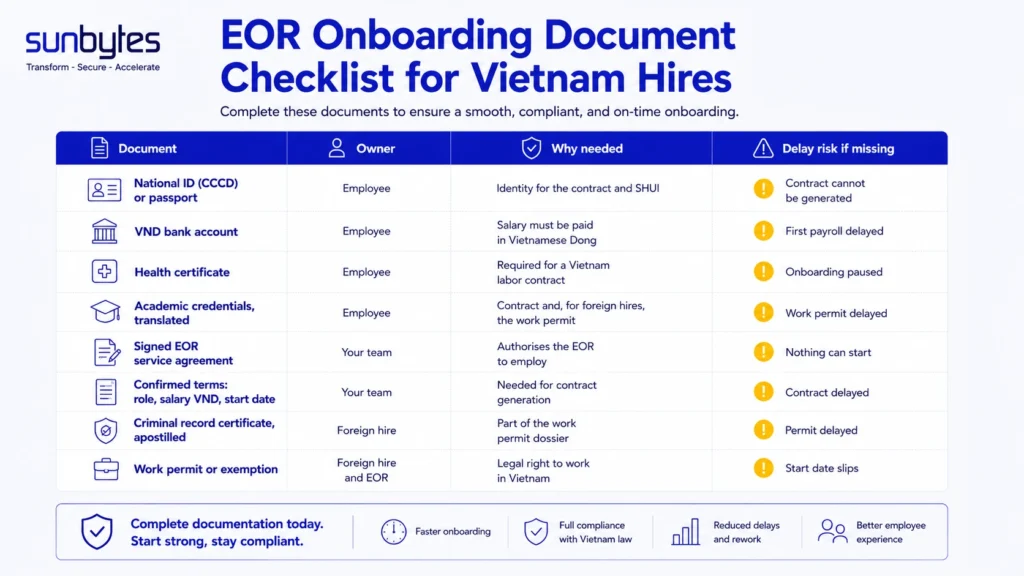
This EOR document checklist for Vietnam lists what to collect before the contract stage, because the EOR can issue a bilingual contract within about two business days of receiving a complete set. Starting collection only after the service agreement is signed adds days with no benefit, since most sets take 3 to 5 business days to gather, verify, and translate.
| Document | Owner | Why needed | Delay risk if missing |
|---|---|---|---|
| National ID (CCCD) or passport | Employee | Identity for the contract and SHUI | Contract cannot be generated |
| VND bank account | Employee | Salary must be paid in Vietnamese Dong | First payroll delayed |
| Health certificate | Employee | Required for a Vietnam labor contract | Onboarding paused |
| Academic credentials, translated | Employee | Contract and, for foreign hires, the work permit | Work permit delayed |
| Signed EOR service agreement | Your team | Authorises the EOR to employ | Nothing can start |
| Confirmed terms: role, salary VND, start date | Your team | Needed for contract generation | Contract delayed |
| Criminal record certificate, apostilled | Foreign hire | Part of the work permit dossier | Permit delayed |
| Work permit or exemption | Foreign hire and EOR | Legal right to work in Vietnam | Start date slips |
What the EOR provider handles vs what your team still owns
The EOR handles legal employment; your team handles everything an employee touches on day one. The provider does not create email accounts, ship laptops, or run team introductions. Naming an internal owner for each client-side task, with a deadline three business days before the start date, is what makes the first day work.
| Onboarding task | EOR provider | Your team |
|---|---|---|
| Bilingual employment contract | Drafts and signs it | Approves the terms |
| SHUI registration | Submits to Social Insurance | Not involved |
| PIT setup | Configures and withholds | Provides dependant details |
| First payroll | Runs it on the agreed cycle | Confirms the configuration |
| Work permit (foreign hire) | Prepares and submits the dossier | Supplies personal documents |
| Laptop and equipment | Not included | Ships before day one |
| Email and system access | Not included | Creates accounts before day one |
| Manager and buddy | Not included | Assigns for the first week |
| Role and objectives | Not included | Owns direction and reviews |
Choosing the partner is a separate step from onboarding. If you have not selected one yet, work through the EOR provider checklist Vietnam first.
Compliance steps that cannot wait until day one
These compliance steps start before or on the first working day, not after, because Vietnam’s employment rules apply from the contract start date. The EOR sets them up inside the onboarding window so there is no gap in coverage.
The employment contract follows the Vietnam Labor Code 2019 (Law No. 45/2019/QH14): written, bilingual, with the Vietnamese version controlling, and probation up to 60 days for roles needing university-level qualifications (Vietnam Labor Code 2019).
Employer SHUI contributions total 21.5% of gross salary (Social Insurance 17.5%, Health Insurance 3%, Unemployment Insurance 1%) and employees contribute 10.5%, on a salary capped at 20 times the reference level (PwC Worldwide Tax Summaries). PIT is withheld monthly on progressive rates from 5% to 35%, after a personal deduction of VND 11 million and VND 4.4 million per dependant, and remitted by the 20th of the following month.
Where EU employee data is processed, sign a GDPR Article 28 data processing agreement before any data moves. Vietnam’s own rules now sit under the Personal Data Protection Law (Law No. 91/2025/QH15) and Decree 356/2025/ND-CP, both effective January 1, 2026, a framework law firm analysis describes as closely modelled on the EU GDPR (Baker McKenzie). For a foreign hire, the work permit follows Decree 219/2025/ND-CP, effective August 7, 2025, which uses a single dossier and 10 working days of processing from a complete application (Decree 219/2025/ND-CP).
| Step | Owner | Proof needed | Source to verify |
|---|---|---|---|
| Bilingual employment contract | EOR | Signed contract, Vietnamese controlling | Vietnam Labor Code 2019 |
| SHUI registration | EOR | Social insurance code confirmation | PwC tax summary |
| PIT setup and withholding | EOR | Tax code and first payslip | PwC tax summary |
| Payroll cut-off alignment | EOR and you | Payroll calendar, first run date | EOR service agreement |
| Data processing agreement | EOR and you | Signed GDPR Article 28 DPA | PDPL 91/2025, Baker McKenzie |
| Work permit (foreign hire) | EOR | Issued permit or exemption | Decree 219/2025/ND-CP |
Confirm these legal and payroll figures with your adviser before they go live. For the deeper statutory view, see EOR compliance Vietnam and Vietnam personal income tax for employers.
Common delays and how to prevent them
Most EOR onboarding delays in Vietnam are preventable and trace back to a missing owner. Each row below ties a cause to the action that removes it, so you can assign the fix before it costs a start date.
| Cause | Days lost | Prevention action |
|---|---|---|
| Documents collected only after signing | 3 to 5 | Collect candidate documents in parallel from Week 0 |
| No VND bank account ready | 2 to 4 | Confirm the VND account at the document stage, not before payroll |
| Payroll cut-off checked too late | Up to a full cycle | Confirm the cut-off before setting the start date |
| EOR relationship not explained to the candidate | 1 to 3 | Brief the candidate at the offer stage on who the legal employer is |
| No internal IT owner | Day one only | Assign IT provisioning three business days before the start date |
How Sunbytes supports EOR onboarding in Vietnam
EOR onboarding in Vietnam only works when legal employment setup and your internal day-one preparation move together. Sunbytes employs your Vietnam hire through our Employer of Record (EOR) service and runs contract, SHUI, PIT, first payroll, and offboarding planning as one sequence rather than separate tasks.
- Onboarding is planned in 2 to 4 weeks once documents are ready, so the contract is issued before the start date.
- Payroll runs on time, with the first cycle confirmed before day one, and offboarding actions initiated within 24 hours.
- A 4 to 5 hour working overlap between the Netherlands and Vietnam, with ISO 27001 controls and a GDPR Article 28 data processing agreement.
Founded in the Netherlands with a delivery hub in Ho Chi Minh City, over 15 years of experience, and 300+ projects across 20+ countries, Sunbytes builds employment infrastructure for foreign companies in Vietnam, a market the World Bank links to its goal of high-income status by 2045.
- Compliance you can demonstrate: Through Accelerate Workforce Solutions, Sunbytes manages Vietnamese labor contracts, Social Insurance administration, and PIT obligations. Through CyberSecurity Solutions employee data handling is supported by GDPR Article 28 data processing agreements and ISO 27001-certified security controls.
- Service levels you can track: Through Accelerate Workforce Solutions onboarding is planned within 2 to 4 weeks when documents are ready, payroll is delivered on time, and offboarding actions are initiated within 24 hours against defined operational targets.
- Growth without administrative complexity: Through Digital Transformation Solutions Sunbytes helps organizations build and scale Vietnam-based technical teams while Accelerate Workforce Solutions maintains employment administration and local compliance processes.