

A role has been live for two weeks. CVs are coming in, but your hiring manager is still saying, “We are not seeing the right engineers.”
That does not always mean Vietnam is the wrong market. It can mean the job description was written for internal approval, not for Vietnam-based engineers deciding whether to apply.
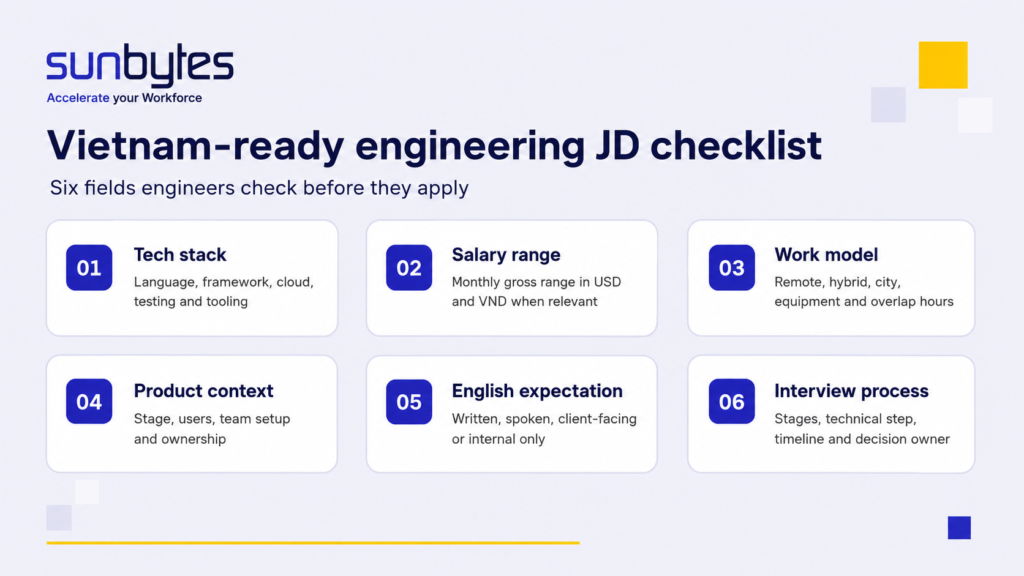
A strong job description for Vietnam engineers should make the role clear before sourcing starts: stack, salary range, work model, product context, English expectation, and interview process. When those details are missing, your recruiter screens against assumptions and your shortlist gets slower.
If you need support aligning your hiring brief before sourcing, explore Sunbytes recruitment services in Vietnam.
TL;DR
A Vietnam-ready engineering job description is a market-facing hiring brief that helps candidates self-assess fit before they apply. It explains the role in terms engineers actually use: stack, salary range, work model, product context, English expectation, and interview process. A Vietnam-ready engineering job description should make six decisions clear before sourcing starts: tech stack, salary range, work model, product context, English expectation, and interview process. For EU teams, the JD should also separate must-have skills from nice-to-have skills, show salary in USD and VND when relevant, and explain how the Vietnam role fits the wider team.
- Vietnamese engineers respond better to specific role details than broad employer-brand language.
- Salary signal, stack clarity, and interview transparency reduce weak applications before screening starts.
- A calibrated brief can support time-to-shortlist in 3 days when role scope, salary, and decision owners are aligned.
Why EU-style job descriptions underperform in Vietnam
EU-style job descriptions often underperform in Vietnam because they explain what the company wants, but not what the engineer needs to decide. A Vietnam-ready JD should help candidates understand the role fast enough to apply or self-filter.
The difference is visible in the first screening round.
An internal European JD might say:
“We are looking for a proactive software engineer to join our product team and work on scalable digital solutions.”
That sentence may pass internal review. It does not help a candidate understand the stack, seniority, salary level, reporting line, product maturity, language expectation, or hiring process.
Vietnamese engineers usually scan the JD for decision details first. They want to know whether the role matches their technical level, salary expectation, work model, English ability, and interview availability. If those details are unclear, good candidates may skip the role before your recruiter ever sees them.
This is where sourcing gets misdiagnosed. Your team may think the channel is weak, when the first filter was already broken. A clearer JD will not solve every hiring problem, but it gives sourcing, screening, technical assessment, and hiring-manager feedback the same baseline.
What a job description for Vietnam engineers must make clear
A job description for Vietnam engineers should answer six questions before the application form. The candidate should understand what they will build, what they need to know, how they will work, how they will communicate, what the pay signal looks like, and what happens after applying.
| Field | What the JD should say | Weak version | Stronger version |
|---|---|---|---|
| Tech stack | Main language, framework, cloud, testing, tooling | “Experience with modern JavaScript” | “React, TypeScript, REST APIs, GitHub, basic automated testing. Node.js is a plus.” |
| Salary range | Monthly gross range in USD and VND, with seniority note | “Competitive salary” | “USD 1,500–2,500 per month, approx. VND 39–66 million. Final range depends on seniority and interview result.” |
| Work model | Remote, hybrid, city, equipment, overlap | “Remote-friendly” | “Remote in Vietnam, with 4–5 hours overlap with the Netherlands. Laptop provided.” |
| Product context | Product stage, users, team setup, ownership | “Join our product team” | “Work on a B2B SaaS platform used by EU clients. The Vietnam engineer joins a 6-person product squad.” |
| English expectation | Written, spoken, client-facing, internal only | “Good English” | “English is needed for daily stand-ups, written updates, and sprint planning with the Dutch team.” |
| Interview process | Stages, technical test, timeline, decision owner | “Technical test required” | “Screening call, technical interview, short code review task, final interview. Target decision within 2 weeks.” |
Stack clarity should show the real working environment
Stack clarity means naming the tools the engineer will actually use. It does not mean listing every technology your company has touched in the last five years.
A backend JD should name the core language, framework, database, cloud environment, testing expectation, and team workflow. A frontend JD should name the framework, state management approach if relevant, API style, design handoff, and browser or performance expectations.
Clear stack descriptions help candidates judge fit and allow recruiters to screen more accurately.
Salary signal should be visible before screening starts
A salary signal should appear in the JD when the budget is already calibrated. For Vietnam engineering roles, show the salary in USD and VND when your internal budget uses USD or when the external benchmark is quoted in USD.
According to Robert Walters Vietnam salary guide, 2026 software engineer salary ranges are USD 900–1,300 per month for entry-level roles, USD 1,500–2,500 for mid-level roles, and USD 2,800–4,500+ for senior-level roles.
Use those ranges as a benchmark, not as a promise. The final range depends on stack, seniority, English level, location, and whether the role is local, remote, or client-facing.
A publish-ready salary line could look like this:
“Salary range: USD 1,500–2,500 per month, approx. VND 39–66 million. Final offer depends on seniority, technical assessment, and English communication level.”
For VND-based calibration, use ITviec’s Vietnam IT Salary Report. It gives local market signals by role and experience level, which helps avoid writing a range that looks attractive in Europe but misses the Vietnam hiring market.
Use published salary guides such as Robert Walters Vietnam and ITviec as planning benchmarks, not offer promises. Final ranges should be calibrated against stack, seniority, English level, location, remote/client-facing expectations, and current candidate availability.
Work model needs more than remote or hybrid
A work model line should explain how the engineer will work with your team. “Remote” is not enough.
For Dutch and EU teams, the overlap matters. Vietnam is usually 4–5 hours ahead of the Netherlands depending on daylight saving time. That can work well for engineering delivery, but only if the JD says what the overlap is for.
A clearer version:
“Remote from Vietnam. The role requires 4–5 hours of overlap with the Netherlands for stand-ups, sprint planning, and technical handoff. Most deep work happens asynchronously.”
That sentence reduces confusion before screening. It also protects your hiring manager from late-stage mismatches around meeting hours.
Must-have vs nice-to-have is where good candidates drop out
Good candidates drop out when the JD treats every preference as mandatory. A strong Vietnam engineering JD separates what the engineer needs on day one from what can be learned after joining.
Use three levels:
| Requirement type | Meaning | Example |
|---|---|---|
| Must-have | Needed to do the role in the first 30–60 days | “3+ years with React and TypeScript in production.” |
| Nice-to-have | Useful, but not required to start | “Experience with Node.js or GraphQL is a plus.” |
| Deal-breaker | Required because of the business setup | “Able to join daily English stand-ups with the Dutch engineering lead.” |
The danger is role inflation. A JD for a mid-level frontend engineer becomes a senior full-stack cloud engineer job because every stakeholder adds one more requirement. That narrows the pool before the first interview.
Your hiring manager may still need a strong engineer. But the JD should not ask for a senior engineer, a DevOps engineer, a product analyst, and a client-facing consultant in the same role unless the salary range and title match that scope.
To avoid this, align your screening criteria early by reviewing how to assess candidates after sourcing so your JD and evaluation process stay consistent.
Before and after: how to rewrite a Vietnam engineering JD
The best rewrite does not make the JD longer. It makes the candidate decision easier.
| Vague internal requirement | Why it gets ignored | Vietnam-ready rewrite |
|---|---|---|
| 5+ years of JavaScript experience | Years alone do not show the working level or stack | “4+ years in frontend development, with production experience in React and TypeScript. You should be comfortable reviewing pull requests and working with REST APIs.” |
| Good English communication | Candidates do not know if the role is internal or client-facing | “English is used for daily written updates, sprint planning, and technical discussion with the Dutch engineering lead. Client calls are occasional.” |
| Fast-paced environment | Too broad and often read as overtime risk | “Two-week sprint cycle, weekly planning, and async updates through Jira and Slack. Release support may be needed during agreed hours.” |
| Full-stack developer | Full-stack can mean many things | “Main focus: React and TypeScript. Backend exposure in Node.js is useful for API integration, but this is not a backend-heavy role.” |
| Culture fit | Vague and hard to screen fairly | “The role fits someone who gives clear written updates, asks early when blocked, and can work with a Dutch product owner across time zones.” |
| Technical test required | Candidates may fear a long unpaid assignment | “The technical step is a 60–90 minute code review task. It is used to discuss reasoning, trade-offs, and code quality in the technical interview.” |

This rewrite also helps your recruiter. A recruiter can screen for React, TypeScript, API work, English usage, salary fit, and availability without inventing criteria during the call.
That is where shortlist quality changes.
To strengthen this step further, review candidate vetting in Vietnam to ensure your shortlist reflects real technical fit.
How a clearer JD improves screening and time-to-hire
A clearer JD improves time-to-hire because it gives every person in the recruitment process the same screening baseline. Your recruiter, technical interviewer, hiring manager, and candidate should all be working from the same role definition.
When the brief is vague, screening slows down in small ways. The recruiter asks broad questions. The hiring manager rejects CVs without a clear reason. Candidates enter the process with salary or work-model assumptions that break later.
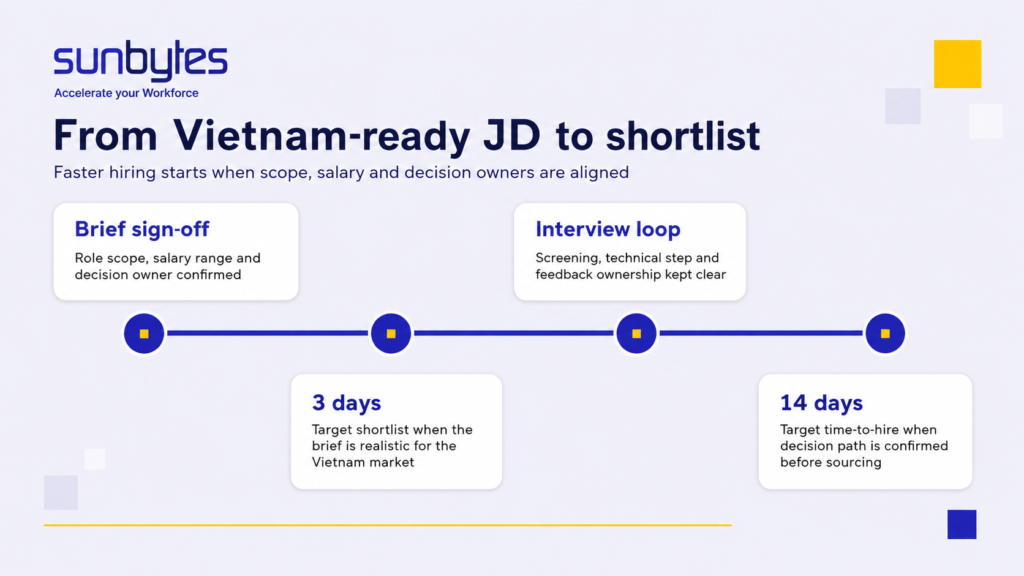
When the brief is calibrated, the first shortlist can move faster. For Sunbytes recruitment workflows, time-to-shortlist can be 3 days from brief sign-off when the role scope, salary range, and decision owners are realistic for the Vietnam market. Time-to-hire can reach 14 days when the interview process and feedback ownership are confirmed before sourcing starts.
The reverse is also true.
If your team rewrites the brief after two weeks of outreach, the pipeline resets. New sourcing criteria, new screening questions, and new candidate expectations can add 3–4 weeks to close.
For a deeper breakdown of timelines, see how long recruitment takes in Vietnam.
Need to fix the brief before sourcing starts?
Sunbytes can help translate your internal hiring need into a Vietnam-ready engineering brief before the first candidate search starts.
Keep GDPR/AVG handling light but visible in the handoff
EU companies hiring in Vietnam should keep candidate data handling visible, but the JD does not need to become a legal document. The practical point is simple: collect only the candidate data needed for selection and define who can access it.
A structured handoff should cover CVs, test results, interview notes, salary expectations, and rejection records. The recruiter, hiring manager, and technical interviewer should know which notes are stored, who can view them, and when they are removed.
According to the European Data Protection Supervisor (EDPS), recruitment procedures involve processing personal data such as CVs, diplomas, professional experience, and evaluation reports. The UK ICO recruitment guidance also outlines how candidate data should be handled from application to deletion.
For a Vietnam engineering JD, keep the compliance signal short:
“Candidate information is processed only for recruitment purposes. Technical assessment results and interview notes are shared with the hiring team involved in this role.”
That is enough for the JD. The detailed AVG/GDPR handling belongs in the recruitment workflow and service agreement.
How Sunbytes turns role requirements into a Vietnam-ready brief
A weak job description usually becomes a slow shortlist. Sunbytes helps EU teams fix the brief before sourcing starts, so recruiters are not guessing what the hiring manager meant and engineers are not left guessing whether the role fits them.
The workflow starts with role calibration: title, seniority, salary signal, stack, work model, English expectation, interview path, and decision owner. From there, Sunbytes turns the internal requirement into a Vietnam-ready engineering brief and builds the sourcing workflow around it.
This is where Sunbytes’ cross-pillar setup becomes useful. Accelerate Workforce Solutions owns the recruitment workflow: market calibration, sourcing, screening, shortlist delivery, interview coordination, and offer support. Digital Transformation Solutions helps translate technical requirements into a brief that engineers can understand, especially when the role involves product ownership, delivery setup, stack decisions, or technical assessment handoff. CyberSecurity Solutions supports the secure handling of candidate data, technical test materials, access rights, and recruitment documentation when GDPR/AVG or client data sensitivity matters.
For EU teams, the useful point is ownership. Your CTO should not spend two weeks rewriting the same requirement with every recruiter. Your HR lead should not discover salary mismatch after the first shortlist. Your hiring manager should not wait a week for candidate feedback after a technical interview.
When the role, salary range, and decision process are aligned, Sunbytes targets a shortlist within 3 days from brief sign-off and time-to-hire of 14 days. The 4–5 hour NL–VN overlap also keeps feedback loops workable for Dutch and Vietnam teams.
Talk to Sunbytes about your Vietnam engineering brief. Explore Sunbytes recruitment services.