

Candidate vetting Vietnam should reduce hiring risk before the offer, not create a larger data-handling problem for your HR team.
For EU companies hiring professional employees in Vietnam, the issue usually appears late in the process. Your hiring manager likes the candidate. The salary range is agreed. The team wants to move fast. Then the questions start: which checks are lawful, who asks for consent, who calls references, what goes into the contract, and how should probation be measured?
That is where background checks, reference calls, technical validation, and probation planning need to work together. A background check can verify facts. It cannot tell your team whether the person will work well under remote ownership, client pressure, or a 4 to 5 hour Netherlands to Vietnam overlap.
This guide explains how EU teams can structure candidate vetting in Vietnam before the final offer, with light GDPR / AVG framing, Vietnam data protection awareness, and a practical handoff into contract and probation setup. If you want a broader overview of hiring workflows, you can explore recruitment services guide in Vietnam to understand how vetting fits into the full hiring process.
TL;DR
- Candidate vetting Vietnam should include identity and right-to-work verification, employment history, education or professional credentials where relevant, structured reference calls, role-specific assessment, and lawful criminal record documentation only when the role justifies it.
- A background check Vietnam employees process should stay narrow, consent-led, and documented. EU employers should collect only the data needed for the hiring decision, explain the purpose to the candidate, and control who can access or store the result.
- Background checks should feed into the offer, contract, and probation plan. Factual checks confirm the candidate’s claims, reference checks show how the person worked, and probation planning turns those signals into clear first-month expectations.
Candidate vetting Vietnam: what should a background check include?
A background check Vietnam employees process should verify only the information that is lawful, relevant, and necessary for the role. It should not become an open-ended investigation into a candidate’s personal life.
Candidate vetting is broader than a background check. It is the process of deciding whether a candidate is suitable to hire by combining factual verification, reference feedback, role assessment, and probation planning.
For professional employees in Vietnam, a practical vetting scope usually includes:
- Identity and right-to-work verification.
- Employment history and job title confirmation.
- Education or professional credential checks where the qualification matters.
- Reference calls with former managers or senior collaborators.
- Technical or role-specific assessment.
- Criminal record documentation only where lawful, relevant, and proportionate.
- Work permit document checks for foreign employees working in Vietnam.
The European Data Protection Supervisor guidance on selection and recruitment notes that recruitment procedures can involve processing candidate personal data such as CVs, diplomas, professional experience, evaluation tests, and reports. That is why vetting should be designed as a controlled recruitment step, not an informal document collection exercise.
For tech roles, the background check should not replace technical validation. A senior backend engineer can have a clean employment history and still fail the role if the architecture expectations, code review habits, or communication style do not match your delivery setup. To go deeper into this, you can review how to assess Vietnamese developers remotely when evaluating technical candidates.
For HR and operations teams, the main point is ownership. Decide who owns each part before the final interview. HR should own consent and data handling. The hiring manager should own role-fit questions. A technical lead should own skill validation. Legal or an employment partner should review sensitive checks and probation wording.
What needs consent and data handling controls in Vietnam?
Candidate data should be collected with a clear purpose, clear scope, and documented consent where required. EU employers should treat Vietnam candidate vetting as a data protection workflow, not only as a recruitment task.
Vietnam’s Law No. 91/2025/QH15 on Personal Data Protection was issued on 26 June 2025 and takes effect on 1 January 2026. EU employers also need to consider GDPR/AVG expectations when candidate data is handled by EU teams or transferred between Vietnam and Europe. The European Data Protection Board guidelines on Article 3 and Chapter V GDPR international transfers are relevant when EU-controlled candidate data moves across borders.
For Dutch employers, the Dutch Data Protection Authority also gives practical guidance on personal data of applicants, including the point that some personal data should only be requested when an applicant starts working. That principle fits the recruitment logic here: ask for what you need at the right stage, not everything at the first screening step.
A safer vetting workflow starts with four questions:
- What exact information do we need to verify?
- Why is that information necessary for this role?
- Has the candidate been told what will be checked and how the data will be used?
- Who will store the result, for how long, and under which access controls?
A finance manager may justify deeper checks than a marketing executive because the role may involve financial authority. A software engineer with production access may need stronger identity, employment, and technical validation than a junior content role. A blanket process for every candidate creates unnecessary data risk.
Sensitive checks need extra care. Criminal record information, health information, biometric data, financial information, and personal identifiers should never be collected casually. Before running sensitive checks, confirm legal basis, candidate consent, data retention, and role relevance with counsel or a qualified employment partner.
For EU teams, the practical rule is simple: collect less, document more. The check should answer a hiring question. If the result will not change the hiring decision, it probably should not be collected.
Reference checks should produce role signal, not character gossip
Reference checks in Vietnam hiring should focus on work evidence: role ownership, reliability, collaboration, communication, and delivery under pressure. A reference call should not ask vague character questions that cannot be tied back to the role.
The best reference calls happen after the hiring manager has already identified the risk areas. If the candidate is strong technically but quiet in interviews, references should explore communication and ownership. If the candidate has worked in several short roles, references should explore delivery context, not assume instability.
Useful reference questions include:
- What work did the candidate directly own?
- How did the candidate handle unclear requirements?
- How did the candidate respond to feedback?
- What level of supervision did the candidate need?
- Would you hire this person again for a similar role?
- What should a new manager know in the first 30 days?
For tech hiring, reference calls should not ask “were they good?” That answer is too broad to help. Ask how the person worked in sprint planning, handled production issues, reviewed code, communicated blockers, or collaborated with product and QA.
The candidate should know that reference calls are part of the process. Candidate awareness protects trust and reduces the risk of back-channel calls that create privacy or reputational issues.
Background checks, reference checks, and technical vetting solve different problems
Background checks verify facts. Reference checks verify working behaviour. Technical vetting verifies role capability. Your hiring decision is safer when each method answers a different question.
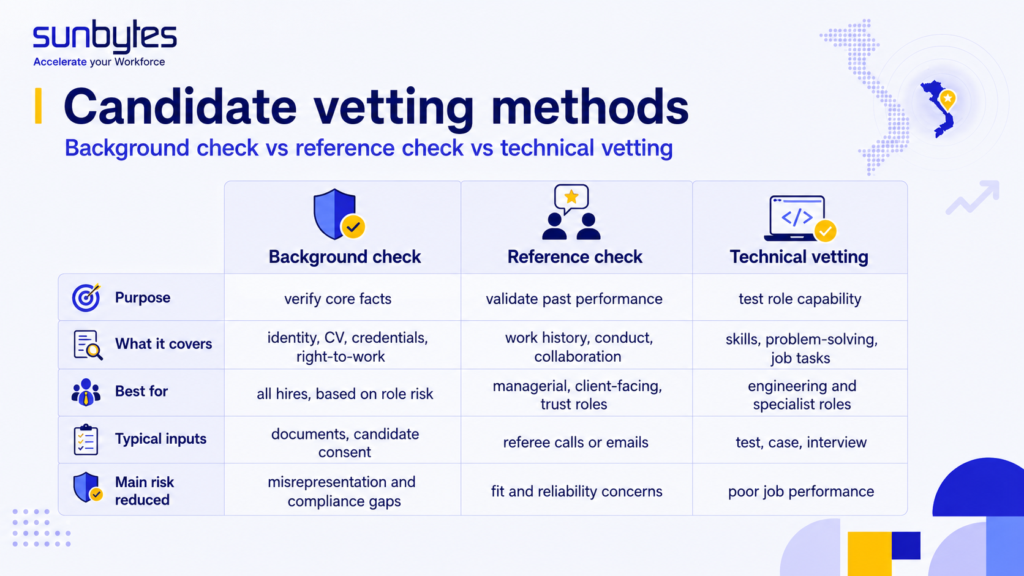
| Vetting method | What it verifies | Who owns it | Data and privacy note | Handoff action |
|---|---|---|---|---|
| Identity and right-to-work check | Candidate identity and ability to work in Vietnam | HR or employment partner | Collect only required ID and work documents | Confirm before offer or employment setup |
| Employment history check | Previous employers, dates, titles, and role claims | Recruiter or HR | Candidate should know what will be verified | Resolve gaps before final offer |
| Education or credential check | Degree, certificate, or professional qualification | Recruiter or HR | Use only when qualification matters for the role | Document result in hiring file |
| Criminal record documentation | Relevant record information where lawful and role-specific | Legal, HR, or employment partner | Sensitive data. Confirm legal basis and role relevance | Use only for defined risk roles |
| Reference check | Ownership, collaboration, reliability, manager feedback | Hiring manager or recruiter | Candidate awareness recommended | Turn findings into onboarding and probation notes |
| Technical assessment | Practical skill, code quality, judgement, communication | Technical lead or hiring manager | Avoid storing unnecessary test data | Feed into interview decision and probation goals |
| Probation plan | First 30 to 60 day success criteria | Hiring manager and HR | Avoid copying sensitive vetting details into manager notes | Add measurable goals to contract or onboarding plan |
This is the information gain most generic background-check articles miss. The value is not only in running checks. The value is in deciding what happens with the result.
- If an employment-history check shows title inflation, the right action may be a scope adjustment, not an automatic rejection.
- If references show the candidate needs strong product direction, the right action may be a tighter first-month onboarding plan.
- If the technical assessment shows weak testing habits, the probation plan should include code review and test coverage expectations.
Probation risk should be clarified before the offer is signed
Probation in Vietnam is useful only when the role expectations are specific before the employee starts. A vague probation clause gives your team less protection than a clear 30 to 60 day success plan.
Under Vietnam Labour Code 2019, probation can be included in the employment contract or agreed in a separate probation contract. The official English legal database version of Labour Code No. 45/2019/QH14 states that the probation period depends on the nature and complexity of the job. The roles requiring a junior college degree or above, the probation period cannot exceed 60 days. For certain enterprise executive roles, the limit can be up to 180 days.
For professional employees, this means probation should be designed before the offer is accepted. The hiring manager should not wait until week six to decide what success means. To better understand how this connects to legal setup, you can review employment contract and probation clauses before finalizing your offer.
A practical probation handoff should include:
- Role scope confirmed against the final job description.
- First 30 day deliverables.
- First 60 day capability expectations where applicable.
- Communication and reporting expectations.
- Manager check-in rhythm.
- Technical or role-specific areas to validate.
- Any support the candidate needs from the employer.
For a senior developer, probation may include code review quality, sprint predictability, architecture judgement, documentation habits, and collaboration with product owners. For a finance or operations role, probation may include reporting accuracy, deadline ownership, compliance handoff, and stakeholder communication.
Do not copy sensitive vetting data into broad manager notes. A probation plan should translate the hiring signal into job expectations. It should not expose unnecessary personal data to people who do not need it.
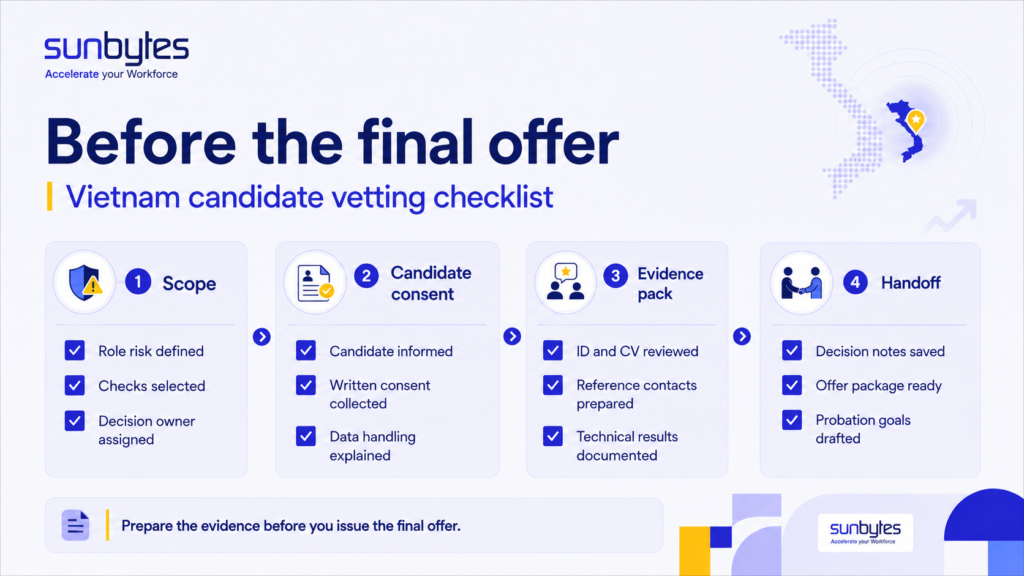
A practical vetting workflow before the final offer
A safer candidate vetting workflow starts before the final interview and ends only when the contract and probation plan are ready. The process should run in parallel with hiring decisions, not after the team has already promised a start date.
Use this sequence for professional roles in Vietnam:
- Calibrate the role risk before screening starts
Decide which checks are necessary for the role. A senior finance hire, HR manager, or engineer with production access may need a different vetting package than a generalist role. - Inform the candidate before checks begin
Explain what will be checked, why it is relevant, who will process the data, and what the candidate can expect. Keep the wording plain. - Get documented consent where required
Consent should be specific to the purpose. Avoid broad consent forms that authorise any future check without a clear reason. - Run factual checks and reference calls separately
Do not mix factual verification with subjective feedback. A background check result and a reference opinion need different handling. - Review findings against role relevance
A finding should be assessed against the role, not against a generic idea of a “perfect candidate.” HR, the hiring manager, and legal counsel should agree on how sensitive findings are handled. - Convert hiring signal into probation planning
The final handoff should include what to confirm during onboarding, what to measure in the first month, and what support the manager needs to provide. - Keep only what you need
Store vetting outcomes according to your retention policy. Limit access to people with a clear role in the hiring decision or employment setup.
Time-to-shortlist still matters. If your vetting process begins only after the final interview, you may add avoidable delay at the exact moment a strong candidate is most likely to accept another offer. For aligned roles, Sunbytes targets a shortlist within 3 days from brief sign-off and time-to-hire of 14 days when role scope, salary range, and decision owners are confirmed.
Need to reduce hiring risk before offer stage?
Sunbytes can help structure candidate vetting in Vietnam before your final hiring decision. That means consent-led screening, reference calls, role-specific validation, and probation handoff planned before your candidate reaches contract stage. Learn more about Sunbytes recruitment services if you want expert support in managing this process.
What to avoid when vetting candidates in Vietnam
The fastest way to create risk is to let vetting happen informally. Informal checks often feel faster, but they leave weak documentation and unclear data ownership.
Avoid these common mistakes:
- Running the same checks for every role without testing relevance.
- Asking for sensitive documents before the candidate understands the purpose.
- Contacting former employers without candidate awareness.
- Using back-channel references as a substitute for structured reference calls.
- Treating criminal record information as an automatic rejection factor.
- Storing candidate documents in email threads or shared folders without access control.
- Letting probation start without clear success criteria.
- Asking recruiters to interpret legal or sensitive findings without HR or legal review.
For EU teams, the privacy risk often comes from convenience. A manager saves a CV to a local drive. A recruiter forwards a passport scan by email. A reference note gets pasted into a shared Slack channel. None of these actions look serious in isolation. Together, they create a candidate data trail your team may struggle to explain later. For a broader perspective, you can read more about background checks in hiring and how global practices compare.
How Sunbytes supports candidate vetting in Vietnam
Candidate vetting should give your team a cleaner hiring decision before the offer. It should not leave HR chasing consent forms, references, technical feedback, and probation notes across five different owners.
Sunbytes helps EU companies turn candidate vetting into a controlled recruitment workflow in Vietnam. The process can include role calibration, sourcing, consent-led screening, structured reference calls, technical assessment handoff, offer support, and employment setup guidance.
The useful point is ownership. The hiring manager should not need to decide which candidate data can be collected. And HR lead should not discover reference gaps after the offer is already accepted. The legal or operations team should not receive a candidate file with unclear consent or missing probation notes.
For recruitment projects, Sunbytes targets time-to-shortlist within 3 days from brief sign-off and time-to-hire of 14 days when the role, salary range, and decision owners are aligned. The Vietnam delivery team works with a 4 to 5 hour Netherlands to Vietnam overlap, so reference follow-ups, candidate communication, and handoff questions do not wait until the next working day.
If you are planning to hire in Vietnam, consider working with Sunbytes recruitment services to streamline your vetting and hiring process.