

Code generated with AI can work today and still be difficult to maintain, test or change safely. Duplicated logic, missing tests and unclear dependencies may not affect the first release, but they can make later changes harder and increase the risk of regressions.
Measuring AI code quality means looking beyond whether the code runs. This guide explains seven practical metrics, how to interpret them, what level of evidence matters at different product stages and why automated scores still need human judgement.
TL;DR
AI code quality is the quality of code written with an AI coding tool, judged by whether it works correctly and whether people can understand, test and change it safely later. An AI tool can help review its own output, but that self-assessment does not replace deterministic checks, outcome data and human review.
- Seven indicators: duplicated business logic, complexity in high-impact files, test coverage on critical behaviours, dependency risk, static analysis findings, change failure rate and short-term code churn, read as a dated trend.
- How to read them: each indicator points to an area worth investigating; none of the seven proves on its own that the code is good or bad.
- Evidence by stage: working critical flows for a prototype; risk-based tests and no known exploitable vulnerabilities once users depend on it; a documented maintainability check before other people change the code.
- Limits: automated scores do not show whether access control is correct, personal data is handled lawfully or the architecture fits the product’s next 12 months.
What does AI code quality mean?
AI code quality is the quality of code produced with an AI coding tool, judged by the same standard as any other software: does it do what the product needs, correctly and securely, and can people other than the tool that wrote it understand, test and change it without breaking what already works. Working functionality and maintainable code are two different properties, and an AI-built product needs both.
ISO/IEC 25010:2023, the international product quality model for software, is a useful reference for naming those properties. It lists nine characteristics: functional suitability, performance efficiency, compatibility, interaction capability, reliability, security, maintainability, flexibility and safety. Maintainability is the one AI-assisted development puts under most pressure, and the standard splits it into five sub-characteristics: modularity, reusability, analysability, modifiability and testability. The measurements in this guide focus on maintainability and change reliability; they say little about the other characteristics, which need their own checks.
Maintainability matters more, not less, in an AI-built product. If the next change is also made by an AI coding tool, that tool reads the existing code as its context, so duplicated logic and inconsistent structure become patterns it can repeat. The founder’s guide to shipping AI-built products safely covers this risk at product level; quality measurement makes it visible in the code.
Seven code quality metrics to assess AI-written code
Seven code quality metrics, read as indicators rather than verdicts, give a founder a practical view of AI-written code: duplicated business logic, complexity in high-impact files, test coverage on critical behaviours, dependency risk, static analysis findings, change failure rate and short-term code churn. Five describe the code itself; change failure rate is an operational outcome signal, and churn describes how the code changes over time. Each one tells you where to look, not what the verdict is.
| Indicator | What it measures | How to read it | Data source |
|---|---|---|---|
| 1. Duplicated business logic | Rules such as pricing, permissions or validation implemented in more than one place | A concern when one business change has to be made in several places. Some copied code is harmless; removing all duplication can increase coupling | Static analysis, plus a developer’s check of what the duplicates contain |
| 2. Complexity in high-impact files | How hard the files that change often, or that critical flows depend on, are to follow. Cyclomatic complexity counts the paths through a function; cognitive complexity estimates how hard it is to read | Frequent change alone can mean the product is developing as planned. Read complexity together with defect history and how far a change in that file spreads | Static analysis, version control and defect history |
| 3. Test coverage on critical behaviours | Whether automated tests exercise and assert the behaviours that matter most, such as login, payment and access to personal data | Coverage shows which code runs during tests, not whether the tests would catch a fault. Look for risk-based tests with assertions on expected results | Test runner in the CI pipeline |
| 4. Dependency risk | Third-party packages with known exploitable vulnerabilities, packages that are no longer supported, and routine updates | Separate the three: an outdated package is not automatically insecure; a known exploitable vulnerability in a used package needs an owner and a plan | Dependency scanner and vulnerability advisories |
| 5. Static analysis findings | Type errors, lint warnings and other issues a tool finds without running the code | Sort by severity and confidence, and count suppressed rules. A rising number of suppressions can hide problems the totals no longer show | Type checker and linter in the CI pipeline |
| 6. Change failure rate | The share of deployments that need immediate intervention after release, such as a hotfix or rollback | An operational outcome signal, not a direct measure of the source code. A rise after fast AI-assisted feature work is a reason to look at tests and review | Deployment and incident records |
| 7. Short-term code churn | The share of new code rewritten or deleted within a few weeks of being added | Churn can rise through experimentation or active refactoring. It matters when it comes with repeated rework of the same area or with defects | Version control history |
Change failure rate comes from DORA’s software delivery performance metrics, which describe it (as “change fail rate”) as the proportion of deployments that require immediate intervention, such as a hotfix or rollback. It measures what happens after a change ships, so it complements the code-level indicators rather than replacing them, and it is a different measure from short-term code churn, which looks at code rewritten soon after it was written.
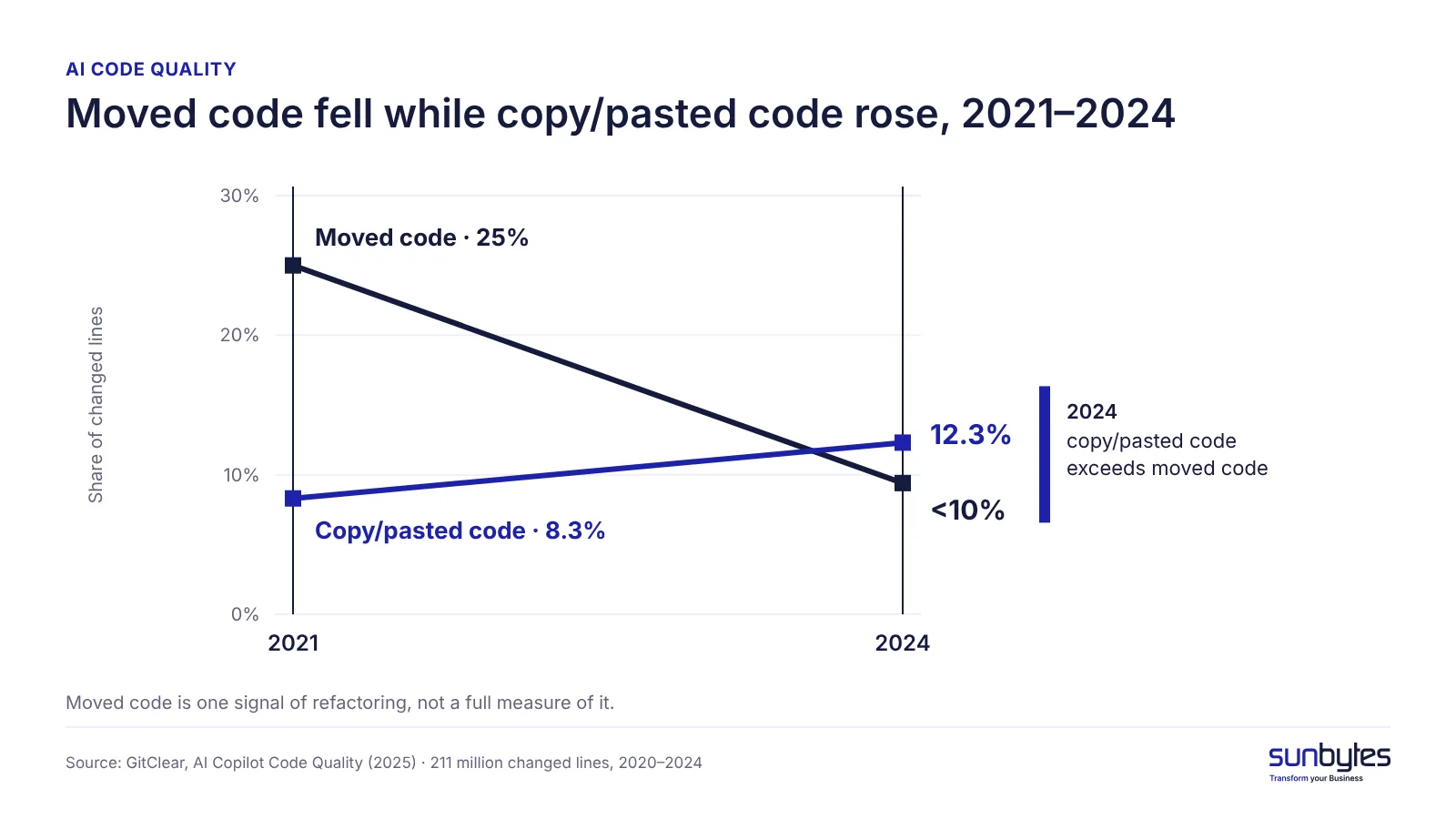
Research on large codebases shows why duplication and churn are worth tracking. GitClear’s 2025 research, covering 211 million changed lines from 2020 to 2024, found that moved code fell from 25% of changed lines in 2021 to less than 10% in 2024, while copy/pasted lines rose from 8.3% to 12.3%. Moved code is one signal of refactoring, not a full measure of it, since some refactoring produces no moved lines. GitClear’s follow-up, The Maintainability Gap: AI Code Quality in 2026, based on 623 million changes from 2023 to 2026, reports the same direction. Both studies place the shift in the period AI coding assistants spread; neither proves the tools are the only cause. For a founder, the practical reading is that duplication and churn deserve a place in the baseline.
Establish a dated baseline and update it at meaningful points in the development cycle, such as major releases, significant architectural changes or regular engineering reviews. For actively developed products, capture automated measurements continuously and review the trend at an agreed cadence. If the team wants numeric targets, set them from your own baseline rather than copying another company’s numbers.
When these indicators point at the same areas, they also show where AI technical debt is building up. They tell you where to look; an AI code review tells you what is wrong in the files they point to.
Seven numbers show where the code may be weak. They do not show why, or what to fix first. An AI-built product review reads the code behind the numbers and explains the findings in plain English, with a prioritised action plan. Not a scanner export.
How to check code maintainability in AI-written code
Code maintainability is best assessed by checking how easily developers can understand, modify and test the code without causing unexpected problems. Your existing engineering team can perform this assessment. A developer unfamiliar with the codebase can provide an additional perspective, particularly before a handover, but is not required for every maintainability check.
Start with a high-impact part of the codebase, such as a frequently changed module or a critical business workflow. Then follow five steps:
- Identify what to review. Use code quality indicators, change history and reported defects to select the areas where maintainability matters most.
- Check code understanding. Ask an engineer to identify the relevant business rules, dependencies and data flows. Record any undocumented assumptions, duplicated logic or unclear relationships between components.
- Make a representative change. Implement a small, realistic modification on a separate branch. Note how many components it affects and whether the change reveals unexpected dependencies.
- Verify the result. Run relevant automated tests, check that they validate the intended behaviour, and have another engineer review the change. Record any regressions or difficulties in verifying the change.
- Prioritise the findings. Fix first the issues that make critical changes unsafe or repeatedly slow down delivery. Lower-risk improvements can be planned alongside feature development.
Who owns that work after launch is covered in maintaining an AI-built app.
What is good enough for your product?

Good enough AI code quality depends on what the code has to carry, not on revenue alone. The evidence that matters grows with the risk: who depends on the product, what data it handles and who else will change the code. Table 2 is a working guide from AI-built product reviews, not an industry benchmark, so it contains no percentage targets.
| Situation | Evidence that matters | What can wait |
|---|---|---|
| Prototype: only the original builder changes the code, no real user data | Critical flows run end to end; no secrets or API keys in the code | Quality targets; duplication and complexity tracking |
| Real users, payments or personal data depend on the product | Risk-based tests with assertions on login, payment and personal-data access; no known exploitable vulnerabilities in used dependencies; change failure rate recorded | Numeric targets for duplication and complexity |
| Other people will change the code: new hires, an agency, a handover or an outside review | A dated baseline of the seven indicators; a documented maintainability check on high-impact areas; duplicated business logic and complexity reviewed in high-impact files | Improvements in code that rarely changes and no critical flow depends on |
Start measuring when someone other than the original builder will change the code, or when users depend on it, whichever comes first. Releases before that point have no baseline to compare against.
What code quality metrics cannot tell you
Code quality metrics show where code may be weak; they cannot show whether the product does the right thing safely. Four limits matter for AI-built products.
Scores can create false confidence. An AI coding tool asked to raise a number can do it without improving the code: tests that run the code but assert nothing increase coverage, and a request to “fix the linter” can suppress a rule while the cause stays. Checking that tests fail when the code is broken is covered in testing AI applications.
Scores do not judge correctness. A file with low complexity and high coverage can still let one customer read another customer’s data, because a test may check that a page loads, not who is allowed to see it.
Scores do not judge security or compliance. Whether access control is designed correctly, or personal data is processed lawfully under the GDPR, needs a security and privacy review.
Scores do not judge architecture fit. Whether the design will carry the next 12 months of features, users and integrations is a decision for people who know what the product has to do next.
How to document code quality for a review
A code quality record for a customer, investor or new engineering partner is one dated page: the seven indicators with their trend, test coverage on critical behaviours, current dependency risk and who owns and can change the code. Describe it in ISO/IEC 25010 terms, such as maintainability or reliability, so reviewers read it the same way. What investors examine beyond code quality is covered in technical due diligence for AI-built products.
For some products, the EU Cyber Resilience Act, Regulation (EU) 2024/2847, adds a reason to keep such records. It applies to products with digital elements, including remote data processing a product needs to function; a web application provided purely as a service may fall outside it. Reporting obligations apply from 11 September 2026 and most other obligations from 11 December 2027 (Article 71). Check whether it applies to your product.
How Sunbytes reviews AI code quality
Code quality metrics can highlight areas worth investigating, but they cannot explain every risk or establish which changes should come first. Sunbytes’ AI-Built Product Review combines software engineering and security expertise to examine the agreed technical scope, including code structure, dependencies, maintainability, critical workflows and security concerns.
Rather than relying on a scanner score alone, engineers examine the evidence behind the findings and how the issues affect the product. You receive clear findings, a prioritised action plan and a technical handoff your team can use to plan improvements. Your team can address the issues, or Sunbytes can scope remediation separately.
Sunbytes brings 15+ years of software delivery experience across 300+ projects, with Netherlands-led delivery and an ISO 27001-certified information security management system.
Need to understand whether your AI-built codebase can be changed safely? Talk to Sunbytes about reviewing its quality and technical risks.