

A headhunter in Vietnam finds and approaches the leader you want to hire, but your side decides what the role is, who gets the job and what the offer says. Learning how to work with a headhunter comes down to knowing which of those decisions are yours at each step, from the first written brief to the signed offer.
This guide is for HR directors and hiring managers who have hired a headhunter, or are about to, for a manager or director role in Vietnam. It splits the work into seven steps, shows the Vietnamese rules that shape the offer and the notice period, and lists what to agree before the first candidate is approached. For the wider market picture, start with our guide to headhunting in Vietnam.
TL;DR
Working with a headhunter in Vietnam splits the work in two. You own the role brief, the hiring decisions and the offer; the headhunter owns the market approach, the first assessment and the offer support. Your search keeps moving when every decision has a named owner on your side and a feedback deadline you keep.
- The seven steps are the role brief, the search plan and market map, longlist calibration, shortlist interviews, references, the offer, and the resignation and notice period.
- A Vietnamese offer is read as a total package: gross monthly salary, any 13th-month salary or Tet bonus, allowances, probation and the start date.
- A candidate on an indefinite-term contract must give at least 45 days’ notice (Labour Code 2019, Article 35); an enterprise manager such as a general director must give at least 120 days (Decree 145/2020/ND-CP, Article 7).
- Off-limits companies, one decision-maker per stage, a weekly feedback slot and candidate-data handling are agreed in writing before outreach starts.
What working with a headhunter involves
Working with a headhunter means splitting the search between two parties: you decide, the headhunter searches and advises. The headhunter brings market knowledge and access to people who are not applying for jobs. Your side brings the role definition, the interview panel and the authority to make an offer.
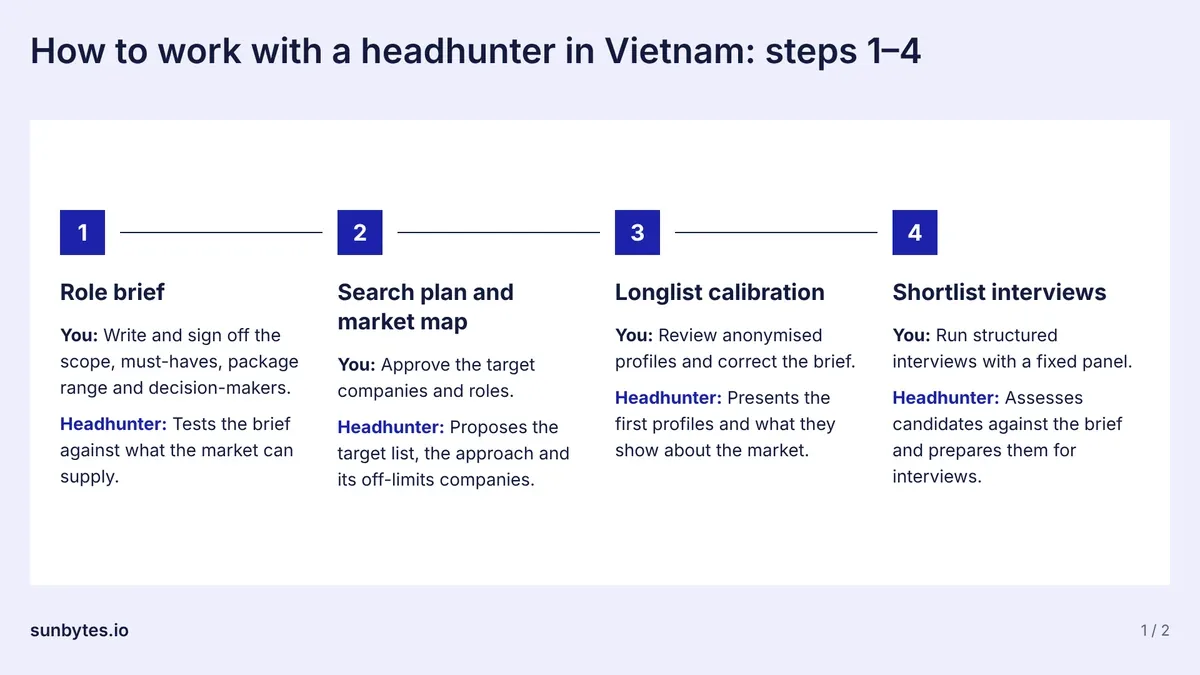
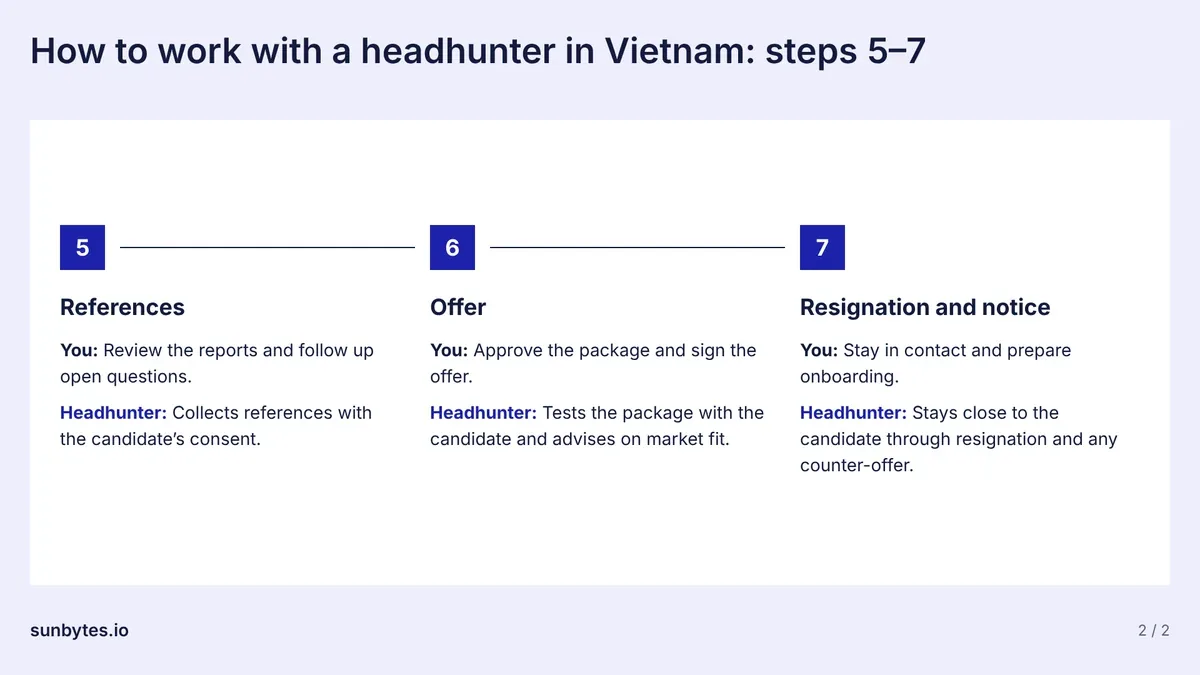
Selecting the partner happens before any of this; our article on how to choose a headhunting partner covers that decision. Once the agreement is signed, Table 1 shows who leads each step.
| Step | You | Headhunter |
|---|---|---|
| 1. Role brief | Write and sign off the scope, must-haves, package range and decision-makers | Tests the brief against what the market can supply |
| 2. Search plan and market map | Approve the target companies and roles | Proposes the target list, the approach and its off-limits companies |
| 3. Longlist calibration | Review anonymised profiles and correct the brief | Presents the first profiles and what they show about the market |
| 4. Shortlist interviews | Run structured interviews with a fixed panel | Assesses candidates against the brief and prepares them for interviews |
| 5. References | Review the reports and follow up open questions | Collects references with the candidate’s consent |
| 6. Offer | Approve the package and sign the offer | Tests the package with the candidate and advises on market fit |
| 7. Resignation and notice | Stay in contact and prepare onboarding | Stays close to the candidate through resignation and any counter-offer |
If a step in the “You” column has no named owner yet, that is the step where your search will wait.
How to work with a headhunter in Vietnam: 7 steps
Working with a headhunter in Vietnam follows a seven-step headhunting process, and each step ends with a decision on your side. The headhunter prepares each decision; your answer releases the next step.
Write the role brief with your headquarters
The role brief is one written document signed off by everyone who will approve the hire: global stakeholders and in-country leadership, if there is one. It states the scope, reporting lines, must-haves versus nice-to-haves, the package range and the working languages. The headhunter searches against this document, not against meeting notes.
Separate requirements from preferences honestly. A required language such as Japanese or Korean narrows the people the headhunter can approach; a preferred industry background does not have to. Give a package range rather than one figure, so the headhunter can tell you early if the range sits below what your target profiles earn.
Agree the search plan and market map
The search plan shows which companies, roles and locations the headhunter will approach, and in which order. Approve it before outreach starts: add competitors you want covered, remove companies you have a relationship with, and check that the plan still matches the brief.
The market map behind the plan is a form of talent mapping: a structured view of who holds comparable roles today. Ask which target companies are off-limits to the headhunter, because nobody there can be approached for your role.
Calibrate on the longlist
Calibration means reviewing a first batch of anonymised profiles before the headhunter approaches people at scale. Your feedback on why each profile fits or misses corrects the brief while changes cost little. Give reasons, not just yes or no: “too operational, we need someone who has run a P&L” tells the headhunter what to change.
When you turn down most of the first batch, rewrite the brief before outreach continues. A brief that only changes in conversation sends the next batch in the same direction.
Interview the shortlist
Interview every shortlisted candidate with the same panel and the same structured questions, so you compare people rather than conversations. Put one interviewer from your global side and one from in-country leadership, if there is one, on the panel. Score each candidate against the brief’s must-haves straight after the interview.
The headhunter’s own assessment comes before your interviews; candidate vetting in Vietnam explains the checks behind a shortlist. Ask the headhunter what each finalist’s motivation to move is, and test it in your interview.
Check references
Ask for two references per finalist, ideally a former manager and a former peer or direct report, and contact them only with the candidate’s written consent. The person who introduced the candidate to the search should not act as a reference. Use the same questions for every finalist so the answers can be compared.
Ask about the situations the role will bring, such as how the candidate handled an underperforming team over a full quarter. Reference reports are personal data: Vietnam’s Personal Data Protection Law (Law 91/2025/QH15) applies to them, and the GDPR applies as well when a company in the EU receives the reports.
Make an offer that fits a Vietnamese package
Make the offer in total-package terms: gross monthly salary, any 13th-month salary or Tet bonus, allowances, insurance and the start date. A senior candidate will set your offer against their current package line by line, so an offer that states only the base salary can look lower than it is.
A 13th-month salary is custom, not law: Labour Code 2019, Article 104 leaves bonuses to the employer’s own bonus rules. If the candidate’s current employer pays one, include it or explain what replaces it. State whether figures are gross or net, because the employee’s social insurance contributions and personal income tax are deducted from the gross salary.
Put the probation period in the offer as well. For an enterprise manager role it can last up to 180 days under Article 25 of the Labour Code 2019.
Manage resignation, notice period and counter-offer
Your signed offer starts the candidate’s notice period, not their first working day. Under Article 35 of the Labour Code 2019, an employee must give at least 45 days’ notice on an indefinite-term contract and at least 30 days on a fixed-term contract of 12 to 36 months. Decree 145/2020/ND-CP, Article 7, raises this to at least 120 days for enterprise managers, such as a general director, on contracts of 12 months or more.
A counter-offer from the current employer, if one comes, arrives inside that window. Keep in contact every week during the notice period: an introduction to the team, the onboarding plan, a call with the future manager. The headhunter stays in touch with the candidate too. Our article on poaching and non-compete rules in Vietnam covers counter-offers and non-compete clauses in more detail.
Starting a search in Vietnam? Our recruitment team advises on the approach and the cost for your role before the search starts. See our recruitment services.
How headhunters reach passive candidates in Vietnam
Headhunters reach passive candidates, people who are not applying for jobs, through direct approach and referrals rather than job ads. A plant manager or finance director who is doing well in their current role has little reason to scan job boards, so the headhunter goes to them.
In Vietnam the approach runs through channels such as:
- a direct, discreet approach by LinkedIn message, phone or personal introduction, working from the target list in the market map;
- foreign business chambers such as EuroCham, JCCI and KoCham, whose events bring together managers from foreign-invested companies;
- referrals from former colleagues, who can say whether a person would consider a move and why.
A first approach is a conversation, not an application. The headhunter can describe the role without naming your company and shares a profile with you only after the candidate agrees. A passive candidate has no reason to wait, so your response time to each profile matters as much as the quality of the approach.
What to agree with your headhunter before the search starts
Agree four things in writing before the first approach: which companies are off-limits, who decides at each stage, when feedback happens and how candidate data is handled. Settling them now means the search does not have to stop later while your side sorts them out.

Exclusivity and off-limits companies
Agree whether the headhunter works on the role exclusively and which companies it will not approach. A headhunter normally keeps its own clients off-limits, so ask for that list in writing at the briefing. If a direct competitor is on it, part of your target market is closed to this search.
Exclusivity also protects your discretion: a passive leader hears about your role once, from one source. Our comparison of retained vs contingency headhunting explains how each model handles exclusivity. The off-limits rule works in your favour once you are a client: the headhunter will not approach your own team.
Who decides at each stage
Name one decision-maker for each stage: brief sign-off, shortlist approval, final selection and offer approval. When an offer has to wait for a committee meeting at headquarters, finalists keep talking to other employers. One named person per stage, with a deputy for holidays, keeps your decisions on schedule.
Confirm the offer approval route before the final round starts, including who signs off a package above the agreed range.
Feedback rhythm across time zones
Set a fixed weekly call in the hours your teams share, plus a response deadline for every profile the headhunter sends. Vietnam runs on UTC+7 all year without daylight saving time; for a team in Central Europe, for example, a morning call lands in the Vietnamese afternoon.
A response deadline you set yourself protects your momentum with the candidate. Ask the headhunter to flag any profile that has waited past it.
Confidentiality and candidate data
Agree who sees candidate CVs, where they are stored and how long they are kept, before the first profile arrives. A senior candidate who is still employed may ask for discretion, so agree that the headhunter shares names only once there is interest on both sides.
Two sets of rules can apply. Vietnam’s Personal Data Protection Law (Law 91/2025/QH15) replaced Decree 13/2023/ND-CP on 1 January 2026 and includes rules on transferring personal data outside Vietnam; when CVs go to a company in the EU, the GDPR applies to that company’s processing. Ask the headhunter how files are shared and who can open them.
Signs your search is off track
Three signs show that your search is off track: a shortlist that misses the brief, finalists who drop out at the offer stage and feedback that takes longer than a week. Each one has a fix on your side as well as on the headhunter’s.
The shortlist does not match the brief
A shortlist that misses the brief points to one of two causes: the brief changed in conversations without being rewritten, or the market cannot supply the profile at your package range. Re-calibrate on three profiles, say exactly why each one misses, then update the written brief and ask whether the market map still fits.
Ask the headhunter which must-have removed the most people from the longlist.
Finalists drop out at offer stage
When finalists drop out at the offer, check two causes first: a package below what comparable roles pay, and an approval that took too long. Compare your package range with current salary data before the final round, not after the first refusal, and have the approval route ready before interviews end.
Ask the headhunter what each finalist’s current package includes, 13th-month salary and allowances included, before you set the offer.
Feedback takes longer than a week
When your feedback takes longer than a week, a senior candidate in Vietnam may already be in other processes and may read the silence as a lack of interest. Set a 48-hour feedback rule on your side for every profile and interview, and tell the headhunter when a decision needs longer and why.
A candidate who hears nothing for two weeks can accept the offer that did arrive.
How Sunbytes works with you on a headhunt
The steps where your side decides, the brief, the shortlist and the offer, are where a search in Vietnam slows down or keeps moving. Sunbytes runs its headhunt service for management-level hires around those decisions, as part of our recruitment services.
Finalists reach you with a decision-ready summary of strengths, risks and open questions. When a role needs deeper validation, we add role-based assessments, specialist interviews or reference checks. Your team interviews the finalists and makes the hiring decision.
Candidate and client information stays within Sunbytes’ ISO 27001-certified information security management system, and our team has worked in Vietnam since 2011. Talk to our recruitment team about the role you need to fill in Vietnam.