

Payroll risk management failures do not surface gradually. The error was in the social insurance calculation base; certain allowances required by local regulation were excluded. It was not visible in the payslip. It was not visible in the monthly report but became visible during pre-acquisition due diligence, when the retroactive liability including penalty interest came to EUR 95,000.
TL;DR
- Payroll risk management is not a back-office compliance function. It is a business continuity issue. Your payroll errors do not surface gradually , they surface at audits, inspections, and acquisitions, when the cumulative liability is already material.
- The 6 payroll risks with the highest exposure for international companies are: contribution base errors, withholding misclassification for foreign employees, payroll fraud, data security failures, regulatory change lag, and manual payroll without reconciliation controls.
- The 5-step payroll risk management framework in this article covers risk assessment, control checkpoint design, segregation of duties, formal audit, and escalation protocols.
What payroll risk management means for executives and CEOs
“Payroll risk management is the framework a company uses to detect, prevent and correct payroll errors and fraud before they accumulate into material liability.”
Most payroll risk management frameworks are written for Finance Directors. They describe process controls, reconciliation procedures, and system access protocols. This payroll risk management guide is written for CEOs and CFOs because payroll risk surfaces at the level you are accountable for: acquisitions, audits, and regulatory inspections.

A Finance Director who discovers a contribution calculation error can correct it operationally. A CEO who discovers the same error during due diligence for a EUR 20 million acquisition cannot correct it before deal terms are affected. The risk is the same. The exposure is different because the discovery timing is different.
Why payroll errors surface at the worst possible time
Your payroll errors accumulate silently because the mechanisms that would surface them in normal operations are absent. An internal review confirms that payroll was processed and payments were made. It does not confirm that the calculation basis was correct. The difference between a payroll that was processed and a payroll that was compliant is not visible in the payslip or the payment confirmation.
The events that make payroll errors visible are external: a labor inspection, a statutory authority audit of contribution records, a regulatory review of reported employee headcount against actual contribution data, or financial due diligence for an acquisition. All of these events share one characteristic: your company does not control their timing. The liability has already accumulated by the time the review begins.
The difference between payroll error, payroll fraud, and payroll compliance risk
| Category | Definition | Typical discovery | Financial exposure |
|---|---|---|---|
| Payroll error | Incorrect calculation, data entry mistake, or configuration gap | Internal audit or provider review | Correction plus potential late-payment interest |
| Payroll fraud | Deliberate manipulation of payroll data for financial gain | Forensic audit or whistleblower report | Full amount fraudulently paid, legal cost, reputational damage |
| Payroll compliance risk | Systematic deviation from statutory requirements accumulating over time | External inspection, authority audit, or M&A due diligence | Retroactive contributions, penalty interest, and administrative fines |
Why payroll risk management is a CEO issue, not only a Finance Director issue
When payroll compliance risk surfaces during an acquisition, it affects enterprise valuation, deal structure, and closing conditions. Retroactive contribution liabilities are disclosed as contingent liabilities. If they are material, they reduce purchase price or require escrow provisions. If they are discovered after closing, they become the acquirer’s problem with recourse to representations and warranties.
When payroll compliance risk surfaces during an inspection, administrative penalties in most jurisdictions apply per violation and per affected employee. For an inspection covering a 24-month period with multiple affected employees, the aggregate exposure is a board-level number, not a Finance line item.
Early warning signs your payroll risk management is failing
Four observable patterns in your monthly payroll data indicate structural risk before it accumulates to a material liability. Finance Directors and CFOs can monitor these without a formal audit.
Reconciliation mismatches month-to-month
A payroll that consistently produces different totals for the same headcount, without a documented reason, indicates that your calculation base is unstable. Month-to-month variance in gross payroll of more than 2% without corresponding headcount or compensation changes warrants investigation. This pattern alone has prevented several six-figure retroactive liabilities when caught at the two-month mark.
Manual overrides without audit trail
Every manual override to a system-generated payroll calculation is a risk point. A pattern of manual overrides, particularly in contribution base calculations or income tax withholding, indicates that your system is not correctly configured and is being corrected by hand each cycle. The hand correction is not auditable. The accumulation of uncorrected base errors is.
Same employee receiving multiple adjustments
Recurring adjustments to the same employee’s payroll record across multiple cycles indicate either a data configuration issue or, in a fraud scenario, a pattern of unauthorized modifications. Both require investigation before they represent the population of risk across your payroll.
No variance analysis vs prior payroll cycles
A payroll team that does not produce a variance analysis comparing each cycle to the prior cycle has no systematic mechanism to detect errors as they occur. Variance analysis is a one-hour process that surfaces outliers. Its absence means that errors accumulate to the next external review , which your company does not control the timing of.
The 6 payroll risks that create the most exposure for international companies
The payroll risks and how to mitigate them are ranked below by frequency and magnitude of cumulative exposure for companies operating across multiple markets. Each compounds over time if the control that would prevent it is absent.
The full compliance framework for international businesses, including how each of these risks maps to specific statutory obligations, is covered in the guide to payroll compliance for FDI businesses.
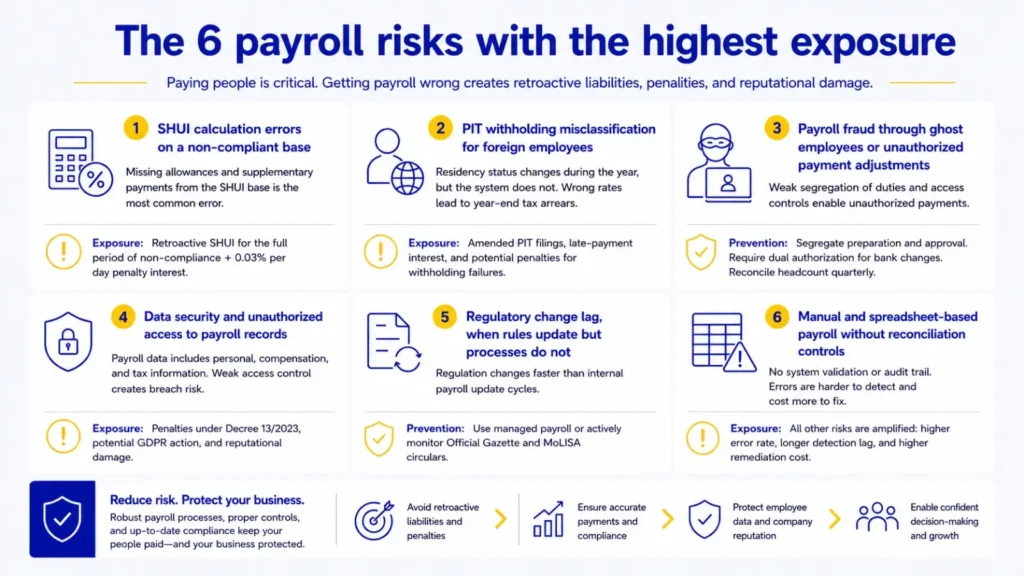
Risk 1: Contribution base errors on a non-compliant calculation
In most markets, the social insurance or statutory contribution base must include all wage and allowance items defined in the employment contract. Most payroll teams calculate on base salary only. The difference is typically 15% to 30% of the employee’s total monthly package, depending on what allowances are contractually specified.
For the European technology company in the opening case, the exclusion of required allowances from the contribution base across 45 employees over 11 months produced a cumulative shortfall of approximately EUR 93,500 before penalty interest. The payroll had been processed correctly in every other respect. This is the most common compliance failure for companies using in-house or spreadsheet-based payroll in markets they are not familiar with.
Exposure: Retroactive contributions for the full period of non-compliance, plus daily penalty interest from the date each contribution was due.
Risk 2: Withholding misclassification for foreign employees
Foreign employees working across multiple jurisdictions create a withholding classification problem that most payroll systems are not configured to handle automatically. The applicable tax rate and structure depends on residency status, which can change during an assignment. A system that does not update the classification as the assignment evolves withholds at the wrong rate, producing either a tax shortfall or an over-withholding that the employee must recover.
The misclassification surfaces at annual tax finalisation, when the calculated liability does not match the withheld amount. At that point, the employer’s withholding records are also incorrect, which triggers an amended filing obligation and potential late-payment liability.
Exposure: Amended tax filings, late-payment interest, and in cases of systematic withholding failures, regulatory penalties for inadequate compliance processes.
Risk 3: Payroll fraud through ghost employees or unauthorized adjustments
Payroll fraud prevention starts with understanding the two most common forms. Ghost employee fraud involves creating payroll records for individuals who do not exist and directing payments to accounts controlled by the fraudster. Unauthorized payment adjustment fraud involves modifying bank account details or payment amounts for real employees after payroll approval. Both require access to payroll systems without segregation of approval authority.
In companies that use manual payroll processes or have a single person responsible for both payroll preparation and payment approval, this fraud is more common than most finance teams expect. The fraud is typically discovered during a headcount reconciliation or external audit, by which point the cumulative loss is material.
Prevention: Separate payroll preparation from payroll approval. Require dual authorization for any bank account change. Conduct quarterly headcount reconciliation against HR records.
Risk 4: Data security and unauthorized access to payroll records
Your payroll data includes personal information, compensation data, and tax data. Unauthorized access by an internal employee or external party constitutes a breach under applicable data protection law , in the EU under GDPR, and under equivalent national frameworks in other markets. The most common access control failure is a payroll system in which multiple users have administrator rights that allow them to modify records without an audit trail.
In a spreadsheet-based payroll, every person with access to the file has this level of access by default. There is no role-based permission structure, no audit log, and no system alert when a record is modified. The modification might be legitimate. It might not be. Your system cannot tell the difference.
CyberSecurity Solutions controls access to payroll information using role-based permissions supported by full audit trails, so every modification is logged with its actor, time, and prior value.
Exposure: Regulatory penalties under applicable data protection law, potential legal action, and reputational damage if the breach involves compensation data that reaches employees or competitors.
Risk 5: Regulatory change lag, when rules update but your processes do not
Payroll regulations change across all markets. Contribution ceilings, withholding thresholds, exemption amounts, and reporting format requirements are updated on cycles that do not align with your payroll review schedules. A payroll process that was compliant in year one may not be compliant in year three if the regulatory changes in between have not been incorporated.
Companies using in-house or spreadsheet payroll are responsible for monitoring these changes themselves. A managed provider updates configuration as regulations change. In markets you are not deeply familiar with, the regulatory change lag is the risk that most consistently creates the EUR 95,000 scenarios , because it compounds from the point of the rule change, not from the point of discovery.
Prevention: Managed payroll providers update their configuration as regulations change. In-house and spreadsheet payroll requires your Finance team to actively monitor the official gazette and relevant authority communications for each of your jurisdictions.
Risk 6: Manual and spreadsheet-based payroll without reconciliation controls
Spreadsheet-based payroll is the highest-risk configuration for any company with more than 10 employees. Every formula is a potential error point. Every manual entry is a potential inconsistency. There is no system validation that flags a contribution base that is lower than it should be or a withholding calculation that does not match the applicable table.
The risk compounds because spreadsheet payroll has no audit trail. When a discrepancy is discovered, it is not possible to identify when the error was introduced, which cycles are affected, or whether the error was accidental or deliberate. Reconstructing the full payroll history from source documents is a multi-week project even for a company with 30 employees.
Exposure: All of the above risks are amplified. Without a system that validates calculation logic, your error rate is higher, the detection lag is longer, and the remediation cost is greater. For companies replacing spreadsheet payroll with an integrated stack, Digital Transformation Solutions handles the integration architecture so that data flows between payroll, HR, and ERP are structured to prevent the field-mapping failures that cause calculation errors.
How payroll risk compounds without payroll risk management controls
The compounding mechanism is not complicated. A single contribution calculation error in month one is a correction of a few hundred euros per employee.
For companies building compliance knowledge across their payroll operations, the payroll processing guide covers how statutory calculations are structured and what configuration prevents the most common error types before they begin to accumulate.
Learn more: Payroll processing guide in Vietnam
Why payroll risk is cumulative, not periodic
Each month that a payroll error goes undetected adds to your retroactive liability. Unlike a one-time compliance failure, which is corrected and closed, a systematic payroll error is a per-cycle liability that grows with every payroll run. At the point of discovery, your liability includes: retroactive contributions for every affected cycle, penalty interest from the first day each contribution was late, and in some cases, an administrative fine for the violation itself.
The penalty interest rate in most markets runs at 0.03% to 0.05% per day (in Vietnam, set at 0.03% per day under Decision 595/QD-BHXH, Article 60. Applied to a meaningful monthly contribution shortfall across 30 employees over 12 months, the interest component alone represents a material number. This is the scale of exposure that a single configuration error can produce for a company that considers itself fully operational and compliant.
The audit and acquisition event: when hidden liability becomes a balance sheet item
Your company does not control when a labor inspection or statutory authority audit occurs. It does not control the timing of an acquisition process that triggers financial due diligence. Both events review the same payroll records , and both happen at a moment when the cumulative liability has already reached its maximum.
For acquisitions, financial due diligence reviews payroll compliance as a standard component of employment liability assessment. A retroactive contribution liability discovered during due diligence will appear as a disclosed contingent liability and affect deal structure. Discovered after closing, it affects your representations and warranties coverage.
Reputational and M&A impact of payroll compliance failures
A payroll compliance failure that surfaces during an inspection or labor dispute becomes part of your company’s regulatory record. In markets where labor compliance violations are reported to central authorities, the record affects your relationship with the agencies that issued your operating licenses and employment authorizations.
For companies seeking to attract senior management, a payroll compliance failure damages employer credibility. Senior candidates evaluate employers’ compliance record as part of their assessment. The reputational cost does not appear on a balance sheet. It appears to offer acceptance rates and candidate willingness to take your business seriously.
A payroll risk management framework for international companies (5 steps)
Managing payroll risk for international companies requires a framework that is operational, not aspirational. The 5-step process below gives each control a specific owner, a frequency, and a measurable output.
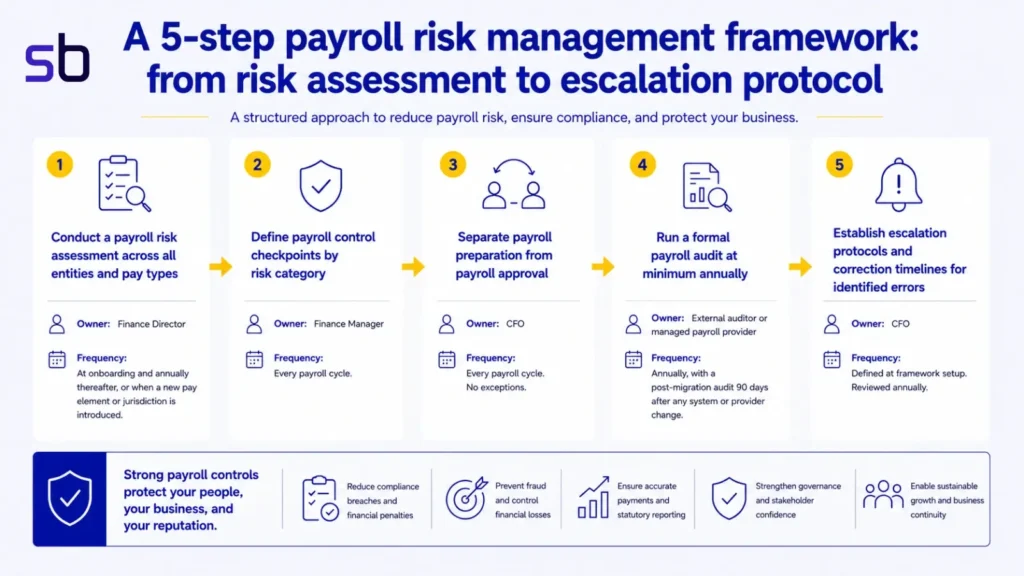
Step 1: Conduct a payroll risk assessment across all entities and pay types
The risk assessment maps every pay element against the statutory obligation it affects. Contribution base elements are mapped against the applicable social insurance regulation for each jurisdiction. Withholding-taxable elements are mapped against the applicable income tax law. Each element is classified as correctly configured, incorrectly configured, or not configured. The output is a written risk register with a remediation priority.
Owner: Finance Director.
Frequency: At onboarding and annually thereafter, or when a new pay element or jurisdiction is introduced.
Step 2: Define payroll control checkpoints by risk category
Control checkpoints are specific verification steps built into your payroll processing cycle. For statutory contributions, the checkpoint confirms that the calculation base matches the employment contract before the contribution is submitted. For income tax, the checkpoint confirms that the withholding rate matches the employee’s residency and classification status on file. Each checkpoint is documented, dated, and signed.
Owner: Finance Manager.
Frequency: Every payroll cycle.
Step 3: Separate payroll preparation from payroll approval
Segregation of duties means that the person who prepares payroll cannot also approve it for payment. This single control prevents the most common forms of payroll fraud and creates an independent review of every payroll cycle before funds are released. In a company with a small Finance team, the approver can be the CFO or the Managing Director. The approval must be a genuine review, not a rubber stamp.
Owner: CFO.
Frequency: Every payroll cycle. No exceptions.
Step 4: Run a formal payroll audit at minimum annually
A formal payroll audit is an independent review of the payroll for a defined period , typically 12 months , by a party who did not prepare the payroll. The audit confirms that contributions match the correct base, that withholding matches submitted tax returns, that all employees on the payroll are on the HR register, and that all payment transactions are authorized and documented.
Annual payroll audits are covered in detail in the guide to why your business needs regular payroll audits. For companies that have not previously run an external payroll audit, the first audit typically surfaces two to four configuration issues that have been accumulating since payroll was first set up.
Owner: External auditor or managed payroll provider.
Frequency: Annually, with a post-migration audit 90 days after any system or provider change.
Step 5: Establish escalation protocols and correction timelines for identified errors
When a payroll error is identified, your escalation protocol defines: who is notified within what timeframe, what authority is required to approve a correction, whether the correction requires an amended statutory submission, and what the deadline is for the correction to prevent additional penalty interest accrual.
Without a defined protocol, errors are discussed, reviewed, and eventually corrected , but the timeline is uncontrolled. Each uncontrolled day adds to your penalty interest exposure.
Owner: CFO.
Frequency: Defined at framework setup. Reviewed annually.
Payroll risk management in Vietnam: what is different for FDI companies
The 5-step framework applies in any market. If you operate in Vietnam, four specific compliance dimensions require additional attention because they create the liability pattern described in this article more frequently than in European markets.
A broader overview of the managed payroll environment in Vietnam and why international companies use specialist providers is covered in the guide to payroll service in Vietnam.
SHUI and PIT compliance risks specific to Vietnam under Decree 143/2018 and Decree 12/2022
Decree 143/2018/ND-CP specifies that the SHUI contribution base must include all wage and allowance items defined in the employment contract that are paid regularly and with definite amounts. This specifically includes position allowances, responsibility allowances, and supplementary pay tied to business conditions. Most payroll teams calculate on base salary only. This is the exact error that produced the European technology company’s EUR 95,000 liability.
Decree 12/2022/ND-CP governs penalties for SHUI non-compliance: VND 18,000,000 to VND 75,000,000 per violation depending on the number of employees affected and the duration. Each month of non-compliance for each affected employee is a separate violation count. The penalty structure is multiplicative, not additive.
MoLISA inspection triggers: what labor inspectors look for
Vietnam’s Ministry of Labour, Invalids and Social Affairs conducts both scheduled and unscheduled inspections. The primary triggers for a targeted inspection are: a discrepancy between the number of employees reported on MoLISA labor reports and the number covered by SHUI contributions at VSS, a complaint from a current or former employee, and a sector-wide compliance sweep in industries with historically high non-compliance rates.
When an inspection begins, the inspector reviews labor contracts for all current employees, payroll records for the inspection period, VSS contribution records, and MoLISA labor reports. The inspection does not require advance notice for unscheduled reviews.
Why foreign-invested enterprises face higher payroll audit scrutiny in Vietnam
Foreign-invested enterprises (FIEs) are subject to higher-frequency compliance review for two reasons. They are more likely to employ foreign workers whose residency status and work permit validity requires additional verification. And they are more likely to have compensation structures that include non-monetary benefits and allowances that complicate the SHUI base calculation.
VSS and MoLISA data systems have been integrated since 2021, enabling cross-reference of employer SHUI contributions against reported employee headcount. FIEs with headcount growth that does not correspond to proportional SHUI contribution growth are flagged for review automatically.
Most payroll compliance failures are not discovered by the company.
They are discovered by an inspector, an auditor, or an acquirer. Sunbytes provides managed payroll in Vietnam with monthly compliance verification , SHUI calculated on the correct base under Decree 143/2018, MoLISA reporting filed directly, variance analysis every cycle. The EUR 95,000 scenario is preventable at the configuration stage.
How Sunbytes manages payroll compliance for international companies?
Sunbytes delivers managed payroll services designed for international companies operating across complex compliance environments. SHUI and PIT are calculated in-house, MoLISA reporting is filed directly, and monthly variance checks are conducted against previous payroll cycles to identify inconsistencies before they become compliance risks.
Sunbytes is a Dutch-founded technology and workforce company founded in 2011, with 300+ client projects across 20+ countries.
- Accelerate Workforce Solutions: Sunbytes provides managed payroll with SHUI and PIT calculated in-house, MoLISA reporting filed directly, and monthly variance analysis against prior cycles. The 5-step payroll risk management framework is embedded in the standard payroll process , not an add-on. ISO 27001 certified. Signed Data Processing Agreement on all engagements. Payroll on time every cycle.
- Digital Transformation Solutions: For companies connecting payroll to a European ERP or HR platform, Digital Transformation Solutions handles the integration architecture. Data flows are structured to prevent the field mapping failures that cause calculation errors when data moves between systems.
CyberSecurity Solutions: Sunbytes strengthens payroll data protection through CyberSecurity Solutions that secure the full payroll lifecycle. Access to payroll information is controlled using role-based permissions supported by comprehensive audit trails, helping companies maintain visibility over sensitive employee and financial data.