
Payroll trends in 2026 point to a clear shift: payroll is moving closer to compliance, data protection, and workforce control.
For EU companies hiring in Vietnam, the question is no longer only whether salaries arrive on time. Your payroll process now needs to answer harder questions: who checked tax treatment, who approved the salary change, who stored the employee documents, and whether payroll data can support EU-level reporting expectations.
This guide explains the payroll trends that matter most in 2026 and what your HR and finance teams should prepare before your next Vietnam hiring phase.
TL;DR
Payroll trends in 2026 show that payroll is becoming a compliance, data, and workforce control function. For EU companies hiring in Vietnam, the main priorities are accurate local payroll processing, secure employee-data handling, pay transparency readiness, social insurance compliance, and clearer ownership across HR, finance, and local operations.
- Payroll accuracy matters because PIT, social insurance, salary components, and employee records must stay consistent.
- Payroll security matters because salary files, contracts, ID documents, and bank details are sensitive employee data.
- Payroll ownership matters because distributed teams create gaps between EU policy and Vietnam execution.
Payroll trends in 2026 are moving from payment admin to operational control
Payroll trends are the changes shaping how companies calculate, approve, pay, secure, report, and govern employee compensation.
That definition matters because payroll is no longer a back-office task that starts at month-end. It begins when a contract is created, when a salary component is approved, when an employee submits bank information, and when HR updates a benefit or allowance.
For EU companies hiring in Vietnam, payroll has three jobs:
First, it must pay people correctly and on time. Second, it must support Vietnam employment, tax, and social insurance obligations. Third, it must keep employee data secure enough for EU expectations around privacy and governance.
The World Economic Forum’s Future of Jobs Report 2025 is based on input from more than 1,000 employers representing over 14 million workers. It frames 2025–2030 as a period of workforce transformation driven by technology, economic shifts, and changing skills needs. Payroll sits inside that change because workforce models are becoming more distributed and data-heavy.
For your HR and finance teams, the practical question is simple: can your payroll setup keep pace with hiring without creating errors, weak data handling, or unclear ownership?

Trend 1: Payroll compliance will need earlier review, not month-end fixes
Payroll compliance in Vietnam starts before payroll is calculated. It depends on whether the employee is classified correctly, whether the contract reflects the working arrangement, whether salary components are treated correctly, and whether social insurance and personal income tax are handled on time.
For foreign workers, the compliance line became more defined after the 2024 Law on Social Insurance and Decree No. 158/2025/ND-CP took effect on July 1, 2025. Vietnam Social Security states that these rules clarify mandatory social insurance policy for foreign workers in Vietnam. Foreign nationals working in Vietnam must join compulsory social insurance when they are employed under fixed-term labor contracts of at least 12 months, unless a listed exemption applies.
That matters for EU companies because payroll errors can start quietly. A salary component may be entered in the wrong category. A foreign employee may be treated under the wrong social insurance assumption. A monthly payroll run may be approved even though the supporting contract data is incomplete.
By the time finance sees the payment file, the issue has already moved through HR, contract management, and payroll calculation.
A safer 2026 payroll process checks the following before payroll closes:
| Payroll checkpoint | What to verify | Why it matters |
|---|---|---|
| Employee status | Local employee, foreign employee, contractor, or secondee | Determines tax, social insurance, and employment handling |
| Contract record | Signed contract, start date, salary, working location | Payroll must match the employment record |
| Salary components | Base salary, allowances, bonus, overtime, benefits | Different components may have different tax or contribution treatment |
| PIT treatment | Residency status, taxable income, deductions | Reduces under-withholding or over-withholding risk |
| Social insurance basis | Eligible salary base and participation status | Keeps contributions consistent with the employment setup |
| Approval chain | HR input, finance review, final payroll approval | Prevents unapproved changes entering payroll |
| Document storage | Contract, ID, bank details, tax records | Supports audit trail and secure retrieval |
Trend 2: Payroll data security will become part of employee trust
Payroll data is employee data at its most sensitive. A payroll folder can include salary, bank details, tax codes, ID documents, contracts, dependents, social insurance records, and performance-linked payment information. If that data is handled through open spreadsheets, email chains, or shared folders with loose permissions, the payroll risk is no longer only financial. It becomes a people-risk issue.
Vietnam’s Decree 356/2025/ND-CP took effect on January 1, 2026 and replaced Decree 13/2023/ND-CP on personal data protection. The decree also references impact assessment duties for personal data processing and cross-border personal data transfer in relevant cases.
For EU companies, GDPR expectations add another layer. Even when payroll is processed in Vietnam, EU headquarters will usually expect documented controls over who can access employee data, where it is stored, how files are shared, and how access is removed when someone leaves.
ISO/IEC 27001 is useful here because it defines requirements for an information security management system. ISO describes it as a standard that covers people, policies, and technology, with risk management adapted to the size and needs of the organization.
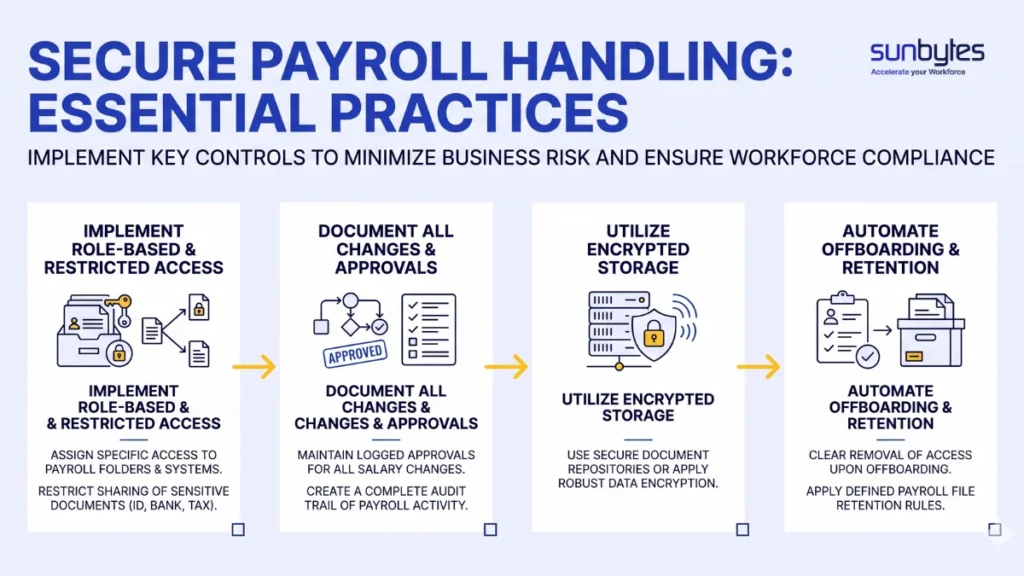
Secure payroll handling should include:
- role-based access to payroll folders and systems;
- documented approval logs for salary changes;
- restricted sharing of ID, bank, and tax documents;
- encrypted storage or secure document repositories;
- clear removal of access during offboarding;
- payroll file retention rules;
- audit trail for payroll changes.
This is where payroll security becomes employee trust. People may not see your payroll controls, but they will feel the failure quickly if salary data is exposed, payment is delayed, or a document is sent to the wrong person.
Trend 3: Pay transparency will raise pressure on salary-data quality
EU pay transparency rules will make payroll data quality more visible.
The European Commission states that EU Member States must transpose the Pay Transparency Directive into national law by June 7, 2026. The directive includes pay reporting on pay gaps for employers with at least 100 employees, plus worker rights to request pay information and rules on pay transparency before employment.
The Council of the EU explains that companies with more than 250 employees will report annually on the gender pay gap, while smaller organizations report every three years, and organizations with fewer than 100 employees have no reporting obligation. It also states that companies must act if a pay gap above 5% cannot be justified by objective, gender-neutral criteria.
For a company hiring in Vietnam, this does not automatically mean every Vietnam payroll record appears in a public EU report. The scope depends on entity structure, employment model, jurisdiction, and local implementation.
The practical effect is still clear: EU headquarters will need cleaner salary data.
Your Vietnam payroll data may feed:
- compensation reviews;
- internal pay-band checks;
- finance reporting;
- headcount planning;
- group-level pay equity analysis;
- employee cost modelling.
If Vietnam payroll data is inconsistent, pay transparency work becomes harder later. Job titles may not match internal job families. Salary components may be coded differently from the EU system. Allowances may sit in free-text fields. Contract data may not match payroll records.
In 2026, the safer approach is to treat payroll data as reporting data from the beginning.
Trend 4: Automation will shift from speed to error prevention
Payroll automation is often framed as a way to make payroll faster. For EU teams hiring in Vietnam, speed is useful only when the inputs are right.
The better 2026 use case is error prevention.
Automation should help your team catch inconsistent inputs before payroll closes. That means checking whether a new hire has a signed contract, whether a bank account is missing, whether a salary change has approval, whether an allowance has the right tax treatment, or whether a terminated employee still appears in the payment file.
Payroll automation should protect the payroll run before payment is released.
| Pre-payroll check | Error it prevents |
|---|---|
| Missing signed contract | Employee paid without complete employment record |
| Unapproved salary change | Incorrect salary paid from informal instruction |
| Expired work permit or contract | Payroll continues without valid supporting document |
| Wrong salary component code | Incorrect PIT or contribution treatment |
| Missing bank details | Payment delay |
| Duplicate employee record | Duplicate payment or reporting error |
| Offboarded employee still active | Payment or access control issue |
| Unapproved overtime | Variable pay dispute |
The goal is not to remove payroll judgment. It is to give HR, finance, and local operations fewer things to chase manually each month.
When your team is growing, payroll should not depend on someone remembering which spreadsheet has the latest approved salary. The payroll process should make the missing approval visible before the payroll file goes to payment.
Trend 5: Distributed teams need clearer payroll ownership
Payroll breaks down in the handoffs. EU headquarters may own compensation policy. Vietnam HR may collect employee documents. Finance may release payment. A local advisor may confirm tax or social insurance treatment. A manager may approve overtime. If no one owns the full payroll run, your process depends on informal coordination.
That works with five employees. It starts to fail when your Vietnam team grows, employee categories change, or payroll variables increase.
A clear payroll ownership model defines who owns each step:
| Payroll step | Owner to define | Risk if unclear |
|---|---|---|
| New hire setup | HR or local operations | Missing documents before first payroll |
| Contract data | HR and legal | Payroll does not match employment terms |
| Monthly variables | Team lead and HR | Overtime, bonus, or leave errors |
| Payroll calculation | Payroll owner | Wrong tax, contribution, or net pay |
| Review and approval | Finance and HR | Errors released to payment file |
| Salary payment | Finance | Late or incorrect payment |
| Payslip and employee query | Payroll owner | Slow response, lower employee trust |
| Records and access | HR, finance, IT/security | Data exposure or weak audit trail |
| Offboarding | HR, payroll, IT/security | Final pay or access removal missed |
The trend is not that payroll must always be outsourced. The trend is that ownership must be visible.
When your internal team has the capacity and Vietnam payroll knowledge, payroll can stay in-house. When payroll relies on multiple countries, sensitive documents, local compliance review, and month-end pressure, external payroll support becomes useful quickly.
A 2026 payroll readiness checklist for EU companies hiring in Vietnam
Use this checklist before your next Vietnam hiring phase or before the first payroll run of 2026.
| Readiness area | What to check | Ready when |
|---|---|---|
| Payroll calendar | Salary cut-off, approval date, payment date, tax and contribution deadlines | Every owner knows the monthly payroll timeline |
| Employee classification | Employee, foreign worker, contractor, secondee | Each worker has the right payroll and compliance treatment |
| Contract records | Signed contract, salary, start date, job title, working location | Payroll matches the employment file |
| PIT setup | Residency status, taxable income, deductions, withholding process | Tax treatment is documented before payroll closes |
| Social insurance | Participation status, contribution base, foreign-worker treatment | Contributions match the employee category |
| Salary components | Base pay, allowances, benefits, bonus, overtime | Each component has a defined payroll treatment |
| Data access | Who can view, edit, approve, and export payroll data | Access is role-based and reviewed |
| Document handling | ID, bank, tax, contract, and dependent documents | Sensitive files are stored and shared securely |
| Change approval | Salary changes, bank changes, bonus, overtime | Every change has a named approver |
| Reporting | EU HQ reporting needs, local reports, finance files | Payroll data can support both local and group-level needs |
| Offboarding | Final pay, unused leave, document retention, access removal | Payroll and system access close together |
The main lesson from these payroll trends is not “buy more tools.” It is to make payroll easier to control.
Your process should show who owns each step, which data is trusted, which documents support the calculation, and how employee information is protected.
Need a clearer payroll baseline before hiring more people in Vietnam?
Sunbytes helps EU companies run Vietnam payroll with on-time processing, secure document handling, GDPR-aware workflows, and ISO/IEC 27001:2022-informed controls.
If your next hiring phase depends on accurate local execution, start with a payroll readiness review.
How Sunbytes supports payroll operations for EU companies in Vietnam
When your team is split between EU headquarters and Vietnam operations, payroll often fails in the handoffs: who approved the salary change, who stored the contract, who checked social insurance, and who released payment.
Sunbytes removes that uncertainty through Accelerate Workforce Solutions, where payroll is handled as an operating process, not a month-end file. Employee records, salary inputs, approval steps, payment timing, payslips, and payroll questions all have clear ownership.
This works because Sunbytes connects payroll operations with the right delivery foundations. Digital Transformation Solutions supports the workflow layer: cleaner handoffs, structured records, clearer approval paths, and payroll data that can support reporting across distributed teams. CyberSecurity Solutions supports the protection layer: secure document handling, access control, GDPR-aware workflows, audit trails, and ISO/IEC 27001:2022-informed security standards.
For EU companies hiring in Vietnam, that means fewer payroll gaps left unmanaged. Your HR team can onboard people with clearer documents. The finance team can approve payroll with better records. And your employees get paid on time, with fewer avoidable questions after payday.
Sunbytes brings 15 years of experience supporting distributed teams and clients across 20 countries. For payroll, the proof points are practical: payroll on time, secure document handling, GDPR-aware workflows, and controlled access to sensitive employee data.