
Most vendor evaluation processes for enterprise web development partner ask the same questions: who have you worked with, what did you build, what does it cost? For high-traffic platforms, these are the wrong starting points.
A development partner who built a strong portfolio of project websites is not necessarily able to maintain a platform serving millions of visitors every day. The skill sets overlap. The discipline required doesn’t. Building and operating are different jobs, and the difference matters significantly when your platform handles serious daily traffic.
For a deeper look at what that discipline actually involves, see our article on why enterprise WordPress development is a different discipline from website development. This article addresses the adjacent question: how do you identify a development partner who can operate at that level?
TL;DR
- Standard vendor evaluation criteria were built for project work. High-traffic platforms need a different checklist entirely.
- The questions that reveal operational capability: how does the team handle production incidents, what does deployment look like, and can they show engagements that ran for two or more years.
- Platform context is the most valuable asset a development team can hold. It only accumulates through sustained continuity.
- Portfolio and pricing still matter. They come second to operational track record.
Why standard vendor evaluation fails for high-traffic platforms
The typical vendor evaluation was designed for project work: scoped deliverable, defined timeline, clear endpoint. When the project ships, the engagement ends. High-traffic platforms don’t work that way. They evolve continuously, carry legacy infrastructure alongside new development, and require engineering teams that accumulate context over time rather than hand it off at the end of a contract.
A team that passes every standard evaluation check can still be the wrong choice for platform work. The failure mode usually appears three to six months in. Initial delivery velocity starts compressing as technical debt accumulates. A production incident during peak traffic shows that nobody truly owns the system. The agency completes its contracted scope, offboards, and leaves with all the platform context in their heads. At that point, the evaluation criteria that selected them still look fine on paper. The engagement model was simply wrong for what the platform requires.
Five questions to ask for choosing a enterprise web development partner for high-traffic platforms
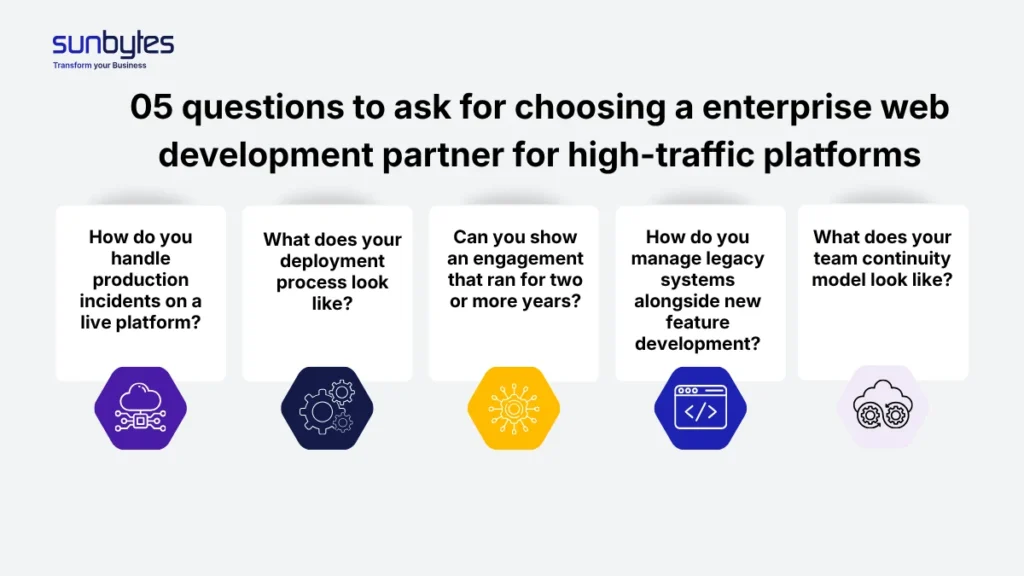
How do you handle production incidents on a live platform?
The answer should be specific: a documented incident response process, defined escalation paths, named responsibilities, recovery time targets. If the answer is “we respond quickly,” ask for a recent example. What did the last production incident look like? How long did resolution take? What changed in the process afterward?
Teams that have operated high-traffic platforms answer this with specifics. Teams that primarily deliver project work often struggle to answer with precision.
What does your deployment process look like?
On a high-traffic platform, a deployment is a coordinated event, not a technical one. The process should account for live traffic, rollback procedures, staging environments that match production configuration, and deployment windows calibrated to traffic patterns.
For WordPress VIP specifically: ask directly whether the team has worked within VIP’s deployment pipeline. VIP enforces a code review process before deployments reach production. A team unfamiliar with those constraints carries a real ramp-up cost in the first three months.
Can you show an engagement that ran for two or more years?
Project experience and platform experience are different. A portfolio of twelve-month engagements demonstrates delivery capability. It doesn’t demonstrate the ability to maintain a platform over time.
Long-term platform engagements require sustained ownership. Context accumulates. The team learns the system’s behavioral patterns and responds to issues faster because they’ve seen similar ones before. Ask what a long engagement looked like in year two versus year one: how the team evolved, what knowledge they built, and how operational responsibility was structured.
How do you manage legacy systems alongside new feature development?
Few high-traffic platforms run on fully modern architecture. The more common situation is legacy infrastructure handling live traffic while modern components are built alongside it, with the same engineering team responsible for keeping both stable.
Ask how they handle this. The answer should describe a clear process for maintaining stability in legacy systems while building forward, and ideally an example of having done it.
What does your team continuity model look like?
Platform context lives in people. When a team member leaves or an engagement ends and a new team starts, context rebuilds from zero. On a high-traffic platform, that rebuilding shows up in slower incident resolution and avoidable errors in the early sprints.
Ask specifically: how do they structure long-term teams, how do they handle turnover, and what is their average engagement length for platform clients.
For general European vendor selection, see The framework to evaluate Web Development Partner in Europe
What a high-traffic platform engagement model should actually look like
Beyond the five questions, the engagement model itself needs to match what the platform requires.
Dedicated team structures outperform project-based ones for ongoing platform work. A dedicated team – a project manager, senior engineers with platform specialization, and a QA engineer – operates with continuity that project arrangements can’t replicate. The project manager coordinates between the client’s internal team and the engineering team. Platform context accumulates from the first sprint rather than being reconstructed at the start of each new contract.
For most senior dedicated teams, two to four weeks covers role confirmation, team selection, and the start of onboarding. Context deepens from there. The alternative is a project-based model where a team is assembled for defined scope, delivers, and disengages. For a platform with no natural endpoint, this creates recurring context loss. Over three years, the aggregate cost of rebuilding context with each new engagement typically exceeds the perceived benefit of scope flexibility.
See what a 6-year dedicated team engagement looks like in practice.
Red flags during the enterprise web development partner’s evaluation process
These signals suggest the engagement model won’t fit high-traffic platform work.
Incident management answers that describe communication rather than process.
Platforms handling significant daily traffic need documented response procedures, not informal escalation. “We’ll stay in close contact” is not an incident response model.
A portfolio without long-term platform references.
Strong project work with no sustained engagements tells you the team can deliver. It doesn’t tell you whether they can maintain. Ask specifically for references from engagements that ran two or more years.
Project-based pricing for ongoing platform work.
Scope pricing assumes an endpoint. High-traffic platforms don’t have one. Misaligned commercial structures create incentive problems when ongoing work is forced into project cost models.
No specific experience with your platform’s technical requirements.
For WordPress VIP: the platform’s code standards, deployment pipeline, and performance thresholds are specific enough that general WordPress experience doesn’t transfer cleanly. A team without VIP engagement history will spend meaningful time adapting in the first quarter.
How Sunbytes approaches high-traffic platform work
Sunbytes builds and maintains dedicated engineering teams for high-traffic web platforms across media, publishing, and SaaS. That includes platforms on WordPress VIP and headless WordPress architectures handling 50M+ monthly visitors.
Two engagements show the model in practice.
- Flexpress runs a headless WordPress stack serving 50M+ monthly visitors across a growing portfolio of sites. Nine-person dedicated team over three years, scaling from a single site to a multi-property platform.
- Dedicated senior teams are operational in two to four weeks: project manager, senior full-stack engineers, QA engineer. 300+ projects delivered. ISO 27001 certified. GDPR Article 28 DPA on every engagement.
If you’re evaluating development partners for a high-traffic platform, talk to our team.