

ISO 27001 certifies the information security management system around how your company governs information risk. For a software team, the practical question is narrower: can your delivery process show evidence that secure development controls operate during design, coding, review, release, and remediation?
That is where DevSecOps matters. It turns ISO 27001 secure development expectations into CI/CD controls, pull request records, vulnerability tickets, access reviews, deployment logs, and exception approvals. The audit value is not the scanner output alone. The audit value is the documented chain from risk to control, from control to owner, and from finding to remediation.
TL;DR
- ISO 27001 DevSecOps means mapping secure development controls into your pipeline so engineering can produce audit-ready evidence without stopping delivery.
- For Dutch and EU SaaS teams, the useful evidence usually includes pull request reviews, SAST and SCA results, access review records, exception approvals, deployment logs, and remediation tickets with owners and dates.
- Use this approach when your team is preparing for ISO 27001 certification, recertification, customer security questionnaires, or internal audit. Watch for one common failure: treating scan results as proof of compliance without showing who reviewed the finding, what was fixed, and when the control was rechecked.
What does ISO 27001 require from software delivery?
ISO 27001 requires a managed security system, not a one-time security report. In software delivery, that means your ISMS needs to show how security risks are identified, treated, assigned, reviewed, and improved across the delivery lifecycle.
ISO/IEC 27001:2022 is an information security management system standard. It asks the organisation to define security objectives, assess risks, choose controls, document responsibilities, and improve the system over time. ISO/IEC 27002:2022 supports that work by giving implementation guidance for controls.
For engineering teams, the relevant control areas usually sit around secure development, access control, change management, vulnerability handling, logging, monitoring, and supplier or outsourced development. The exact scope depends on your Statement of Applicability, your risk assessment, and what your auditor expects to see.
The most practical way to translate this into software delivery is to separate three layers.
- First, the ISMS layer defines policy and accountability. This includes risk assessment, the Statement of Applicability, secure development policy, access policy, change policy, and supplier security requirements.
- Second, the delivery layer shows how those policies run inside engineering. This includes pull request review rules, branch protection, CI/CD gates, dependency checks, deployment approvals, and vulnerability triage.
- Third, the evidence layer proves that the controls operated. This includes review logs, ticket histories, scan reports, access review sign-offs, exception records, and release notes.
If your team still needs the certification journey before the delivery mapping, use the ISO 27001 certification process guide first, then return to this guide to convert secure development controls into engineering evidence.
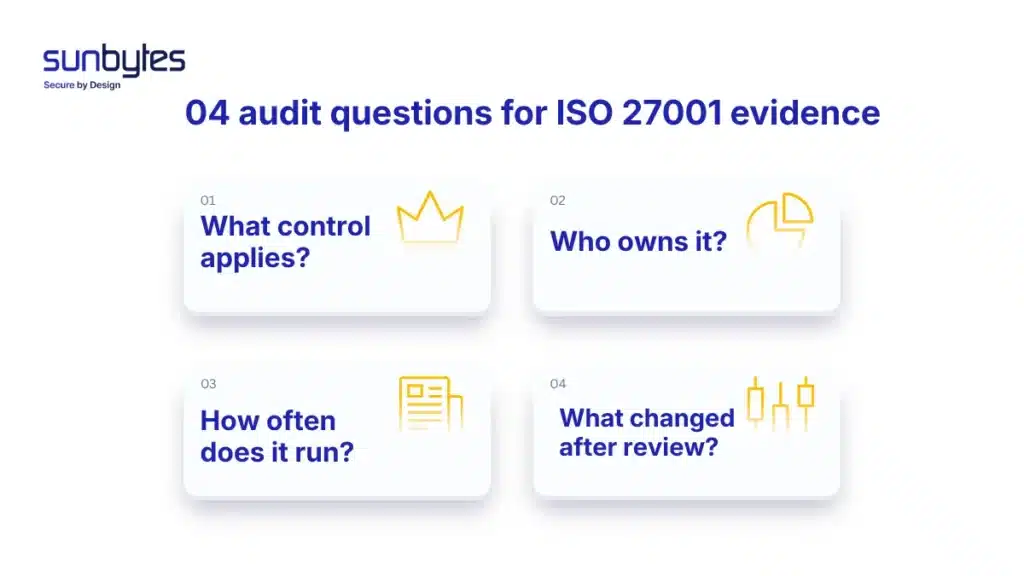
ISO 27001 evidence should answer four audit questions:
| Audit question | Engineering translation | Evidence to keep |
|---|---|---|
| What control applies? | Which secure development or pipeline control maps to this risk? | Statement of Applicability, control mapping, secure development policy |
| Who owns it? | Which role reviews, approves, fixes, or accepts risk? | RACI, ticket owner, approval record |
| How often does it run? | Per pull request, per release, weekly, monthly, or quarterly? | CI/CD logs, review records, access review calendar |
| What changed after review? | Was the risk fixed, accepted, deferred, or escalated? | Remediation ticket, exception approval, retest evidence |
The control is only audit-ready when all four questions have a documented answer.
How to map ISO 27001 controls to a DevSecOps pipeline
Map ISO controls to DevSecOps by assigning each control area to one pipeline stage, one evidence artifact, one owner, and one review frequency. A control without an owner becomes a policy statement. A control with a recurring evidence trail becomes auditable.
For a Dutch or EU SaaS company, the useful mapping usually starts with secure development controls under ISO/IEC 27001:2022 Annex A, then connects them to engineering workflows.
| ISO 27001 control area | Pipeline control | Evidence artifact | Owner | Frequency |
|---|---|---|---|---|
| Secure development lifecycle | Security requirements added before development starts | Security acceptance criteria, threat notes, architecture decision record | Product owner, Security Lead, Engineering Manager | Per feature or epic |
| Application security requirements | Security requirements included in backlog and test cases | User story security criteria, QA test record | Product owner, QA Lead | Per sprint |
| Secure system architecture and engineering principles | Architecture review before high-risk changes | Architecture decision record, review comments, risk notes | Tech Lead, Security Lead | Per major change |
| Secure coding | Peer review, branch protection, coding standards | Pull request review, merge approval, branch rule config | Engineering Manager, Tech Lead | Per pull request |
| Security testing in development and acceptance | SAST, SCA, DAST, secret scanning, manual review where needed | Scan reports, triage notes, retest results | DevSecOps Engineer, QA Lead | Per build or release |
| Management of technical vulnerabilities | Severity-based triage and remediation SLA | Vulnerability tickets, fix dates, risk acceptance records | Security Lead, Engineering Manager | Weekly or per release |
| Access control and access rights | Least-privilege access for code, cloud, CI/CD, and production | Access matrix, approval tickets, quarterly review sign-off | IT Admin, Security Lead | Quarterly |
| Change management | Release approval and rollback procedure | Deployment log, change ticket, release approval | Release Manager, Engineering Manager | Per release |
| Logging and monitoring | Security events logged for build, deploy, and production systems | Log retention policy, monitoring alerts, incident ticket | DevOps Lead, Security Lead | Continuous, reviewed monthly |
| Outsourced development | Supplier controls for external engineering support | DPA, access scope, onboarding record, offboarding record | Compliance Manager, Vendor Owner | Per vendor and quarterly |
The mapping should not be a static spreadsheet that gets updated before audit week. It should be tied to existing work systems: Jira, Azure DevOps, GitHub, GitLab, Bitbucket, cloud IAM, CI/CD tooling, and vulnerability management tools.
For example, secure coding evidence should come from pull requests and merge rules. Vulnerability evidence should come from tickets and retest records. Access control evidence should come from access reviews and approval logs. Change management evidence should come from deployment records and release approvals.
This is also where ISO 27001 DevSecOps differs from a general DevSecOps pipeline guide, explaining where security belongs in CI/CD. This article answers a narrower question: what evidence does that pipeline need to produce for ISO 27001?
A practical mapping rule works well here: if the control cannot produce evidence without a manual scramble, it is not yet embedded in delivery.
Need help turning ISO 27001 DevSecOps into a working delivery plan? Sunbytes can help your team define control ownership, map pipeline evidence, and build a remediation path through its cybersecurity service before the next audit or customer security review.
Which evidence should engineering keep for an audit?
Engineering should keep evidence that shows the full control cycle: requirement, review, finding, decision, fix, and recheck. A scanner report by itself only shows detection. ISO 27001 evidence needs to show governance and follow-through.
The most useful audit evidence is produced during normal delivery work. Do not wait until audit preparation to create it. Build the evidence trail into the workflow.
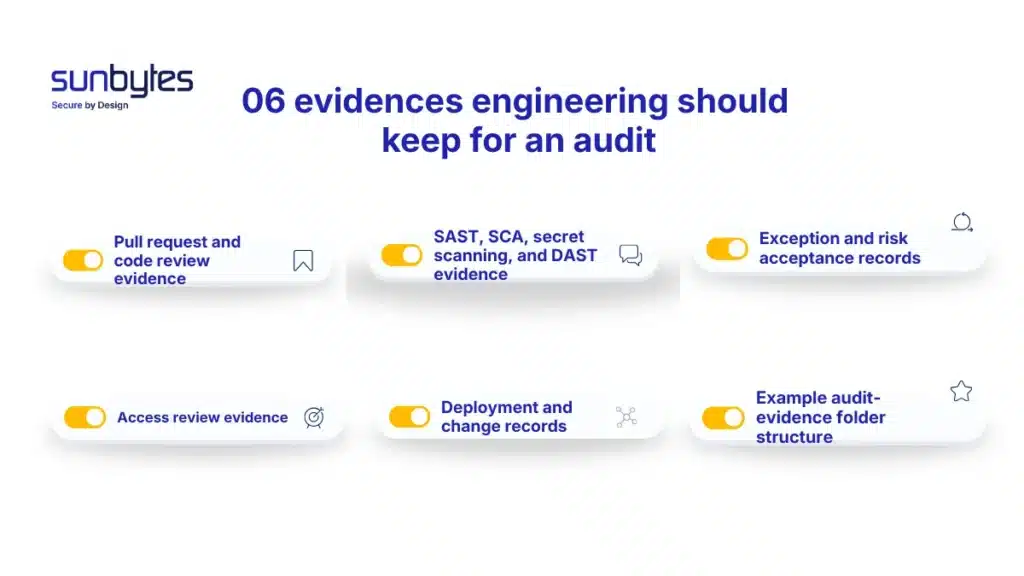
Pull request and code review evidence
Keep pull request records that show who reviewed the change, what was discussed, which security checks passed, and who approved the merge. A useful pull request record includes:
| Evidence field | What it proves |
|---|---|
| Reviewer name and timestamp | The review happened before merge |
| Required reviewer rule | Peer review is enforced, not optional |
| Security-related comments | The team looked for security impact, not only functionality |
| Linked ticket or story | The change connects to approved work |
| CI/CD status checks | Automated checks passed before merge |
SAST, SCA, secret scanning, and DAST evidence
Keep scan results, but connect them to triage and remediation. The evidence should show which findings were accepted, fixed, or deferred. A finding without triage is noise. A finding with owner, severity, due date, fix commit, and retest record becomes audit evidence. Use severity thresholds before the audit begins. For example:
| Severity | Suggested delivery rule |
|---|---|
| Critical | Block release unless a documented risk acceptance exists |
| High | Fix before release or within the agreed sprint SLA |
| Medium | Add to remediation backlog with owner and target date |
| Low | Track, batch, or accept based on risk context |
The exact thresholds should match your risk appetite, customer commitments, and auditor expectations. The key is consistency. If one release blocks on a high-severity dependency issue and another release ignores the same issue without approval, the evidence trail becomes weak.
Exception and risk acceptance records
Not every finding blocks a release. Some risks are accepted temporarily because a compensating control exists, the affected component is not internet-facing, or a business deadline has been approved by the right owner. The exception record should state:
| Field | Required detail |
|---|---|
| Finding | What risk exists |
| Reason | Why the release can continue |
| Compensating control | What reduces exposure |
| Owner | Who accepts the risk |
| Expiry date | When the exception must be reviewed |
| Follow-up ticket | What will close the risk |
Without an expiry date, an exception becomes a permanent blind spot.
Access review evidence
Access reviews matter because DevSecOps tooling often touches source code, secrets, build systems, production logs, and cloud infrastructure. Keep records for code repositories, CI/CD platforms, cloud accounts, production systems, monitoring tools, and vulnerability platforms.
A quarterly access review is a practical cadence for many SaaS teams. The review should show who has access, what changed since the previous review, who approved continued access, and which accounts were removed.
For Dutch and EU SaaS teams working with external engineers, access evidence should also show onboarding and offboarding. The audit question is simple: did each person have the right access, for the right period, with documented approval?
Deployment and change records
Deployment logs should show what changed, who approved the release, which checks passed, and how the team could roll back if needed.
A release record should connect:
| Release element | Evidence |
|---|---|
| Change request | Ticket or release scope |
| Approval | Product, engineering, or change owner sign-off |
| Security gate | CI/CD results, scan threshold, exception record |
| Deployment | Timestamp, environment, version, actor |
| Rollback | Rollback plan or previous version reference |
If the release changes authentication, payment, customer data handling, encryption, or administrative access, add a security review before deployment.
Example audit-evidence folder structure
The practical structure can be simple as long as every folder maps to a control area and owner.
Example:
ISO-27001-DevSecOps-Evidence/
  01-secure-development-policy/
  02-control-mapping-and-SoA/
  03-architecture-and-threat-review/
  04-code-review-records/
  05-ci-cd-security-gates/
  06-vulnerability-management/
  07-risk-acceptance-and-exceptions/
  08-access-reviews/
  09-release-and-change-records/
  10-supplier-and-outsourced-development/
  11-audit-testing-and-follow-up/
The folder structure is not the control. It is the index that helps your team find the control evidence when an auditor, buyer, or internal reviewer asks for it.
If your team builds mobile or customer-facing applications, the related ISO 27001 and app development article can support the app-specific angle while this article stays focused on DevSecOps pipeline evidence.
How to avoid slowing delivery while collecting evidence
The fastest way to collect ISO 27001 evidence is to stop collecting it manually. Evidence should be created by the same systems that already manage code, builds, releases, access, and tickets.
A SaaS team should not add a manual compliance step to every sprint if the CI/CD platform, ticketing system, and repository already contain the proof. The work is to standardise naming, ownership, thresholds, and storage.
Use policy-as-code for repeatable controls
Policy-as-code turns control rules into repeatable checks. Examples include branch protection, required reviewers, required status checks, dependency thresholds, infrastructure policy checks, and secret scanning.
The advantage is consistency. A manually reviewed checklist depends on who is working that day. A pipeline rule applies the same gate every time. Use policy-as-code where the rule is clear:
| Control need | Good automation fit |
|---|---|
| Required code review | Branch protection |
| Dependency severity threshold | SCA gate |
| Secret detection | Secret scanning |
| Infrastructure policy | IaC scanning |
| Deployment approval | Protected environments |
| Access expiry | IAM workflow or access management tool |
Keep human review for decisions that require context: risk acceptance, architecture trade-offs, compensating controls, and customer impact.
Define release gates by severity and system risk
A release gate should block the few risks that matter most. If every scan finding blocks release, teams will work around the control. If nothing blocks release, the control has no force.
A practical starting point:
| Situation | Release decision |
|---|---|
| Critical vulnerability in internet-facing service | Block release unless approved risk acceptance exists |
| High vulnerability in dependency with available fix | Fix before release or document approved exception |
| Medium finding in internal tool | Track in backlog with owner and target date |
| Low informational finding | Batch review monthly |
| Secret detected in repository | Block and rotate credential before release |
| Missing reviewer on protected branch | Block merge |
Release gates should be reviewed after one or two release cycles. If gates block too much low-risk work, adjust thresholds. If gates allow repeated high-risk exceptions, fix ownership.
Keep evidence close to the work
Evidence should live near the system of record. Pull request evidence belongs in the code platform. Vulnerability evidence belongs in the ticketing and scanning tools. Access evidence belongs in IAM or access review records. Release evidence belongs in deployment logs and change tickets.
The evidence folder should link to those systems rather than duplicate everything manually. Duplicated evidence creates drift. Linked evidence keeps the audit trail closer to the actual work.
For teams also preparing for Dutch NIS2 requirements, some evidence can support both ISO 27001 and NIS2 readiness. The overlap is not automatic, but the same engineering records often help answer security management, incident handling, access control, and vulnerability management questions. For the Dutch regulatory angle, see DevSecOps and NIS2 for Dutch companies.

Common ISO 27001 DevSecOps mistakes
The most common ISO 27001 DevSecOps mistake is confusing activity with evidence. Running scans, holding reviews, or using DevSecOps tools does not help an audit unless the output is documented, owned, reviewed, and connected to risk treatment.
Mistake 1: Treating scanner output as compliance proof
SAST or SCA results can support ISO 27001 evidence, but they do not prove compliance alone.
The missing part is the decision trail. Who reviewed the finding? Was it exploitable? Was it fixed, accepted, or deferred? What retest evidence shows closure?
A useful scan record should connect to a ticket, owner, severity, decision, target date, fix commit, and retest result.
Mistake 2: Keeping evidence across scattered tools with no index
Engineering evidence often exists, but nobody can find it quickly. Pull requests are in GitHub, issues are in Jira, approvals are in Slack, access records are in Google Workspace, and deployment logs are in the cloud console.
That setup fails when audit preparation becomes a search exercise.
Create one evidence index with links to the systems of record. The index should show control area, owner, evidence location, review frequency, and last review date.
Mistake 3: Assigning controls to tools instead of people
Tools do not own controls. People do.
A SAST tool can detect a vulnerability. It cannot decide whether the finding blocks release. A CI/CD gate can enforce a threshold. It cannot approve a risk exception. An access management tool can show user rights. It cannot explain why a contractor still has production access six weeks after project end.
Every control needs an accountable role: Security Lead, Engineering Manager, Tech Lead, Release Manager, Product Owner, IT Admin, or Compliance Manager.
Mistake 4: Using the 2013 control language without mapping to 2022
Many older articles and templates still refer to ISO 27001:2013 Annex A.14 for system acquisition, development, and maintenance. For new work, map your language to ISO/IEC 27001:2022 Annex A controls and your Statement of Applicability.
If legacy documents still use A.14, keep a mapping note. Do not let old control labels create confusion in audit evidence, internal training, or customer questionnaires.
Mistake 5: Writing risk acceptance with no expiry date
Risk acceptance without an expiry date becomes unmanaged risk.
Each exception should have an owner, reason, compensating control, expiry date, and follow-up ticket. Review exceptions before the next release or at the agreed cadence. Expired exceptions should be escalated, closed, or renewed with documented approval.
Mistake 6: Making compliance a separate lane from engineering
If compliance evidence sits outside delivery, it becomes late, incomplete, and expensive to maintain. The better pattern is to make the delivery system produce evidence by default.
That means repository rules, CI/CD gates, ticket workflows, access review calendars, and release approvals need to align with the control map. The audit trail should be the byproduct of controlled delivery, not a reporting project at the end of the quarter.
How Sunbytes supports ISO 27001 DevSecOps delivery
Sunbytes supports ISO-aware DevSecOps delivery by helping SaaS teams turn secure development controls into working delivery practices, evidence trails, and remediation ownership. The goal is not to claim that a client product becomes ISO certified because Sunbytes is certified. The goal is to help the client build the evidence their own ISMS, audit, or customer review requires.
Sunbytes is ISO 27001 certified and works with delivery models where security controls need to operate inside real engineering work: code review, CI/CD, vulnerability handling, release approval, access review, and audit documentation.
For Dutch and EU SaaS teams, the practical support usually falls into three areas.
- First, Sunbytes helps define the control-to-delivery map. That means connecting secure development expectations to the pipeline stage, evidence type, owner, and review cadence.
- Second, Sunbytes helps close delivery gaps. If the team lacks DevSecOps capacity, security review ownership, or remediation bandwidth, Sunbytes can add engineering support without restarting the hiring cycle.
- Third, Sunbytes helps prepare audit-ready evidence. That includes control mapping, remediation records, access review support, DPA-backed delivery, and evidence trails that security questionnaires and auditors can inspect.
The output should be concrete: a mapped control set, evidence locations, named owners, remediation actions, and a next-step plan for gaps that cannot be solved in the current sprint.
If your next ISO 27001 audit, customer questionnaire, or internal review is exposing gaps in ownership or evidence, talk to Sunbytes through its cybersecurity service to map the controls that need to operate inside your DevSecOps pipeline.