

SAST (Static Application Security Testing) is a baseline control. Secure code review is a decision control.
Automated SAST should run across every pull request or build because it is fast, repeatable, and useful for known code-level weakness patterns. Secure code review should be added when the change needs human context: authentication, authorization, tenant isolation, payment logic, encryption, secrets handling, data export, or high-risk remediation.
The practical answer is not “choose one.” Use SAST to scale routine checks. Use secure code review to gate changes where a scanner cannot understand business rules, trust boundaries, or abuse paths.
This article focuses on secure code review vs SAST inside a DevSecOps workflow. For the broader business trade-off between human review and automated review, read Sunbytes’ guide to manual vs automated code review.
TL;DR
- SAST should run on every pull request or build because it gives fast, repeatable checks for known code-level weakness patterns. Secure code review should be added when the change needs human context, such as authentication, authorization, tenant isolation, payment logic, encryption, secrets handling, data export, or critical vulnerability fixes.
- Use SAST as the baseline gate. Use secure code review as the risk-based release gate. The strongest DevSecOps workflow combines both: automated scanning for scale, human review for high-risk decisions, and an evidence trail that records findings, remediation tickets, fix commits, retest results, and approval decisions.

What SAST can and cannot catch
SAST can catch repeatable code-level issues before code reaches production, but it cannot decide whether the feature logic is safe for your business model.
SAST analyzes source code, bytecode, or binaries without running the application. In a DevSecOps setup, tools such as GitHub CodeQL, GitLab SAST, SonarQube or SonarCloud, and Snyk Code can run inside pull requests, CI pipelines, or scheduled scans. That makes SAST useful for fast feedback.
SAST is strongest when the weakness has a recognizable pattern. Examples include unsafe input handling, insecure function use, hardcoded secrets, injection patterns, weak cryptographic usage, dependency-adjacent code issues, and some access-control mistakes where the rule can be detected from code structure.
The value is operational. A team can run SAST on every pull request, assign findings to the developer who owns the change, and track remediation through the same ticketing flow as other engineering work. That creates a repeatable evidence trail: scan result, ticket, fix commit, reviewer approval, and retest result.
SAST has limits. It can miss issues that depend on business context. A scanner may see that an API endpoint checks for a valid user session. It may not know whether that user should be allowed to export another tenant’s data, approve a refund, change billing ownership, or bypass a workflow step. The code may look valid while the product behavior is unsafe.
SAST also creates false positives. A finding may be technically possible but not exploitable in the real deployment path. Without triage rules, teams either waste sprint time on low-value fixes or start ignoring scanner output. Use SAST as the first filter. Do not make it the final security decision for high-risk product changes.
If your team is still choosing where SAST fits in the toolchain, this DevSecOps tools selection guide explains how different tool categories support the pipeline.
What secure code review adds that SAST misses
Secure code review is a human review of security-sensitive code, data flows, permissions, and business logic before merge or release. It checks whether the change is safe in context, not only whether the code matches known weakness patterns.
A secure code review looks at how a change behaves in context. The reviewer checks the code, but also the feature intent, affected assets, trust boundaries, user permissions, data movement, error handling, and abuse paths. This is where human review adds value that SAST cannot fully replace. For example, SAST may scan a new data export feature and find no obvious injection issue. A secure reviewer can still ask sharper questions:
- Can a customer export another customer’s records?
- Can a support user trigger the export without approval?
- Does the export include personal data that should be masked?
- Is the download link time-limited?
- Is the export event logged with the right user ID and tenant ID?
Those questions are not just code questions. They are product and security questions.
Secure code review is especially useful for high-risk changes involving:
- Authentication flows, login logic, session handling, password reset, MFA, SSO, and account recovery
- Authorization logic, role-based access control, admin permissions, and privilege changes
- Tenant isolation in SaaS platforms, especially where shared infrastructure stores customer data
- Payment logic, billing changes, refund flows, checkout logic, and transaction approval
- Encryption, key handling, token storage, and secrets management
- Data export, reporting, file downloads, bulk actions, and integrations that move data outside the application
- Critical vulnerability fixes where the team needs proof that the issue was fixed and retested
OWASP’s secure code review guidance treats automated scanning as part of the review process, not a full substitute for human review. That is the right operating model for DevSecOps teams: automate the repeatable checks, then use human review where the scanner lacks context.
A secure review should end with decisions, not only findings. The reviewer should confirm what must be fixed before merge, what can be accepted with a documented reason, what needs retesting, and what evidence should be kept for future audit, client security review, or internal control checks.
Secure code review vs SAST comparison table
Secure code review vs SAST should be compared by release-gate fit, not by which method is “better.”
| Criteria | SAST | Secure code review |
|---|---|---|
| Best use case | Baseline scanning for every PR or build | High-risk changes that need human context |
| Speed | Fast enough for CI/CD feedback | Slower, because a reviewer must understand the change |
| Coverage | Broad code coverage across repeatable rules | Focused coverage on selected features, flows, or risk areas |
| Context | Limited understanding of business logic and user intent | Stronger understanding of architecture, roles, abuse paths, and data flow |
| False positives | Can be high without tuned rules and triage | Lower when reviewer understands the system, but depends on reviewer quality |
| Best at finding | Known code weakness patterns, insecure functions, risky data handling patterns, hardcoded secrets | Broken authorization, tenant boundary issues, unsafe workflows, payment logic flaws, risky remediation gaps |
| Weakness | Can miss context-heavy security issues | Cannot scale to every line of code on every release |
| Evidence value | Scan report, finding ID, severity, fix commit, retest result | Reviewer notes, approved risk decision, remediation ticket, retest evidence, release approval |
| Release-gate fit | Good for automated baseline gates | Good for manual gates on high-risk PRs |
| Owner | Engineering team, DevOps, AppSec, or platform team | AppSec lead, senior engineer, security reviewer, or external secure development specialist |
The decision is simple: SAST should be always-on. Secure code review should be risk-triggered. A routine UI change should not wait for a full manual review if SAST passes and no sensitive flow is affected. A change to tenant permissions, payment handling, or data export should not ship only because SAST is clean.
When to use SAST only, secure review only, or both
Use SAST only for low-risk changes, secure review only for narrow expert checks, and both for high-risk release gates.
The best model is a risk-based decision matrix. It gives Engineering Managers and CTOs a clear rule for when a pull request needs extra review.
| Change type | SAST only | Secure review only | Both SAST and secure code review |
|---|---|---|---|
| Copy change, styling update, low-risk UI adjustment | Yes, if SAST scope is affected | No | No |
| Routine backend change with no sensitive data or permission change | Usually yes | No | Sometimes, if the module is security-sensitive |
| New API endpoint | No | No | Yes, if it handles user data, permissions, or external access |
| Authentication or account recovery change | No | No | Yes |
| Authorization, admin role, or permission change | No | No | Yes |
| Tenant isolation change in SaaS | No | No | Yes |
| Payment, billing, refund, or checkout logic | No | No | Yes |
| Encryption, token, key, or secret handling | No | Sometimes, for focused expert review | Usually yes |
| Data export, reporting, file download, or bulk data action | No | No | Yes |
| Critical vulnerability fix | No | Sometimes, if the code path is narrow | Yes, with retest evidence |
| Regulated or client-sensitive release | No | No | Yes, with approval evidence |
The rule should be visible in the engineering workflow. Add a short “security review trigger” checklist to the pull request template:
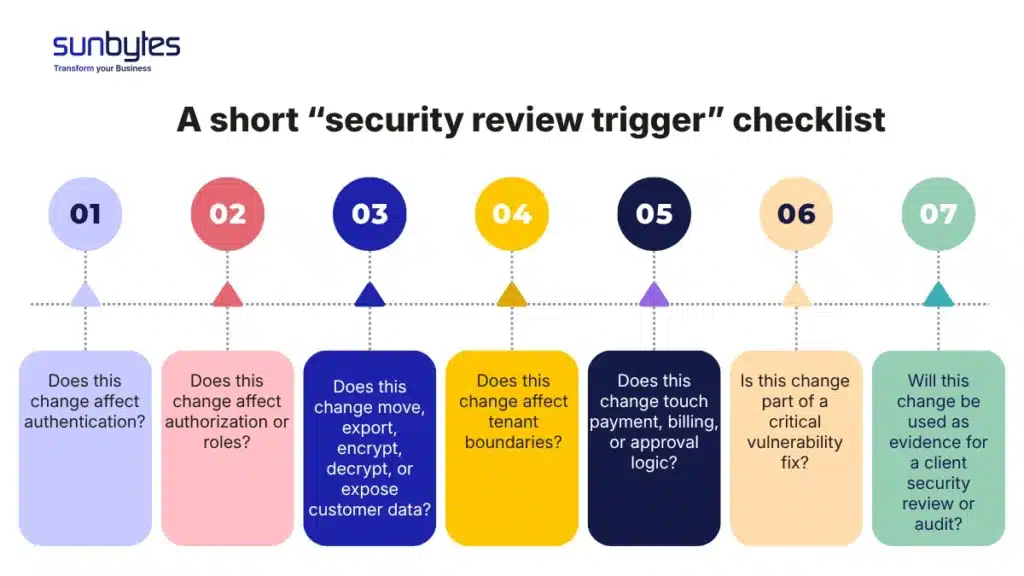
- Does this change affect authentication?
- Does this change affect authorization or roles?
- Does this change move, export, encrypt, decrypt, or expose customer data?
- Does this change affect tenant boundaries?
- Does this change touch payment, billing, or approval logic?
- Is this change part of a critical vulnerability fix?
- Will this change be used as evidence for a client security review or audit?
If the answer is yes to any item, SAST is not enough. The pull request should receive secure code review before merge or before release, depending on the deployment model.
Need help turning secure code review vs SAST into a working delivery rule? Sunbytes can help define review ownership, pipeline controls, remediation evidence, and secure development practices through Secure Development Services.
How to combine SAST and secure code review in a DevSecOps pipeline
Combine SAST and secure code review by using SAST on every build and manual review only when a risk trigger is met. A workable DevSecOps workflow should not send every pull request into a long security queue. It should create clear gates.
A practical workflow looks like this:
- Developer opens a pull request.
- SAST runs automatically through the CI/CD pipeline.
- The pull request template asks risk-trigger questions.
- Low-risk changes continue if SAST passes or findings are accepted under the team’s policy.
- High-risk changes are routed to a secure reviewer.
- Findings are logged as tickets with severity, owner, fix target, and retest requirement.
- The reviewer approves the fix or documents an accepted risk.
- The release keeps evidence: scan result, review notes, ticket link, fix commit, retest result, and final approval.
This keeps the pipeline moving without removing security judgement from important changes.
The remediation SLA should match severity. For example, a critical issue in authentication or tenant isolation should block release until fixed and retested. A medium-risk issue in a non-sensitive flow may be assigned to a sprint with an owner and due date. A low-risk false positive can be closed with a reason if the reviewer can show why the finding is not exploitable in that context.
The evidence trail matters because security work is often questioned later. A client asks how a vulnerability was handled. An internal manager asks why a release was approved. An ISO-aware audit checks whether security controls are actually used. Without tickets, review notes, and retest records, the answer becomes verbal. Verbal evidence does not scale.
For teams building this into CI/CD, Sunbytes’ DevSecOps pipeline guide explains how pipeline controls, tool gates, and ownership work together. The operating principle is direct: SAST creates the baseline. Secure code review creates the release decision for high-risk change.
For Dutch and EU SaaS teams, the SAST vs secure code review decision is also an evidence decision. A clean scanner result shows that automated checks ran. A secure code review record shows why a high-risk change was accepted, fixed, retested, or blocked.
That matters when a client asks for proof of secure development, when ISO 27001 evidence is reviewed, or when GDPR Article 32 security-of-processing expectations need to be translated into engineering controls. Keep the pull request, scan result, review notes, remediation ticket, fix commit, retest result, and release approval together. Without that chain, the control happened in practice but is hard to prove later.
How Sunbytes supports secure code review and pipeline security
Sunbytes supports secure code review by helping engineering teams turn security checks into working delivery controls.
For a CTO or Engineering Manager, the issue is rarely “do we need security?” The harder question is where security review fits without slowing every sprint. Sunbytes helps define that line: what SAST should scan, which changes need human review, who owns remediation, and what evidence should be kept after release.
Sunbytes can support teams through Secure Development Services, DevSecOps delivery support, and ISO-aware engineering practices. That can include reviewing high-risk pull requests, mapping review triggers to the pipeline, checking security-sensitive flows, supporting remediation, and creating evidence trails that engineering and security teams can reuse.
The model fits teams that need practical execution. Sunbytes combines Dutch account management with Vietnam delivery support, 2–4 week onboarding for dedicated technical capacity, and ISO 27001 experience. That helps teams add secure development capability without restarting a full hiring cycle.
If your current setup has SAST alerts but no clear review owner, no release rule for high-risk changes, or no evidence trail after remediation, the next step is to define the workflow before adding more tools.
Start with the Cybersecurity service overview if you need a broader security baseline, or go directly to Secure Development Services if the immediate need is secure code review, SAST triage, or secure development support.