The DevSecOps hiring decision is usually not about finding “a security person.” It is about deciding who owns security inside delivery.
To hire DevSecOps engineers for EU companies, start with the operating model: in-house when security ownership must become part of your permanent engineering culture, freelance when the scope is narrow and time-boxed, and dedicated DevSecOps engineer support when you need embedded capacity faster than a local hiring cycle allows.
A DevSecOps engineer is an engineering role that builds security into the software delivery pipeline. The role connects CI/CD, cloud security, vulnerability management, release gates, evidence collection, and developer workflows. If your team already understands the model and only needs the role brief, screening task, and interview scorecard, use the supporting guide on how to hire a DevSecOps engineer.
This page is the broader decision guide. It compares hiring models, cost drivers, skills, onboarding, compliance expectations, and the first 90 days of ownership.
TL;DR
Hiring a DevSecOps engineer works when the role has pipeline ownership, not only tool ownership. For EU SaaS and software teams, the strongest model depends on urgency, audit pressure, internal security maturity, and how much engineering control you want to keep in-house.
- Use in-house hiring when DevSecOps ownership is strategic and you can wait through a local hiring cycle.
- Use freelance DevSecOps support when the scope is narrow, such as a CI/CD review, SAST rollout, or cloud misconfiguration fix.
- Use dedicated DevSecOps engineers when you need embedded capacity across sprints, security evidence, vulnerability handling, and release gates.
- Watch for candidates who can explain tools but cannot explain ownership, evidence, remediation flow, or developer adoption.
If you need the basics first, start with what is DevSecOps. If your main question is budget, compare the latest DevSecOps engineer salary in Europe. If you are comparing build-versus-buy models, read DevSecOps as a Service. If the hiring need comes from CI/CD gaps, connect the role to your DevSecOps pipeline guide.
When EU companies should hire DevSecOps engineers
Hire a DevSecOps engineer when security work starts blocking delivery decisions. That point usually appears before a breach, audit, or regulatory deadline. It shows up in sprint planning, release approvals, buyer due diligence, and vulnerability backlogs.
The clearest hiring triggers are operational. Enterprise security questionnaires start asking for evidence your team cannot produce quickly. The engineering team has scanners in place, but no owner for triage, prioritisation, and remediation follow-up. A release needs a security gate, but nobody knows which findings should block production and which should become backlog items. Cloud permissions, secrets management, container scanning, and CI/CD controls are split across DevOps, backend, QA, and security. That is when DevSecOps becomes an ownership problem.
For Dutch and EU SaaS teams, the pressure often comes from five places:
| Hiring trigger | What it looks like inside the team | What the DevSecOps engineer should own |
|---|---|---|
| Enterprise buyer security checks | Sales asks engineering for SOC 2, ISO 27001, penetration test, access control, or vulnerability evidence | Evidence flow, control mapping, remediation ownership |
| NIS2 buyer pressure | Customers or partners ask how the company manages supplier, incident, access, and continuity risk | Pipeline controls mapped to NIS2-style risk management expectations |
| Release gate confusion | Security findings appear late and delay production | Severity rules, exception flow, release criteria |
| Scanner noise | SAST, SCA, container, or cloud tools create hundreds of findings | Triage, prioritisation, false-positive handling, developer workflow |
| Audit evidence gaps | Controls exist, but logs, owners, and decisions are not easy to prove | Audit trail, ownership records, recurring review cadence |
A DevSecOps engineer should not become the person who says “no” at the end of the release cycle. The role works when security decisions move earlier: into pull requests, build steps, dependency updates, environment configuration, and sprint ownership.
What a DevSecOps engineer owns
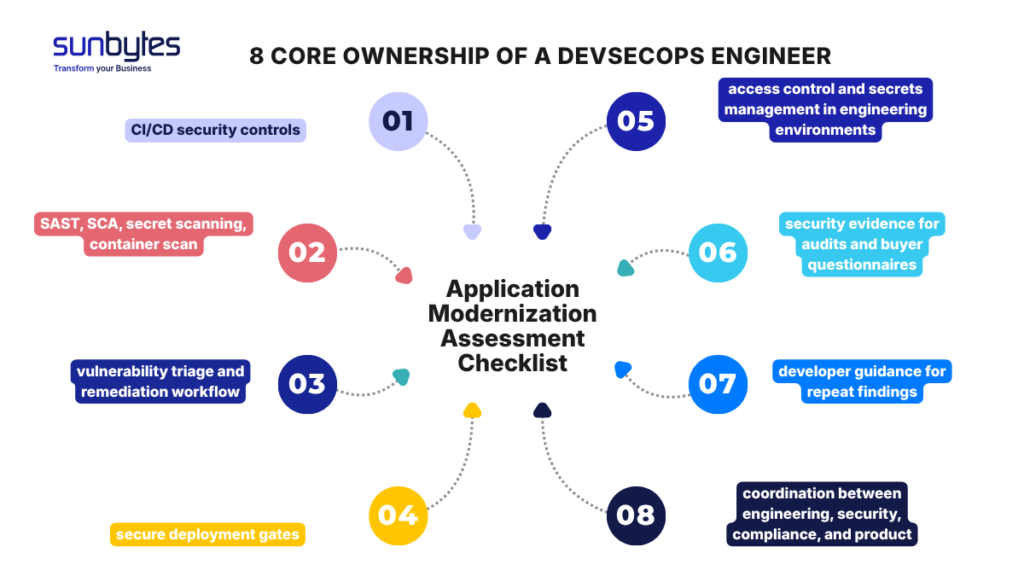
A DevSecOps engineer owns the security mechanics that sit between code and production. The exact scope changes by company, but the core ownership usually includes:
- CI/CD security controls
- SAST, SCA, secret scanning, container scanning, and cloud security findings
- vulnerability triage and remediation workflow
- secure deployment gates
- access control and secrets management in engineering environments
- security evidence for audits and buyer questionnaires
- developer guidance for repeat findings
- coordination between engineering, security, compliance, and product
The role should stay close to engineering. If the DevSecOps engineer sits too far from sprint planning, the work becomes a review layer. Findings arrive late. Developers treat security as interruption. Evidence becomes a document exercise instead of a delivery habit.
For a mid-size SaaS company, a stronger setup is usually one DevSecOps engineer embedded with platform, DevOps, or core engineering, with clear links to product and security leadership. The reporting line can vary. The ownership model should not.
Three hiring models compared (in-house / freelance / dedicated team)
The model matters more than the title.
Three candidates can all call themselves DevSecOps engineers and create three different outcomes. One becomes a permanent security owner inside engineering. One fixes a narrow problem and leaves. One joins your delivery system as dedicated capacity and helps build the controls while your internal team keeps product ownership.
The right model depends on four questions:
- How urgent is the security capacity gap?
- How much internal ownership do you want to build?
- Is the work continuous or project-based?
- Do you need delivery capacity, compliance evidence, or both?
| Criteria | In-house DevSecOps engineer | Freelance DevSecOps engineer | Dedicated DevSecOps engineer |
|---|---|---|---|
| Best fit | Long-term internal ownership | Narrow, time-boxed technical scope | Embedded sprint capacity with faster setup |
| Cost model | Salary, employer costs, tooling, recruitment, management time | Day rate or project fee | Monthly dedicated capacity |
| Hiring speed | Slowest, because senior EU talent is limited | Fast if the scope is clear | Faster than local hiring when provider has available vetted capacity |
| Control level | Highest | Medium, depends on contract and access | High if the engineer works inside your workflow |
| Knowledge retention | Strong if documentation and handover are enforced | Weak unless handover is scoped | Stronger than freelance if the role stays embedded across sprints |
| Compliance evidence | Strong when the role is tied to audit ownership | Variable | Strong when evidence collection is part of delivery scope |
| Main risk | Long hiring cycle and single-person dependency | Patchwork fixes without lasting ownership | Vendor fit, access governance, and onboarding discipline |
| Use when | DevSecOps is a permanent capability | You need a specific audit, review, or tool rollout | You need capacity before hiring catches up |
In-house is the right model when DevSecOps is part of your long-term engineering identity. If the company is growing a platform team, preparing for recurring audits, or building regulated product infrastructure, permanent ownership makes sense. The trade-off is time. A strong DevSecOps engineer needs security depth, cloud knowledge, CI/CD fluency, and developer trust. That combination is not easy to hire quickly.
Freelance support works when the problem is narrow. A freelancer can review a pipeline, configure a tool, clean up a cloud security issue, or prepare a specific control set. The risk appears when the work is continuous but the contract is not. If nobody owns remediation after the freelancer leaves, the backlog returns.
Dedicated DevSecOps engineer support works when the company needs embedded capacity faster than it can hire locally. This is the model to consider when the pipeline is active, product releases cannot pause, and evidence demands are increasing. The company keeps product ownership while the dedicated engineer takes operational ownership of security controls, findings, and delivery rhythm.
Need DevSecOps ownership before the local hiring cycle finishes? Sunbytes can help compare your model options, define the first role scope, and add dedicated DevSecOps capacity around your pipeline and compliance evidence. Discuss your DevSecOps hiring model
What it costs to hire a DevSecOps engineer in Europe
The visible cost is salary. The real cost is the ownership system around the role. For EU companies, the cost of hiring a DevSecOps engineer usually includes six layers:
| Cost layer | What to include | Why it matters |
|---|---|---|
| Cost layer | What to include | Why it matters |
| Gross salary or monthly capacity fee | Country-specific salary, freelance day rate, or dedicated engineer fee | This is the easiest number to compare, but not the full cost |
| Employer and contract costs | Social contributions, benefits, pension, insurance, payroll, legal setup | In-house cost is higher than salary alone |
| Recruitment cost | Recruiter fee, interview time, technical screening, offer negotiation | Senior DevSecOps profiles take longer to assess because the role crosses domains |
| Tooling cost | SAST, SCA, secrets scanning, container scanning, CSPM, SIEM, ticketing, evidence tools | Tool licenses can grow faster than planned when every repo or cloud account is added |
| Management cost | Sprint planning, access approvals, architecture decisions, security exceptions | Weak ownership makes senior engineers the default escalation point |
| Rework cost | Findings discovered late, duplicated remediation, release delays | Late security work costs more than pipeline-level prevention |
For current country-level benchmarks, read this detailed guide DevSecOps engineer salary in Europe article.
The cost decision should not stop at “in-house is expensive” or “offshore is cheaper.” That is too shallow for DevSecOps. A cheaper model becomes expensive when it creates more correction work for senior engineers. A premium in-house hire becomes expensive when the role is isolated and cannot change the pipeline. A dedicated engineer becomes expensive when access, ownership, and evidence requirements are not agreed in week one.
The useful comparison is total cost of ownership:
- How fast can the role start owning findings?
- How much senior engineering time will the model free up?
- Will evidence be produced as part of delivery, or collected later?
- Can the model reduce release friction within the first two to three sprints?
- Does the model leave your team with a stronger pipeline after 90 days?
If the answer is unclear, define the first 90 days before choosing the model.
Skills, certifications, and red flags
A DevSecOps engineer needs enough security depth to set controls and enough engineering fluency to make those controls usable.
The strongest candidates do not only know tools. They can explain where a tool sits in the delivery flow, who owns the output, what happens when a finding is ignored, and how the team proves the control later.
| Skill area | What to look for | Red flag |
|---|---|---|
| CI/CD security | Can add security checks without breaking release flow | Talks about scanners but not gates, exceptions, or ownership |
| Cloud and infrastructure security | Understands IAM, secrets, network exposure, logging, and environment separation | Treats cloud security as a one-time configuration task |
| Vulnerability management | Can triage by exploitability, asset criticality, and business impact | Uses CVSS alone without context |
| Developer workflow | Can make security visible in pull requests, tickets, and sprint planning | Pushes findings to developers without guidance |
| Compliance evidence | Can map controls to audit trails, owners, logs, and review cadence | Treats compliance as a document task after the work is done |
| Communication | Can explain trade-offs to CTO, product, DevOps, and developers | Uses security language that engineering teams cannot act on |
| Incident readiness | Understands detection, escalation, containment, and post-incident learning | Focuses only on prevention and ignores response flow |
Certifications can support the profile, but they should not replace technical proof. Useful certification signals may include cloud security certifications, Kubernetes security, security engineering, ISO 27001 knowledge, or secure software development training. The stronger signal is still practical: can the candidate design a control, place it in the pipeline, handle the developer workflow, and produce evidence?
For the full role brief, screening task, and interview scorecard, use the dedicated guide on how to hire a DevSecOps engineer.
Sample interview questions for DevSecOps roles

The questions below are enough to test hiring direction. They are not meant to replace a full technical interview scorecard.
- Walk us through where you would place SAST, SCA, container scanning, and secret scanning in a CI/CD pipeline. Which findings should block a release?
- How would you design a vulnerability triage flow between developers, DevOps, product, and security?
- A customer asks for evidence that access to production is controlled. What evidence would you collect and where should it live?
- How do you handle a critical dependency vulnerability discovered two days before release?
- What security control would you add first for a SaaS team that has CI/CD but no formal DevSecOps ownership?
- Tell us about a time when a security control slowed developers down. What did you change?
- A scanner creates 300 findings after the first rollout. How do you reduce noise without hiding real risk?
A strong candidate explains the mechanism, not only the tool name.
For example, a weak answer says: “I would add Snyk or another SCA tool to the pipeline.” A stronger answer says: “I would start with dependency scanning on pull requests, set severity thresholds by service criticality, push findings into the team’s ticket flow, define an exception rule with expiry dates, and review open criticals weekly with the service owner.” That answer shows ownership.
Onboarding a remote DevSecOps team
Remote DevSecOps onboarding fails when access is granted faster than ownership is defined. The first 90 days should create a working system, not only a tool rollout. The engineer needs access, context, decision rights, and a clear relationship with engineering.
Use this 90-day structure as the baseline.
| Timeline | Focus | Expected output |
|---|---|---|
| Week 1 | Access, architecture, pipeline review | Repo map, CI/CD map, cloud access boundaries, security tool inventory |
| Weeks 2–3 | First controls and triage flow | Initial scanner rules, finding ownership, ticket workflow, release gate proposal |
| Weeks 4–6 | Remediation rhythm | Weekly vulnerability review, exception policy, backlog prioritisation, first evidence pack |
| Weeks 7–10 | Developer adoption | Pull request guidance, reusable templates, secure defaults, documentation |
| Weeks 11–13 | Evidence and operating cadence | Control ownership map, audit trail, reporting rhythm, 90-day recommendations |
The first two weeks should answer three questions:
- Which systems are in scope?
- Which risks can block release?
- Who owns the decision when security and delivery conflict?
Without those answers, the DevSecOps engineer becomes a tool administrator. With those answers, the role becomes a delivery owner for security.
NIS2, GDPR, and ISO 27001: what your DevSecOps hire must know
EU companies do not need DevSecOps engineers to act as lawyers. They need engineers who understand how compliance pressure becomes delivery work.
For Dutch and EU teams, the most relevant compliance signals are NIS2, GDPR, and ISO 27001.
- NIS2 Article 21 matters because it points to practical risk-management measures: incident handling, business continuity, supply chain security, security in acquisition, development and maintenance, vulnerability handling, access control, cyber hygiene, and MFA where appropriate. In DevSecOps terms, these are not abstract policies. They become pipeline controls, owner records, remediation tickets, access reviews, and evidence.
- GDPR Article 32 matters when product teams process personal data. The article requires technical and organisational measures appropriate to the risk, including confidentiality, integrity, availability, resilience, restoration, and regular testing of measures. A DevSecOps engineer can support this by making controls visible in systems, not only in documents.
- ISO 27001 matters because buyers often ask for evidence that security is managed through a controlled system. For DevSecOps, the useful evidence is practical: access reviews, change records, vulnerability decisions, incident response flow, supplier controls, and documented ownership.
This is also where vendor and dedicated engineer due diligence matters. If a provider will work inside your codebase, cloud environment, or delivery process, ask for security evidence before onboarding.
If you are comparing external providers, use the DevSecOps outsourcing checklist to assess ISO 27001 evidence, DPA coverage, access governance, escalation rhythm, and reject-if criteria.
How Sunbytes delivers DevSecOps engineers for Dutch and EU teams
Sunbytes helps Dutch and EU software teams add dedicated DevSecOps engineers when security ownership needs to move into the delivery system quickly. The model is designed for teams that cannot wait for a full local hiring cycle, but still need structured onboarding, pipeline context, and evidence discipline.
Sunbytes is a Dutch technology company headquartered in the Netherlands with a delivery hub in Vietnam. For DevSecOps work, that setup gives European teams Netherlands-based accountability with a practical delivery rhythm across time zones. The Amsterdam–Vietnam working overlap is typically 4 to 5 hours, which is enough for sprint planning, handover, security triage, release decisions, and escalation. The delivery model connects three needs:
- First, the engineer works inside your delivery flow. That means CI/CD, tickets, repositories, cloud context, release rules, and team ceremonies are part of the onboarding scope.
- Second, security evidence is treated as an operating output. ISO 27001 certified operations, access governance, documented decisions, and audit-ready evidence help reduce the gap between what engineering does and what buyers or auditors ask for.
- Third, the engagement can start with focused capacity and scale when ownership expands. For many teams, the first role is not a full security department. It is one dedicated DevSecOps engineer who can turn scanner output, pipeline controls, and compliance pressure into a working rhythm.
Sunbytes supports this through hire dedicated DevSecOps engineers under the Dedicated Remote Developers model. Dedicated senior teams can typically become operational within 2 to 4 weeks, depending on role scope, access readiness, and technical requirements.
If your DevSecOps decision is really a question of ownership, start with the model. Compare in-house, freelance, and dedicated capacity against your pipeline maturity, compliance evidence needs, and release pressure. Sunbytes helps Dutch and EU teams add dedicated DevSecOps engineers through a Netherlands–Vietnam delivery setup, ISO 27001 certified operations, and a working rhythm designed for European teams. Discuss your DevSecOps hiring model with Sunbytes
FAQs
You need a DevSecOps engineer when security work repeatedly appears inside delivery but has no clear owner. Common signs include scanner findings nobody triages, release gates that are unclear, buyer security questionnaires that take too long to answer, or audit evidence that must be rebuilt manually every time.
For SaaS and software product teams, DevSecOps should stay close to engineering because the role changes how code moves to production. Security leadership can define standards and risk appetite, but the DevSecOps engineer needs direct access to CI/CD, cloud infrastructure, tickets, and sprint decisions.
One DevSecOps engineer can be enough when the company has a clear platform team, limited product lines, and defined engineering ownership. The role becomes harder when there are many teams, many cloud accounts, multiple regulated products, or no existing DevOps maturity. In that case, start with one owner and add coverage based on pipeline scope and vulnerability volume.
Freelance DevSecOps is better for narrow, time-boxed work such as a pipeline review, cloud hardening sprint, or tool rollout. A dedicated DevSecOps engineer is stronger when the work is continuous across sprints and needs recurring ownership for findings, controls, releases, and evidence.
Prepare a system map, repo list, CI/CD overview, cloud access boundaries, tool inventory, current vulnerability backlog, and named internal owners. The first week should define scope and access. The first month should produce a working triage rhythm, not only documentation.
DevSecOps can support NIS2 and GDPR by turning security requirements into engineering controls, evidence, and repeatable review processes. It does not replace legal or compliance advice. It helps the engineering team prove how controls work in practice, especially around vulnerability handling, access control, business continuity, and secure development.
The first DevSecOps hire usually owns pipeline security, scanner rollout, vulnerability triage, security gates, cloud and secrets hygiene, developer guidance, and evidence flow. The role should start with a narrow 90-day scope so the engineer can create visible improvement before expanding into broader security ownership.
DevSecOps as a service can fit when you need capability, process, and evidence but are not ready to hire internally. It works best when the partner is embedded into delivery and has clear ownership for pipeline controls, review rhythms, and documentation. It works poorly when treated as a disconnected external scan provider.
Let’s start with Sunbytes
Let us know your requirements for the team and we will contact you right away.