

Not every staffing service solves the same problem. Temporary staffing fills a production gap for six weeks. An Employer of Record(EOR) gets you a permanent hire in a new country without entity setup. A Contractor of Record protects you from misclassification when a specialist engagement runs longer than planned. Finding the best staffing service for international companies means matching the model to the situation, not choosing based on brand name or familiarity.
TL;DR
- Staffing services are split into four types: temporary staffing, permanent placement, Employer of Record, and Contract staffing or Contractor of Record. Each fits a different engagement length, risk profile, and market entry stage.
- The right staffing service depends on four variables: how long the engagement runs, whether your company has a local entity, the role type, and how much compliance risk you can absorb directly.
- EOR is the fastest path to compliant permanent hiring in a new market. Temporary staffing is the fastest path to scalable short-term headcount. COR is the right structure when a specialist engagement carries classification risk.
The right staffing service depends on your hiring situation
Most companies discover the wrong staffing model after they have already committed to it. A company hires through a permanent placement agency in a country where it has no entity, then spends eight weeks trying to figure out who holds the employment contract. Another company uses temporary staffing for a role that ends up running 14 months, then faces misclassification questions it had not anticipated.
The four main staffing models exist because four genuinely different hiring situations exist. Understanding which situation you are in before you choose a provider is the decision that determines whether the engagement works.
Not sure which staffing model applies to your situation?
Sunbytes matches international companies to the right staffing structure, from EOR and temporary staffing to COR and IT staffing, across Vietnam and EU markets. No local entity required to start.
Explore Accelerate Workforce Solutions
What are staffing services and why the type matters
Staffing services is a broad term that covers several different models. Before choosing between them, it helps to understand what separates staffing from simple recruitment, and how the model changes depending on where your company is in its growth.
Staffing services vs recruitment: the key difference
Recruitment is a matchmaking service. A recruiter finds candidates, the client evaluates and hires them, and the recruiter’s involvement ends at placement. The client becomes the employer of record. All employment obligations, including social insurance, tax withholding, and labor contract compliance, sit with the client company.
Staffing services go further. The staffing provider sources workers and maintains an ongoing relationship with the engagement. That relationship takes different forms depending on the model: the provider may be the legal employer, the contracting entity, or the supplier of temporary workers under its own employment contract. The compliance liability shifts depending on which structure you choose.
This distinction matters because international companies entering new markets often conflate the two. A recruitment agency finding candidates in Vietnam does not solve the problem of how to employ them if you have no Vietnamese entity. A staffing provider that also offers EOR does.
How the right staffing model changes by company stage
The staffing model that fits a company testing a new market is different from the one that fits a company scaling a team of 50. At the market entry stage, speed and flexibility matter more than cost optimization. At scale, the economics of each model become more significant such as
- A company exploring Vietnam for the first time needs EOR: fast, compliant, no entity required.
- A company with an established Vietnamese entity, hiring volume, and assembly workers for peak season needs temporary staffing.
- A company retaining a senior specialist for a defined project needs COR.
- A company with a local HR function hiring permanent management roles needs permanent placement.
The model follows the situation, not the other way around.
The 4 main types of staffing services explained
The four models differ in who holds the employment contract, who absorbs compliance liability, and how long the engagement typically runs. Understanding those three dimensions tells you which model fits before you have spoken to a provider.
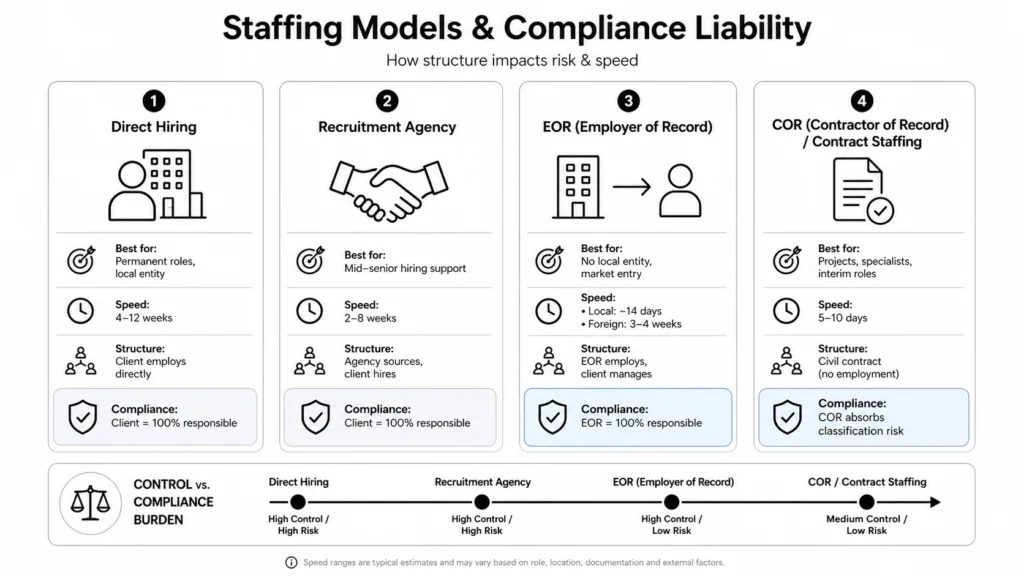
Learn more: The Definition Of Staffing Service And The Best Option In Vietnam Market
Temporary staffing (short-term, project-based)
“Temporary staffing is an arrangement where the staffing provider employs workers and supplies them to the client for a defined period. The client directs the daily work. The provider handles payroll, social insurance, and employment compliance.”
This is the right model when the headcount needs to have a clear end date. Production peaks, project-based ramp-ups, parental leave cover, and seasonal demand spikes are all temporary staffing situations. The client does not become the employer. When the engagement ends, the workers return to the staffing provider’s pool.
For a Dutch manufacturing company expanding into Southeast Asia, temporary staffing covered the assembly worker cohort during production ramp-up. Headcount scaled up in four weeks and down after the peak without the company carrying fixed employment costs or severance obligations.
Best for: Volume ops roles, seasonal or peak demand, project-based work with a defined endpoint.
Speed: 2 to 6 weeks from brief to first cohort onboarded, depending on role type and location.
Compliance note: In Vietnam, temporary staffing is regulated under Decree 145/2020/ND-CP. The provider must hold a labor leasing license. The client is not the employer but retains obligations around working conditions and safety.
Permanent placement staffing
“Permanent placement staffing connects companies with candidates for full-time employment, where the client becomes the direct employer. The agency’s involvement ends at successful placement.”
This is recruitment with a higher-touch process and stronger candidate vetting than a standard job board. The staffing provider handles sourcing, screening, and shortlisting. The client interviews, selects, and hires. After placement, the employment relationship is entirely between the client and the worker.
Permanent placement works when you have a local entity in the target market, an internal HR function capable of managing employment compliance, and a role that genuinely requires permanent headcount rather than project-based or flexible staffing.
Best for: Senior management, specialist roles, and any permanent hire where the client already has a local entity and the legal capacity to employ directly.
Speed: 4 to 12 weeks depending on role seniority and market. Senior and specialist roles take longer because the candidate pool is smaller.
Compliance note: The client holds all employment compliance obligations once the candidate is placed. Social insurance registration, tax withholding, and labor contract management are the client’s responsibility, not the agency’s.
Employer of Record (EOR) staffing
“An Employer of Record is the legal employer of the worker in the target country. The EOR handles the employment contract, social insurance, tax withholding, and payroll. The client retains full operational control of the worker’s daily role.”
EOR is the model that unlocks permanent hiring without local entity setup. The EOR’s entity is what makes compliant employment possible in a market where the client has no legal presence. For international companies evaluating or entering a new market, EOR removes the single biggest structural barrier to building a team.
The Dutch manufacturing company used EOR for its three permanent engineering hires in Southeast Asia. Setting up a local entity would have taken 16 to 20 weeks and cost approximately EUR 40,000 in legal, registration, and capital requirements. Through EOR, the first engineer was employed and operational in 14 days.
Best for: First hires in a new market, permanent roles in countries where the client has no entity, and any situation where the client wants full operational control without the compliance burden of direct employment.
Speed: 14 business days for Vietnamese nationals from document receipt to day one. 3 to 4 weeks for foreign employees requiring a work permit.
Compliance note: The EOR holds all employment compliance: labor contract, social insurance, PIT withholding, and payroll. The client has no direct employment relationship with the worker and therefore no direct compliance liability.
Contract staffing and Contractor of Record (COR)
“Contract staffing engages workers under a service agreement rather than an employment contract. A Contractor of Record is the structure that formalises this engagement through a third-party entity, absorbing the classification risk from the client.”
Contract staffing is used for specialist roles engaged for a defined scope and duration, where the worker is genuinely independent and not integrated into the client’s employment structure. IT architects, interim executives, legal advisors, and compliance specialists are common contractor profiles.
The risk in contract staffing is misclassification. In most markets, including Vietnam, a working arrangement that involves paid work, management and supervision, and regular payment will be treated as employment regardless of what the contract says. An engagement that starts as a three-month project and runs to 14 months with daily standups and client-provided tools is not a contractor arrangement. It is employment without the compliance structure.
A Contractor of Record removes this risk. The COR holds the service agreement with the contractor and the commercial agreement with the client. If a labor authority reviews the arrangement, the COR, not the client, is the engaging entity.
Best for: Specialist project roles, interim management, high-value engagements where IP ownership and confidentiality terms need to be formally documented.
Speed: 5 to 10 business days from agreement to first working day.
Compliance note: COR absorbs classification risk for the client. No statutory employment benefits apply because the worker is engaged under a civil service agreement, not a labor contract.
Comparing the 4 staffing service types at a glance
Each model has a different employment structure, compliance owner, and ideal use case. This table summarises how they compare across the dimensions that matter most when choosing.
| Temporary staffing | Permanent placement | EOR | COR | |
|---|---|---|---|---|
| Who holds employment | Staffing provider | Client company | EOR entity | Neither (service agreement) |
| Local entity required? | No | Yes | No | No |
| Engagement length | Days to 12 months | Permanent | Ongoing, no fixed term | Project-based, 1 month to ongoing |
| Social insurance (SHUI) | Provider handles | Client handles | EOR handles | Not applicable |
| Best for | Volume, seasonal, short-term | Permanent hire, existing entity | First hire in new market | Specialist contractors, project roles |
| Compliance liability | Stays with provider | Transfers to client | Stays with EOR | COR absorbs classification risk |
How to choose the right staffing service: a decision framework
Knowing how to choose a staffing agency starts with knowing which model fits your situation. The right staffing model is determined by four variables. Answer these four before contacting a provider, and the model choice becomes clear.

Four-variable decision framework for choosing the right staffing service
Variable 1: engagement duration (short-term vs ongoing)
The temporary vs permanent staffing question is the first decision to make. If the engagement has a defined endpoint within 12 months, temporary staffing or COR is likely the right model. If the role is permanent or open-ended, EOR or permanent placement is more appropriate. Duration is the first filter because it determines how the engagement looks under labor law in most markets.
An engagement that starts as three months and rolls over repeatedly eventually becomes permanent employment in practice, regardless of what the contract says. Getting the model right from the start is cheaper than correcting it after a labor inspection.
Variable 2: local entity status
If your company has a legal entity in the target market, all four models are available to you. If you do not have a local entity, permanent placement is not viable as a standalone service because the client needs to be able to hold the employment contract.
Without a local entity, your options are EOR (permanent hire), temporary staffing through a provider that employs the workers directly, or COR for contractor arrangements. Of these, EOR is the most commonly used for companies at the market entry stage because it creates permanent employment relationships without requiring the client to establish a local legal presence.
Variable 3: role type (volume ops vs specialist)
Volume ops roles, assembly workers, logistics operators, customer service representatives, and administrative support, are typically filled through temporary staffing because the provider already holds an active talent pool in the relevant location. Individual specialist roles, senior engineers, compliance officers, interim executives, are filled through permanent placement (if the client has an entity) or EOR (if it does not).
Contractor or COR arrangements are used for roles where the worker needs to remain structurally independent, typically high-value technical or advisory specialists engaged for a defined project scope.
Variable 4: compliance risk tolerance
Every staffing model carries some compliance exposure. The question is which party holds it. In temporary staffing, the provider is responsible for employment compliance. And in permanent placement, the client holds it. In EOR, the EOR holds it. In COR, the COR absorbs classification risk.
A company with a strong in-house legal and HR function may be comfortable holding direct employment compliance in markets where it has an entity. A company entering a new market for the first time, with no local HR infrastructure, should not be absorbing compliance liability it has no capacity to manage. The model should match the compliance capability on your side, not just the hiring need.
Decision table: which staffing service fits each scenario
| Scenario | Recommended model | Why |
|---|---|---|
| First hire in a new market, no local entity | EOR | Fastest compliant employment without entity setup. 14 days to day one. |
| Volume seasonal workers, peak demand, existing entity | Temporary staffing | The provider employs workers. Clients scale up and down without fixed employment costs. |
| Senior permanent hire, existing local entity | Permanent placement | Client becomes direct employer. The agency manages sourcing and vetting. |
| Specialist contractor, project scope, classification risk | COR | COR holds a service agreement. Client retains operational control. Classification risk transferred. |
| Mixed need: seasonal ops + permanent leadership | Temporary staffing + EOR | Temporary staffing for volume ops. EOR for permanent hires. No entity required for either. |
| Long-running specialist role, uncertain duration | EOR or COR | If integration level is high and duration is uncertain, EOR is safer. COR if genuine independence is maintained. |
Not sure which staffing model fits your situation?
Sunbytes works with international companies to match the right structure to each hiring need, including EOR, temporary staffing, COR, and IT staffing, across Vietnam and EU markets. No entity required to start.
Common mistakes when choosing a staffing service
Most mistakes happen when the model is chosen based on cost or familiarity rather than fit. These are the four that create the most downstream problems.
Using permanent placement in a market where you have no entity
Permanent placement agencies find and vet candidates. They do not employ them. If your company has no legal entity in the target market, you cannot hold the employment contract that permanent placement requires. The engagement stalls at the offer stage while you scramble to find an EOR or rush an entity setup. The candidate accepts another offer.
Using temporary staffing for a role that will run longer than 12 months
In most markets, temporary staffing arrangements have legal limits on duration. In Vietnam, labor leasing contracts cannot exceed 12 months and are restricted to roles that meet specific criteria under Decree 145/2020/ND-CP. A temporary staffing arrangement that extends beyond these limits creates reclassification risk. The correct model for an ongoing role is EOR, not extended temporary staffing.
Choosing a provider that does not own its local entity
Some staffing agencies operate through local sub-contractors rather than owning their entity in the target market. When the provider does not own the entity, the employment contract is held by a third party the client has not vetted. Compliance liability sits with an entity the client cannot audit. The agency’s global brand does not guarantee that the local employment structure meets the client’s compliance requirements.
Treating contractor arrangements as permanent alternatives to avoid employment costs
A contractor arrangement that involves daily supervision, fixed hours, client-provided tools, and monthly payment is not a contractor arrangement. It is employment without the compliance structure. In Vietnam, this triggers retroactive SHUI contributions, penalty interest, and potential criminal sanctions under Decree 12/2022/ND-CP. The cost of the misclassification consistently exceeds the cost of using the correct model from the start.
How Sunbytes helps international companies choose and deploy the right staffing model
Choosing the right staffing model only solves half the problem. The other half is having a provider that can actually deliver it compliantly in the market you are entering. For most international companies, that means a provider with its own legal entity, a labor leasing license, in-house payroll and social insurance administration, and data handling practices that meet EU standards.
Sunbytes is a Dutch-founded technology and workforce company founded in 2011, with 300+ client projects across 20+ countries.
The employment infrastructure behind the right model
Through Accelerate Workforce Solutions, Sunbytes provides temporary staffing, EOR, and COR arrangements under its own Vietnamese legal entity. Employment contracts issued within 48 hours of complete documents. SHUI registered from the contract start date. Payroll on time every cycle. Time-to-hire: 14 days for Vietnamese nationals under EOR. Offboarding within 24 hours. ISO 27001 certified. All engagements under a signed Data Processing Agreement.
Technical roles across both staffing and direct employment models
For companies whose hiring need is in engineering, AI, or cloud architecture, Digital Transformation Solutions sources engineers and technical leads through active talent networks in HCMC and Hanoi. The engagement structure, temporary, EOR, or COR, is determined by the role type and the client’s entity status. The sourcing and compliance run together, not separately.
Data compliance across EU-Vietnam hiring flows
When employment documents and personal data move between European clients and Vietnamese operations, GDPR Article 32 and Decree 13/2023/ND-CP both apply. CyberSecurity Solutions embeds both compliance requirements into every staffing engagement from the first document exchange.