The wrong question is usually “WordPress or custom?” The better question is, what does your website need to do, and which build model delivers that with the least rework over the next three years?
For many Dutch and European companies, WordPress is the right answer. It is fast to launch, easier for non-technical teams to manage, and cost-effective for content-led websites. A custom website becomes the better choice when the site has complex workflows, sensitive data, heavy integrations, strict security expectations, or scale requirements that would otherwise depend on plugin workarounds.
TL;DR
WordPress is usually the better choice for brochure websites, content-heavy sites, and fast launches. Custom development is better when the website needs complex workflows, sensitive data handling, specific integrations, or performance-critical scale.
- WordPress fits standard business websites where speed, budget, and content editing matter most.
- Custom fits websites that behave more like business systems than content channels.
- The right choice depends on what the site must do after launch, not only what it costs to build.
WordPress vs custom website: the 8-dimensional comparison
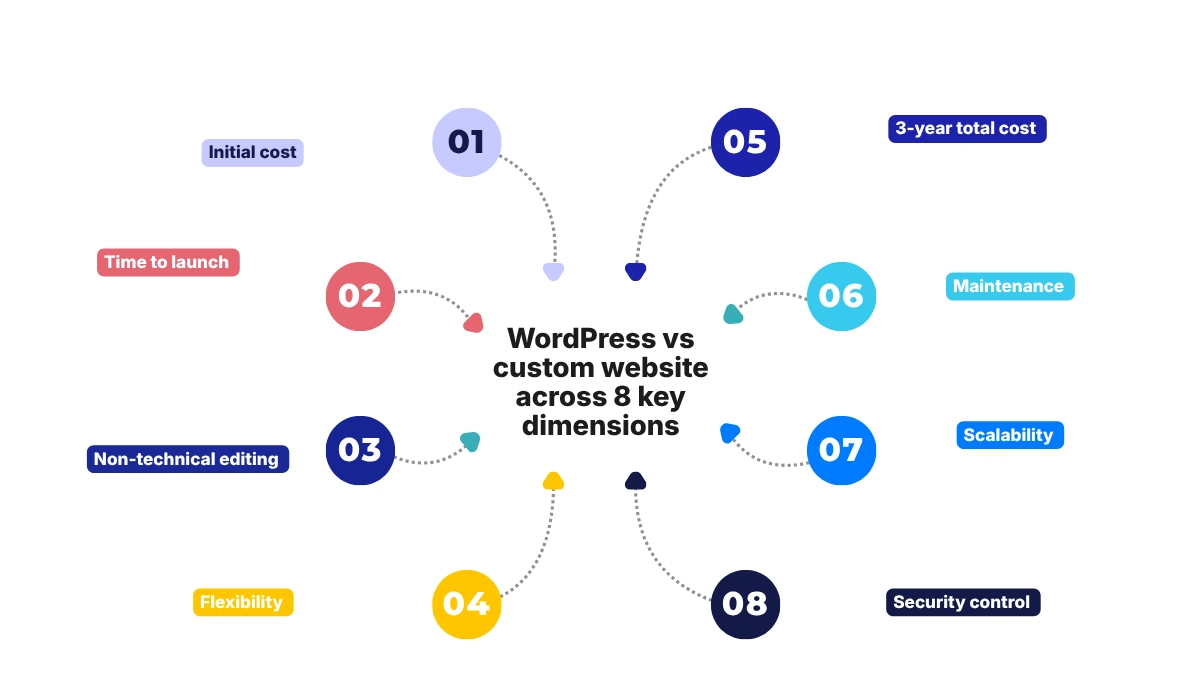
A WordPress website uses an existing content management system, themes, plugins, and configuration to build the site faster. A custom website is designed and developed around your business requirements, codebase, integrations, and workflows. The table below compares the decision points that matter most for Dutch and European companies. The costs are based on Sunbytes delivery data, 2026 planning ranges, not fixed market rates or final quotes. Real cost depends on scope, integrations, design depth, content readiness, compliance requirements, and the delivery model. If you are still mapping the full website scope before choosing a build model, start with our complete guide to website development. It explains the main website development types, core components, technologies, and process steps that should be clear before comparing WordPress with a custom build.
| Dimension | WordPress | Custom website | When it matters most |
|---|---|---|---|
| Dimension | WordPress | Custom website | When it matters most |
| Initial build cost | Often around €4,000–€25,000 for a professional SME website, depending on design, theme quality, content volume, and setup. | Often around €25,000–€150,000+ depending on workflows, integrations, frontend complexity, and backend logic. | When the website is mostly content, pages, forms, and standard CMS functionality. |
| Time to launch | Often 3–8 weeks if content and approvals are ready. | Often 8–24+ weeks depending on complexity. | When the business needs to launch quickly with standard functionality. |
| Non-technical editing | Strong by default. Marketing teams can usually manage pages, posts, and media after training. | Depends on the CMS built into the project. A custom admin can be excellent, but it must be designed and budgeted. | When the marketing team needs frequent content updates without developer support. |
| Flexibility | Flexible for common website needs, but complex logic often depends on plugins or custom plugin development. | High control over workflows, data models, user journeys, and integrations. | When the site does more than publish content. |
| Security control | Secure when maintained well, but plugins, themes, accounts, and updates create ongoing operational work. | Smaller dependency footprint if built well, with security controls designed into the architecture. | When the site handles sensitive data, transactions, or regulated workflows. |
| Scalability | Good for content traffic with caching, hosting, and CDN setup. More difficult when the site has many dynamic or transaction-heavy flows. | Architecture can be designed for expected traffic, data, API load, and future modules. | When usage growth is expected within 12–18 months. |
| Maintenance | Requires updates for core, themes, plugins, backups, monitoring, and compatibility checks. | Requires codebase, dependency, framework, infrastructure, monitoring, and security patch maintenance. | When internal IT capacity is limited or the site is business-critical. |
| 3-year total cost | Low upfront, but plugin licences, updates, security support, and workaround development can accumulate. | Higher upfront, but more predictable if the scope is stable and the system avoids plugin workarounds. | When the site contains custom workflows or integrations. |
WordPress wins where the website is mostly a content and marketing system. Custom wins where the website becomes operational infrastructure: lead routing, customer portals, checkout rules, integrations, permissions, or workflows that cannot fail silently.
What WordPress actually means in 2026
WordPress is not one type of project. A €4,000 WordPress site using a ready-made theme is very different from a €25,000 WordPress build with a custom theme, paid plugins, advanced forms, multilingual setup, and CRM integration. This is where many platform decisions go wrong: the team says “WordPress” but the scope has already moved into custom territory. A useful way to think about it:
| WordPress setup | Typical use case | Planning range | Risk point |
|---|---|---|---|
| Basic theme setup | Small brochure site, simple pages, low content volume | €4,000–€8,000 | Limited design and flexibility |
| Premium theme or page builder | Marketing site, landing pages, blog, standard forms | €8,000–€20,000 | Builder lock-in and plugin dependency |
| Custom WordPress theme | Brand-specific design, structured content, better performance control | €18,000–€40,000 | Starts approaching custom build cost |
| WordPress with custom plugins | CRM logic, custom forms, booking flows, gated content | €30,000–€70,000+ | Plugin maintenance becomes software maintenance |
| Full custom build | Unique workflows, complex integrations, high control requirements | €40,000–€150,000+ | Requires stronger delivery governance |
The comparison in this article applies mainly to standard WordPress builds. Once a project needs a custom theme, custom plugin development, integration logic, or performance optimization, it should be compared against a custom build before the contract is signed. For European websites, “WordPress setup” may also include multilingual content, cookie consent, accessibility checks, and EU hosting or data residency decisions.
The decision matrix: which option fits your situation?
Use this matrix before asking agencies for proposals. It helps prevent the most common mistake: comparing a low-cost WordPress quote against a custom quote without comparing the actual delivery risk.
| Your situation | WordPress | Custom website | Why |
|---|---|---|---|
| Brochure website, standard pages, blog, basic forms | Best fit | Usually overkill | WordPress delivers the required outcome faster and at lower initial cost. |
| Content-heavy marketing site with frequent updates | Best fit | Possible, but only if CMS is planned | WordPress gives marketing teams strong editing control by default. |
| Complex business logic, custom workflows, or CRM routing | Risky | Best fit | Plugin workarounds can create technical debt and unreliable integrations. |
| High traffic with mostly static content | Good with proper hosting and caching | Good | WordPress can work well if infrastructure is configured properly. |
| High transaction volume, logged-in users, or dynamic data | Needs careful engineering | Best fit | Custom architecture gives better control over load, data flow, and performance. |
| Sensitive personal data or NIS2-scope organisation | Needs hardening and strict maintenance | Often stronger fit | Security, access control, logging, and data processing need to be designed deliberately. |
| Launch required within 4–6 weeks | Best fit | Only for a narrow scope | Custom can launch quickly only when the scope is tightly defined. |
| Website is becoming a product or platform | Short-term bridge only | Best fit | Once the website carries product logic, it should be treated as software. |
The decision becomes clearer when the website is mapped to business situations, not platform preferences. It also helps clarify whether the project needs a standard web build, WordPress specialists, or hiring a dedicated development team for custom development, integrations, and long-term maintenance.
Not sure whether WordPress or custom fits your project? Sunbytes can review your build model in a 30-minute scoping call.
3 European company scenarios where the choice matters
The platform choice becomes clearer when you look at the type of work the website needs to handle. These 3 scenarios show where WordPress is enough, where custom development is stronger, and where a company may need to plan a migration before the current setup becomes a constraint.
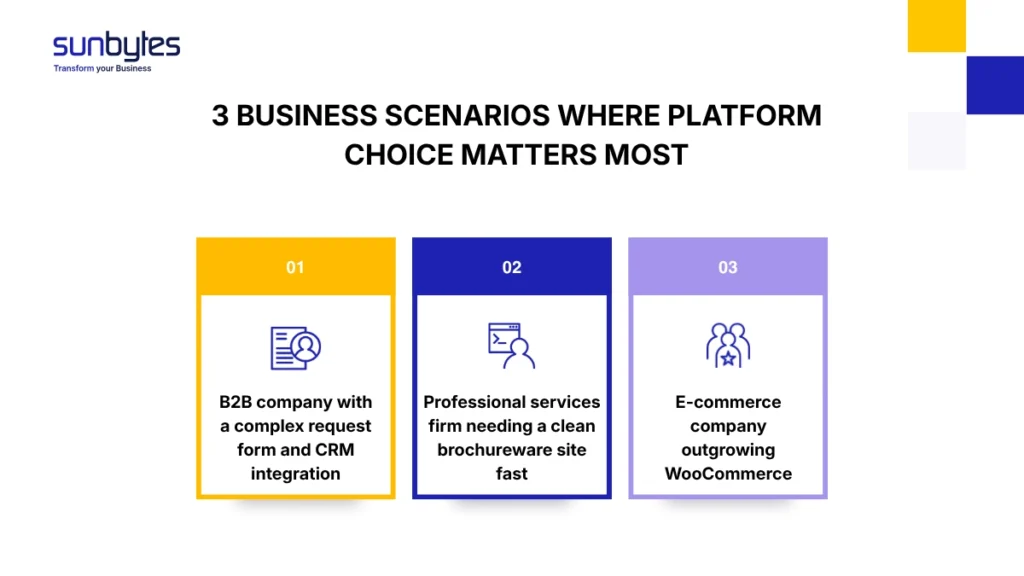
Scenario 1: B2B company with CRM integration and lead routing
A Dutch B2B company needs a website with product pages, gated content, a complex contact form, CRM sync, and lead routing by region, product type, and account size.
WordPress can handle the first version with forms and CRM plugins. The risk appears later. Every new lead rule adds another configuration layer. If the CRM plugin updates, the sync needs testing. If the sales team changes routing logic monthly, the website becomes a fragile operational tool.
Custom is usually the stronger option when the business logic is the value. The form, routing rules, CRM sync, audit trail, and error handling can be designed as one workflow instead of a chain of plugins.
Recommendation: choose custom if the request form affects sales operations, lead quality, or CRM reliability.
Scenario 2: Professional services firm with a 10-page website
A European consulting firm needs a sharp website with service pages, team profiles, case studies, articles, and a contact form. The team wants to launch in 6–8 weeks and edit content without asking a developer.
WordPress is the better choice. A custom build would add cost and time without changing the business outcome. The important work is content structure, design quality, performance setup, analytics, and good governance around plugins and updates.
A software development outsourcing partner can help choose the appropriate tech stack, delivery model, reduce plugin conflicts, and keep the website easier to maintain after launch.
Recommendation: choose WordPress with a clean theme, limited plugin stack, strong hosting, backups, and clear update ownership.
Scenario 3: E-commerce company outgrowing WooCommerce
A Dutch e-commerce company has grown from a simple catalogue into a complex operation: B2B pricing, customer-specific discounts, stock rules, ERP connection, and custom checkout logic.
WooCommerce may still work for a while with performance tuning, caching, and careful plugin management. But each new operational rule increases the risk of compatibility problems. At some point, the team is no longer running a store on WordPress. It is running a commerce system through WordPress.
Recommendation: assess custom before performance, checkout, or integration issues become urgent. A migration is easier to plan 6–12 months before the current setup becomes a constraint.
WordPress security for Dutch and European SMEs: what the NCSC NL says
WordPress is not automatically unsafe. The risk usually comes from the maintenance model: plugins, themes, admin access, updates, backups, and monitoring.
The Dutch National Cyber Security Centre advises companies to protect CMS environments with strong passwords, two-factor authentication, careful plugin use, regular backups, access reviews, HTTPS, and brute-force protection. It also notes that third-party plugins can contain vulnerabilities when they are poorly built or maintained.
For Dutch and European SMEs, the takeaway is simple: WordPress can be secure when it is actively maintained. The practical safeguard is not complicated: before launch, run WordPress site testing across plugin compatibility, forms, performance, accessibility, backups, and security checks.
If the site handles sensitive data, requires audit trails, or falls under stricter security expectations such as GDPR or NIS2, custom development may become more competitive.
How Sunbytes approaches the WordPress vs custom decision
The WordPress vs custom decision should start with one question: is the website mainly a content system, or is it starting to carry business logic? WordPress is often the faster and cleaner choice for content-led websites. Custom development becomes stronger when plugin workarounds start replacing designed architecture.
Sunbytes helps Dutch and European companies review scope, architecture, integrations, security expectations, and delivery team needs before development starts. Through Digital Transformation Solutions, we help define the right build model and delivery path. Accelerate Workforce Solutions supports the people layer when a senior development team is needed, while Cybersecurity Solutions adds secure-by-design controls for projects involving sensitive data, access management, or stricter compliance expectations.
With 300+ projects delivered, senior teams operational in 2–4 weeks, ISO-guided delivery, and DORA-tracked outcomes where relevant, Sunbytes helps teams move from platform uncertainty to a build model they can launch and maintain. Ready to choose the right build model? Contact Sunbytes to review whether WordPress, custom, or a hybrid route fits your website.
FAQs
Yes, WordPress can be secure when it is configured and maintained properly. The main gap is usually maintenance discipline: plugin control, updates, backups, access management, monitoring, and restore planning. A poorly maintained custom build can be less secure than a well-maintained WordPress site.
WooCommerce can be enough for smaller or mid-sized stores with standard catalogue, checkout, and payment needs. It becomes harder to maintain when the business needs B2B pricing, ERP integration, custom checkout rules, or high transaction volume. At that point, custom development may create a cleaner long-term architecture.
Headless CMS architecture is a third option when a company needs custom frontend control but still wants non-technical content editing. It can fit teams that need performance, structured content, and marketing autonomy, but it adds architecture and deployment complexity.
Yes, when WordPress is the right fit. Sunbytes recommends WordPress for brochureware, content-heavy websites, and projects where time to launch and content editing matter more than custom business logic. Custom is recommended when the website needs complex workflows, integrations, security control, or performance-critical scale.
No. A custom website is not automatically better. For a standard business website, custom development can add cost, timeline, and maintenance work without improving the business outcome. Custom becomes better when the website needs to behave like a business system, not just a content channel.
Based on typical planning ranges from delivery experience, a professional WordPress website often starts around €4,000–€25,000 depending on design, content, plugins, and setup. A custom website often starts around €25,000 and can exceed €150,000 when it includes complex workflows, integrations, user accounts, or transaction-heavy features. The safer comparison is three-year total cost, not only initial build cost.
Let’s start with Sunbytes!
Let us know your requirements for the team and we will contact you right away.