

For EU companies hiring through an EOR in Vietnam, termination has to be handled as a local employment exit. That means the legal ground, notice period, final pay, SHUI records, PIT coordination, document return, and access handover all need to be sequenced before the employee leaves.
This is where an Employer of Record service matters. The EOR is the local legal employer. Your company still directs the work and approves the business decision, but the EOR should handle the local employment process.
If your team is still comparing the broader hiring model, this guide sits inside the wider topic of employer of record in Vietnam and focuses only on what happens when the employment relationship ends.
TL;DR
EOR termination in Vietnam means the Employer of Record executes the local employment exit while your company provides the business reason, evidence, timing, and access actions.
Key points:
- For employer unilateral termination, common Labour Code 2019 notice periods are 45 days, 30 days, or 3 working days, depending on contract type and case route.
- Final settlement should be prepared before the last working day because Article 48 sets a general 14-working-day payment window, with limited extensions up to 30 days.
- Before notice is issued, your EOR should confirm the lawful ground, protected-status risk, final pay inputs, SHUI/PIT closure, documents, and access handover evidence.
What EOR termination Vietnam means in practice
EOR termination Vietnam means the EOR carries out the employment exit as the local legal employer, while your company supplies the business context, evidence, timing, and access actions.
That split matters.
Your company may decide that the role is ending, the project has closed, or the employee has resigned. But the EOR should confirm how that decision fits Vietnamese employment law before any notice, payroll closure, or document handover begins.
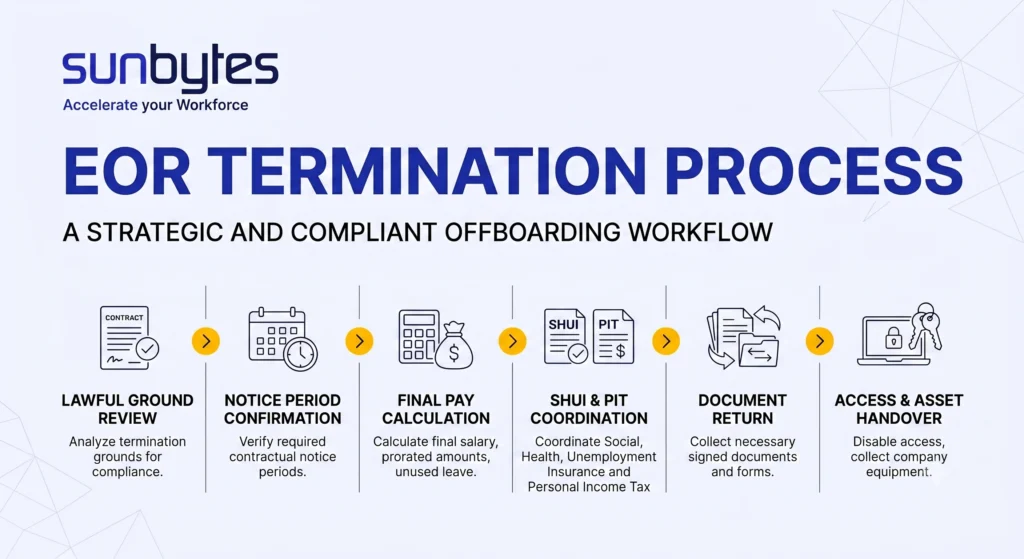
A clean EOR termination process usually covers six workstreams:
- lawful ground review
- notice period confirmation
- final pay calculation
- SHUI and PIT coordination
- document return
- access and asset handover
This is also why termination should be viewed as part of the full employment lifecycle, not a separate admin step. To understand how employee records, contracts, and compliance are established at the start of employment, see our guide to EOR onboarding.
Which termination routes need EOR confirmation?
Every EOR termination route needs confirmation before action is taken because the route decides the notice, documents, payment items, and dispute risk.
In Vietnam, an employment contract may end for several reasons. Common routes include contract expiry, completion of work under the contract, mutual agreement, employee resignation, employer unilateral termination, dismissal, redundancy, and work permit expiry for foreign employees.
For an EOR setup, the first question should not be “What date do we want the person to leave?”
The first question should be: “What is the lawful route, and what evidence supports it?”
Here is the practical split:
| Termination route | What your company usually knows first | What the EOR should confirm |
|---|---|---|
| Employee resignation | The employee has submitted notice or confirmed intent to leave | Notice date, last working day, final pay items, SHUI/PIT closure |
| Mutual agreement | Both sides are open to ending the contract by agreement | Written agreement wording, payment items, document closure |
| Fixed-term contract expiry | The contract end date is approaching | Written notice needs, renewal status, final settlement |
| Employer unilateral termination | The business wants to end the contract before expiry | Lawful ground, notice period, protected-status check, evidence file |
| Redundancy or restructure | The role may no longer exist | Labour utilization plan, consultation needs, allowance exposure |
| Foreign worker issue | Work permit or visa status may affect employment | Work permit expiry, immigration timing, document handover |
Vietnam’s official Labour Code 2019 outlines the legally recognized cases of employment contract termination in Article 34.
Before you issue notice, ask the EOR for written confirmation of the route. That written confirmation is not just for legal comfort. It tells payroll, HR, IT, and finance what needs to happen next.
Vietnam notice periods and final payment timeline
Vietnam notice periods depend on the contract type and termination ground. Final settlement also has its own deadline, so notice and payroll closure need to be planned together.
For employer unilateral termination under Labour Code 2019 Article 36, the commonly cited notice periods are:
| Item | Timeline | Legal source placement |
|---|---|---|
| Indefinite-term employment contract | At least 45 days’ notice | Labour Code 2019, Article 36 |
| Fixed-term employment contract from 12 to 36 months | At least 30 days’ notice | Labour Code 2019, Article 36 |
| Fixed-term employment contract under 12 months | At least 3 working days’ notice | Labour Code 2019, Article 36 |
| Final settlement after termination | Within 14 working days | Labour Code 2019, Article 48 |
| Extended final settlement in named cases | Up to 30 days | Labour Code 2019, Article 48 |
Vietnam’s Labour Code 2019, Article 34, sets out the legally recognized cases of employment contract termination. Use the official text as the starting point, then ask the EOR to confirm how the route applies to the specific employee file.
For your HR team, the key point is not only the number of days. It is the sequence.
If notice is issued before payroll inputs are ready, the final settlement may become rushed. If the EOR does not confirm unused leave, allowances, PIT treatment, or SHUI records early, finance may discover open items after the employee has already left.
A better workflow is simple: confirm the legal route first, then the notice period, then final pay inputs, then access and document handover.
What must be settled before the employee exits
Before the employee exits, the EOR and client company should agree on every payment, document, and local record that must be closed.
For most EOR offboarding cases in Vietnam, the final settlement checklist should include:
| Item | What to check | Owner |
|---|---|---|
| Salary to last working day | Confirm actual working days, unpaid leave, and final payroll cut-off | EOR with client input |
| Unused annual leave | Check unused leave balance and payment treatment | EOR with client HR input |
| Allowances or bonus | Confirm contractual allowances, bonus rules, and any approved variable pay | Client provides input, EOR calculates |
| Severance or redundancy | Check whether statutory allowance applies | EOR confirms, legal review where needed |
| PIT withholding | Confirm payroll tax treatment and final withholding | EOR |
| SHUI record | Verify local insurance record closure or confirmation | EOR |
| Company property | Laptop, ID card, devices, files, documents | Client company |
| Employment documents | Return required documents and provide copies where requested | EOR |
For finance teams, final pay is often where the exit becomes stressful. A resignation may look simple until bonus inputs, leave balance, PIT withholding, or social insurance records are checked. That is why final payroll should not start on the last working day. It should start as soon as the termination route is confirmed.
To understand how salary calculations, deductions, and tax reporting fit into the broader employment process, read how EOR payroll works in Vietnam.
What the EOR handles vs what your company must approve
The EOR handles the local employment process. Your company still owns the business context, timing, and internal access decisions.
This section is the buyer check. If your EOR provider cannot explain the responsibility split in writing, the exit process is not ready.
| Task | EOR responsibility | Client company responsibility | Evidence to request |
|---|---|---|---|
| Lawful ground check | Confirm the legal route and risk flags under Vietnamese employment law | Provide business reason, performance records, resignation letter, restructure context, or contract documents | Written ground confirmation |
| Protected-status check | Check whether the employee is in a protected situation before action | Provide any known leave, health, pregnancy, maternity, or dispute context | Protected-status confirmation |
| Notice letter | Prepare or issue local employment notice where required | Approve timing, business wording, and manager communication | Notice copy and delivery record |
| Final pay calculation | Calculate salary, leave, allowances, PIT, SHUI, severance, or redundancy items | Provide bonus, allowance, leave, and asset deduction inputs | Final payroll calculation |
| SHUI/PIT closure | Coordinate local employer records and payroll tax steps | Confirm any final payroll inputs and timing needs | SHUI/PIT closure status |
| Document return | Return required employee documents and provide requested work-related copies | Confirm company property return and document ownership | Document return log |
| IT access removal | Align access timing with the legal exit sequence | Remove system access, recover devices, and close internal accounts | Access handover checklist |
| Employee communication | Confirm the formal employment message | Coordinate manager communication and handover plan | Communication record |
This matrix also helps when you compare EOR providers in Vietnam. A provider comparison should not stop at onboarding speed or monthly fee. Offboarding evidence matters because termination is where weak ownership becomes visible.
Talk to Sunbytes about your EOR offboarding setup before notice is issued.
We will check the sequence with you: lawful ground, notice period, final pay inputs, SHUI/PIT closure, document return, and access handover. Offboarding actions are initiated within 24 hours once the required information is available and the route is confirmed.
Common mistakes during EOR offboarding in Vietnam
Most EOR offboarding problems start before the termination date. The issue is usually not one missing form. It is a sequence problem.
The first mistake is removing access too early. Your IT team may want to protect company data, especially when the employee has access to client systems or employee records. That is reasonable. But access removal should be timed with the employment route, notice plan, and handover instructions. For EU companies, employee data handling should also stay aligned with GDPR/AVG expectations.
The second mistake is using European notice assumptions in Vietnam. A Dutch or EU notice model should not be copied into a Vietnam employment exit. The EOR should confirm the Vietnamese notice requirement, contract type, and termination route before any written notice is sent.
The third mistake is treating SHUI and PIT as payroll cleanup. SHUI and PIT are part of the employment closure. If they are not checked before exit, finance may have to reopen the file later.
The fourth mistake is not asking for evidence. A short email saying “termination completed” is not enough for a BoFU buyer or finance owner. Ask for the notice record, final pay calculation, SHUI/PIT status, document return log, and access handover confirmation.
For more detail on the legal obligations that apply throughout the employment lifecycle, see our guide to employer of record compliance Vietnam.
When to ask for legal review before terminating
Ask for legal review before termination if the case involves protected status, disputed facts, misconduct, redundancy, representative organization involvement, or foreign worker documentation.
A termination can look operational from the client side but legal from the EOR side.
Legal review should happen before notice is issued in these cases:
- pregnancy, maternity leave, or raising a child under 12 months
- illness, occupational accident, or treatment period
- approved annual leave, personal leave, or other approved leave
- misconduct or disciplinary dismissal
- redundancy, restructure, or role elimination
- disputed performance history
- employee representative organization involvement
- work permit, visa, or immigration status issue for a foreign employee
The restrictions on unilateral termination and related legal consequences are covered in Articles 37 and 39 of the Labour Code 2019.
This is not a place for shortcuts. If the route is wrong, the final payroll and document process will not fix the risk later.
Before moving forward with any provider, review our EOR provider checklist Vietnam to verify that notice, settlement, SHUI/PIT closure, and offboarding documentation are handled correctly.
How Sunbytes supports EOR offboarding in Vietnam
Termination risk drops when the exit sequence is agreed before notice is issued: lawful route, protected-status check, final pay inputs, SHUI/PIT closure, document return, and access timing.
Sunbytes supports EU companies hiring in Vietnam through Employer of Record(EOR) by coordinating the employment admin around that sequence: local contract handling, payroll inputs, SHUI/PIT coordination, document closure, and offboarding records. Your team stays focused on the business handover: project access, equipment return, client communication, and knowledge transfer.
NL-headquartered with a Vietnam delivery hub. Payroll runs on time. Offboarding actions are initiated within 24 hours once the route and required inputs are confirmed.
Talk to Sunbytes about your EOR offboarding setup before notice is issued.