DevSecOps as a Service is the practice of embedding security into the software development lifecycle through an external managed provider, instead of building the full capability in-house from day one.
For Dutch and EU SaaS scale-ups with 50 to 200 employees, this usually means dedicated DevSecOps engineers working inside the existing delivery rhythm: repositories, CI/CD pipelines, pull requests, vulnerability queues, and release gates. It is managed DevSecOps coverage, but the work happens close to engineering.
The useful question is not “do we need DevSecOps?” Most SaaS teams already know they do. The better question is whether the company needs permanent internal headcount now, or managed DevSecOps coverage while the product, team, and compliance pressure are still changing.
A clear signal: if your product team ships faster than security can review, DevSecOps as a Service is worth evaluating. If your team is still aligning on the basics, start with what DevSecOps means for EU tech leaders before comparing delivery models.
TL;DR
- DevSecOps as a Service fits SaaS teams that need security coverage inside delivery but cannot justify or hire a full internal DevSecOps team yet.
- DevSecOps as a Service works best when security review has become a release bottleneck, NIS2 or GDPR expectations are creating buyer pressure, and engineering still needs to ship.
- DevSecOps as a Service is a weaker fit when the company already has mature internal security capacity, requires full on-premise control, or has fewer than five developers.
How DevSecOps as a Service works in practice
DevSecOps as a Service works by putting security engineering into the delivery system itself. The provider supplies DevSecOps engineers who work with the client’s repositories, CI/CD tools, deployment workflow, and engineering cadence.
The work usually covers three areas.
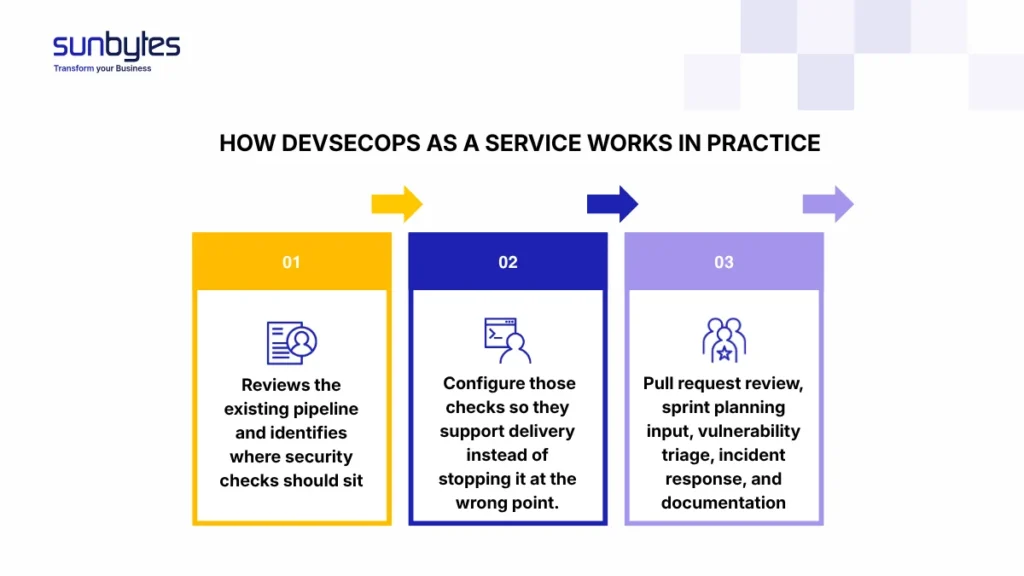
- First, the team reviews the existing pipeline and identifies where security checks should sit. That can include SAST, DAST, dependency scanning, secrets detection, container checks, and policy gates.
- Second, the DevSecOps engineer helps configure those checks so they support delivery instead of stopping it at the wrong point. A scan that runs too late creates rework. A scan that blocks every minor issue creates noise. The point is to catch the right issues at the right stage.
- Third, the engineer joins the operating rhythm: pull request review, sprint planning input, vulnerability triage, incident response, and documentation.
That is the difference between managed DevSecOps and a one-time audit. A consultant can tell you where the gaps are. Managed DevSecOps coverage gives your engineering team someone responsible for closing the loop when a pipeline fails, a dependency needs patching, or a release needs a security decision.
For EU teams, timezone rhythm matters. A distributed provider can work well when there is a 4 to 5 hour overlap with European teams. That is enough time for sprint ceremonies, security reviews, escalation calls, and handover, without forcing every task into synchronous hours.
For the technical foundation behind this model, the DevSecOps pipeline guide explains where SAST, DAST, dependency scanning, and release checks fit inside CI/CD.
DevSecOps-aaS vs in-house build: a direct comparison
The decision is not “service or no service.” It is a timing decision. Build in-house when DevSecOps is already a permanent strategic function. Use DevSecOps-aaS when the company needs coverage before the hiring model is stable.
| Factor | DevSecOps as a Service | In-house build |
|---|---|---|
| Time to first coverage | Typically 2 to 4 weeks for onboarding, access setup, and first pipeline integration | Often measured in months once recruitment, notice periods, onboarding, and ramp-up are included |
| Cost model | Scoped monthly capacity in EUR, based on role seniority, coverage model, tooling scope, and response expectations | Salary, employer costs, recruitment cost, tooling, management time, and retention risk |
| Compliance coverage | Provider-dependent. Verify DPA terms, ISO 27001 certification, access controls, and audit evidence | Fully controllable internally, but only if the company has the right security leadership and documentation discipline |
| Scalability | Capacity can adjust by sprint cycle or scope change | Headcount changes usually take longer and carry hiring risk |
| Control over tooling and process | Shared. The provider should adapt to your pipeline and document any default tooling choices | Full internal control over stack, process, and roadmap |
| Knowledge retention | Depends on documentation, runbooks, and handover clauses | Knowledge stays in-house, but only if the team is retained |
| Best fit | SaaS teams that need coverage now but are not ready for a full internal DevSecOps team | Companies where security engineering is already a core, permanent function |
The crossover point usually comes later than teams expect. One DevSecOps hire rarely covers everything: pipeline design, secure code review, incident response, tooling maintenance, compliance evidence, and developer enablement. At 50 to 200 employees, many SaaS companies need part of that capability before they need a full internal function.
A good rule: choose DevSecOps-aaS when the risk is continuous, but the hiring need is not yet permanent.
If the comparison points to a coverage gap rather than a permanent hiring plan, talk to Sunbytes about dedicated DevSecOps engineers who can work inside your existing delivery process.
When DevSecOps as a Service fits your company
DevSecOps as a Service fits when the company has outgrown ad hoc security checks, but has not yet reached the point where a full internal DevSecOps team makes sense.
It is usually a strong fit when:
- The company has no dedicated security engineer, but ships into a regulated or security-sensitive environment.
- The SaaS product handles personal data, enterprise customer data, or systems that need stronger evidence under GDPR, NIS2, ISO 27001, or customer due diligence.
- The product team is shipping faster than security can review, and the vulnerability backlog is growing.
- Enterprise customers or investors are asking for security evidence before contracts can move forward.
- The company has tried to hire a DevSecOps engineer for several months and still has no accepted candidate.
- The engineering team needs coverage in the pipeline, not a report that sits outside delivery.
It is a poorer fit when:
- The company already has three or more security engineers and the bottleneck is process design, not capacity.
- The product requires strict on-premise or sovereign control that prevents external engineering access.
- The engineering team has fewer than five developers. At that size, a security champion model inside the existing team may be enough.
- Leadership wants to outsource accountability instead of capacity. DevSecOps-aaS can supply expertise and execution, but product risk still belongs to the company.
The model works best when internal engineering keeps ownership and the provider adds security depth. If the external team becomes a black box, the company is buying short-term relief and creating long-term dependency.
What a managed DevSecOps provider should deliver
A managed DevSecOps provider should deliver more than tool setup. Tooling is only useful when it changes the delivery rhythm.
For Dutch and EU SaaS buyers, the provider should be able to show:
- SAST and DAST integrated into the existing CI/CD pipeline, not run as a separate monthly scan.
- Secure code review on high-risk pull requests, especially authentication, payment, tenant isolation, and data access logic.
- Dependency and secrets scanning with clear rules for severity, ownership, and remediation deadlines.
- Incident response expectations, including response time for critical and high-risk findings.
- A GDPR Article 28 Data Processing Agreement before access to personal-data environments.
- ISO 27001 certification that can be verified, not only stated in sales material.
- A clear access model for repositories, environments, production systems, and audit logs.
- Documentation and knowledge transfer, including pipeline configuration, runbooks, decision records, and handover steps.
The handover clause matters. If you decide to hire in-house after 12 or 18 months, your internal team should not have to reverse-engineer the security setup. Ask the provider what they hand over, in which format, and how often it is updated.
Before choosing a provider, use the vendor selection checklist for DevSecOps outsourcing in the EU to verify access, governance, reporting, and knowledge-transfer expectations.
How Sunbytes delivers DevSecOps as a Service
Sunbytes delivers DevSecOps as managed coverage through dedicated DevSecOps engineers who work inside the client’s engineering process. The model is not a black-box security service. It is embedded delivery support for teams that need security closer to code, pipelines, and release decisions.
For Dutch and EU SaaS scale-ups, that means the engagement starts with the delivery setup: repositories, CI/CD pipeline, deployment process, vulnerability workflow, access controls, and escalation paths. The first target is practical coverage, not a large advisory report.
Why Sunbytes?
Sunbytes is a Dutch technology company with headquarters in the Netherlands and a delivery hub in Vietnam. For 15 years, we have helped companies turn technology strategy into reliable delivery, with security built into the way teams plan, ship, and improve software.
For DevSecOps as a Service, that means Sunbytes can support your team across three connected but distinct service pillars:
- Digital Transformation Solutions: We help build and modernize digital products with senior engineering teams covering custom development, QA/testing, maintenance, and support. For SaaS scale-ups, this gives DevSecOps engineers the delivery context they need to work inside real pipelines, not outside them.
- CyberSecurity Solutions: We help reduce risk without slowing down delivery through practical security services and compliance readiness. For managed DevSecOps coverage, this means security reviews, pipeline controls, vulnerability handling, and evidence practices are treated as part of the software lifecycle.
- Accelerate Workforce Solutions: We help companies scale capability and capacity through recruitment and workforce support when growth demands it. If your team needs dedicated DevSecOps engineers before an in-house hiring plan is ready, Sunbytes can help you add the right coverage without turning security into a long recruitment delay.
If your SaaS team needs managed DevSecOps coverage inside its current delivery process, talk to Sunbytes about dedicated DevSecOps engineers for your pipeline.
FAQs
DevSecOps as a Service works inside the software delivery process. It covers code review, CI/CD security checks, dependency scanning, pipeline controls, and developer-facing remediation.
An MSSP usually focuses on monitoring infrastructure, networks, endpoints, and alerts. Many SaaS companies need both, but they solve different problems.
With a clear technical brief and access provisioning, first integration can usually start within 2 to 4 weeks. The first sprint normally covers repository access, CI/CD review, baseline scanning, and priority risks.
The full value appears after the engineer has learned the codebase, release rhythm, and recurring failure points.
Yes, when the provider can support the right contractual, technical, and evidence requirements. For GDPR, check whether a DPA is in place before any access to personal-data environments.
For NIS2-related readiness, check whether the provider can help evidence risk management measures such as vulnerability handling, incident response, access control, and secure development practices.
The cost depends on scope, seniority, coverage hours, tooling, response expectations, and whether the provider needs access to production or only development environments.
Avoid comparing a scoped monthly engagement with salary alone. The in-house cost also includes recruitment, onboarding, tooling, management time, replacement risk, and knowledge retention.
Yes, if the provider documents the work properly. The contract should include knowledge transfer, runbooks, pipeline configuration, access records, and handover expectations.
Ask this before signing: “If we hire our own DevSecOps engineer in 18 months, what exactly do you hand over?” A vague answer is a warning sign.
They overlap, but they are not always the same. Outsourcing can mean a broad external vendor relationship. DevSecOps as a Service should mean managed, ongoing security coverage embedded in software delivery.
For SaaS teams, the distinction matters less than the operating model: who joins the engineering rhythm, who owns remediation follow-up, and how knowledge is transferred back to the company.
For teams comparing permanent hiring with external delivery, the in-house vs outsourced DevSecOps comparison gives a broader cost, risk, and speed view.
Hire in-house when DevSecOps is already a permanent strategic function, the company has enough security workload for full-time ownership, and leadership wants direct control over tooling, process, and security roadmap.
For many 50 to 200 employee SaaS companies, the first step is managed coverage. The internal hire can come later, when the company knows what the role should own.
Let’s start with Sunbytes
Let us know your requirements for the team and we will contact you right away.