
Your Vietnam-based employee is ready to start. The offer is approved. The manager wants a start date. However, the risk is that the employment setup moves slower than the hiring decision.
An employer of record checklist helps a European or Dutch company confirm the hiring model, provider, documents, contract, DPA, payroll, PIT, SHUI, and first-month review before the employee starts.
An Employer of Record is the legal employer in the hiring country. The EOR signs the local employment contract, runs payroll, supports statutory employment administration, and helps manage required employment processes while your company directs the employee’s day-to-day work.
If you are still exploring how this hiring model works, start with our guide to EOR in Vietnam, which explains the legal structure, responsibilities, and common use cases for international employers.
TL;DR
An employer of record checklist should cover six steps before your Vietnam-based employee starts: confirm EOR is the right model, verify the provider, prepare employee and company documents, sign the contract and DPA, complete onboarding and payroll setup, then review the first 30 days.
- Use EOR when your company needs to hire in Vietnam before setting up a local entity.
- Confirm the DPA, privacy notice, and access controls before employee data moves.
- Treat first payroll as a compliance gate, not only an admin task.
Best fit: EOR works best when a European or Dutch company is hiring its first employee or small team in Vietnam and needs a structured setup within 2–4 weeks.
Watch out: Legal review is needed when the role involves foreign employees, contractor-to-employee conversion, sensitive employee data, or unclear employment classification.
To turn this checklist into an assigned setup plan, review the Sunbytes EOR service before the employee signs.
The employer of record checklist in 6 steps
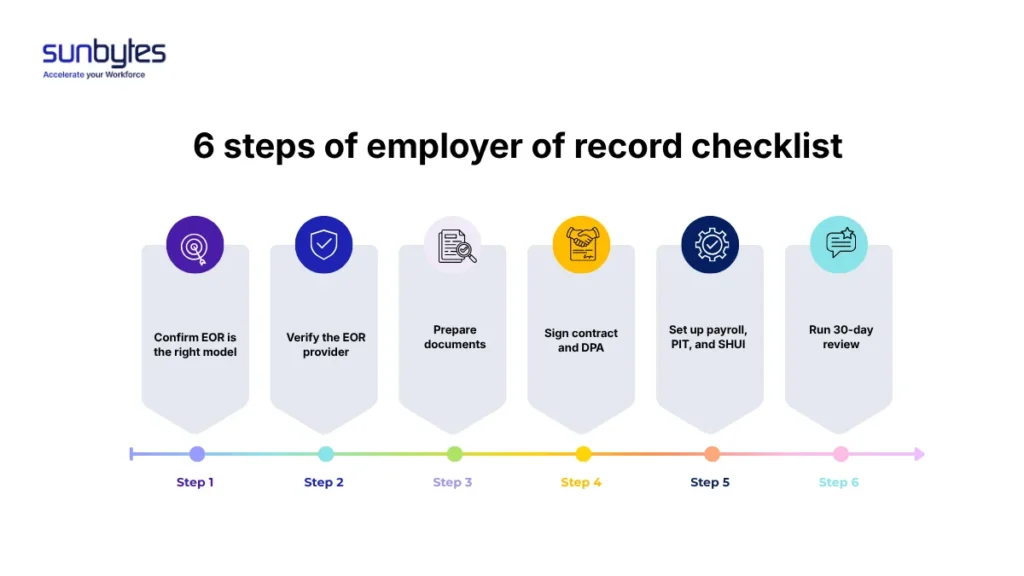
A useful employer of record checklist covers the full setup path, not only provider selection. The checklist should start before the offer is final and continue until the first payroll and 30-day review are complete.
| Step | What to check | Owner | Timing | Proof to collect |
|---|---|---|---|---|
| 1 | Confirm EOR is the right model | Founder / HR / legal | Before offer | Hiring model decision |
| 2 | Verify the EOR provider | HR / procurement | Before contract | Provider proof, SLA, DPA |
| 3 | Prepare documents | HR / employee | Before signing | Employee and company file |
| 4 | Sign contract and DPA | Legal / IT / HR | Before data moves | Contract, DPA, privacy notice |
| 5 | Set up payroll, PIT, and SHUI | HR / payroll | Before first payroll | Payroll file, SHUI proof |
| 6 | Run 30-day review | HR / manager | After first payroll | Payslip, access, manager feedback |
Step 1: Confirm EOR is the right hiring model
EOR is usually the right model when your company wants to employ someone in Vietnam before setting up a local entity. It is not the right answer for every hiring case.
| Model | Best fit | Main risk | What to verify |
|---|---|---|---|
| EOR | First employee or small team in Vietnam | Wrong provider or unclear role setup | Contract, payroll, SHUI, DPA, service owner |
| Local entity | Long-term local operation | Time, setup cost, admin load | Entity plan, tax setup, HR ownership |
| Contractor | Independent project work | Misclassification risk | Independence, scope, control, equipment |
If your employee works under your direction, follows your schedule, uses your tools, and works mainly for your company, review the employment model before using a contractor route.
Vietnam’s Labour Code 2019 provides the legal framework for employment relationships, labour contracts, employee rights, and employer obligations. Reviewing these rules can help determine whether a worker should be engaged as an employee rather than an independent contractor.
Step 2: Choose and verify the EOR provider
Provider verification should happen before the employee signs. The EOR will own the local employment contract, payroll process, statutory employment administration, and offboarding workflow.
Check whether the provider can show:
- legal employer capability in Vietnam
- payroll cut-off dates
- SHUI registration process
- DPA and data security controls
- named account owner
- offboarding support within 24h
- working-hour overlap with your Dutch or EU team
This article focuses on implementation. If you are still comparing vendors, read our guide on how to choose the right EOR service before committing to a provider.
Step 3: Prepare employee and company documents
Document preparation should be finished before contract signing. Missing payroll or identity details can move the start date, even when the candidate has accepted the offer.
For the employee file, prepare legal name, ID or passport, address, bank details, tax information, emergency contact, and work permit or exemption documents where relevant.
For the company file, prepare job title, job description, salary and allowance structure, start date, reporting manager, payroll cut-off, equipment plan, access scope, and data handling requirements.
Once the candidate accepts the offer, follow a structured onboarding process. Our guide to EOR onboarding in Vietnam explains each onboarding stage in more detail.
Step 4: Sign the contract and DPA before data moves
For European and Dutch companies, employee data should not move before the contract, DPA, privacy notice, and access controls are agreed. This matters because EOR onboarding usually involves identity documents, payroll data, bank details, and employment records.
The DPA should define who processes what data, for what purpose, under whose instruction, and with which safeguards. For EU-to-Vietnam data transfers, legal review should confirm whether Article 46 transfer safeguards or another lawful mechanism applies.
The General Data Protection Regulation (GDPR) requires organizations to establish clear responsibilities between controllers and processors and to implement safeguards when transferring personal data outside the European Economic Area. Articles 28 and 46 are particularly relevant when employee information is shared with an EOR provider operating in Vietnam.
Legal-review box:
Review before employee data moves:
- Is the EOR a processor, controller, or separate controller for each data activity?
- Does the DPA include Article 28 processor clauses where required?
- Is the EU-to-Vietnam data transfer mechanism documented?
- Are access controls and retention rules written down?
- Does the employee privacy notice match the actual data flow?
Turn this checklist into a 2–4 week EOR onboarding plan.
Before your Vietnam-based employee signs, Sunbytes can help assign each checklist item to the right owner: contract, DPA, payroll, PIT, SHUI, employee documents, and first-month review.
Learn more about the Sunbytes EOR service and move from checklist to execution.
Step 5: Complete onboarding, payroll, PIT, and SHUI setup
The first payroll run is the main compliance gate. It tests whether the contract, salary structure, PIT assumptions, SHUI registration, bank details, and payroll cut-off are ready.
For Vietnam hiring, the payroll file should match the signed employment setup. If the employee is a foreign national working in Vietnam, the work permit or exemption status should be reviewed before the start date.
Vietnam’s updated Personal Income Tax legislation affects tax thresholds, deductions, and withholding obligations. Employers and EOR providers should ensure payroll calculations reflect the latest requirements before processing salary payments.
For foreign employees, Vietnam’s Decree 219/2025/ND-CP outlines rules related to foreign workers, including work permit procedures and exemptions. Reviewing these requirements before onboarding helps reduce immigration and employment compliance risks.
Review these items before first payroll:
- PIT withholding and tax residency assumptions
- SHUI registration and contribution base
- foreign employee work permit or exemption status
- salary, allowance, and probation terms
- contract language and required employment clauses
For a broader overview of legal obligations, payroll requirements, and employment administration, see our guide to EOR compliance in Vietnam.
Step 6: Run the first 30-day review
The checklist is not finished when the employee starts. The first 30-day review confirms whether the employment setup works in practice.
After first payroll, check:
- Was payroll paid on time?
- Was the payslip correct?
- Was SHUI proof received?
- Were PIT assumptions confirmed?
- Were equipment and system access reviewed?
- Did the manager confirm the role and reporting line?
- Were missing documents closed?
- Is the offboarding process documented in case it is needed later?
This review gives your HR, finance, and manager a clean handover before the employment setup becomes routine.
Legal-review checklist before using this setup

This article supports preparation. It does not replace legal, tax, immigration, or data protection advice.
Ask a qualified reviewer to check:
- employment model classification
- PIT withholding and residency
- SHUI registration and contribution base
- work permit or exemption status
- GDPR/AVG data transfer and DPA
- contract terms under Vietnam labour rules
- termination and offboarding process
The legal review should happen before the employee signs, not after the first payroll issue appears.
How Sunbytes supports your EOR checklist
An effective EOR setup is not only about hiring compliantly. It is also about creating the right foundation for growth and protecting your business as it expands into a new market.
Sunbytes combines its EOR capabilities with expertise across our Transform and Secure Solutions, as well as our Accelerate Workforce Solutions offering. This means companies can move beyond employment administration and build a scalable, compliant operating model in Vietnam from day one.
Through our Digital Transform Solutions, we help organisations establish the people, processes, and delivery structures needed to support international growth. Whether you are hiring your first employee, building a dedicated development team, or preparing for long-term expansion, Sunbytes helps align workforce planning with your broader business objectives.
Through our Cybersecurity Solutions, we help organisations address data protection, access management, compliance controls, and cybersecurity considerations that often arise when onboarding employees across borders. This is particularly important when handling employee data, implementing GDPR safeguards, and managing access to business-critical systems.
With Dutch HQ accountability, a Vietnam delivery hub, NL–VN 4–5 hour overlap, and local EOR operations, Sunbytes provides a practical bridge between compliant hiring, operational transformation, and secure business growth.
If your team is still evaluating whether this hiring model fits your expansion plans, read about the pros and cons of using an EOR before making a final decision.
Turn this checklist into a 2–4 week EOR onboarding plan with Sunbytes. Explore the Sunbytes EOR service to get started.
FAQs
An Employer of Record checklist should include the hiring model, provider verification, employee documents, company documents, contract, DPA, payroll setup, PIT, SHUI, and first payroll review. For Vietnam hiring, the checklist should also include work permit checks where relevant and a 30-day review after onboarding.
Use EOR when your company needs to hire in Vietnam before opening a local entity or when your first local team is still small. Entity setup may become more suitable when the company has a larger long-term team, local revenue operations, or a wider market presence that requires a local company structure.
The employee file usually needs ID or passport details, address, bank information, tax information, job details, salary structure, start date, and work permit or exemption documents where relevant. The company side should prepare the job description, reporting line, payroll cut-off, access plan, and data handling requirements.
A structured EOR setup can often be planned within 2–4 weeks when documents, contract details, DPA approval, payroll data, and compliance checks are ready. Work permit cases, incomplete employee documents, or unresolved data transfer questions can extend the timeline.
After first payroll, check the payslip, payment date, PIT withholding assumptions, SHUI proof, employee bank details, allowances, and payroll deductions. The manager should also confirm that the employee’s role, access, equipment, and reporting line match the signed employment setup.
No. EOR and contractor hiring solve different problems. EOR is better when the person works like an employee under company direction, while contractor hiring requires a genuine independent contractor setup. Classification should be reviewed before using either route.
Let’s start with Sunbytes
Let us know your requirements for the team and we will contact you right away.