
Most DevSecOps tool stacks fail after the scan runs. A SAST alert with no owner becomes backlog noise. An SCA report with no severity rule creates patch churn. A DAST scan that cannot export evidence will not help vendor due diligence.
DevSecOps tools only create value when each tool has four things attached to it: a pipeline stage, a severity rule, an evidence output and a remediation owner. For Dutch and EU SaaS teams with 50 to 500 employees, the first tool stack should usually cover code, dependencies, infrastructure, containers and secrets before adding runtime security platforms.
TL;DR
- DevSecOps tools create value when each scanner maps to a pipeline stage, severity rule, evidence output and remediation owner.
- EU SaaS teams should start with code, dependency, infrastructure-as-code, container and secrets controls before buying runtime platforms.
- A DevSecOps tool is mature only when findings are triaged, assigned, fixed and exported as evidence for vendor due diligence or audit review.
For the pipeline context behind this selection process, see our DevSecOps pipeline guide.
What are DevSecOps tools?
DevSecOps tools are software security controls that run inside the development and delivery process. They help teams detect security issues earlier, document evidence and reduce the gap between engineering work and security requirements.
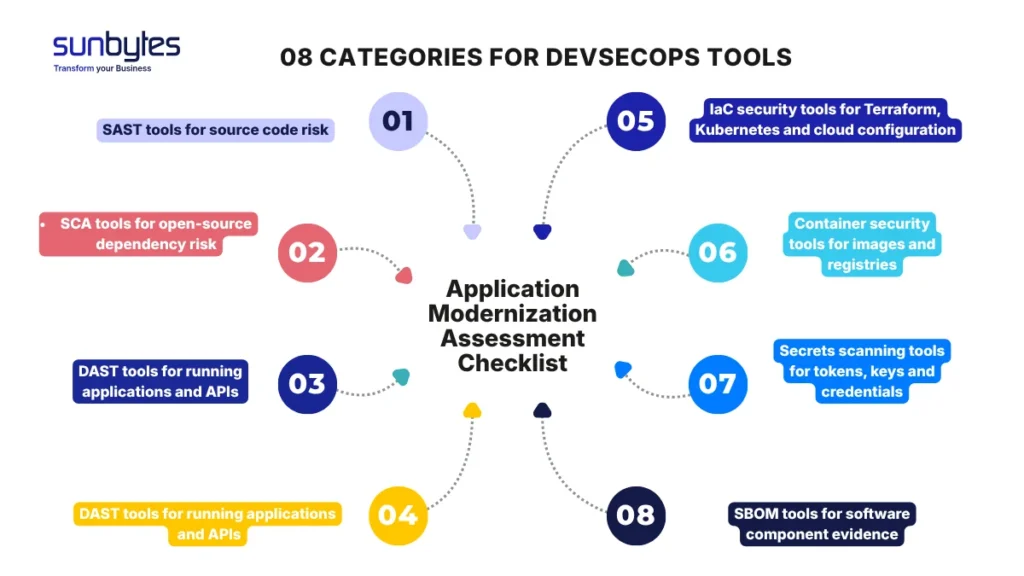
The core categories are:
- SAST tools for source code risk.
- SCA tools for open-source dependency risk.
- DAST tools for running applications and APIs.
- IaC security tools for Terraform, Kubernetes and cloud configuration.
- Container security tools for images and registries.
- Secrets scanning tools for tokens, keys and credentials.
- SBOM tools for software component evidence.
- Runtime monitoring tools for production behavior.
The useful question is not “Which tool is best?” The useful question is “Which risk do we need to control first, and who owns the finding after the tool reports it?”
For teams still aligning on the concept, this article on what DevSecOps means for EU teams explains how DevSecOps connects CI/CD, delivery evidence, NIS2, GDPR and vendor due diligence.
The DevSecOps tool categories European teams should compare first
European SaaS teams should compare tools in the order that matches release risk: code, dependencies, infrastructure, containers, secrets, then runtime. Runtime tooling matters, but it should not be the first purchase if the team still ships vulnerable dependencies or misconfigured infrastructure every sprint.
A practical sequence looks like this:
| Tool category | Pipeline stage | Risk covered | Start when | Main owner |
|---|---|---|---|---|
| SAST | Pull request or build | Insecure code patterns | Your team writes custom business logic | Engineering lead plus security reviewer |
| SCA | Pull request, build or scheduled scan | Vulnerable open-source packages | Your product depends on npm, Maven, PyPI, NuGet or similar package managers | Engineering lead plus product owner for upgrade timing |
| IaC security | Pull request or plan stage | Misconfigured cloud and Kubernetes resources | Infrastructure changes are made through code | DevOps or platform owner |
| Container scanning | Build, registry or deployment gate | Vulnerable base images and packages | You deploy through containers | DevOps or platform owner |
| Secrets scanning | Commit, pull request and repository history | Hardcoded credentials | Developers use tokens, API keys or cloud credentials | Repository owner plus security lead |
| SBOM generation | Build or release stage | Component inventory and supplier evidence | Customers, auditors or procurement ask what is inside the product | Security lead or compliance owner |
| DAST | Test environment or pre-production | Runtime web and API flaws | You have stable test environments | QA plus security reviewer |
| Runtime monitoring | Production | Exploit behavior and abnormal runtime activity | The preventive controls above are already owned | Platform or security operations owner |
This order keeps tool selection close to delivery. If code, dependency and infrastructure findings are still unowned, buying another production monitoring tool usually creates more alerts rather than lower risk.
For a Dutch or EU SaaS company, the first review should also include data handling. Cloud-hosted scanners may process source code, dependency manifests, vulnerability exports, logs, SBOM files and metadata about repositories. Before a tool is approved, the team should know where that data is stored, how long it is retained, which subprocessors can access it and whether the vendor can support a DPA where required.
DevSecOps tools comparison table for 2026
A useful DevSecOps tools comparison table should be category-led, not vendor-ranked. Vendor ranking hides the more important question: what evidence does the tool create, and who uses that evidence?
| Category | Example tools | Best fit | Evidence produced | Owner | Watch-out |
|---|---|---|---|---|---|
| SAST | GitHub CodeQL, GitLab SAST, Semgrep, SonarQube | Teams that need code findings before merge | Code scan results, SARIF exports, pull request comments | Engineering lead | False positives can block releases if severity rules are too broad |
| SCA | Dependabot, Snyk Open Source, GitLab dependency scanning, OWASP Dependency-Check | Products with many open-source dependencies | Vulnerability list, dependency path, fix version, license findings | Engineering lead and product owner | Patch advice may conflict with release timing or compatibility |
| DAST | OWASP ZAP, GitLab DAST, Burp Suite | Web apps and APIs with stable test environments | Runtime scan report, reproduction steps, risk rating | QA and security reviewer | Scans need safe environments and permission rules |
| IaC security | Checkov, Trivy, Snyk IaC | Terraform, Kubernetes and cloud configuration changes | Misconfiguration findings, policy failures, pull request comments | DevOps or platform owner | Generic rules may not match your cloud risk model |
| Container security | Trivy, Grype, Snyk Container, GitLab container scanning | Containerised applications and registry workflows | Image vulnerability report, package inventory, fix guidance | DevOps or platform owner | Base-image ownership must be clear |
| Secrets scanning | GitHub secret scanning, GitLab secret detection, Gitleaks | Teams using tokens, API keys and cloud credentials | Secret type, commit history, repository location | Repository owner and security lead | Detection is only half the process. Rotation must be owned |
| SBOM | Syft, CycloneDX tools, SPDX tooling | Vendor due diligence, procurement and audit evidence | Component inventory, package versions, license metadata | Security or compliance owner | SBOMs become stale if they are not tied to release artifacts |
| Runtime monitoring | Falco, cloud-native runtime tools, CNAPP platforms | Teams with production workloads that need behavior detection | Runtime event logs, policy alerts, workload context | Platform or security operations owner | Alert ownership and escalation rules must exist before rollout |
SAST can catch insecure code patterns, but it does not tell you whether a running API exposes a misconfigured endpoint. SCA can identify a vulnerable library, but it cannot decide whether a major version upgrade fits the sprint. Secrets scanning can detect a token, but it cannot rotate the credential or confirm that the old secret is invalid.
The tool stack works when each finding becomes a managed delivery item. That means a severity policy, a ticket rule, a false-positive review path and an owner who can decide whether the release should stop or continue.
Review your DevSecOps tooling before the next scanner is added. Sunbytes can help map your current CI/CD controls, identify duplicate findings and define who owns remediation across the first 30 days. If the review shows a capacity gap, you can hire dedicated DevSecOps engineers who work inside your delivery rhythm rather than outside it.
How to choose DevSecOps tools for an EU pipeline
Choose DevSecOps tools by the decision they improve, not by the number of findings they produce. A scanner that creates 300 alerts but no release decision has not improved the pipeline.
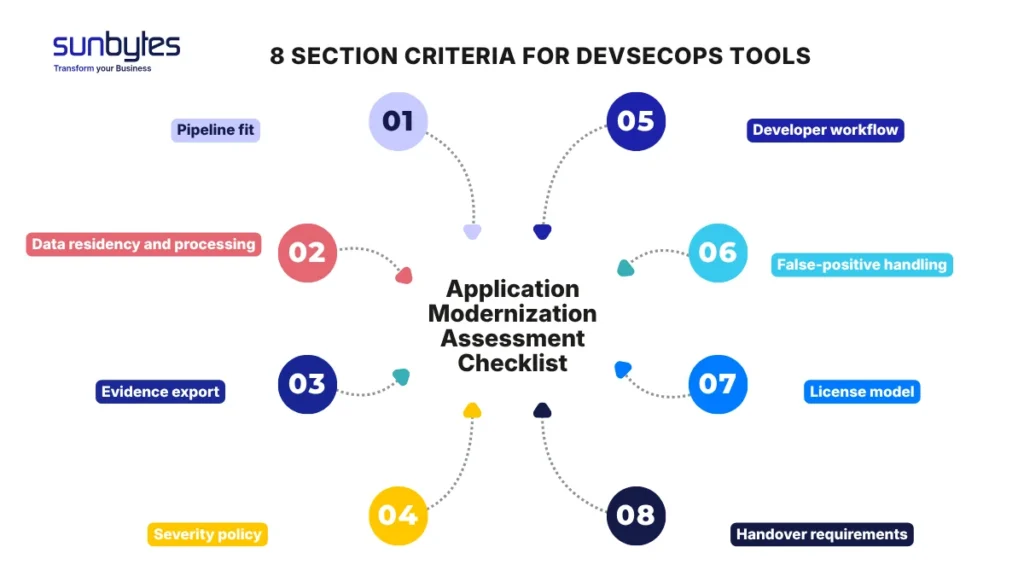
Use these criteria before procurement:
| Selection criterion | What to check | Why it matters for EU SaaS teams |
|---|---|---|
| Pipeline fit | Does it run in GitHub, GitLab, Azure DevOps, Jenkins or your current CI/CD setup? | A tool outside the workflow becomes a side process |
| Data residency and processing | Where are source code, scan results, logs and SBOMs stored? | Vendor evidence and data handling affect GDPR and client due diligence |
| Evidence export | Can the tool export SARIF, JSON, PDF, SBOM or audit-ready reports? | Security findings need to support remediation and vendor questionnaires |
| Severity policy | Can the team define what blocks a merge or release? | Without a blocking rule, every finding becomes a debate |
| Developer workflow | Does it comment on pull requests or create tickets with enough context? | Findings must reach the person who can fix them |
| False-positive handling | Can findings be suppressed with reason, owner and expiry? | Permanent suppressions weaken audit evidence |
| License model | Is pricing based on users, repos, lines of code, projects or cloud assets? | Cost can grow fast across a multi-product engineering organisation |
| Handover requirements | Who owns configuration, tuning, reporting and remediation follow-up? | Tool ownership is often the real bottleneck |
For GDPR Article 32, the point is not that a DevSecOps tool “makes you compliant.” The better claim is narrower: a tool can help provide evidence that the team applies risk-appropriate technical measures, if the evidence is retained and mapped to the right control.
For NIS2 Article 21, the same rule applies. Tooling can support risk management, incident handling, supply chain security and system development security, but only when the process around the tool is documented. A scanner result with no triage rule is not a control. It is a signal.
For ISO 27001, tools should support the ISMS. They should produce evidence for risk treatment, secure development and operational control where relevant. Do not claim that the application is “ISO certified” because a scanner is used. ISO 27001 certification applies to the management system scope, not every application by default.
If you need a deeper bridge between security evidence and software delivery, this article on ISO 27001 app development evidence explains how development work can support control evidence without turning engineering into paperwork.
When tools are not enough
Tools are not enough when findings are created faster than the team can triage, assign and fix them. The clearest signal is repetition: the same type of finding appears across two sprints, or the same high-severity issue is deferred across multiple releases without a documented risk decision.
At that point, the problem is not tool coverage. It is ownership.
A SaaS team with 80 engineers may not need more scanners. It may need one DevSecOps engineer to tune rules, define severity thresholds, connect scan outputs to tickets, remove duplicate findings and coach development teams on remediation patterns.
A smaller team may need a lighter model: one SAST tool, one SCA tool, one secrets scanner, one IaC scanner and a monthly evidence review. Buying a full platform too early can create more administration than risk reduction.
The decision point is simple:
- If findings are fixed inside the sprint, keep improving tool coverage.
- If findings remain unowned after two sprints, add ownership.
- If evidence cannot be exported for vendor reviews, fix reporting before buying another tool.
- If developers disable rules to keep delivery moving, tune severity and false-positive handling before adding a new scanner.
For teams that need embedded delivery support rather than a black-box security service, see how DevSecOps as a Service can work when the goal is tooling ownership, remediation flow and pipeline evidence.
How Sunbytes helps with DevSecOps tooling decisions
Sunbytes helps teams turn DevSecOps tools into owned delivery controls. The work starts with the existing CI/CD setup: where scans run, which findings block release, which findings are informational, where evidence is stored and who owns remediation.
For Dutch and EU SaaS teams, that often means adding dedicated DevSecOps capacity inside the engineering workflow. A dedicated DevSecOps engineer can review the current stack, remove duplicate findings, tune severity rules, define the first 30 days of remediation ownership and help the team produce evidence that supports vendor due diligence, ISO 27001 control work, GDPR Article 32 security measures and NIS2 Article 21 risk-management expectations.
Why Sunbytes?
Sunbytes is a Dutch technology company with headquarters in the Netherlands and a delivery hub in Vietnam. For DevSecOps tooling decisions, the three Sunbytes service pillars work together around one delivery problem: how to ship software faster without losing control of security evidence. Digital Transformation Solutions gives teams the engineering structure to build, modernise, test and maintain software products. CyberSecurity Solutions adds practical risk reduction, compliance readiness and evidence discipline across the pipeline. Accelerate Workforce Solutions helps teams add the right people when the bottleneck is capacity, ownership or specialist knowledge. For a DevSecOps tool stack, that means Sunbytes can support both the technical setup and the team model behind it.
If your tooling review shows that findings are created faster than your team can fix them, talk to Sunbytes about dedicated DevSecOps capacity.