Your team wants to hire software developers in Vietnam. The first question is not whether the Vietnam tech talent market has developers. The harder question is whether Vietnam has the right depth for your role, seniority level, English requirement, salary range, and hiring route.
A React developer in Ho Chi Minh City, a senior DevOps engineer in Hanoi, and an AI engineer who can speak directly with EU stakeholders are three different hiring markets. Treating them as one market is where many first Vietnam searches lose time. This guide gives EU and Dutch hiring teams a practical view of Vietnam tech talent in 2026: where talent is concentrated, which skills are easier or harder to hire, what salary pressure means, and what to prepare before opening the role.
For companies already preparing roles, professional recruitment services in Vietnam can help turn the market view into a role brief, sourcing route, shortlist, and hiring process.
TL;DR
- Vietnam’s 2026 tech talent market is strongest for mid-level web, backend, mobile, QA, Java, .NET, PHP, and cloud-adjacent roles.
- Hiring becomes tighter when the role needs senior ownership, client-facing English, AI/data depth, DevOps/platform skills, cybersecurity experience, or architecture leadership.
- Ho Chi Minh City and Hanoi should be the first search zones for most EU teams; Da Nang works better for selective mid-level, QA, full-stack, and remote-friendly hiring.
- Salary should be treated as a pressure signal in this article. Use a dedicated salary benchmark for stack, city, seniority, English level, and gross monthly pay.
Vietnam tech talent market snapshot for 2026
The Vietnam tech talent market in 2026 is a role-specific market. It is not one large, flat pool of low-cost developers.
Vietnam has enough engineering depth to support web, mobile, backend, QA, and cloud-related hiring. The market becomes tighter when the role needs senior ownership, advanced English, AI/data depth, cybersecurity experience, or platform engineering maturity.
Vietnam’s digital industry direction also affects hiring demand. The Law on Digital Technology Industry, No. 71/2025/QH15, dated 14 June 2025 covers digital technology, semiconductors, AI, digital assets, and the development of digital technology human resources. For employers, this is a signal that technical talent demand is being shaped by both private hiring and national digital industry priorities.
Global technology investment adds more pressure. Reuters reported on 11 June 2025 that Qualcomm launched an AI R&D centre in Vietnam with work across generative AI, agentic AI, smartphones, PCs, XR, automotive systems, and IoT. Reuters also reported on 27 May 2026 that Samsung plans a USD 1.5bn chip testing plant in Vietnam, located north of Hanoi, with operations expected to begin in November 2027.
Use these as demand signals, not supply guarantees. Qualcomm’s AI R&D centre and Samsung’s planned chip testing plant show rising demand for AI, semiconductor-linked, and senior engineering skills. They do not prove that every AI, data, or DevOps role is easy to fill in Vietnam.
The VietJobs 2026 dataset, released in 2026, includes 48,092 Vietnamese job advertisements across all 34 provinces and municipalities. It supports labour-market analysis because it captures job titles, categories, salaries, skills, and employment conditions. It should be treated as supporting labour-market evidence, not as a tech-only salary benchmark.
For salary and job-market checks, sources such as the ITviec Vietnam IT Salary & Recruitment Market Report 2025–2026, TopDev Vietnam IT Market Report 2024–2025, VietnamWorks job-market platform, accessed June 2026, and Robert Walters Vietnam software engineer salary benchmarks 2026 can help validate current pressure by role and seniority.
The practical takeaway is simple. Vietnam can support serious software hiring, but the market needs to be read role by role.
A mid-level backend developer with clear requirements may be reachable quickly. A senior AI engineer with client-facing English and production MLOps ownership will need a tighter search, stronger salary positioning, and faster decision-making.
What the Vietnam tech talent market looks like in 2026
The Vietnam tech talent market is the pool of software engineers, QA specialists, DevOps/cloud engineers, data specialists, AI engineers, cybersecurity talent, and IT professionals available through local employment, remote hiring, recruitment, staffing, EOR, and dedicated team models.
For EU employers, that definition matters. You are not only choosing a country. You are choosing a hiring model, a sourcing route, and a risk level.
Vietnam’s market has grown from outsourcing-led demand into a more mixed engineering base. The market now includes local product companies, global delivery centres, fintech and e-commerce teams, foreign R&D centres, cloud and data projects, and semiconductor-linked technical hiring.
That shift helps companies that need stronger engineering ownership. It also creates hiring pressure. The same senior developer who can work with your Dutch product owner may also be approached by local product companies, regional startups, global outsourcing firms, and foreign R&D teams.
When the hiring need is specifically technical, it helps to read the market through an IT recruitment lens. Sunbytes’ guide to IT recruitment in Vietnam explains how tech stack availability, sourcing, screening, timelines, compliance, and hiring model choices affect the search.
Where Vietnam tech talent is concentrated
Vietnam tech talent is concentrated mainly in Ho Chi Minh City and Hanoi. Da Nang is smaller, but it can work well when the role, salary, and remote setup match the local pool.
The city choice affects search speed, salary pressure, candidate expectations, and interview logistics.
| City or hiring zone | Talent pool depth | Strongest role fit | Senior talent availability | Salary pressure | Best use case | Watch-out |
|---|---|---|---|---|---|---|
| Ho Chi Minh City | High | Product engineering, startups, fintech, web, mobile, full-stack, QA, cloud | Strongest broad pool, also strongest competition | Higher for senior and English-facing roles | First Vietnam hires, product roles, fast-moving search | Candidates may move quickly if feedback is slow |
| Hanoi | High | Enterprise systems, backend, Java, .NET, R&D, infrastructure, AI and semiconductor-linked roles | Strong for structured teams and R&D-linked profiles | Medium to high depending on role | Backend, enterprise, R&D, engineering centres | Senior communication style may need careful screening |
| Da Nang | Moderate | Mid-level developers, QA, full-stack, remote-friendly teams | Selective senior pool | Often more controlled, but depends on stack | Retention-sensitive teams, distributed setup | Smaller pool means role fit matters more |
| Emerging hubs and remote-first hiring | Selective | Specific talent pockets, returnees, remote workers | Case by case | Varies widely | Remote-first hiring when location is flexible | Harder to scale without strong sourcing process |
Ho Chi Minh City has the broadest supply and the fastest competition
Ho Chi Minh City is often the first search zone for EU companies hiring developers in Vietnam. It has broad supply across frontend, backend, mobile, QA, full-stack, and product engineering roles.
It is also the market where delay costs you candidates. If your hiring manager needs one week to review a shortlist, the strongest candidates may already be in another process.
Use Ho Chi Minh City when you need a wide pool and can move quickly.
Hanoi is strong for enterprise, backend, R&D, and structured teams
Hanoi is a strong market for enterprise engineering, backend systems, Java, .NET, infrastructure, and R&D-linked roles. For roles connected to AI, semiconductors, embedded-adjacent work, or larger engineering centres, Hanoi should be part of the search.
The interview process needs to test ownership clearly. A developer may have strong enterprise delivery experience without having owned product trade-offs in the way a Dutch or EU scale-up expects.
Da Nang works when the role and team model fit
Da Nang can be a good fit for remote-friendly companies, mid-level hiring, QA, full-stack development, and retention-sensitive team building.
It is not a smaller version of Ho Chi Minh City. The senior pool is narrower. If your first hire must lead architecture, mentor others, and speak directly with EU stakeholders, Da Nang may still work, but the search should be planned as a selective search rather than a volume search.
Seniority depth: where Vietnam is strong and where the market gets tight
Vietnam is usually strongest at mid-level engineering depth. Senior and lead hiring is available, but it requires sharper positioning, stronger salary calibration, and faster feedback.
Do not translate EU seniority labels directly into Vietnam hiring. A “senior developer” in one company may mean strong delivery execution. In another company, it may mean architecture ownership, mentoring, stakeholder communication, and product judgement.
| Level | Typical experience signal | Market supply | Employer demand | What EU teams should verify |
|---|---|---|---|---|
| Fresher / junior | 0–2 years | High | High for training-led teams | Fundamentals, learning speed, English baseline |
| Mid-level | 2–5 years | Strong | Strong | Code quality, autonomy, testing, collaboration |
| Senior | 5–8+ years | Available but selective | High | Architecture ownership, mentoring, production judgement |
| Lead / architect | 8+ years or equivalent ownership | Tight | High | System design, stakeholder handling, trade-off decisions |
| Engineering manager | Management track | Specialist market | Selective | People management, delivery governance, EU communication |
For many EU companies hiring their first Vietnam team, the practical starting point is not “only hire seniors.” A stronger setup is often a mid-level engineering core with one senior or lead who owns architecture, review quality, and mentoring.
That team shape reduces two common risks. You avoid overpaying for every seat, and you avoid building a team that has delivery capacity but no technical ownership.
For remote roles, define the assessment method before sourcing begins. A good process should test code quality, ownership level, communication habits, and decision-making under realistic project conditions.
English level and ownership expectations for EU teams
English level is a hiring filter in Vietnam, not an afterthought. It affects salary expectations, response rate, interview performance, and whether a developer can work directly with EU product managers or clients.
Written English and spoken English should be screened separately. A developer may write clear tickets and documentation but struggle in live architecture discussion. Another developer may communicate well in meetings but need support for written documentation.
For EU teams, ownership also needs definition. Ask what the role must own:
| Requirement | What to screen for |
|---|---|
| Internal team communication | Async updates, ticket clarity, sprint feedback |
| Client-facing English | Live explanation, confidence, handling unclear questions |
| Product ownership | Ability to challenge requirements and explain trade-offs |
| Architecture ownership | System design, code review, production responsibility |
| Remote collaboration | Response rhythm, documentation habits, timezone overlap |
The Netherlands and Vietnam have a workable overlap for most teams. Depending on daylight saving time, the overlap is usually about four to five hours. That is enough for standups, interviews, planning, and review sessions if the rest of the process is async by default.
When the role brief defines English expectations clearly, screening can happen in the first shortlist. Waiting until the final interview to discover the communication gap adds days or weeks to the process.
Which software skills are easiest and hardest to hire
Common web, backend, mobile, QA, Java, .NET, and PHP roles usually have broader availability in Vietnam. DevOps/cloud, data/AI, cybersecurity, Go/Rust, and senior architecture roles need a tighter search strategy.
Use the matrix below as a planning tool. Final availability should be validated against current job-board data, salary benchmarks, and recruiter input before launch.
| Role or stack | Availability | Hiring difficulty | Likely hiring channel | What to verify |
|---|---|---|---|---|
| React / frontend | High | Medium | LinkedIn, ITviec, TopDev | Product experience, UI quality, component ownership, English collaboration |
| Node.js / backend | High | Medium | LinkedIn, ITviec, referrals | API design, testing, scaling, database ownership |
| Java | High | Medium | LinkedIn, VietnamWorks, enterprise networks | Spring, enterprise delivery, architecture exposure |
| .NET | High | Medium | LinkedIn, VietnamWorks | Enterprise systems, migration work, Azure exposure |
| PHP | High | Low to medium | Job boards, communities | Framework depth, maintainability, legacy system handling |
| Python | Moderate | Medium | LinkedIn, ITviec | Backend vs data distinction, production experience |
| Mobile | Moderate | Medium | ITviec, TopDev, referrals | Native vs React Native or Flutter, release ownership |
| QA automation | Moderate | Medium | LinkedIn, ITviec | Automation framework ownership, CI integration |
| DevOps/cloud | Moderate | High competition | LinkedIn, referrals, recruitment partner | AWS, Azure, GCP, CI/CD, infrastructure ownership |
| Data engineering | Specialist market | High competition | LinkedIn, communities, recruitment partner | Pipelines, warehouse, cloud data stack |
| AI/ML | Specialist market | High competition | LinkedIn, communities, recruitment partner | Applied AI, deployment, model evaluation, MLOps |
| Cybersecurity | Specialist market | High competition | Referrals, LinkedIn, specialist search | Hands-on testing, reporting, compliance context |
| Go / Rust | Specialist market | High competition | LinkedIn, referrals, communities | Production use, systems depth, backend architecture |
Need to check whether Vietnam has the talent depth for your next role? Sunbytes’ recruitment services help EU teams validate role availability, salary positioning, and the sourcing route before the first outreach round.
Roles under pressure in 2026
Hiring pressure is highest when scarce technical depth combines with senior ownership or English-facing communication.
This does not mean those roles are impossible to hire. It means they need a better brief, stronger salary calibration, and a sourcing route that reaches passive candidates.
| Role | Demand pressure | Why it is tighter | Hiring implication | Salary treatment |
|---|---|---|---|---|
| Senior AI/ML engineer | High | AI investment and applied AI adoption are increasing demand | Validate applied experience, not only model knowledge | Salary premium likely, verify in salary article |
| Data engineer | High | Data platforms need production ownership | Check cloud stack, pipeline reliability, business context | Benchmark by cloud/data stack |
| Senior DevOps / platform engineer | High | Cloud, CI/CD, infrastructure, and security overlap | Use referrals and specialist search | Benchmark separately from backend roles |
| Senior iOS / Swift developer | Medium to high | Native mobile depth is more selective than cross-platform hiring | Check app release history and code ownership | Benchmark by native vs cross-platform |
| Senior React / Node full-stack developer | Medium to high | Common stack, but senior ownership is competitive | Test architecture and product judgement | Benchmark by seniority and English level |
| Cybersecurity engineer | High | Specialist skills plus reporting quality are hard to combine | Screen hands-on work and documentation | Benchmark separately from IT admin roles |
| Engineering lead / architect | High | Requires technical, communication, and decision ownership | Use a targeted search with fast feedback | Salary range must match ownership level |
For these roles, the first shortlist should not be measured by volume. Five weak profiles do not help. Three relevant candidates with the right ownership signal are a better start.
Time-to-shortlist matters here. If the role is aligned and feedback is fast, Sunbytes works toward a 3-day shortlist and a 14-day time-to-hire when role scope and decision speed allow it.
Salary signals and hiring pressure
Salary should be treated as a pressure signal in this article, not as a full benchmark table. Detailed salary ranges belong in a dedicated developer salary article where each range can be labelled by stack, city, seniority, gross monthly pay, currency, source date, and exchange-rate note.
For this market overview, the useful question is: which roles need stronger salary positioning before outreach starts?
| Salary pressure factor | What it changes | Hiring implication |
|---|---|---|
| Seniority | Senior, lead, and architect roles require more ownership and stronger compensation than mid-level roles. | Define ownership before benchmarking salary. |
| English level | Client-facing English usually increases salary expectations and candidate selectivity. | Screen English early and budget for communication fit. |
| Stack | DevOps/cloud, data, AI, cybersecurity, and architecture-heavy roles should not be benchmarked like common web roles. | Use stack-specific salary references. |
| City | Ho Chi Minh City and Hanoi can carry different pressure by role type and seniority. | Compare city-level signals before setting one national range. |
| Hiring urgency | Fast hiring usually requires either a stronger offer, a tighter process, or both. | Confirm offer range before sourcing starts. |
| Gross vs net pay | International employers can misread salary data when gross and net are mixed. | Record benchmarks in USD and VND as gross monthly pay. |
Sources such as the TopDev Vietnam IT Market Report 2024–2025, VietnamWorks job-market platform, and Robert Walters Vietnam software engineer salary benchmarks 2026 can support salary-pressure checks. Use them as benchmark inputs, not as a substitute for role-level calibration.
For broader compensation context, Sunbytes’ guide to average salary in Vietnam helps finance and HR teams understand how salary levels vary across Vietnam before they build a detailed tech hiring budget.
Detailed software developer salary ranges should sit in a dedicated salary benchmark article, with USD and VND gross monthly ranges by stack, city, and seniority. This market overview should stay focused on salary pressure, not full compensation tables.
How companies source Vietnamese developers
No single sourcing channel fits every tech role in Vietnam. Channel choice should depend on stack, seniority, urgency, English level, and whether the candidate is active or passive.
| Channel | Best for | Weak spot | When to use | What to verify before outreach |
|---|---|---|---|---|
| Passive senior and specialist candidates | Response rate depends on employer brand and message quality | Senior, niche, English-facing roles | Role clarity, salary range, reason to respond | |
| ITviec | Active tech candidates | Competitive for common stacks | Web, backend, QA, DevOps | JD quality, salary transparency, technical screening |
| TopDev | Developer-focused audience | Requires clear stack and strong role positioning | Stack-specific tech roles | Tech requirement accuracy |
| VietnamWorks | Broader professional roles | Less technical filtering | IT management, business analyst, operations-adjacent roles | Role category and screening criteria |
| Referrals | Trust and senior quality | Limited scale | Architecture, lead, specialist roles | Conflict of interest, notice period, motivation |
| Developer communities | Specialist and active learners | Harder to manage systematically | AI, cloud, cybersecurity, niche stacks | Practical experience, not only interest |
| Recruitment partner | Shortlist quality and speed | Needs clear brief and fast feedback | Senior, urgent, confidential, or EU-facing roles | Scorecard, salary range, timeline owner |
For EU hiring teams, the sourcing issue often appears after two weeks: the role is visible, but the right people are not responding. That usually points to one of four problems: the salary range is off, the role brief is unclear, the channel is wrong, or the employer story is too weak for passive candidates.
Fix the brief before widening the search.
For a deeper workflow view, Sunbytes’ guide to IT recruitment in Vietnam explains how sourcing, screening, salary calibration, technical assessment, and hiring model choices fit together for tech roles.
What does hiring speed depend on in Vietnam
Hiring speed in Vietnam depends less on whether candidates exist and more on role clarity, salary range, screening design, hiring manager availability, offer approval, and notice period.
A slow process weakens candidate quality. A finalist available on Monday may be in another process by Thursday.
| Hiring stage | What usually slows it down | What to prepare | Operating standard |
|---|---|---|---|
| Role brief and salary calibration | Misaligned seniority, unclear ownership, salary too low | Scorecard, salary range, English requirement | Complete before sourcing starts |
| First shortlist | Wrong channel or weak outreach | Role-specific sourcing route | Sunbytes target: 3-day shortlist when role scope allows |
| Technical screening | Test does not match actual role | Practical assessment and review owner | Screen for ownership, not only tools |
| Final interview | Hiring manager delays | Pre-book interview windows | Keep feedback within 24–48 hours |
| Offer and acceptance | Salary approval or unclear benefits | Offer range, benefits, start date | Move before counteroffers appear |
| Notice period and onboarding | Employer model not ready | Contract, payroll, onboarding owner | Link to employment model before start date |
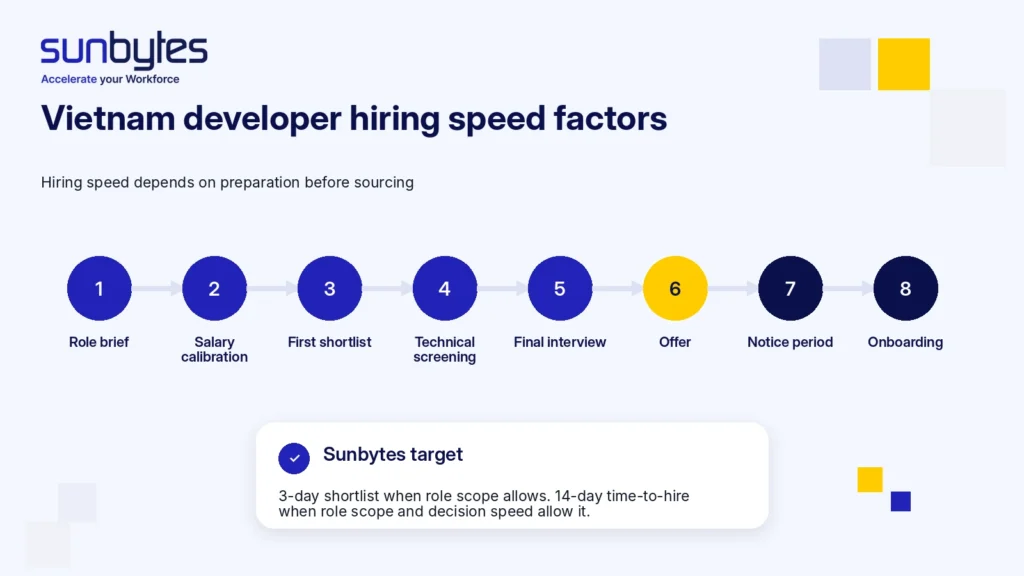
This section should stay short in C1A1. For timeline planning, use the dedicated guide on how long it takes to hire a developer in Vietnam.
Common mistakes EU employers make when reading the market
Most Vietnam hiring problems happen before sourcing starts. The role brief, salary range, assessment method, or employment model does not match the market.
The most common mistakes are easy to avoid.
| Mistake | What happens | Better approach |
|---|---|---|
| Treating Vietnam as only a low-cost market | Strong candidates ignore the role or leave quickly | Position the role by ownership, learning, salary, and team setup |
| Using EU seniority labels directly | “Senior” does not mean the same thing across companies | Define ownership, not only years of experience |
| Checking English too late | Final interviews fail after days of work | Screen English in the first shortlist |
| Opening the role without salary range | Outreach becomes slow and inconsistent | Calibrate salary before sourcing |
| Using one channel for every role | Active job boards miss passive senior candidates | Match channel to stack and seniority |
| Screening for tools only | Candidates pass keyword checks but fail ownership | Test judgement, trade-offs, and production responsibility |
| Treating AI, DevOps, and cybersecurity like common web hiring | Search expectations become unrealistic | Plan targeted sourcing and salary premium |
Boundary condition: when Vietnam may not be the right first market
Vietnam may not be the right first hiring market if the role requires very niche domain expertise, urgent senior-only hiring without a salary premium, or if your company has no hiring owner, assessment process, or employment model ready.
In those cases, the first step is not sourcing. The first step is deciding whether the role should be narrowed, split, hired in another market, or supported through a dedicated team or staffing model.
Vietnam compared with other hiring markets
Vietnam should not be chosen only because it is cheaper. It fits best when the company wants a balance of engineering capability, cost control, manageable EU collaboration, and long-term team stability.
| Market | Strength | Watch-out | When Vietnam may be the better fit |
|---|---|---|---|
| Vietnam | Strong web, mobile, QA, backend, mid-level depth, growing AI/cloud demand | Senior specialist roles need sharper sourcing | You want a durable engineering team with cost control and EU collaboration |
| India | Very large tech talent pool and broad stack coverage | High competition and process noise in some roles | Vietnam may fit better when you want a smaller, more focused team setup |
| Philippines | Strong English communication and support roles | Smaller deep software engineering pool than India or Vietnam | Vietnam may fit better for core engineering hiring |
| Eastern Europe | Strong senior engineering and EU proximity | Higher salary pressure and more competition from EU employers | Vietnam may fit better when cost control matters and async collaboration is acceptable |
| Singapore | High seniority and regional HQ talent | Very high salary cost | Vietnam may fit better for engineering execution and team scaling |
| Local EU hiring | Strong timezone and market familiarity | High salary and long hiring cycles in many roles | Vietnam may fit better when local hiring is too slow or expensive |
When to use recruitment, staffing, EOR, or a dedicated team model
The right model depends on whether your issue is finding talent, employing talent, adding capacity, or building a managed delivery unit.
Choosing the wrong model creates avoidable work. Recruitment solves search. EOR solves employment. Staffing solves capacity. A dedicated team solves delivery ownership.
| Model | Use when | Poor fit when | What to prepare |
|---|---|---|---|
| Recruitment | You need to find and hire permanent employees | You also need legal employment setup in Vietnam | Role brief, salary range, assessment process, decision owner |
| Staffing | You need capacity quickly with managed admin | You need long-term internal ownership from day one | Project duration, reporting line, skill requirements |
| EOR | You found the candidate but do not have a Vietnam entity | You already have a local company ready to employ | Contract, payroll, onboarding, compliance owner |
| Dedicated team | You need a delivery unit, not only individual hires | You only need one permanent employee | Scope, delivery owner, governance, communication rhythm |
If your team is still comparing hiring routes, Sunbytes’ article on direct hiring vs staffing agency explains where each model fits. For a broader model definition, the guide to what a staffing service is compares staffing, recruitment, and EOR in Vietnam.
If you have already found the candidate but do not have a Vietnamese entity, the issue is no longer only recruitment. You also need an employment route. Start with hiring in Vietnam without an entity or review the Employer of Record in Vietnam guide before the offer stage.
For finance planning, EOR pricing in Vietnam explains why the monthly budget includes more than the provider fee.
How Sunbytes helps EU companies understand the Vietnam talent market
Vietnam hiring works best when the role brief matches the market. Sunbytes helps EU teams turn market uncertainty into role-level hiring execution.
That starts before outreach. The role needs a clear ownership profile, salary range, English requirement, sourcing route, and assessment process. Without that, your team may spend two weeks searching and still not know whether the market is the problem or the brief is the problem.
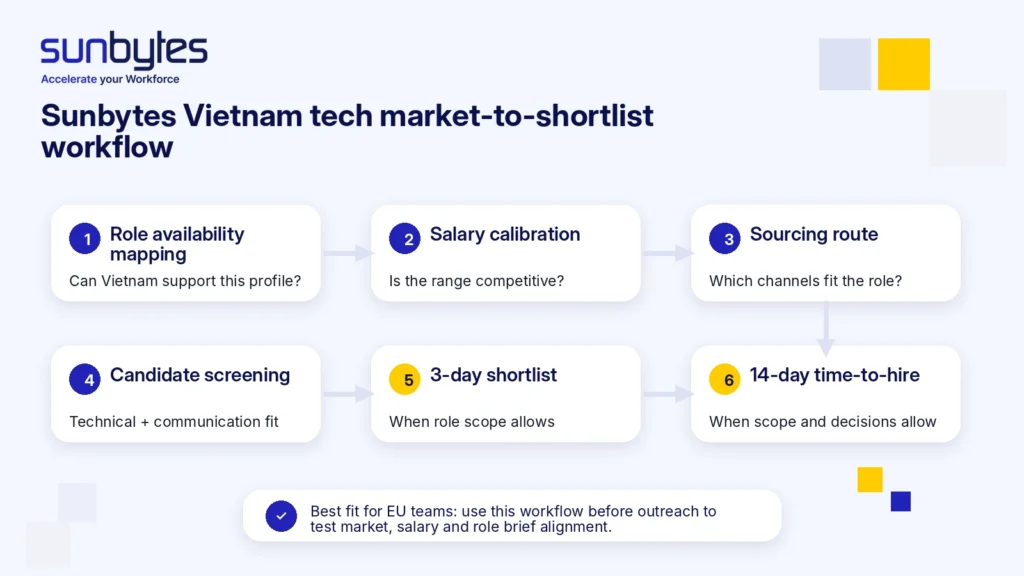
Sunbytes supports EU companies with role availability mapping, salary calibration, sourcing route selection, shortlist quality control, and candidate screening for both technical fit and communication fit.
When the role scope is clear and hiring feedback is fast, Sunbytes works toward a 3-day shortlist and a 14-day time-to-hire. For senior or specialist roles, the first goal is not profile volume. The first goal is a shortlist that shows whether the market can support the role at your salary and ownership level.
Need to validate your first Vietnam tech hire before sourcing starts? Talk to Sunbytes about recruitment services for role availability, salary positioning, and the sourcing route for your next engineering role.
FAQs
Yes. Vietnam is a strong market for software developers when the role matches local supply. Web, mobile, QA, Java, .NET, PHP, and cloud-related roles are usually more accessible than highly specialised senior AI, data, DevOps, cybersecurity, or architecture roles.
Vietnam has available talent across frontend, backend, full-stack, mobile, QA, Java, .NET, PHP, Python, DevOps/cloud, data, AI, and cybersecurity. Availability varies by seniority, city, English level, salary positioning, and sourcing channel.
Most tech hiring depth is concentrated in Ho Chi Minh City and Hanoi. Da Nang can work for remote-friendly and mid-sized teams, but the talent pool is smaller and role fit matters more.
Yes, but senior developers are more selective. Roles that require architecture ownership, product thinking, stakeholder communication, and client-facing English usually need sharper positioning, faster feedback, and a stronger salary range.
Mid-level engineers are often the strongest starting point for first-time Vietnam hiring. Many EU teams get better results by building a mid-level core and adding one senior or lead for architecture, code review, and mentoring.
Senior AI/ML, senior DevOps/platform, cybersecurity, data engineering, senior native iOS, Go/Rust, and engineering lead roles are usually harder to hire than common web or QA roles. These roles need a tighter sourcing route and stronger screening.
Use LinkedIn and referrals for passive senior candidates, ITviec and TopDev for active developer hiring, VietnamWorks for broader professional roles, and a recruitment partner when the role is senior, niche, confidential, or time-sensitive.
For international hiring, use USD and VND together, label the figure as gross monthly salary, and include the source date. This article treats salary as a pressure signal; detailed salary ranges should sit in a dedicated salary benchmark article by stack, city, seniority, English level, and gross monthly pay.
Vietnam may not be the right first market if the role requires very niche domain expertise, urgent senior-only hiring without salary premium, or if the company has no hiring owner, assessment process, or employment model ready.
Let’s start with Sunbytes
Let us know your requirements for the team and we will contact you right away.