DevSecOps benefits appear when security work changes how software is delivered. The value comes from finding issues before they become release blockers, assigning each finding to an owner and producing evidence as part of normal engineering work.
For European SMEs, the result should be visible in fewer remediation hours, shorter security reviews, clearer release decisions and more consistent responses to buyers or auditors.
DevSecOps is an operating model that integrates security responsibilities, controls and evidence into the software delivery lifecycle. It works when engineering, operations and security share a defined process for handling vulnerabilities instead of passing reports between separate teams.
TL;DR
DevSecOps benefits European SMEs by reducing late remediation, clarifying security ownership, improving release control and producing reusable evidence for buyers and compliance reviews. Start by measuring findings, triage time, remediation ownership and release impact. Benefits should appear in operating data within the first few release cycles, not only in the number of scanners installed.
What are the main DevSecOps benefits?
The main DevSecOps benefits are lower rework, earlier vulnerability detection, faster evidence collection, clearer ownership and fewer unplanned release pauses. Each benefit needs a process and a measurement. Otherwise, it remains an assumption.
Earlier detection is useful because a developer can fix a vulnerable dependency, exposed secret or unsafe code pattern while the relevant change is still active. The same issue becomes harder to resolve after release because the team may need to reproduce the problem, assess production impact and coordinate an emergency deployment.
This is where the distinction between tooling and an operating model matters. A scanner can create a finding. DevSecOps defines who reviews it, when it blocks a release, how an exception is approved and where the decision is recorded.
The DevSecOps pipeline guide explains where SAST, software composition analysis, secrets detection, and other controls fit. The business benefit starts after those tools produce a result.
| Benefit | Mechanism | Proof metric | Internal owner | When it appears |
|---|---|---|---|---|
| Lower remediation effort | Findings reach developers before code moves further through delivery | Engineering hours spent on security rework; findings detected before merge versus after release | Engineering Manager | After one to three release cycles with an active gate |
| Faster vulnerability response | Findings have a severity, owner and remediation deadline | Percentage of high-risk findings with an assigned owner; median remediation time | DevSecOps Engineer or Security Lead | Within the first month after triage rules are introduced |
| Clearer release decisions | The team defines which findings block, warn or require an exception | Number of releases delayed by unresolved security decisions; exception approval time | Head of Engineering | As soon as release rules are documented and enforced |
| Less alert noise | Scanner rules are tuned to the codebase and risk profile | Findings closed as false positives; weekly triage hours | DevSecOps or Application Security Owner | Usually after two to four weeks of tool tuning |
| Faster security evidence | Pipeline results, approvals and remediation records are stored consistently | Time needed to answer a buyer questionnaire or evidence request | Security or Compliance Owner | After evidence has been captured for one or two releases |
| Better incident readiness | Teams can trace deployed versions, dependencies and change history | Time needed to identify affected versions and responsible owners | DevOps or Incident Response Lead | After asset, dependency and deployment records are connected |
A useful baseline does not need dozens of metrics. Start with four: open high-risk findings, percentage with an owner, median remediation time and releases delayed by security decisions.
Where DevSecOps creates ROI for European SMEs
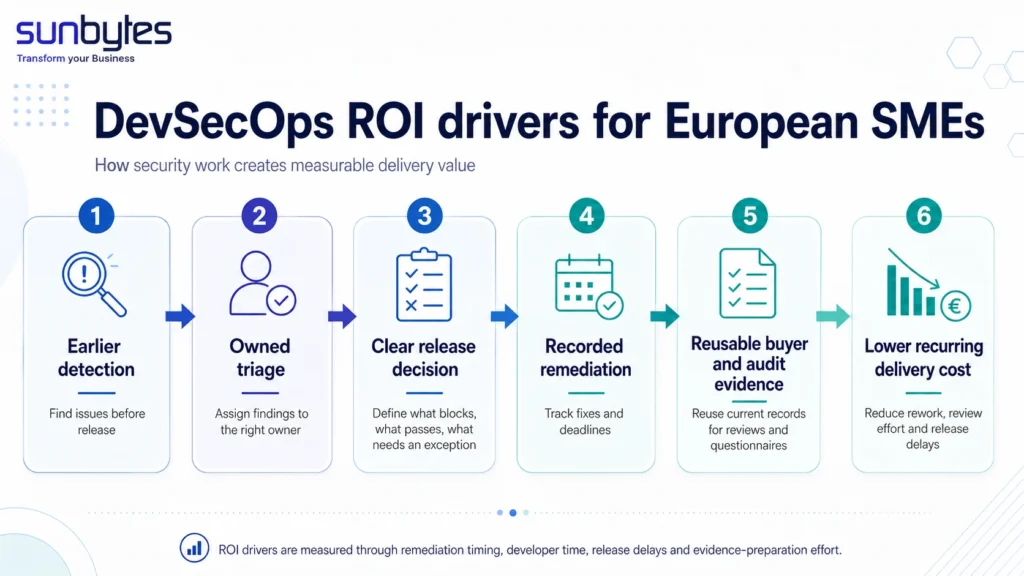
DevSecOps creates ROI when it reduces paid engineering time spent on late fixes, repeated security administration and avoidable release disruption. The calculation should begin with work that the company can observe rather than a broad industry percentage.
A practical ROI model has five inputs:
- Remediation hours avoided by finding issues earlier.
- Developer hours recovered after scanner tuning.
- Time saved when answering buyer and vendor security questionnaires.
- Release delay or incident-response work avoided.
- The cost of tools and DevSecOps capacity required to produce those savings.
Annual DevSecOps value = avoided remediation effort + recovered triage time + faster evidence preparation + avoided release disruption − tools and delivery capacity
Use your own blended engineering cost for the calculation. For example, if one late security issue takes 20 engineering hours to investigate and fix, and the company uses an internal planning rate of €70 per hour, the visible rework cost is €1,400. This is an illustrative calculation, not an industry benchmark. It also excludes management time, testing, release coordination and customer impact.
Tool noise is another measurable cost. A scanner that generates hundreds of findings without context can consume developer time while leaving the highest-risk issues unresolved. Track the number of findings reviewed, accepted, suppressed and remediated. If triage time stays high while remediation time does not improve, the tool is adding activity rather than value.
Procurement evidence belongs in the same model. A CTO, Security Lead and Engineering Manager may all contribute to one enterprise buyer questionnaire. Reusable records such as pull request approvals, dependency reports, access reviews and remediation tickets reduce the need to rebuild the same answer for every deal.
The first ROI review should compare a baseline period with two or three later release cycles. A yearly ROI estimate built before the team has measured rework, triage or release delay will look precise but remain difficult to defend.
DevSecOps benefits by team maturity
DevSecOps benefits change as the team matures. A low-maturity team gains visibility first. A more established team gains faster triage, repeatable release rules and evidence that can be reviewed by leadership or external parties.
The five-stage DevSecOps maturity model provides the wider assessment framework. For benefits tracking, the sequence can be simplified into three operating levels.
Low maturity: visibility before efficiency
A team with inconsistent scanning or no shared vulnerability backlog should not promise immediate ROI. Its first benefit is visibility into exposed secrets, unsafe dependencies, configuration gaps and unclear ownership.
Measure the percentage of repositories covered, findings assigned to an owner and applications with a known release process. A growing backlog is not automatically a negative signal at this stage. It may mean the team is seeing risk that was previously hidden.
Medium maturity: ownership and triage speed
The next benefit appears when findings move through a repeatable workflow. Severity rules, service-level targets and exception approvals reduce uncertainty for developers.
At this level, useful measures include median triage time, median remediation time, false-positive rate and the percentage of high-risk findings with a named owner. Security starts helping delivery when developers receive a clear decision rather than another undifferentiated report.
Higher maturity: delivery and evidence outcomes
A more mature team can connect security controls to delivery performance. DORA’s current software delivery model tracks deployment frequency, change lead time, failed deployment recovery time, change fail rate, and deployment rework rate. These metrics help teams see whether security controls improve release quality or simply add waiting time.
For example, a new release gate may reduce production incidents while increasing change lead time. That trade-off should be reviewed. The goal is to improve control without allowing low-risk findings to block every deployment.
NIST’s Secure Software Development Framework also groups secure development work around preparing the organisation, protecting software, producing well-secured software and responding to vulnerabilities. It gives software producers and buyers a shared language for discussing secure development practices.
The right next step depends on the operating level. Low-maturity teams should establish visibility and ownership. Medium-maturity teams should tune triage and release rules. Higher-maturity teams should connect security evidence to delivery and governance outcomes.
Benefits do not come from adding scanners alone. Sunbytes can help assign ownership, tune the first release gates and turn findings into a working backlog.
Explore how dedicated DevSecOps engineers can extend your delivery team →
Compliance and customer trust benefits
DevSecOps supports compliance and customer trust by producing traceable evidence of how software risks are identified, reviewed and resolved. It does not make a company compliant on its own.
NIS2 Article 21 requires organisations in scope to apply appropriate cybersecurity risk-management measures. The article covers areas such as incident handling, business continuity, supply-chain security, vulnerability handling and security in the acquisition, development and maintenance of network and information systems.
A DevSecOps process can support those expectations through records such as:
- repository and pipeline access reviews;
- vulnerability findings with owners and due dates;
- release-gate results;
- approved risk exceptions;
- software dependency records;
- remediation and retest tickets;
- deployment and rollback logs.
GDPR Article 32 requires controllers and processors to apply technical and organisational measures appropriate to the risk. It refers to confidentiality, integrity, availability, resilience, restoration and the regular testing of security measures. DevSecOps can provide evidence that these measures are tested and maintained during software delivery.
For teams preparing ISO 27001 evidence, the ISO 27001 DevSecOps pipeline guide explains how pull request reviews, SAST and dependency results, access records, exception approvals and remediation tickets can support secure development controls.
The customer trust benefit is operational. Enterprise buyers receive faster, more consistent answers because the evidence already exists. A sales or procurement response backed by dated reports, owners and approval records is stronger than a statement that the company “follows secure development practices.”
Track the average time spent answering security questionnaires and the number of answers that require new evidence. If the same questions still trigger a company-wide search after several releases, the evidence process has not matured yet.
When DevSecOps benefits do not appear yet
DevSecOps benefits do not appear when tools, owners and release decisions operate separately. The clearest warning sign is rising security activity without shorter remediation time or better release control.
Tooling exists, but findings have no owner
A shared dashboard is not an operating backlog. Every high-risk finding needs a named owner, due date and escalation path. Without these fields, unresolved findings accumulate while engineering and security assume the other team is responsible.
Release gates exist, but blocking rules are unclear
A gate that blocks every finding creates workarounds. A gate that blocks nothing becomes reporting noise. Define which severity and asset conditions stop a release, which produce a warning and who can approve an exception.
Scanners run, but no one tunes them
Default scanner rules rarely match every repository, language and threat model. Track false positives and repeated suppressions. A DevSecOps owner should review noisy rules within the first two to four weeks rather than asking developers to ignore them informally.
Security requirements reach developers too late
Controls introduced during final release review create the delay DevSecOps is meant to prevent. Threat modelling, dependency policies and acceptance criteria should enter planning and development before the release candidate exists.
Metrics exist without a baseline
A lower vulnerability count can mean the software improved, scanning coverage declined or teams stopped recording findings. Compare security metrics with repository coverage, deployment frequency and release volume.
The 90-day DevSecOps implementation roadmap provides a sequence for establishing ownership, introducing the first controls and moving toward evidence and delivery metrics. Use it after the team has identified which benefit is currently missing.
How Sunbytes helps convert DevSecOps effort into delivery value
The ownership gap is usually the first constraint to fix. Tools can already be running, but findings still need triage, release rules, remediation support and evidence storage.
Sunbytes helps EU software companies add dedicated DevSecOps capacity without separating that capacity from the product team. The setup combines Netherlands-based accountability with delivery capability in Vietnam. A typical Amsterdam–Vietnam working overlap of four to five hours supports daily triage, code review, release decisions and escalation.
Where scope, access and responsibilities are clear, onboarding can move from assessment to operating support in two to four weeks. Delivery runs through ISO 27001 certified operations, with DORA-tracked signals used to review release flow and rework. Sunbytes’ Secure specialists can also support evidence mapping when findings need to connect to GDPR, NIS2 or ISO 27001 requirements.
Teams that are still deciding how the role should fit can use the DevSecOps engineer hiring guide to compare ownership, skills, and delivery models.
If DevSecOps needs to show value within the next quarter, start with one baseline: findings, remediation ownership, release-gate status and evidence output. Hire dedicated DevSecOps engineers to make that baseline operational inside the delivery team.
FAQs
The biggest DevSecOps benefits are earlier vulnerability detection, lower remediation effort, clearer ownership, more controlled releases and faster security evidence. The benefits become measurable when findings have owners, deadlines and defined release consequences.
DevSecOps improves ROI by reducing late remediation work, scanner noise, repeated evidence preparation and unplanned release delays. Measure engineering hours, triage time, remediation time and questionnaire response effort before calculating financial value.
DevSecOps can support NIS2 and GDPR by producing evidence of technical and organisational security measures. It can record vulnerability handling, access control, testing, release decisions and remediation. Legal compliance still depends on the organisation’s scope, risk assessment and wider governance.
Visibility and ownership can improve within the first month. Triage, remediation and release metrics usually require several release cycles before a useful comparison is possible. Evidence benefits appear once reports and approvals have been stored consistently across at least one or two releases.
Yes, poorly designed DevSecOps can slow developers down. Excessive false positives, undefined blocking rules and manual approvals increase change lead time. The solution is to tune controls, automate repeatable checks and reserve hard release blocks for defined risk conditions.
Small teams benefit when they release customer-facing software, handle sensitive data or need to answer buyer security questions. They rarely need a large security function. Start with one accountable owner, a small set of pipeline controls and a shared remediation backlog.
Let’s start with Sunbytes
Let us know your requirements for the team and we will contact you right away.