

A DevSecOps maturity model is useful only when it shows what is already working, what is missing, and what should change next.
For many European software teams, the weak point is not awareness. They already know security should sit inside delivery. The gap is proof. They have scanners, tickets and policies, but no clear view of whether those controls block risky releases, produce evidence, or have a named owner.
This article uses OWASP DSOMM and CMU SEI’s DevSecOps adoption work as references, then translates them into a simplified 5-stage operating model for Dutch and EU software companies with 50 to 500 employees. OWASP DSOMM focuses on security measures that can be applied and prioritised in DevOps environments, while CMU SEI frames DevSecOps and CI/CD maturity as a staged path toward functional pipeline capability.
For a broader definition before using the model, start with DevSecOps explained.
TL;DR
A DevSecOps maturity model scores how deeply security is built into software delivery, from ad hoc checks to governed pipeline evidence. The useful version does not stop at “level 1 to level 5.” It shows which controls exist, who owns them, where evidence is stored, and which improvement should happen in the next 30 days.
- Use the model to score pipeline controls, ownership, release gates and evidence.
- Treat maturity as an operating baseline, not as a compliance certificate.
- Prioritise the lowest-scoring area first: ownership, pipeline integration, exception handling, evidence storage or remediation SLA.
What is a DevSecOps maturity model?
A DevSecOps maturity model is a scoring framework that measures how well security is embedded into software delivery. It should assess people, process, pipeline, tooling, evidence and governance, not only whether a team owns security tools.
The practical test is simple: can your team prove what happened before a release?
A low-maturity team may run scans manually, discuss findings in Slack, and rely on one senior engineer to decide whether a risk matters. A higher-maturity team connects security checks to CI/CD, assigns findings to owners, defines release blocking rules, records exceptions, and keeps evidence for leadership or audit review.
That distinction matters for EU teams because frameworks and regulations increasingly expect security to be operational, not decorative. NIS2 Article 21 refers to cybersecurity risk-management measures including supply chain security, security in acquisition, development and maintenance, vulnerability handling, and procedures to assess whether measures work. GDPR Article 32 also expects risk-appropriate technical and organisational measures, including a process for testing and evaluating security measures.
A maturity score does not prove compliance. It shows whether the delivery system can produce the kind of evidence a compliance, procurement or leadership review will ask for.
The 5 maturity stages
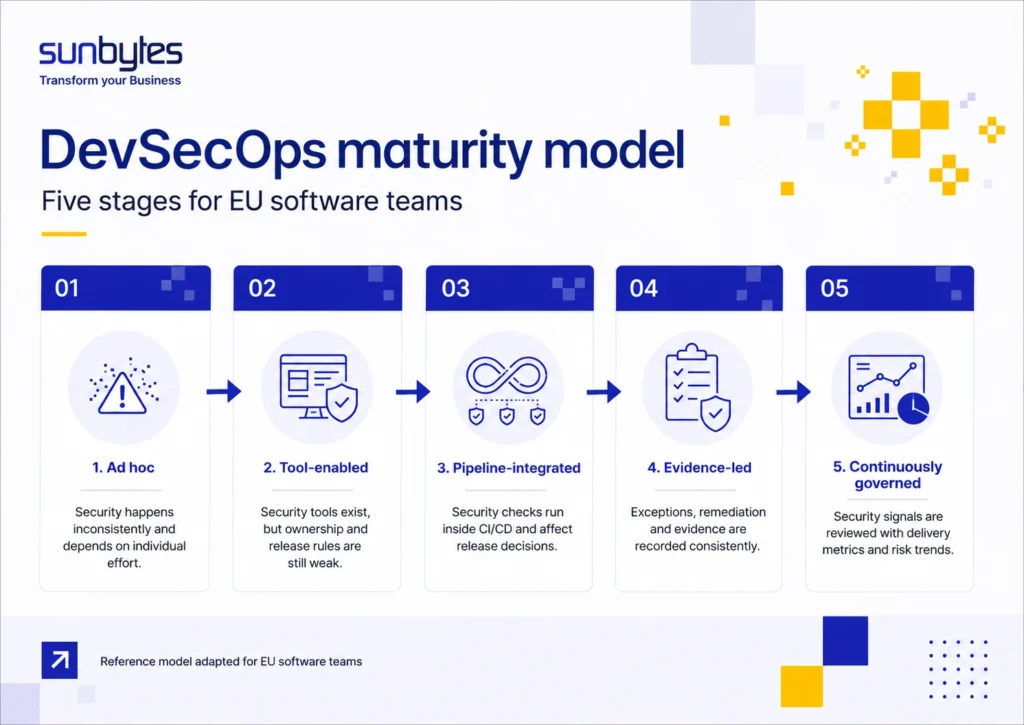
The 5 maturity stages are ad hoc, tool-enabled, pipeline-integrated, evidence-led and continuously governed. The difference between the stages is not tool count. It is how consistently the team turns security activity into owned decisions and reusable evidence.
| Stage | Operating state | Typical signal | Evidence artifact |
|---|---|---|---|
| 1. Ad hoc | Security happens when someone remembers, reports a concern or prepares for a review. | Findings are discussed informally and resolved inconsistently. | Manual vulnerability note or one-off remediation ticket |
| 2. Tool-enabled | The team has scanners or security tools, but findings are not consistently tied to owners or release rules. | Security reports exist, but engineers still debate what blocks a release. | Scanner report or dependency scan output |
| 3. Pipeline-integrated | Security checks run inside CI/CD and trigger tickets or release decisions. | The pipeline catches repeatable issues before production. | CI/CD pipeline report or release gate log |
| 4. Evidence-led | Security decisions produce stored evidence, exception records and remediation SLAs. | The team can explain why a release passed, failed or needed an exception. | Risk exception register or remediation SLA report |
| 5. Continuously governed | Security controls are reviewed with delivery metrics, risk trends and governance cadence. | Leaders see security signals beside DORA metrics and delivery outcomes. | DORA-tracked security dashboard or quarterly control review |
Stage 1 is common when DevSecOps starts as a person rather than a system. The team may have strong engineers, but security decisions depend on memory and individual judgement. That creates rework when a late finding blocks a release.
Stage 2 is better, but still unstable. Tools create visibility, but visibility without triage rules adds noise. A scanner report that nobody owns is not a control.
Stage 3 is where DevSecOps starts to affect delivery. Security checks sit inside the pipeline, findings flow into tickets, and release gates define which issues must stop deployment. For implementation mechanics, use the DevSecOps pipeline guide as the next technical reference.
Stage 4 gives the team evidence. Exceptions are approved, remediation deadlines are tracked, and audit trails are stored. This is where vendor questionnaires become easier because the team can answer with records rather than explanations.
Stage 5 connects DevSecOps to governance. The team reviews security signals with deployment frequency, lead time for changes, change failure rate and MTTR. CMU SEI describes mature DevSecOps and CI/CD adoption as an ordered approach across adoption, implementation, improvement and maintenance, with automation supporting the process.
How to score your current DevSecOps maturity
Score DevSecOps maturity with proof-based questions. Do not ask whether the team “does security.” Ask whether a reviewer can see the control, owner, decision and evidence record.
Use this 10-question scorecard. Give each question 0 to 5 points.
0 means no clear practice exists.
1 to 2 means the practice exists but is manual, inconsistent or owned by one person.
3 to 4 means the practice is repeatable and tied to delivery.
5 means the practice is governed, evidenced and reviewed.
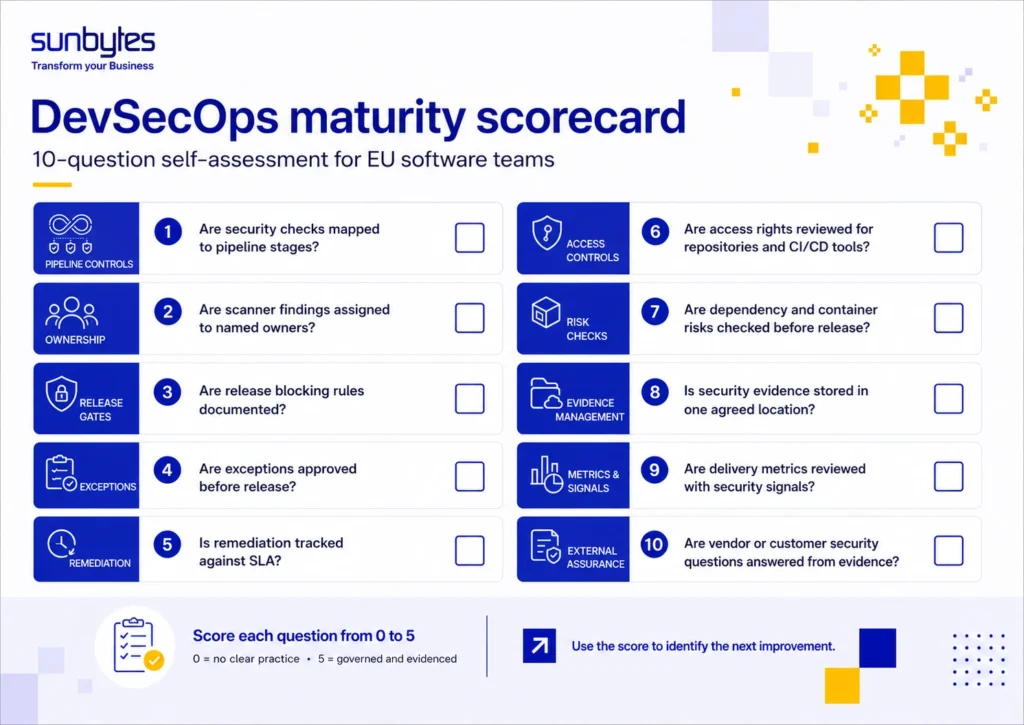
| Question | What proof should exist? | Score |
|---|---|---|
| 1. Are security checks mapped to pipeline stages? | Pipeline configuration or control map | 0-5 |
| 2. Are scanner findings assigned to named owners? | Ticket ownership and triage rules | 0-5 |
| 3. Are release blocking rules documented? | Release gate policy | 0-5 |
| 4. Are exceptions approved before release? | Exception approval record | 0-5 |
| 5. Is remediation tracked against SLA? | Remediation log with due dates | 0-5 |
| 6. Are access rights reviewed for repositories and CI/CD tools? | Access review record | 0-5 |
| 7. Are dependency and container risks checked before release? | SCA, image or dependency report | 0-5 |
| 8. Is security evidence stored in one agreed location? | Evidence folder, GRC workspace or ticket system | 0-5 |
| 9. Are delivery metrics reviewed with security signals? | DORA dashboard or sprint review record | 0-5 |
| 10. Are vendor or customer security questions answered from evidence? | Completed questionnaire with linked proof | 0-5 |
Score interpretation
| Score | Maturity level | What it means | First decision |
|---|---|---|---|
| 0-10 | Ad hoc | Security depends on individual effort. | Assign ownership before adding more tools. |
| 11-20 | Tool-enabled | Tools exist, but findings do not reliably change releases. | Define triage and blocking rules. |
| 21-30 | Pipeline-integrated | Security checks are part of delivery, but evidence may be scattered. | Standardise evidence storage. |
| 31-40 | Evidence-led | Controls produce records, but governance is not yet continuous. | Add review cadence and trend metrics. |
| 41-50 | Continuously governed | Security controls, evidence and delivery metrics are reviewed together. | Improve weak controls, not the whole system. |
A score below 20 usually means the team should not start with a large tooling rollout. The first move is ownership. Without a clear owner, every new tool adds another stream of findings that nobody is accountable for closing.
A score between 21 and 30 means the pipeline is ready for more structure. The next move is evidence storage and exception handling. This is where DevSecOps starts supporting procurement, ISO 27001 readiness and customer trust.
A score above 40 should not create comfort by itself. Mature teams still reassess because threats, dependencies, team structure and release cadence change. The point is to keep the baseline current.
A maturity score is useful only when it produces a next move. If your score shows weak ownership, scattered evidence or unclear release gates, start with a 30-day DevSecOps operating baseline before adding more tools. Sunbytes can help map your current controls, assign ownership and define the first pipeline rules through dedicated DevSecOps capacity.
What each maturity level means for EU compliance evidence
Each maturity level changes the quality of evidence a team can produce for NIS2, GDPR, ISO 27001 and vendor security questionnaires. A higher score does not equal compliance. It means the team is better prepared to show how security is managed inside delivery.
NIS2 Article 21 includes measures for risk analysis, incident handling, supply chain security, secure acquisition, development and maintenance, vulnerability handling, and effectiveness assessment. GDPR Article 32 focuses on security appropriate to risk, including confidentiality, integrity, availability, resilience and regular testing of security measures. ISO 27001 Annex A 8.25 is commonly used to evidence rules for secure development across the software lifecycle.
For a maturity model, these references should be translated into evidence questions:
| Maturity level | Compliance evidence quality | Typical gap |
|---|---|---|
| Ad hoc | Evidence is mostly narrative. | “We usually check this” is not proof. |
| Tool-enabled | Reports exist, but ownership is unclear. | Scanner output is not tied to release decisions. |
| Pipeline-integrated | Controls run at delivery points. | Evidence may still sit across multiple systems. |
| Evidence-led | Decisions, exceptions and remediation are recorded. | Review cadence may be weak. |
| Continuously governed | Evidence is reviewed with metrics and risk trends. | The team must keep scope current as systems change. |
Vendor questionnaires expose these gaps quickly. A buyer rarely asks whether the team “uses DevSecOps.” They ask for secure development policy, access control evidence, vulnerability handling, remediation process, incident response flow, supplier risk handling and proof that controls are reviewed.
The practical target is not a perfect score. The target is a defensible answer backed by a record.
What to improve first at each maturity stage
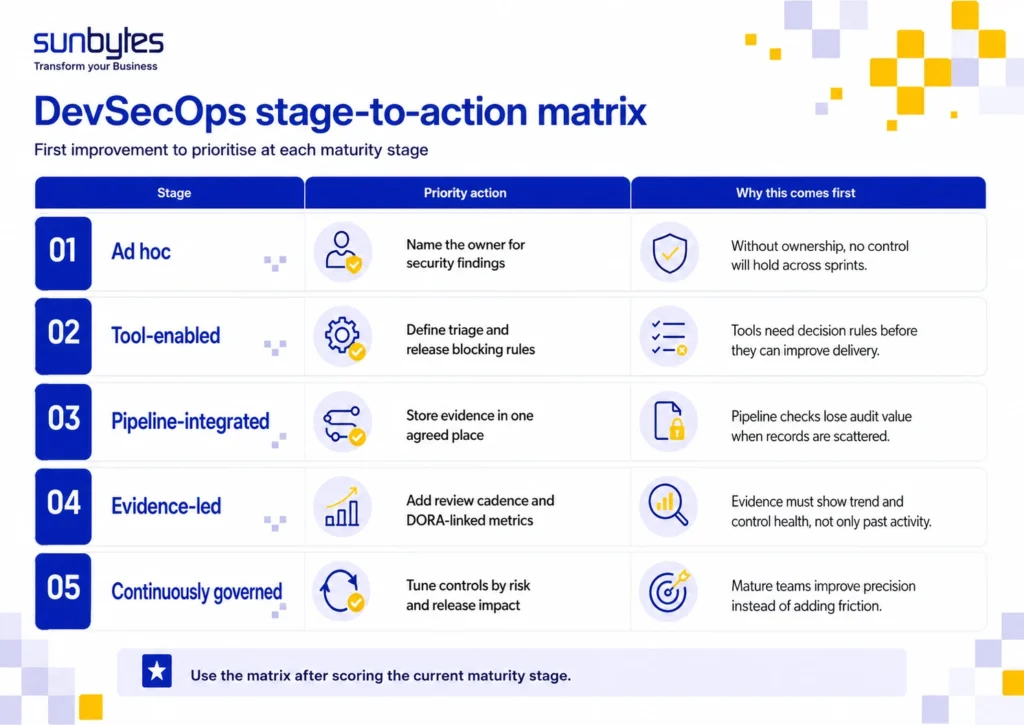
Improve the weakest maturity constraint first. Adding another tool rarely fixes a missing owner, unclear release gate or weak evidence trail.
| Current stage | Improve first | Why this comes first |
|---|---|---|
| Ad hoc | Name the owner for security findings. | Without ownership, no control will hold across sprints. |
| Tool-enabled | Define triage and release blocking rules. | Tools need decision rules before they can improve delivery. |
| Pipeline-integrated | Store evidence in one agreed place. | Pipeline checks lose audit value when records are scattered. |
| Evidence-led | Add review cadence and DORA-linked metrics. | Evidence must show trend and control health, not only past activity. |
| Continuously governed | Tune controls by risk and release impact. | Mature teams improve precision instead of adding friction. |
If the team is ad hoc, start with one owner and one rule: which findings block release? This creates a baseline within the next sprint.
If the team is tool-enabled, connect scan results to tickets and release gates. The first useful threshold is not “scan everything.” It is “critical and exploitable findings cannot pass without approval.”
If the team is pipeline-integrated, move from logs to evidence. Decide where reports, exceptions and remediation records live. A pipeline report buried in a CI/CD run history is hard to use in a leadership or procurement review.
If the team is evidence-led, review the evidence with delivery metrics. Change failure rate, MTTR and lead time for changes show whether security controls are helping delivery or creating unmanaged delay.
If the team is continuously governed, avoid overcorrecting. Use risk trends to tune controls. A mature DevSecOps operating model should block what matters, record why exceptions happen, and keep releases moving when risk is understood.
When the assessment is complete, the execution path belongs in a roadmap. Use the 90-day DevSecOps implementation plan to turn the maturity score into a phased improvement sequence.
How Sunbytes helps teams move from assessment to operating baseline
Sunbytes helps teams turn a DevSecOps maturity score into an operating baseline: named ownership, first pipeline controls, release decision rules, DORA-tracked delivery signals and evidence ready for leadership review.
The usual maturity gap is not that teams have no security activity. It is that security activity is not yet operating as a system. Scanners produce reports. Engineers fix issues. Managers answer questionnaires manually. But the evidence trail does not connect cleanly from finding to owner, release decision, exception and remediation.
Sunbytes supports that transition through dedicated DevSecOps and secure delivery capacity. For Dutch and European teams, the model combines Netherlands-based accountability with Vietnam delivery capability, a 4-5 hour Amsterdam-Vietnam overlap, ISO 27001 certified delivery and onboarding that can move from assessment to operating support in 2-4 weeks where scope is clear.
That matters when the scorecard exposes a capacity gap. If your team can identify missing controls but cannot assign an owner, maintain pipeline rules or keep evidence current, the next step is not another assessment. The next step is operating support.
For teams that need DevSecOps capacity without building the role fully in-house, Sunbytes can help you hire dedicated DevSecOps engineers and move from scorecard to first working baseline.