

Employer of Record cost usually starts with a monthly service fee. That is the number most providers advertise first. But it is not the full cost. For most companies, the real number includes the EOR service fee, statutory employer costs, payroll funding, benefits, one-time setup fees, FX handling, and any add-ons needed for the employee to start correctly.
Public EOR pricing often starts around USD 199 per employee per month and can move above USD 599 per employee per month depending on provider, country, and service scope. For EU budgeting, a practical planning range is often €300–600 per employee per month, or 15–25% of gross salary, before local employer contributions.
That distinction matters.
A quote that says “€400 per employee per month” may only cover the provider fee. It may not include social insurance, health insurance, unemployment insurance, private benefits, equipment, onboarding, offboarding, work permit support, or currency conversion.
For companies hiring in Vietnam, India, Eastern Europe, or LatAm, the number finance needs is Total Cost of Employment. That means gross salary, employer contributions, EOR fee, and any one-time or optional charges. After reading this guide, you will understand how to evaluate EOR quotes more accurately and avoid hidden costs.
TL;DR
- EOR cost typically ranges from $199–$800 per employee/month or €300–600/month, depending on provider and pricing model.
- Total cost includes service fee + employer taxes + optional costs, not just the monthly fee.
- Pricing models are either flat fee or percentage of salary (15–25%).
- Employer contributions vary by country and can exceed the service fee.
- The most accurate number is Total Cost of Employment, not the advertised EOR fee.

The cost of opening a local entity
Before comparing EOR providers, compare EOR with the main alternative: opening your own local entity.
A local entity gives you direct control. You employ people under your own company structure, manage local payroll, register with tax and labour authorities, and build your own HR compliance process.
That control comes with time and setup cost.
For a first hire in a new market, entity setup can include:
- company registration
- legal and notary support
- local bank account setup
- tax registration
- payroll registration
- employment contract templates
- local accounting support
- ongoing compliance filings
- local HR and legal administration
For planning, entity setup can easily move into the €15,000–50,000+ range before ongoing payroll, accounting, and administration costs are counted. In some countries, the bigger issue is not only cost. It is time. A local entity can take 3–6 months before the first employee can be paid correctly. An EOR setup is often ready in 2–4 weeks when documents and offer terms are prepared. That is why EOR is often cheaper for the first 1–20 employees in a new country. It is not always the lowest monthly option forever. But it can be the faster and lower-overhead route while you test a market, hire a first team, or avoid delaying a key employee start date.
If your choice is between opening a company and using an EOR, compare the timing and operating cost in EOR vs entity setup in Vietnam.
What employer of record cost includes
Most EOR pricing pages show a monthly amount per employee.
Your invoice may include more than that.
| Cost component | What it means | Budget effect |
|---|---|---|
| EOR service fee | Fee for employment administration, local contracts, payroll coordination, compliance handling, and employee lifecycle support | Flat monthly fee or percentage of salary |
| Statutory employer contributions | Mandatory employer costs such as social insurance, health insurance, pension, payroll taxes, or unemployment insurance | Varies by country and salary base |
| One-time costs | Setup, onboarding, contract creation, amendments, termination, or offboarding | Charged per event |
| Optional add-ons | Benefits, equipment, background checks, immigration support, private insurance, reporting | Depends on scope |
| FX and payroll funding | Currency conversion, exchange timing, transfer fees, or payroll funding requirements | Can affect EUR budget when payroll is paid locally |
In Vietnam, employer contributions for a Vietnamese employee can include:
- social insurance: 17.5%
- health insurance: 3%
- unemployment insurance: 1%
Source: PwC Vietnam individual other taxes summary
These costs are separate from the EOR provider fee. They may be passed through as statutory employer costs or included in a total invoice estimate, depending on how the provider structures the quote.
EOR pricing models
EOR providers usually price in one of three ways: flat monthly fee, percentage of salary, or custom quote.
Flat monthly fee
A flat monthly fee is a fixed amount per employee per month.
For Example: €500 per employee per month.
This model is easier for finance teams to forecast because the provider fee does not rise automatically when salary increases. It is often better for senior employees, managers, and specialist roles where salary is higher. Flat pricing also makes provider comparison easier. If two providers both charge a fixed monthly fee, you can ask what is included, what is passed through, and what is billed separately. Watch out for low flat fees that exclude onboarding, offboarding, FX, benefit administration, or contract changes.
Percentage of salary
A percentage-based fee is calculated from the employee’s gross salary.
Example:
- €2,500 salary × 20% = €500 EOR fee
- €4,000 salary × 20% = €800 EOR fee
This model can look attractive for junior roles. But it becomes more expensive as salary rises.
For senior engineers, managers, and hard-to-hire specialists, percentage pricing can create a higher provider fee without adding more value. It can also make future salary increases more expensive for the employer.
Custom pricing
Custom pricing is used when the setup is more complex. This may apply when you need work permit support, multi-country payroll, special benefits, equipment handling, private insurance, frequent variable pay, or several employees in the same country. Custom pricing is not automatically bad. It can be the right model when the scope is specific. But it should still be itemized. If a custom quote does not separate service fee, statutory employer costs, one-time charges, FX handling, and optional add-ons, it is hard to compare with other providers.
EOR cost by market
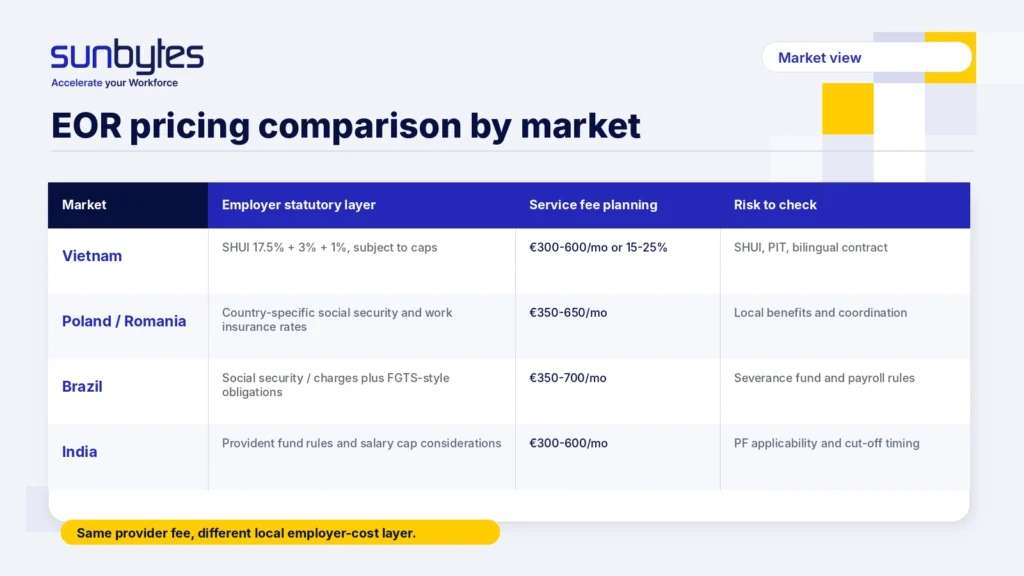
The same EOR service fee can lead to very different total costs by country. A €400 monthly service fee in Vietnam, Poland, Brazil, or India does not carry the same statutory employer burden. Local insurance, pension, payroll tax, severance, benefits, caps, and registration rules change the final number.
| Market example | Employer statutory cost to check | Practical EOR service fee planning range | Typical onboarding expectation | Notable risk to check |
|---|---|---|---|---|
| Vietnam | Social insurance 17.5%, health insurance 3%, unemployment insurance 1% for Vietnamese employees, subject to caps | €300–600/month or 15–25% of gross salary | Often 2–4 weeks once documents are ready | SHUI registration, PIT withholding, bilingual contract, contractor misclassification |
| Eastern Europe example: Poland / Romania | Poland employer contributions can sit around 19.21–22.41%. Romania’s normal employer work insurance contribution is 2.25%, with extra rates for special work conditions | €350–650/month depending on market and payroll scope | Often 2–5 weeks depending on document readiness | Country-by-country payroll rules, social security coordination, local benefits |
| LatAm example: Brazil | Employer social security and other social charges can range from 20–28.8%, plus 8% FGTS | €350–700/month depending on complexity | Often 3–6 weeks depending on registrations and role type | Severance fund, mandatory local payroll rules, local benefit obligations |
| India | Employer provident fund contribution is generally 12% where the PF Act applies, with salary cap rules for pension allocation | €300–600/month depending on scope | Often 2–5 weeks depending on documents and payroll setup | PF applicability, international worker rules, payroll cut-off timing |
Source basis for this table: PwC Vietnam individual other taxes, PwC Poland individual other taxes, PwC Romania individual other taxes, KPMG Brazil payroll tax guidance, and PwC India individual other taxes. For Vietnam-specific planning, the important point is simple: PIT is usually withheld from the employee’s taxable income when salary is agreed on a gross basis. It is not normally an additional employer cost unless the offer is negotiated on a net basis. The employer cost layer comes mainly from SHUI and any benefits, insurance, equipment, or support added to the employment package. For a deeper Vietnam view, use EOR cost breakdown for Vietnam.
What drives EOR cost up or down
Two companies hiring the same number of people can still receive very different EOR quotes. The difference usually comes from five cost drivers:
1. Country
Country changes the cost because employment rules are local.
Vietnam, Poland, Brazil, India, and the Netherlands all have different employer contributions, payroll rules, contract requirements, benefit expectations, termination rules, and registration steps.
That is why a provider fee alone is not enough. The same fee can sit on top of very different statutory costs.
2. Salary level
Salary affects total cost in two ways.
First, employer contributions are often calculated from salary, sometimes with caps.
Second, percentage-based EOR fees rise as salary rises.
A junior role may look cheaper under percentage pricing. A senior developer or engineering manager may be cheaper under a flat monthly fee.
3. Number of employees
Team size can change the per-employee fee.
Some providers reduce the monthly fee when several employees are hired in the same country because payroll and administration become more repeatable.
Ask whether volume pricing applies after 5, 10, or 20 employees.
4. Payroll complexity
Simple salary is easier to process.
Variable bonus plans, allowances, commissions, equity, reimbursement rules, expense payments, overtime, and off-cycle payments can increase the work required.
This does not always mean the quote should be higher. But it should be clear.
5. Add-ons and service scope
Add-ons should be named before signature.
These can include:
- employee benefits
- private health insurance
- background checks
- laptop or equipment procurement
- work permit support
- visa support
- employment contract amendments
- offboarding
- employee documentation
- custom reporting
These add-ons can be useful. They just should not appear later as surprise invoice lines. Before choosing the model, review the pros and cons of using an Employer of Record for control, cost, compliance, and scaling trade-offs.
By the end of this comparison, the decision should not be “Provider A is €100 cheaper.” It should be: “Provider A includes statutory pass-through, FX handling, onboarding, and offboarding. Provider B does not.”
Hidden EOR costs to ask about
Hidden costs usually appear when the quote is too simple. A clean proposal should make every cost visible before you sign.
Ask these questions before committing to an EOR provider:
| Hidden cost area | What to ask | Why it matters |
|---|---|---|
| Setup fees | Is onboarding or contract setup charged separately? | A low monthly fee can hide upfront cost |
| Termination fees | Are there early exit penalties or offboarding fees? | Leaving the provider may cost more than expected |
| Compliance fees | Is local compliance support included or billed as extra? | Compliance should not appear as an unclear invoice line |
| Benefits administration | Are mandatory and optional benefits included? | Benefits can become a large recurring cost |
| FX handling | What exchange source is used, and is there a markup? | EUR budgets can move when payroll is funded in VND, INR, PLN, RON, or BRL |
| Payroll funding | When must payroll funds be transferred? | Late funding can delay salary payment |
| Contract changes | Are amendments billed separately? | Salary changes, role changes, and benefit changes may trigger fees |
| Equipment | Who buys, ships, tracks, and retrieves equipment? | This affects onboarding and offboarding cost |
| Background checks | Are checks included or optional? | Required checks should be priced before offer approval |
Three fee categories deserve extra attention.
First, ask whether vague “admin fees” can appear outside the monthly service fee. If the invoice category is unclear, cost control becomes harder.
Second, ask about contract length and early termination fees. A low monthly fee is less useful if leaving early creates a large penalty.
Third, ask how offboarding is processed. For a clean exit, offboarding should be processed within 24 hours after the required documents and approvals are complete. If the provider cannot commit to a clear offboarding process, ask how final payroll, access removal, statutory updates, and equipment return are handled.
Need the quote structure before finance approves the offer?
Sunbytes can prepare an itemized EOR estimate that separates service fee, statutory pass-through, FX handling, onboarding, and offboarding before the candidate signs.
EOR versus contractor versus staffing agency
EOR is not the only way to hire internationally. And each model solves a different problem.
| Hiring model | Best fit | Cost model | Main risk |
|---|---|---|---|
| EOR | You have selected the employee and need to employ them legally in another country | Service fee + employer costs | Hidden cost if the quote is not itemized |
| Contractor | Short-term, project-based, independent work | Invoice | Misclassification if the person works like an employee |
| Staffing agency | You need temporary capacity supplied and managed through a provider | Markup or hourly/daily rate | Less direct employment control |
| Local entity | You are building a long-term local operation with enough headcount to justify the setup | Setup + payroll + admin + legal | Slow setup and higher overhead for first hires |
A contractor may look cheaper in month one. But if the person works full-time, follows your schedule, uses your tools, and reports into your team like an employee, the employment risk can appear later. A staffing agency can be useful when you need capacity quickly but do not want to own the employment relationship directly. EOR is usually the better fit when you already know who you want to hire and need a compliant employment setup in that country.
If your decision is between EOR and staffing, use this employer of record vs staffing agency comparison before choosing the route.
How to compare EOR quotes
A usable EOR quote answers three questions before you ask:
- What is the provider fee?
- What statutory costs are passed through?
- What is included, optional, or billed separately?
Ask every provider for the same quote structure.
| Quote item | What to ask | Why it matters |
|---|---|---|
| Service fee | Is the fee flat monthly or percentage-based? | This determines whether cost rises with salary |
| Statutory pass-through | Which employer contributions are included, and which are passed through separately? | This prevents employer burden and provider fee from being mixed together |
| One-time costs | Are onboarding, contract setup, amendments, and offboarding billed separately? | This prevents event-based charges from being hidden behind a low monthly fee |
| FX handling | What exchange source is used, and is there a markup? | This protects your EUR budget when payroll is paid in local currency |
| Optional add-ons | Which benefits, equipment, checks, and reports are included? | This stops optional services from becoming unexpected invoice lines |
| Payroll timeline | When must payroll funding be completed each month? | This protects salary payment timing |
| Offboarding | What happens when the employee leaves? | This protects final payroll, access removal, and statutory updates |
Here is the easiest way to compare two providers.
Do not compare the headline fee first. Compare the total monthly employment cost for the same employee, in the same country, using the same salary, same benefit assumptions, and same start date. Then compare what happens outside the monthly fee. If Provider A includes onboarding, FX handling, statutory reporting, and offboarding, while Provider B charges those separately, the lower monthly fee may not be the lower total cost.
Total Cost of Employment example for Vietnam
The useful number is not the EOR service fee. The useful number is the total monthly cost to employ one person.
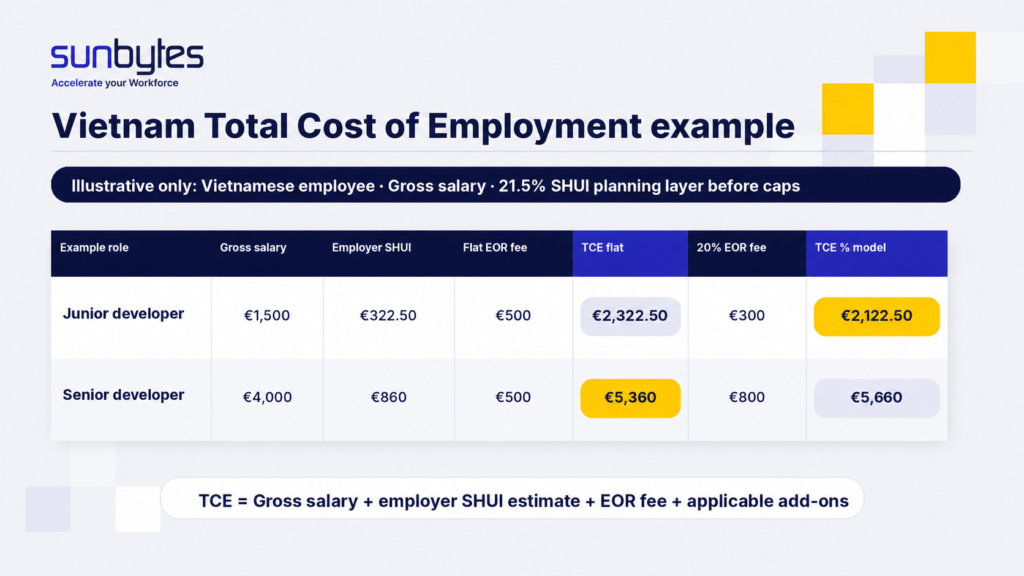
The example below uses assumed salaries for calculation only. These are not salary benchmarks and not Sunbytes quote figures.
Assumptions:
- Employee type: Vietnamese employee in Vietnam
- Salary basis: gross monthly salary
- Employer statutory layer used for planning: 21.5% of insurable salary before caps, made up of social insurance, health insurance, and unemployment insurance
- EOR fee model A: €500 flat monthly fee
- EOR fee model B: 20% of gross salary
- PIT: withheld from employee salary, not added to employer cost unless salary is negotiated on a net basis
- Caps and role-specific benefits require final verification before publishing or quoting
| Example role | Gross monthly salary | Employer SHUI planning estimate | EOR fee, flat model | Estimated monthly TCE, flat model | EOR fee, 20% model | Estimated monthly TCE, percentage model |
|---|---|---|---|---|---|---|
| Junior developer | €1,500 | €322.50 | €500 | €2,322.50 | €300 | €2,122.50 |
| Senior developer | €4,000 | €860 | €500 | €5,360 | €800 | €5,660 |
This table shows why fee structure matters. For the junior developer example, the percentage fee is cheaper than the flat fee. For the senior developer example, the flat fee is cheaper. The calculation finance needs before approving a new country hire. The EOR fee is only one row. The real budget is gross salary, employer contribution, service fee, and any add-ons that apply to the role.
For a deeper Vietnam-only view, use Vietnam EOR cost breakdown with current SHUI rates .
When EOR cost is worth it
EOR cost is usually worth it when speed, compliance, and first-hire readiness matter more than building a full local infrastructure.
It is often a good fit when:
- you are hiring your first employee in a new country
- you need the person to start within weeks, not months
- you want to test a market before opening an entity
- you have selected the candidate but cannot employ them locally yet
- you need payroll, contract, and statutory registration handled before day one
- you want one provider to manage employment administration while your team directs the work
It may not be the best fit when:
- you already have a local entity
- you are hiring a large long-term team in one country
- you need direct local operational control
- your finance team wants to build in-house payroll infrastructure
- local entity setup has already been approved and is close to completion
For many EU companies hiring in Vietnam, EOR is a bridge. It lets the employee start while your business decides whether the market justifies deeper local investment.
Ready to check the real number for your team?
The estimate above gives you the structure.
Your actual EOR quote depends on team size, seniority mix, employee location, statutory caps, benefits, onboarding needs, and whether you use flat-fee or percentage pricing.
Sunbytes can prepare an itemized EOR quote after reviewing team size, role level, and country setup. The quote separates service fee, statutory pass-through, one-time costs, FX handling, and optional add-ons so your finance team can approve the number without guessing what is included.
How Sunbytes connects EOR cost with hiring, security, and delivery setup
EOR pricing becomes easier to approve when the quote reflects the full operating setup around the hire.
The monthly fee is only one part of the decision. Before the employee starts, your team needs the contract ready, payroll funded, statutory registration handled, employee data protected, and onboarding connected to the way the person will actually work.
That is where Sunbytes connects Accelerate, Secure, and Transform around one hiring outcome.
Through Accelerate Workforce Solutions, Sunbytes helps structure the employment setup itself: local contracts, payroll coordination, SHUI registration, PIT withholding, and employment handling in Vietnam. Payroll runs on time. Offboarding is processed within 24 hours after the required approvals and documents are complete. If you also need to find the engineer before employing them, recruitment and EOR can run under one engagement with a single point of contact.
Cybersecurity Solutions matters because EOR setup involves employee data, salary records, identity documents, contracts, access rights, and offboarding evidence. Sunbytes can support secure document handling, DPA alignment, access control, and audit-ready workflows so the employment process does not create unnecessary GDPR or internal security gaps.
Digital Transformation Solutions matters when the hire is joining a delivery team, not just a payroll record. If your Vietnam-based employee needs to plug into product delivery, tooling, reporting, or engineering workflows, Sunbytes can help connect the workforce setup with the way the team works after onboarding.
The goal is not the lowest headline fee. The goal is a quote your HR, finance, security, and delivery stakeholders can trust before the hire starts.