

A working AI-built product answers one question: does it run? An AI code audit answers the next one: will the product hold up when real users, real personal data and a customer’s security team arrive? This article covers the audit of software whose code was written largely by AI tools. Audits carried out by AI tools are a separate question, answered in the section on choosing a provider.
The article follow name the five review areas, the four engagement stages, the three deliverables, and how an audit compares with an automated scan, a penetration test and a secure code review. For the wider route from prototype to live product, read the founder’s guide to ai-generated code in production.
TL;DR
An AI code audit is an independent review of a product whose code was written largely by AI tools such as Lovable, Bolt, Replit or Cursor, checking whether the product is safe and maintainable for real users. The audit supports one decision: launch, sell to an enterprise customer, raise funding or hand the product over to engineers.
- Five review areas make up an AI code audit, each run as a workstream with its own evidence: access and data security, architecture and code quality, critical workflows, deployment and operations, and ownership and handover.
- Four engagement stages structure the audit: scoping, review, report and read-out, and an optional remediation and re-test stage that the contract defines separately.
- Three deliverables come out of the audit: findings with evidence, a prioritised action plan (fix now, can wait, where to start) and a technical handoff that a team or an AI coding tool can act on.
- An AI code audit comes first for a pre-launch AI-built product; a penetration test is added when the threat model or a customer calls for proof that the running product resists attack, and a secure code review fits a mature codebase that needs security-only depth.
Preparing for launch, an enterprise security review or an engineering handover?
A scoped AI-built product review gives you evidence-backed findings, a prioritised fix order and a technical handoff. See what Sunbytes reviews before you commit to the next milestone.
What is an AI code audit?
An AI code audit is an independent review of a software product whose code was written largely by AI tools, checking whether the product is safe and maintainable enough for real users.
An AI code audit is not a certificate and not a penetration test. The audit reads source code, configuration and infrastructure settings, and it produces findings with a fix order rather than a pass or fail stamp.
When an AI-built product needs a code audit
An AI-built product needs a code audit before the first moment someone outside the founding team depends on the code or inspects it. Five events mark that moment:
- Real users or personal data are about to go in. From that point, GDPR Article 32 requires security measures appropriate to the risk.
- An enterprise customer sends a vendor security questionnaire. Many questionnaires follow from NIS2 (Directive (EU) 2022/2555) Article 21(2)(d), which requires in-scope organisations to manage supply chain security, including their relationships with direct suppliers and service providers.
- An investor starts technical due diligence.
- You hire the first engineer or hand the product to an agency.
- Bugs or outages cluster in the weeks after launch.
If none of the five events applies yet, for example a prototype with test data and no paying users, the audit can wait until one of them does.
What an AI code audit covers: five review areas
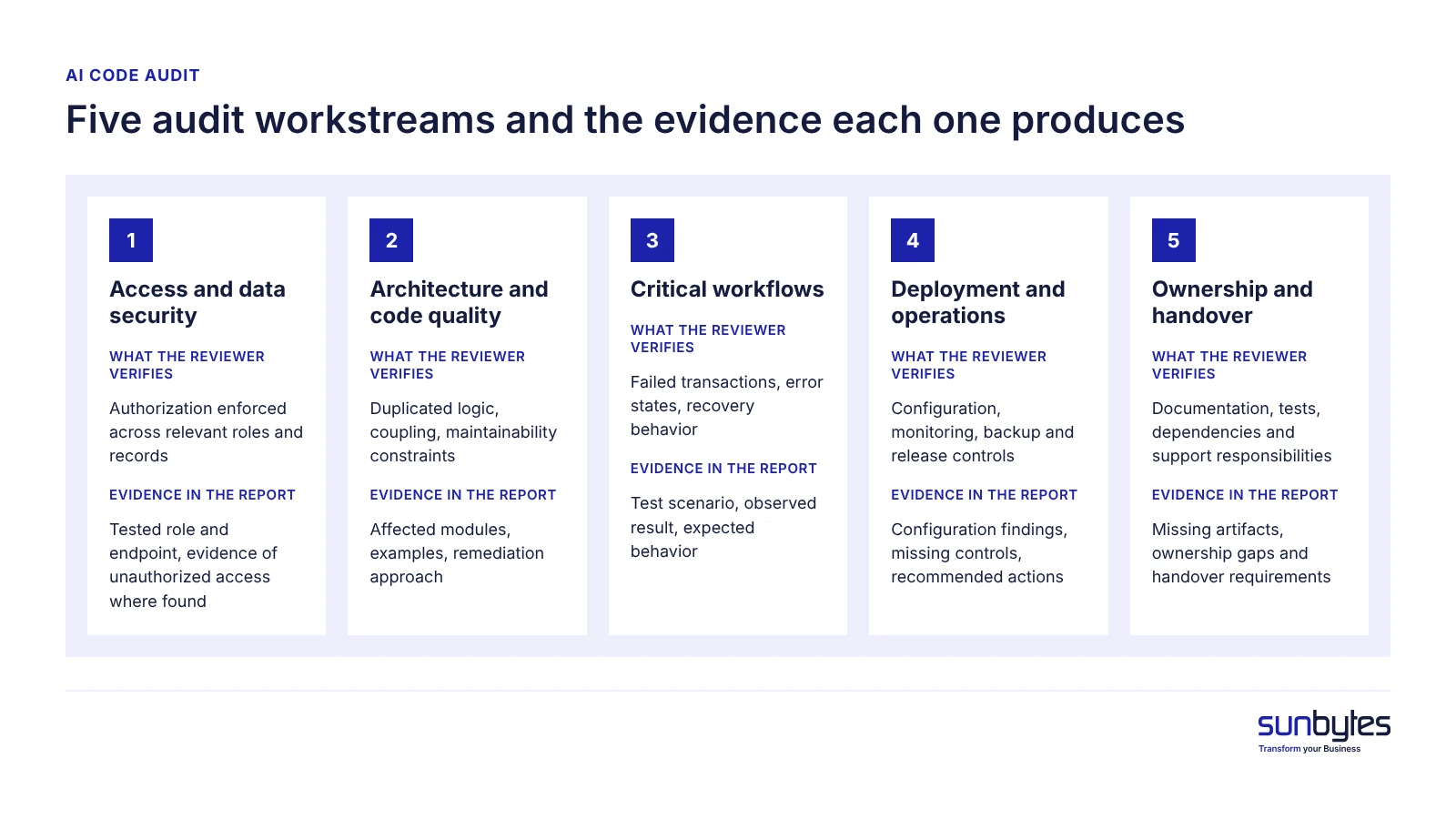
An AI code audit covers five review areas: access and data security, architecture and code quality, critical workflows, deployment and operations, and ownership and handover. For a buyer, the useful scope question is what the reviewer verifies in each workstream and what proof comes back in the report. The failure patterns themselves are described in the guide where AI-built products break and, for security, in vibe coding security risks.
| Audit workstream | What the reviewer verifies | Evidence in the report |
|---|---|---|
| Access and data security | Authorization enforced across relevant roles and records | Tested role and endpoint, evidence of unauthorized access where found |
| Architecture and code quality | Duplicated logic, coupling, maintainability constraints | Affected modules, examples, remediation approach |
| Critical workflows | Failed transactions, error states, recovery behavior | Test scenario, observed result, expected behavior |
| Deployment and operations | Configuration, monitoring, backup and release controls | Configuration findings, missing controls, recommended actions |
| Ownership and handover | Documentation, tests, dependencies and support responsibilities | Missing artifacts, ownership gaps and handover requirements |
A finding enters the report only after the reviewer has validated it. For access and data security, the reviewer reproduces the issue with test accounts in at least two roles and records the request and the response. For critical workflows, the reviewer runs the failure scenario and records the observed result next to the expected behaviour. A suspected issue that cannot be reproduced is reported as a risk to investigate, with the reason it could not be confirmed.
Security findings carry an OWASP Top 10:2025 category where one applies, for example A01:2025 Broken Access Control for a role that can open another customer’s records. For EU products that hold personal data, the access and data security evidence also supports GDPR Article 25 (data protection by design and by default) and Article 32 (security of processing).
Not sure which of the five areas is weakest in your product?
An AI-built product review checks all five in one pass and explains every finding in plain English: what we found, why it matters for your launch, and what to fix first. Engineering and security are reviewed together, so you get one prioritized list instead of two reports that disagree.
AI code audit checklist: 12 checks for an audit proposal
The 12 checks below show whether the scope, evidence, and terms cover what the AI code audit must prove. Use it to compare offers before signing.
| # | Check in the proposal | What a complete answer looks like |
|---|---|---|
| 1 | All five workstreams in scope | Each workstream named, with exclusions stated |
| 2 | Roles and records tested | The user roles and data types the reviewer will test access for |
| 3 | Critical workflows named | Signup, payment or other flows listed, with the failure scenarios to run |
| 4 | Environments covered | Which environments and which configuration the reviewer reads |
| 5 | Dependencies and licences | Whether third-party packages are checked for known vulnerabilities and licence conflicts |
| 6 | Evidence per finding | Location, reproduction steps or test result, and severity for every finding |
| 7 | Validation method | How findings are confirmed, and how unconfirmed risks are labelled |
| 8 | Prioritisation method | How severity and fix order are set against your decision and date |
| 9 | Report format and read-out | A sample finding or report extract, plus a read-out with the decision owner |
| 10 | Confidentiality and access | Read-only access, named reviewers, an NDA and how code access ends after the audit |
| 11 | Independence | Who builds or fixes the product, and whether the reviewer is separate from that work |
| 12 | Re-test terms | Whether re-testing is included, how many rounds and within what period |
Checks 6, 7 and 12 are the ones a scanner-based offer cannot answer: a scan output has no reproduced evidence, no validation step and no re-test terms.
How the AI code audit process works
An AI code audit engagement runs in four stages, and each stage has a client input, a reviewer activity and an output that marks the stage as done. Stages 1 to 3 are the audit itself. Stage 4, remediation and re-test, is a separate scope that the contract has to define.
| Audit stage | Client input | Reviewer activity | Output or acceptance point |
|---|---|---|---|
| 1. Scoping | The decision the audit supports, environments, user roles, read-only repository access | Agrees workstreams, critical workflows and exclusions; confirms access and confidentiality terms | Signed scope with workstreams, workflows in scope and report date |
| 2. Review | Answers to reviewer questions; a test account per role | Reviews code, configuration and deployment across the five workstreams; tests critical workflows and role access | Draft findings, each with evidence |
| 3. Report and read-out | Decision owner and technical lead attend the read-out | Prioritises findings and walks through evidence and fix order | Final report accepted: findings, prioritised action plan, technical handoff |
| 4. Remediation and re-test (optional) | Fixes by your team, your AI coding tool or a partner; list of findings claimed as fixed | Re-tests each claimed fix against the original evidence | Re-test result per finding: closed, partly closed or open |
Remediation and re-testing are not part of the audit by default. Agree three terms before scoping closes: whether a re-test is included, how many rounds, and within what period after the report.
What to prepare before the audit
Five inputs let the review start on day one:
- Read-only access to the code repository.
- A list of environments (development, staging, production) and third-party services such as payments, email, login and AI model APIs.
- The user roles and what each role may see or change.
- Known issues, bugs and outages so far.
- The decision the audit must support, and its date.
Code access is the founder’s first confidentiality question, and the answer to ask for is concrete: only named reviewers see the code, access is read-only, and an NDA covering the code and the findings is signed before access is granted. At Sunbytes, code access is handled under an ISO/IEC 27001:2022-certified information security management system (ISMS).
Timeline and cost
The timeline and cost of an AI code audit depend on four drivers: the size of the codebase, the number of user roles and integrations, the number of environments, and whether a re-test is included. A fixed scope agreed in the first stage sets both before the review starts. Our ai code audit cost explains how each driver moves the price.
What you receive: audit deliverables
An AI code audit delivers three things: clear findings, a prioritised action plan and a technical handoff. Each deliverable is written so a non-technical founder can decide and an engineer or an AI coding tool can act.
- Clear findings: what was found, why it matters, and the evidence (file, endpoint, request and response).
- Prioritised action plan: what to fix now, what can wait, and where to start.
- Technical handoff: instructions your team or an AI coding tool can act on.
A scanner export is not an audit report. A scanner lists pattern matches with severity scores; an audit finding adds the business impact, the evidence that the issue is reachable and its place in the fix order. A full example of a code audit report shows how the three deliverables fit together.
AI code audit vs penetration test vs secure code review
An AI code audit is the first check when the decision is whether an AI-built product is ready for real users. A penetration test or a secure code review is added when the risk calls for more depth in one direction, and the choice depends on the threat model and the data the product holds as much as on a customer request. Choose a secure code review when the codebase is mature and the open question is security depth in specific modules.
| Situation | Recommended check | Why |
|---|---|---|
| Pre-launch or newly launched AI-built product; the decision is launch, sale, funding or handover | AI code audit | Covers engineering and security across five workstreams and produces a fix order |
| The product holds payment, health or other high-impact personal data, or is a likely target | AI code audit, then a penetration test | The threat model calls for proof that the running product resists an attacker, once the audit fixes are in |
| A customer or auditor asks for test evidence from the running system | Penetration test, after or alongside the audit | The evidence has to come from attacking the live system, not from reading code |
| Mature codebase, engineering quality under control, security depth needed in specific modules | Secure code review | A line-by-line security review of the modules that carry the risk |
How to choose an independent AI code audit provider
An independent AI code audit provider should be able to explain who reviews your product, how findings are validated and what evidence you receive. The review scope, confidentiality terms and any remediation work should be clear before you sign.
To compare providers, use our guide to choosing an AI code audit company. It includes eight questions to ask, red flags to watch for and a weighted scorecard for evaluating proposals.
AI audit tools and scanners belong in the pipeline and can feed the review, but they do not judge business rules, role design or the fix order for a specific launch. The full argument is in the founder’s guide under who should review AI-generated code, and in ai code review. When the findings point to structural problems, the keep, refactor or rebuild decision is covered in the founder’s guide under fix, refactor or rebuild, and in refactor or rewrite.
How Sunbytes reviews AI-built products
Most risks in AI-built products emerge where code, user permissions, data and critical workflows connect. That is why Sunbytes approaches its AI-built product review as an independent assessment of product readiness, rather than a reason to redesign the product.
Our engineering, QA and security specialists combine manual review with automated tools to validate findings and provide evidence-backed recommendations. The review typically takes five business days from complete access, with scope and data handling agreed upfront. You receive a plain-English report showing what needs fixing before wider use and what can wait.
When deeper security testing is needed, our Cybersecurity Solutions team can conduct a separate penetration test or secure code review. If remediation requires additional engineering capacity, a dedicated software development team can support the fixes under a separate agreement. You remain free to work with your own team or another provider.
Sunbytes brings 15+ years of experience, 300+ delivered projects across 20 countries and ISO/IEC 27001:2022 certification to its technical reviews.
Explore our AI-built product review or discuss your AI-built product with our team before your next launch, enterprise deal or engineering handover.