
Most AI code audit companies describe themselves in the same words: senior engineers, an NDA, a clear roadmap. The difference shows when you ask how they will test who can see which data in your product.
This guide is for founders and COOs of products built with AI tools. It covers the four kinds of AI code audit company you will meet, eight questions to ask on the first call, the red flags that end a conversation and a scorecard to compare two or three providers in 5 working days. It builds on our guide to ai-generated code in production.
TL;DR
Choose an AI code audit company by how specifically it answers eight questions about who reviews your product, how it tests who can see which data, how it proves its findings and what it earns after the audit. Homepage claims do not separate providers; a 30-minute call does.
- Four kinds of AI code audit company sell this work: AI-built product audit specialists, software development agencies, security and penetration testing firms, and independent senior freelancers. Each earns on something different once the report is delivered.
- Eight questions cover the reviewers, typical AI-built findings, access testing, scope limits, a sample finding, fix order, the fix contract and code access.
- Seven red flags need a clear answer before a provider makes the shortlist, including a full review promised without a defined scope, reviewers nobody can name and a free audit tied to a rebuild.
- Minimum requirements come before the scorecard: providers that meet them are scored 0–2 per question, with double weight on access testing, sample evidence and the fix contract, and compared within 5 working days.
What an AI code audit company does — and the four kinds you will find
An AI code audit company reviews a product built largely with AI coding tools such as Lovable, Bolt, Replit or Cursor and reports whether it is secure, maintainable and ready for real users, with evidence for each finding and an order in which to fix them. What the review covers in detail is explained in our guide to the ai code audit.
Four kinds of company sell this work. They differ less in skill than in what they earn on once the report is delivered, and that incentive shapes how each kind scopes the review.
| Kind | What they usually sell | What they earn on after the audit | Fits when | Ask carefully about |
|---|---|---|---|---|
| AI-built product audit specialists | Fixed-scope review packages for apps built with AI tools | Follow-up packages, re-checks, sometimes fixing | One pre-launch product with a clear date | How much of the review a person does beyond automated tools |
| Software development agencies that also audit | An audit as the first step of a rebuild, extension or retainer | Development work | You also want a team to build the next version | Whether the audit is priced and contracted apart from the build |
| Security and penetration testing firms | Security code review or a penetration test | Security testing and retests | A customer or regulator wants a security test report | Whether architecture and maintainability are in scope |
| Independent senior freelancers | Review hours from one experienced engineer | Further hours | A small codebase or one feature | Security coverage and who takes over if they are unavailable |
Automated platforms such as SonarQube, Snyk Code and Semgrep are tools, not AI code audit companies. They belong in your delivery pipeline and in every provider’s method. Tools can test access rules once those rules are defined, but they cannot independently determine the permission model your product is meant to have.
For a pre-launch AI-built product that holds personal data, we’d recommend a provider that reviews engineering and security together and prices the review separately from any fix work. Add a security firm when a contract asks for a penetration test report. If you only need a second check on a few risky changes, a structured ai code review inside your own team can be enough before you hire anyone.
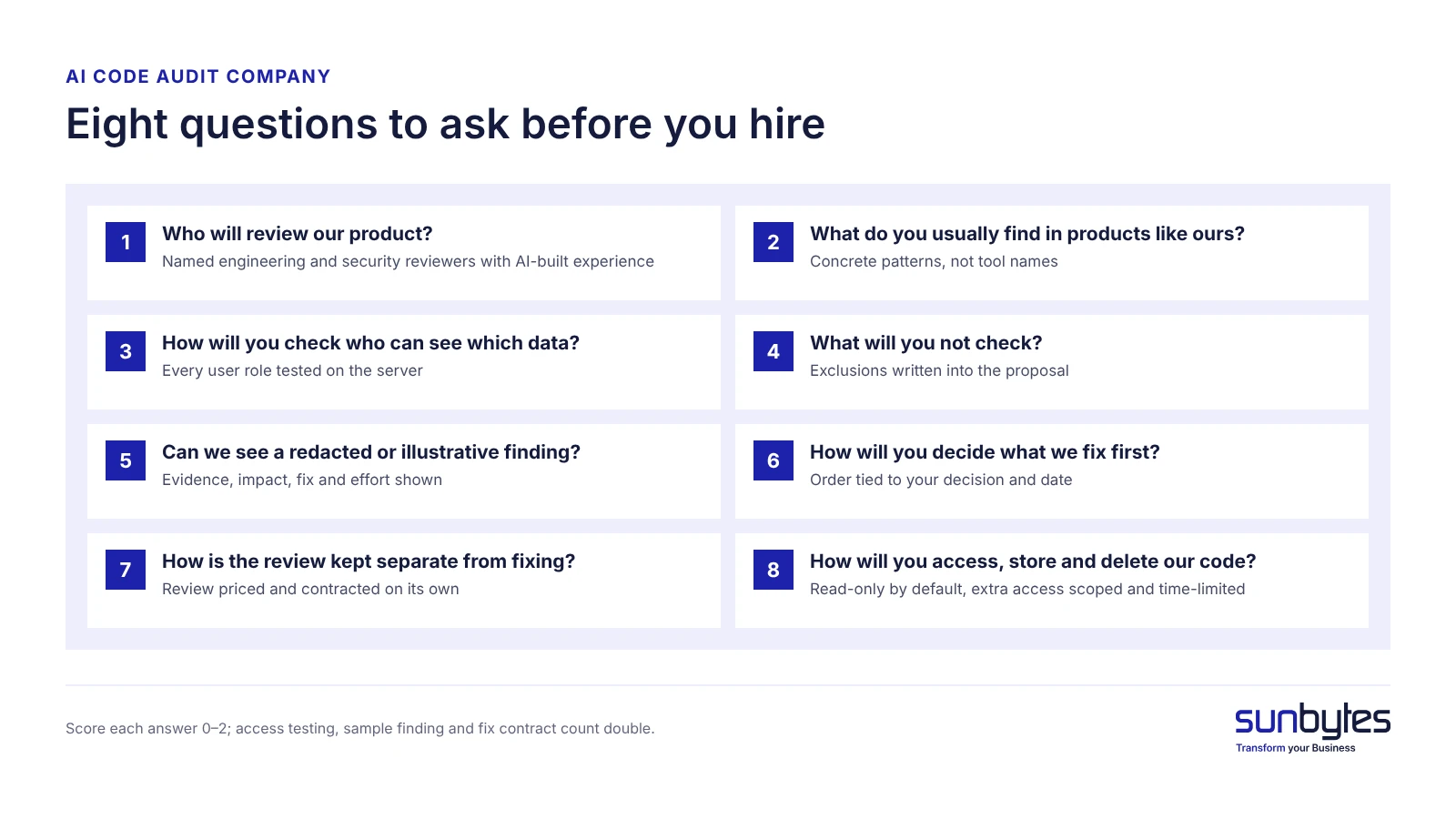
8 questions to ask an AI code audit company
Eight questions, asked in one 30-minute call, separate AI code audit companies faster than any proposal. You do not need to judge the technical detail of each answer. Judge how specific it is: named people, named documents and named tests count for more than general reassurance.
1. Who will review our product, and what have they reviewed that was built with AI tools?
Products built with AI tools share a shape: a generated front end, a hosted back end such as Supabase or Firebase, and business rules spread across many files. A reviewer who has seen that shape before knows where the problems usually sit.
A specific answer names the people who will read your code, their roles in engineering and security, and two or three comparable products they reviewed, without client names. A vague answer refers to “our senior team” and moves straight on to the process.
2. What do you usually find in AI-built products like ours?
The second question tests experience without asking for references. Reviewers who audit AI-built products every month can list the patterns they meet most often.
A specific answer names concrete findings: database access rules left open, API keys in front-end code, checks that run only in the browser, the same business rule written three different ways, and no tests on payment or sign-up flows. A vague answer is “we run our tools and see what comes up”.
3. How will you check who can see which data?
Access control is one of the most consequential risks to test in an AI-built product, and broken access control is ranked first in the OWASP Top 10:2025 as A01. Tools can check access rules once someone has defined them; a reviewer first has to establish the intended rules, for example that a coach may see their own clients but not another coach’s.
A specific answer describes logging in as each real user role and trying to read or change another user’s records, checked on the server and not only in the interface. A vague answer is “our scanner covers the OWASP Top 10”.
4. What is in scope, and what will you not check?
Every audit has limits, and limits nobody wrote down read as approval. A founder who assumes the mobile build or the behaviour of an AI model was checked can make a launch decision on a gap.
A specific answer lists the exclusions in writing, for example live attack simulation, third-party services you do not control or the behaviour of an AI model your product calls. A vague answer is “we check everything”.
5. Can we see a redacted or illustrative finding?
One sample finding shows more about an AI code audit company than its sales deck, because it shows whether the provider proves problems or only lists them. Some providers cannot share real client findings under their NDAs; an anonymised or realistic illustrative finding with the same evidence fields serves the same purpose. Ask for it before the proposal, not after you sign.
A specific answer is a finding, real with client details removed or illustrative, that shows where the problem sits, the evidence or reproduction steps, the business impact in plain language, the fix and the effort. A vague answer is a raw tool export or a slide with a severity chart. Our guide to the code audit report shows what a complete finding contains.
6. How will you decide what we fix first?
A list of 60 findings without an order does not help a founder with a launch date. The order should follow your decision: going live with real users, an investor meeting or a customer’s security questionnaire due in three weeks.
A specific answer explains how severity is weighed against your date and your users, and which findings would block launch versus which can wait for the next sprint. A vague answer sorts by tool score only.
7. Do you also offer to fix the findings, and how is the review kept separate?
Many AI code audit companies also sell remediation, and that is not a problem in itself. The risk is a review shaped by the work that follows it: more findings, or bigger ones, when the provider earns on the fixes.
A specific answer says the review is scoped and priced on its own, you choose who fixes, and the findings are written so your own team or your AI coding tool can act on them without the provider. A vague answer is a free or heavily discounted audit that applies only if you sign for the rebuild.
8. How will you access, store and delete our code?
A repository holds your product, often customer data in seed files, and sometimes keys that open production. The access terms of an AI code audit company matter as much as its review method.
A specific answer starts from read-only access to the relevant code repositories, information about the deployment environment and appropriate test accounts. The exact permissions depend on the agreed scope: if a reviewer needs more access to validate a configuration or reproduce an issue, the request should state why, which environment it covers and when access will be removed. A vague answer asks for unrestricted production administrator access as a default, or keeps a copy of your code “for reference”.
Want to hear how we answer these eight questions for your product?
An AI-built product review starts with scoping your product, then reviews engineering and security together and explains every finding in plain English: what we found, why it matters for your decision and what to fix first. You get a technical handoff your team, or your AI coding tool, can act on.
Red flags in an AI code audit sales call or proposal
Seven red flags deserve a clear answer before an AI code audit company makes your shortlist. None of them is about price alone: a low price can be a fair fixed-fee package for a small product.
| Red flag | Why it matters | Ask instead |
|---|---|---|
| A full review promised within hours, without a defined scope | A narrow automated check can be fast; a full review of access rules and business logic needs an agreed scope and human validation | What exactly is in scope, and which findings will a person validate? |
| Nobody can name who will read the code | You cannot check experience or confidentiality | Who exactly, in which role? |
| No sample finding of any kind | You cannot judge evidence quality before you pay | Can you show an anonymised or illustrative finding with the full evidence fields? |
| A promise to certify the product “secure” | No review proves the absence of all defects; a report states what was checked | What will the report state, and what will it not? |
| A price before anyone has seen the scope | The quote cannot reflect your integrations, data or deadline | What do you need from us to scope it? |
| A free audit if you sign for the rebuild | Findings may be shaped by the work that follows | Can we buy the review on its own? |
| Unrestricted production administrator access requested by default | Elevated access should be limited to what the scope needs, time-limited and explicitly approved | Which access do you need, for which environment, and when is it removed? |
Treat each red flag as a question that needs a clear answer. Resolve the ones that matter for your product, such as scope, access terms or evidence quality, before the provider makes the shortlist.
Match the AI code audit company to the decision you need to make
The right AI code audit company depends on the decision the report must support, and four decisions cover most AI-built products. For organisations within NIS2 scope, Article 21(2)(d) of the NIS2 Directive makes supply-chain security part of their risk-management obligations, including relationships with direct suppliers and service providers. That gives some enterprise customers a specific reason to request evidence about software security, review processes and supplier access controls. If your customer has security requirements under NIS2 or its national implementation, ask which evidence the proposed audit must produce before choosing a provider.
| Decision | What the report must give you | Shortlist | Insist on |
|---|---|---|---|
| Launch to real users with personal data or payments | A launch verdict with the blockers named | A specialist or agency that reviews engineering and security together | Access testing with every user role |
| An enterprise customer sends a vendor security questionnaire | Evidence you can attach to your answers | A specialist, plus a security firm if the contract asks for a test report | A report you may share under NDA |
| Investor technical due diligence | An independent view of risk, maintainability and ownership | A specialist or independent firm, not your current builder | Separation from any fix work |
| Handover to a new team or agency | A map of the codebase and its weakest parts | A specialist, or the incoming agency with a second opinion if it will also rebuild | A technical handoff written for the next team |
When one product faces two of these decisions at once, scope the audit for the evidence each decision needs and the risk involved, rather than ranking one decision above the other. An investor may need evidence on ownership and maintainability; an enterprise customer may need access-control evidence it can attach to a questionnaire.
How to compare AI code audit providers in five working days
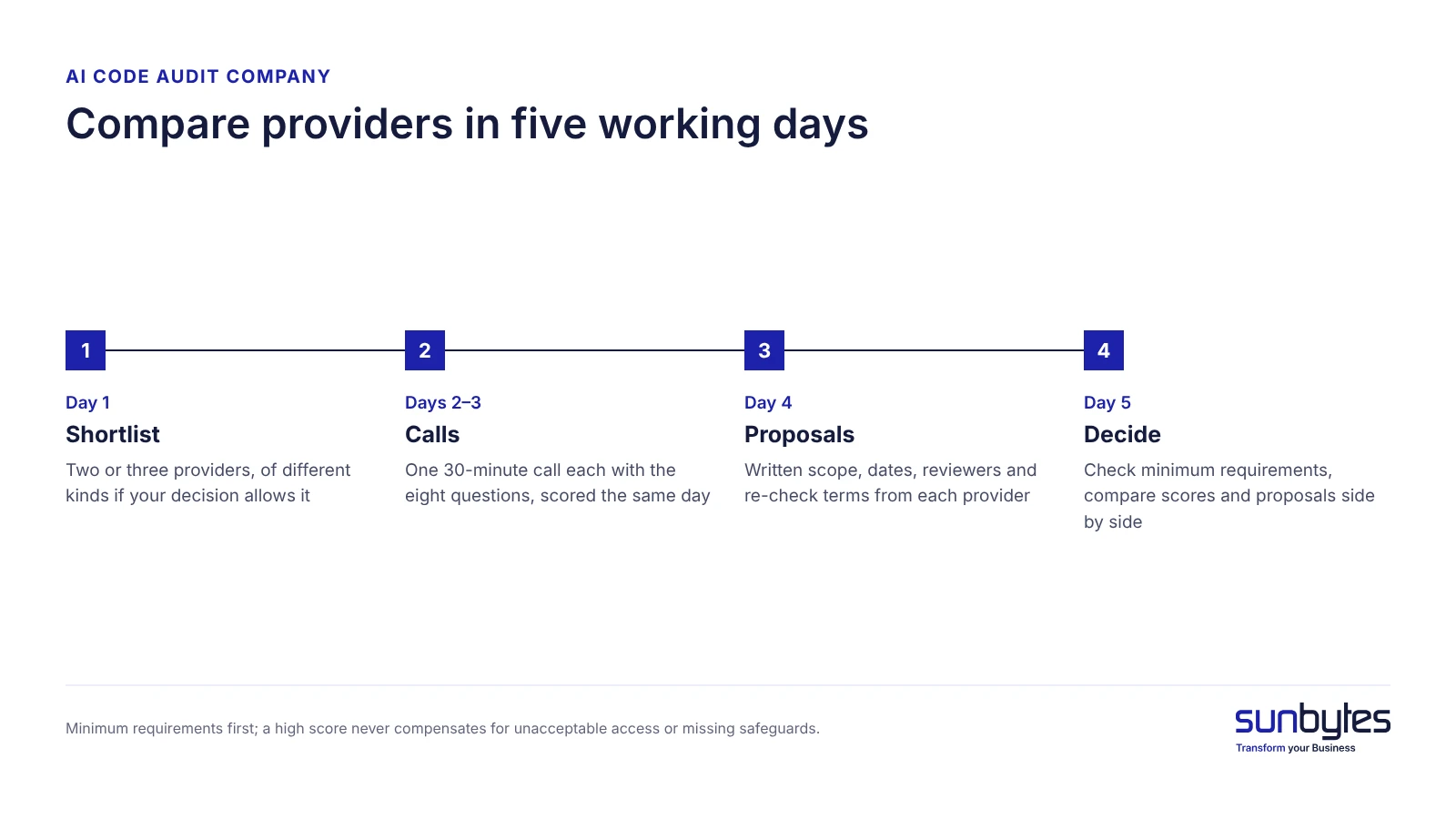
Two or three AI code audit providers can be compared in 5 working days with one call each, a minimum-requirements check and one scorecard. The plan keeps the decision on evidence rather than on the best sales call.
- Day 1: shortlist two or three providers, from different kinds in Table 1 if your decision allows it, and book the calls.
- Days 2–3: hold one 30-minute call with each provider, ask the eight questions and score the answers the same day.
- Day 4: ask for written proposals and check what each quote states about scope, dates, reviewers and re-checks, as set out in our guide to ai code audit cost.
- Day 5: check the minimum requirements, compare scores and proposals side by side, then decide.
Companies certified to ISO/IEC 27001:2022 treat the chosen provider as a supplier: Annex A controls 5.19 and 5.20 expect information security requirements to be agreed with suppliers, and the proposal is where those terms start.
| Question | Listen for | Weight | Provider A | Provider B | Provider C |
|---|---|---|---|---|---|
| 1. Reviewers and AI-built experience | Named people in engineering and security, comparable products | ×1 | |||
| 2. Typical AI-built findings | Concrete patterns, not tool names | ×1 | |||
| 3. Access testing | Every user role tested on the server | ×2 | |||
| 4. Scope and exclusions | Exclusions in writing | ×1 | |||
| 5. Redacted or illustrative finding | Evidence, impact, fix and effort shown | ×2 | |||
| 6. Fix order | Order tied to your decision and date | ×1 | |||
| 7. Fix contract | Review priced and contracted on its own | ×2 | |||
| 8. Code access | Read-only by default, extra access scoped and time-limited | ×1 | |||
| Total | Maximum 22 points |
Score 0 for a vague answer, 1 for a partly specific one and 2 for an answer backed by a document, a sample or a named person, then apply the weights. The eight criteria carry 11 weight points in total, so the maximum is 22.
Check minimum requirements before comparing scores
Use the 22-point scorecard only after confirming that each provider meets the minimum conditions for your product. A provider should be able to document the audit scope and exclusions, explain how access-control testing will be performed, demonstrate the quality of its findings, and agree on appropriate confidentiality and code-access terms.
If a provider cannot meet a condition that is essential for your project, resolve that gap before ranking it against others. A high total score should not compensate for unacceptable access permissions, missing confidentiality safeguards or a report that cannot support your launch decision.
For providers that meet your minimum requirements, score each answer from 0 to 2 and apply the listed weights. Compare the written proposals alongside the scores, including price, availability, deliverables and re-test terms: two providers with close totals can still differ on scope, exclusions or security evidence.
EU checks: code access, personal data and where reviewers sit
Before sharing your code with an AI code audit provider, confirm what information the reviewers will access, where it will be accessed and which contractual safeguards apply.
Personal data in the review environment. If the provider processes personal data on your behalf, GDPR Article 28 requires an appropriate data processing agreement, in the Netherlands a verwerkersovereenkomst. Confirm the parties’ roles and the data involved before granting access. Where possible, use synthetic or anonymised test data to reduce unnecessary exposure.
Reviewers outside the EEA. Access to personal data by a separate organisation outside the European Economic Area may involve an international transfer under GDPR Chapter V. Identify the relevant transfer mechanism, which may include an adequacy decision or appropriate safeguards such as the European Commission’s Standard Contractual Clauses. Assess any additional safeguards required for the particular transfer; the EDPB collects the related guidance.
Certificate scope. If a provider relies on ISO/IEC 27001 certification, request the certificate and check whether the relevant services and operations fall within its stated scope.
Sharing the report. Agree which parts of the audit report may be shared with customers, investors or other third parties, and under what confidentiality terms.
How Sunbytes helps you evaluate an AI-built product before the next decision
A useful AI code audit goes beyond scanning code. It checks whether the application’s permissions, business logic and critical workflows behave as intended, then explains which findings could affect your launch, customer contract or engineering handover.
Sunbytes approaches this through its AI-built product review. Engineering and security specialists examine the agreed scope across five areas: security and data, code and architecture, reliability and critical flows, deployment and operations, and maintainability and code ownership. The findings come with supporting evidence, a prioritised action plan and technical handoff guidance that your team can act on.
The review stands on its own, so you can decide whether to fix the findings internally, engage another provider or discuss remediation with Sunbytes. Specific access arrangements, confidentiality requirements and any follow-up work are agreed during scoping.
With 15+ years of software delivery experience, 300+ projects delivered and an ISO/IEC 27001-certified information security management system, Sunbytes brings engineering and security experience to the same product review.
Comparing providers for an upcoming launch or customer requirement? See what the AI-built product review covers and use the eight questions above to evaluate the fit.