

GDPR DevSecOps starts with one practical shift: privacy and security evidence should be created during delivery, not collected after an audit request.
For EU SaaS teams, GDPR-compliant DevSecOps means translating privacy by design and security-of-processing expectations into delivery controls inside the software pipeline. The goal is to make each release easier to evidence: what changed, who approved it, which risks were checked, and which legal or DPO decisions sit outside engineering.
If your team still needs the basic model before applying GDPR controls, start with Sunbytes’ guide to what DevSecOps means for EU tech leaders.
TL;DR
GDPR DevSecOps means embedding Article 25 and Article 32 controls into the software delivery workflow so every release leaves an audit trail.
- Article 25 belongs in backlog refinement, architecture decisions, data minimisation checks, default settings, and data-flow review.
- Article 32 belongs in access control, encryption, logging, vulnerability remediation, secrets handling, backup checks, and release approval.
- Engineering can produce per-release evidence, but legal, DPO, and compliance still own lawful basis, consent, DPIA scope, DPA terms, and regulator-facing decisions.
Best fit: EU SaaS teams that already ship through CI/CD and need GDPR-aware delivery controls without turning every sprint into a legal review.
Watch out: DevSecOps supports GDPR evidence. It does not prove full GDPR compliance on its own.

What does GDPR-compliant DevSecOps actually mean?
GDPR-compliant DevSecOps means engineering teams build privacy and security controls into the software delivery lifecycle, then keep evidence for every material release. In practical terms, it connects GDPR Article 25 and Article 32 to backlog decisions, CI/CD gates, access reviews, vulnerability tickets, and release approvals.
Article 25 is the privacy-by-design and privacy-by-default obligation. For software teams, that usually means personal data should be considered before a feature reaches production, not after the feature is already live. A new onboarding flow, analytics event, customer dashboard, or support workflow should make clear what personal data is collected, why it is needed, how long it is kept, and who can access it.
Article 32 is the security-of-processing obligation. For engineering, that usually translates into technical and organisational controls: encryption, access control, resilience, restore capability, vulnerability handling, and regular checks that controls still work.
In search terms, gdpr devsecops often looks like a technical query. In practice, it is an ownership question. Which GDPR expectations can engineering turn into repeatable controls, and which decisions need legal, DPO, or compliance review?
The answer should be clear before the first sprint. Engineering can enforce secure coding, dependency checks, access controls, logging, and release evidence. Engineering should not decide lawful basis, consent validity, DPIA scope, or contractual processor terms alone.
Which GDPR obligations belong in the software delivery workflow?
The GDPR obligations that belong in software delivery are the ones engineering can control, test, document, or escalate before release. For EU SMEs, the practical shortlist is data minimisation, default privacy settings, access control, encryption, logging, retention, vulnerability remediation, and data-flow change review.
The mistake is treating GDPR as a policy folder that sits outside delivery. If a SaaS team collects new personal data in sprint 18, changes a data retention rule in sprint 22, or gives support staff access to production records in sprint 25, the policy folder is already behind the product. The pipeline should catch the change before production.
A workable GDPR DevSecOps model uses four delivery checkpoints:
| Delivery checkpoint | GDPR concern | What the team should decide before release |
|---|---|---|
| Backlog refinement | Data minimisation and purpose | Does this feature need this personal data, or can the same outcome be built with less data? |
| Architecture or design review | Privacy by design | Does the design reduce exposure by default, or does it create unnecessary access paths? |
| CI/CD and security gates | Security of processing | Have code, dependencies, secrets, infrastructure, and access changes been checked? |
| Release approval | Evidence and accountability | Is there a release record showing what changed, who approved it, and what risk was accepted? |
Data minimisation should appear in user stories and acceptance criteria. A ticket that introduces a new customer field should state why the field is needed. If the field is optional, default settings should keep it off or uncollected unless there is a defined reason.
Access control should appear in role and permission changes. If support, operations, or engineering teams need production data access, the release record should show the role, the access reason, the approver, and the expiry or review date.
Encryption, logging, and retention should appear in architecture and infrastructure changes. A change to storage, event tracking, backups, or data deletion should not pass as a normal feature ticket. It should trigger a data-flow review.
For teams that already use ISO 27001 as part of their control model, the GDPR workflow should connect to existing access control, supplier, change management, and evidence routines. Sunbytes’ guide to the ISO 27001 certification process is useful when the team needs a wider management system around delivery evidence.
How should GDPR controls appear inside CI/CD?
GDPR controls should appear inside CI/CD as release gates that produce evidence per release. The strongest setup combines automated checks, manual approvals for high-risk changes, and clear owners for each artifact.
Automation is useful when the signal is objective: dependency vulnerabilities, secrets in code, infrastructure policy violations, container image issues, or missing tests. Manual review is still needed when the decision is contextual: whether a new feature collects too much personal data, whether production data access is justified, or whether a vulnerability exception should be accepted for one release.
NIST SSDF gives software teams a useful reference for secure development practices. OWASP SAMM is also useful when the team wants to assess software security maturity across governance, design, implementation, verification, and operations. For GDPR DevSecOps, these frameworks should be translated into evidence the team can keep per release, not copied into a policy document without delivery ownership.
If your team needs the pipeline mechanics behind these gates, Sunbytes’ guide to DevSecOps pipeline controls explains where checks usually sit across code, build, test, deploy, and monitor stages.
| GDPR obligation | DevSecOps control | Evidence artifact | Owner | Review cadence |
|---|---|---|---|---|
| Article 25: data protection by design | Data-flow review for new or changed personal data processing | Data-flow change record, architecture note, approved user story | Product owner + engineering lead | Per release |
| Article 25: data protection by default | Default privacy settings, feature flag review, least-data acceptance criteria | QA checklist, configuration snapshot, release note | Product owner + QA lead | Per release |
| Article 32: confidentiality and integrity | SAST, SCA, secrets scanning, container or IaC policy checks | Scan report, resolved vulnerability tickets, approved exceptions | Security lead + development lead | Per release |
| Article 32: access control | Role-based access control, production access review, break-glass logging | Access review record, approval log, expiry or review date | Platform owner + security lead | Per release |
| Article 32: encryption and secure configuration | TLS checks, storage encryption, KMS or secrets manager review | IaC scan result, configuration record, secrets rotation ticket | DevOps or platform engineer | Per release |
| Article 32: resilience and recovery | Backup, rollback, monitoring, incident runbook check | Release runbook, backup check record, incident response update | DevOps/SRE lead | Per release |
| Processor accountability and DPA readiness | Third-party dependency and vendor access check | Vendor change note, DPA review request, supplier record | Procurement/compliance + engineering owner | Per release when vendor access changes |
If this table shows missing owners, missing evidence, or too much manual work falling on senior engineers, the next step is not another policy document. It is delivery capacity with security discipline built into the sprint.
Sunbytes can help EU SaaS teams add DevSecOps capacity through Dedicated Remote Developers, so GDPR-aware controls can be mapped into backlog, CI/CD, access review, and release evidence without restarting the hiring cycle.
What should engineering teams document for GDPR evidence?
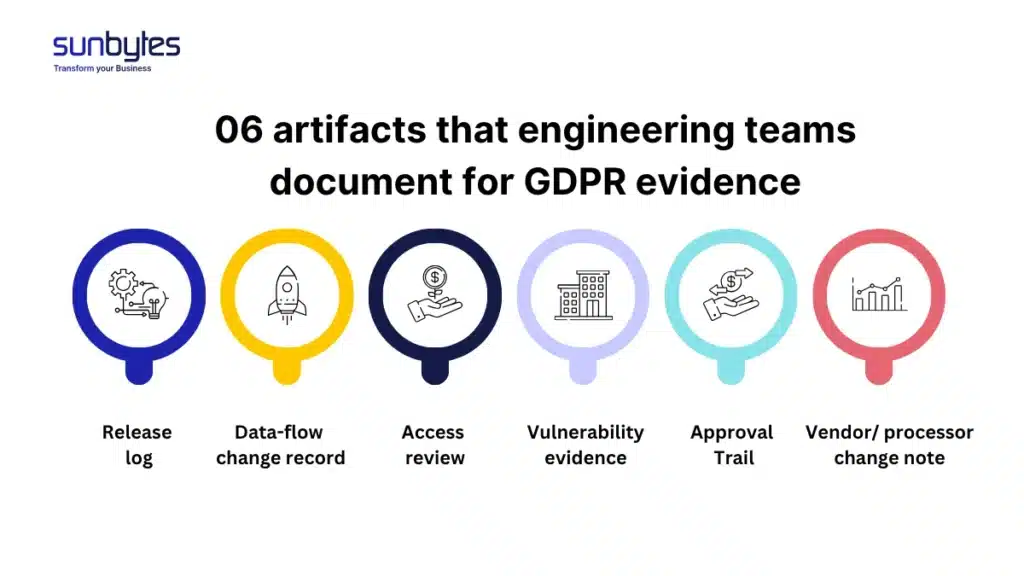
Engineering teams should document the release decisions that prove privacy and security controls were applied before production. For EU SaaS delivery, the minimum evidence set should be created per release, then stored where compliance, security, and delivery leads can retrieve it without chasing individual developers.
- The first artifact is the release log. It should show what changed, which services or data flows were affected, who approved the release, and whether any security or privacy exception was accepted.
- The second artifact is the data-flow change record. This matters when a feature introduces new personal data, sends data to a new third party, changes retention, or changes who can access records. The record does not need to be long. It needs to answer: what data changed, where it moves, who uses it, and whether legal or DPO review is needed.
- The third artifact is the access review. If a release changes roles, permissions, production support access, admin access, or break-glass procedures, the evidence should show the approver and the review cadence.
- The fourth artifact is vulnerability evidence. SAST, SCA, secrets scanning, and infrastructure checks should produce a result. High and critical findings should have tickets. If the team accepts a risk for one release, the exception should name the owner, expiry date, and mitigation.
- The fifth artifact is the approval trail. This includes pull request approvals, security sign-off for high-risk changes, QA results, and release manager approval. The point is not to slow down every release. The point is to avoid a release process where nobody can later explain why a risk was accepted.
- The sixth artifact is the vendor or processor change note. If a release adds a new analytics tool, AI service, cloud integration, support platform, or external processor access, engineering should flag the change. Legal or compliance can then check the DPA or supplier terms before the data flow becomes part of production.
A clean evidence trail reduces rework. When evidence is missing, teams often reconstruct decisions weeks later from Slack messages, Jira comments, pull requests, and memory. That is slow, and it weakens accountability.
Where DevSecOps stops and legal/GRC starts
DevSecOps stops where the decision requires legal interpretation, regulatory judgement, or formal governance approval. Engineering can produce evidence and enforce controls, but it should not own lawful basis, consent validity, DPIA scope, DPA terms, or regulator-facing positions alone.
This boundary should be visible in the operating model. A GDPR-aware pipeline does not remove legal or DPO review. It gives legal and DPO stakeholders better inputs: data-flow changes, access records, vulnerability status, exception logs, and supplier change notes.
| Area | Engineering can own | Security can own | Legal/DPO/GRC should own | Shared decision point |
|---|---|---|---|---|
| Data minimisation | Flag new personal data fields and alternatives | Review exposure risk | Confirm whether processing is justified | Feature can proceed when purpose and data need are clear |
| Privacy by default | Build default settings and acceptance criteria | Review security impact | Confirm privacy wording or consent implications | Default setting is approved before release |
| Access control | Implement roles, permissions, and logging | Review privileged access | Define governance expectations where needed | Production access has owner, reason, and review record |
| Vulnerability handling | Fix defects and document exceptions | Set severity, remediation expectations, and exception rules | Review customer, contractual, or regulatory exposure when needed | High-risk exceptions have expiry and owner |
| DPIA | Provide technical data-flow input | Provide risk input | Decide whether DPIA is required and approve scope | Engineering supplies evidence before DPIA decision |
| DPA and vendor terms | Flag new processor or integration | Review security controls | Review and approve contract terms | Vendor change does not go live before legal review when personal data is involved |
This is also where GDPR DevSecOps differs from NIS2 DevSecOps. GDPR focuses on personal data protection, privacy by design, and security of processing. NIS2 focuses on cybersecurity risk management and incident reporting duties for in-scope organisations. For Dutch companies preparing for NIS2, Sunbytes’ article on NIS2 compliance for Dutch companies covers that separate obligation.
How Sunbytes supports GDPR-aware DevSecOps delivery
Sunbytes helps EU SaaS teams turn GDPR-aware delivery expectations into working engineering routines: backlog checks, CI/CD controls, access review evidence, vulnerability tickets, and release approval records.
This matters when the internal team already knows what should happen, but lacks the capacity to make it repeatable. A senior developer can add a secrets scanner once. A delivery team needs ownership, review cadence, and evidence discipline to keep that control working across releases.
Sunbytes is a Dutch technology company with headquarters in the Netherlands and a delivery hub in Vietnam. For GDPR-aware DevSecOps delivery, that setup helps European teams add engineering capacity while keeping communication close to Dutch and EU working practices. Dedicated senior teams are typically operational within 2 to 4 weeks, with a 4 to 5 hour Amsterdam-Vietnam overlap for sprint planning, review, and escalation.
Sunbytes is ISO 27001 certified. That does not make a client product automatically GDPR compliant. It does mean Sunbytes works with an information security management system that supports controlled delivery, evidence handling, access discipline, and audit-aware ways of working.
If your GDPR DevSecOps gap is delivery capacity, ownership, or evidence discipline, talk to Sunbytes about Dedicated Remote Developers who can help turn Article 25 and Article 32 expectations into sprint-level controls.